
How to Personalize Email Campaigns at Scale in 2026
Here is the paradox facing every B2B GTM team in 2026: according to Salesforce's State of Marketing report, 75% of marketers have adopted AI, yet 84% still admit to running generic campaigns. The tools exist. The data problem does not. Scaling personalized email is no longer a copywriting challenge — it is a data architecture and workflow challenge.
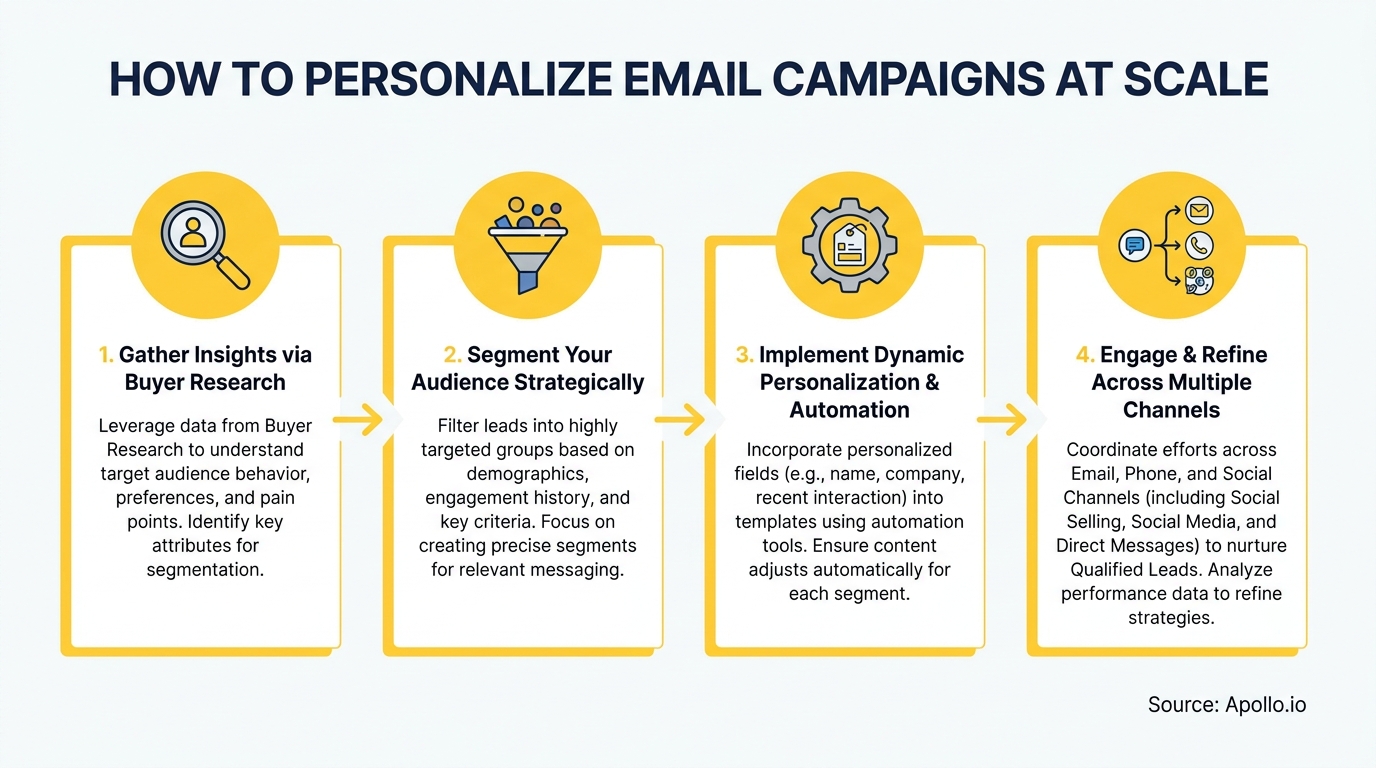
This playbook gives you a practical operating model: from personalization maturity and governance to AI-assisted workflows and measurement. Whether you are an SDR sending 100 sequences or a RevOps leader managing campaigns across a full GTM team, this is how you personalize at scale without sacrificing trust or deliverability. For foundational context, see what B2B email marketing actually involves in 2026.

Scale Smarter With Apollo's AI Engine
Tired of your reps burning hours on manual research instead of selling? Apollo surfaces verified contacts and automates outreach so your team spends time closing, not hunting. Join 600K+ companies building predictable pipeline.
Start Free with Apollo →Key Takeaways
- Personalization at scale is a data and workflow problem, not just a writing problem — unified contact data is the prerequisite.
- Personalized subject lines and segmented campaigns consistently outperform generic sends on open rates and click-through rates.
- Most B2B teams are still doing shallow personalization; moving to behavior-based and intent-triggered emails is where the differentiation gap exists.
- Anti-creepy governance — fallback content, suppression logic, and QA — protects deliverability and buyer trust simultaneously.
- Measurement must go beyond opens and clicks to include pipeline influence, reply-to-meeting conversion, and complaint risk.
What Does Personalization at Scale Actually Mean?
Personalizing email campaigns at scale means systematically tailoring message content, timing, and context to each recipient's role, account, and buying stage — without requiring manual effort per send. It is distinct from mail merge.
Mail merge swaps a first name. Personalization at scale swaps the entire relevance frame: the problem you reference, the proof point you cite, the CTA you offer.
Research from IndustrySelect shows segmenting and personalizing email campaigns can result in a 46% higher open rate than non-personalized campaigns. The upside is clear. The operational question is how to achieve it without a one-to-one manual process.
What Is the Personalization Maturity Model for B2B Email?
The personalization maturity model describes four levels of email relevance, each requiring progressively richer data and more sophisticated content assembly.
| Level | What Changes | Data Required | Example Module |
|---|---|---|---|
| 1 — Basic | First name, company name | Contact record | "Hi {{first_name}}, I work with companies like {{company}}..." |
| 2 — Role-Based | Job title, department pain point | Title + ICP segment | Swap value prop block by persona (SDR vs. RevOps vs. AE) |
| 3 — Account-Stage | Company context, buying stage, recent trigger | Firmographics + intent signals | Reference a hiring signal, funding round, or tech stack change |
| 4 — Behavioral | In-session or cross-channel behavior | Engagement history + CRM activity | Follow-up email referencing content the contact clicked last week |
Data from MoEngage shows that brands using emails personalized according to customer behavior achieve between 2.8x and 300.7x conversion rates compared to non-personalized emails. Most B2B teams operate at Level 1 or 2. Moving to Level 3 and 4 is where significant performance gains appear. Learn how to craft the right message structure for each level in this guide to writing sales emails that get responses.
How Do You Build Anti-Creepy Personalization Governance?
Anti-creepy personalization governance means defining clear rules for which data you use, when you use it, and how you fail gracefully when data is missing or stale. Without governance, AI-assisted personalization at scale produces messages that feel invasive rather than relevant — and a Gartner 2025 survey found that 53% of customers who had negative personalization experiences were 3.2x more likely to regret a purchase.
A practical governance checklist:
- Approved data sources: Only use verified, business-context signals (job title, company size, industry, publicly observable events).
- Fallback content: Every personalized module must have a generic fallback that reads naturally if the data field is empty or outdated.
- Eligibility logic: Define who is excluded — recent unsubscribers, active deals, churned accounts, suppression lists.
- QA review gate: AI-generated personalization for named accounts or high-value segments must pass human review before send.
- Suppression refresh cadence: Sync suppression lists weekly, not monthly, to avoid mailing contacts mid-deal or post-churn.
Deliverability is part of this governance layer. Google's sender guidelines require bulk senders of 5,000+ daily Gmail messages to keep spam rates below 0.10% and implement SPF, DKIM, DMARC, and one-click unsubscribe. Relevance and suppression logic are not just trust tools — they are deliverability requirements. For a deeper dive, see why emails land in spam and how to fix it.

How Do SDRs and Marketers Run an AI-Assisted Personalization Workflow?
An AI-assisted personalization workflow moves from targeting through content assembly to measurement in a repeatable six-step loop — replacing ad hoc copywriting with a modular, governed process.
- Plan: Define segments by ICP fit, buying stage, and intent signal. SDRs focus on account-level triggers; marketing teams focus on behavioral cohorts.
- Target: Apply eligibility and suppression rules. Pull verified contacts with enriched firmographic and role data.
- Assemble: Select pre-approved modular blocks (opening hook, value prop, social proof, CTA) matched to segment. AI fills variable fields from enriched data.
- Review: Human QA for named accounts and any AI-generated opening lines. Flag and correct low-confidence data fills.
- Send: Schedule by time zone and role (executives earlier in the week; practitioners mid-week). Monitor deliverability signals in real time.
- Learn: Feed reply rates, click-to-demo conversions, and unsubscribe signals back into segment criteria and module performance scores.
For SDRs managing high-volume outreach, this workflow consolidates research, writing, and sequencing into one repeatable motion. Spending hours researching and writing one-off emails? Apollo's AI sales automation assembles personalized sequences at scale — so your team books more meetings without manual copy-paste research. For more on sequence structure, see email personalization for sales using smart content.
Turn Funnel Guesswork Into Closed Deals
Pipeline forecasting a guessing game because leads stall before they ever reach your AEs? Apollo surfaces in-market buyers and moves them faster through your funnel. Top revenue teams use Apollo to build pipeline they can actually forecast.
Schedule a Demo →What Should Your Personalization Measurement Dashboard Track?
Your measurement dashboard should track pipeline influence and buyer engagement quality — not just opens and clicks. Open rates are increasingly unreliable as a primary signal due to email client pre-fetching.
Build your dashboard around four metric categories:
| Metric Category | What to Measure | Why It Matters |
|---|---|---|
| Conversion | Reply rate, reply-to-meeting rate, CTA click-to-demo | Direct signal of message relevance |
| Journey Progression | Stage advancement per segment, time from first touch to opportunity | Shows whether personalization accelerates pipeline |
| Deliverability Risk | Spam complaint rate, unsubscribe rate, bounce rate per domain | Early warning for suppression and authentication gaps |
| Module Performance | A/B results per content block, segment, and send time | Identifies which personalization variables drive lift |
According to Insight Market Research, brands using dynamic content report around 22% higher ROI from email programs. Tracking module-level performance is how you identify which dynamic elements are generating that lift — and which to retire. RevOps leaders find that connecting email engagement data to CRM opportunity stages closes the attribution gap between campaign activity and revenue.
How Do You Scale Personalization Without Losing Deliverability?
Scaling personalization safely requires treating deliverability as a first-class system constraint, not an afterthought. The biggest risks at scale are domain reputation degradation from sending to stale or unvalidated contacts, and spam rate spikes from irrelevant messages hitting disengaged segments.
- Verify contacts before sending: Use verified business contact data and remove undeliverable addresses before they hit your sender score. See how to verify email addresses for B2B sales.
- Warm up sending domains: Ramp volume gradually on new domains. Do not jump to 5,000+ sends per day immediately.
- Segment by engagement recency: Re-engagement campaigns for cold segments should use separate sending infrastructure.
- One-click unsubscribe: Required for bulk senders under Google's guidelines. Make it frictionless — friction increases spam complaints.
Working from a high-quality, verified contact list is the foundation. Struggling to build a clean list that actually converts? Search Apollo's 230M+ verified business contacts with 65+ filters to build targeted, deliverable lists for every segment. For best practices on list quality and send volume, see bulk email best practices.

How to Personalize Email Campaigns at Scale: Start Here in 2026
Personalized emails produce a 29% higher open rate and a 41% higher click-through rate compared to non-personalized emails, according to Instapage. The performance case is settled. The execution gap is where most B2B teams still lose.
The teams closing that gap in 2026 share three things: verified, enriched contact data; a modular content system with governed fallbacks; and measurement tied to pipeline, not just opens. Start with your data foundation, build your maturity level systematically, and let AI handle assembly — not governance.
Apollo consolidates the entire workflow: verified contact data, AI-assisted sequencing, multi-channel engagement, and pipeline tracking in one platform. As Cyera put it, "Having everything in one system was a game changer." Start your free trial and run your first personalized campaign today.
Prove Pipeline ROI From Day One
ROI pressure killing your tool budget before it even gets approved? Apollo delivers measurable pipeline impact fast — 46% more meetings with AI, real results leadership can see. Start free today.
Start Free with Apollo →Don't miss these
Sales
Inbound vs Outbound Marketing: Which Strategy Wins?
Sales
What Is a Sales Funnel? The Non-Linear Revenue Framework for 2026
Sales
What Is a Go-to-Market Strategy? The 2026 GTM Playbook
See Apollo in action
We'd love to show how Apollo can help you sell better.
By submitting this form, you will receive information, tips, and promotions from Apollo. To learn more, see our Privacy Statement.
4.7/5 based on 9,690 reviews
