
How to Optimize Call Scripts for Better Engagement and Conversions in 2026
Your buyer already asked ChatGPT before you called. According to Gartner's May 2026 research, 69% of B2B buyers now turn to sales reps specifically to validate AI-generated insights. That shifts the call's entire job: your script no longer needs to educate. It needs to validate, de-risk, and build internal confidence. The reps who learn to optimize their call scripts for each stage will outperform those still reading from generic monologues.

Apollo Turns Hours of Research Into Minutes
Tired of burning your best selling hours on manual lead research and dead-end contact data? Apollo delivers verified contacts instantly so your team spends time closing, not digging. Join 600K+ companies building pipeline faster.
Start Free with Apollo →Key Takeaways
- Scripts should be adaptive talk tracks, not rigid monologues. Buyers want validation and context, not a product pitch.
- Cold, discovery, and demo calls need different engagement benchmarks. One script does not fit all stages.
- Winning calls ask fewer, better questions. Closed-won deals average 15-16 questions; lost deals average around 20.
- Buying committees average 13 people. Scripts need champion enablement modules, not just a single-buyer close.
- Consistent follow-up is critical. The data shows most sales require five or more follow-up touches to close.
What Makes a Call Script High-Converting in 2026?
A high-converting call script is buyer-specific, stage-appropriate, and built for dialogue, not delivery. Research from Martal shows nearly 49% of buyers prefer phone contact for initial outreach, and BetterContact reports that 82% of buyers are open to accepting meetings from strategic cold calls. The opportunity is real. The differentiator is quality of prep and script structure.
A sales professional wrote on Redditthat the biggest script problem is vagueness: phrases like "noticed something was missing" mean nothing to a prospect. Instead, spend two minutes researching and lead with something concrete: "I pulled up your site on my phone and it's not mobile-friendly." Specificity creates urgency. Generality creates dial tones.
How Should Scripts Differ by Stage?
Cold, discovery, and demo scripts need different engagement targets because the buyer's mindset, information level, and decision-making involvement all change at each stage.
| Stage | Target Talk Ratio | Question Target | Primary Goal |
|---|---|---|---|
| Cold Call | 55% seller / 45% buyer | 3-5 focused questions | Permission + curiosity |
| Discovery | 50% seller / 50% buyer | 10-12 deep questions | Uncover pain + fit |
| Demo | 65% seller / 35% buyer | Confirm 3-4 use cases | Validate ROI + next step |
Gong's analysis of 326,000+ sales calls found that closed-won deals averaged 57% seller talk, while lost deals averaged 62%. Winners asked 15-16 questions per call; lost deals averaged about 20. More questions is not better. Deeper follow-up is. For your outbound sequences, each call stage should have its own script module with distinct objectives.
Struggling to reach the right contacts before each call? Search Apollo's 230M+ contacts with 65+ filters to ensure every dial is pointed at a qualified, relevant prospect.
How Do SDRs and BDRs Personalize Scripts Without Wasting Time?
SDRs and BDRs should anchor personalization on three signals: account trigger, role-specific pain, and timing. The 6sense 2026 State of the BDR Report found that 99% of BDRs now use AI, yet outreach volume doubled with no reliable link to quota attainment. Volume without context is noise. The winning frame is: "why this account, why this person, why now."
- Account trigger: Recent funding, hiring spike, new product launch, competitive move
- Role-specific pain: What does this title care about this quarter? (SDRs for VP Sales = pipeline; RevOps for CRO = data hygiene)
- Timing hook: Reference a specific event, not a generic "reaching out to connect"
According to Intelemark, only 1 in 12 potential customers is interested in what you're selling. That ratio improves dramatically when you call with context rather than a cold opener. For AEs managing larger accounts, this same logic applies to renewal and expansion calls: reference usage data and specific outcomes before asking for more budget.

What Is a Buyer-First Script Audit Checklist?
A buyer-first script audit checks whether your script serves the buyer's decision-making process, not just your pipeline stage. Run this checklist before deploying any script:
- Relevance check: Does the opener reference something specific to this company or role?
- ROI proof: Does the script include one concrete proof point tied to their likely business case?
- Consistency check: Does what you say on the call match your website, email follow-ups, and pricing language?
- AI-validation readiness: Does the script address what AI tools may have already told the buyer, and does it correct or expand on that?
- Next step clarity: Does every script end with a specific, time-bound ask, not "let me know if you're interested"?
Gartner found 69% of B2B buyers report inconsistencies between vendor websites and what reps say on calls. That gap destroys trust. Your customer engagement metrics will reflect this mismatch long before a deal is lost.
Turn Funnel Chaos Into Forecast Confidence
Quota missed because weak leads never convert? Apollo surfaces high-intent prospects that actually move through your funnel. Nearly 100K paying customers stopped guessing and started closing.
Schedule a Demo →How Do You Script for a Buying Committee?
Buying committee scripts require modular messaging designed for multiple stakeholders with different priorities. Forrester's 2024 State of Business Buying found the average purchase involves 13 people across at least two departments.
A single-buyer close script will stall most deals.
Build your script with these committee-aware modules:
- Champion enablement: Give your champion language to use internally. "Here's how to explain the ROI to your CFO" is more useful than another product feature.
- Stakeholder-specific proof: IT cares about security and integration. Finance cares about payback period. End users care about time savings. Prepare one sentence for each.
- Internal business case prompts:Ask: "Who else needs to be comfortable with this before you can move forward?" Then offer to help build that case.
- Follow-up asset alignment: Each stakeholder should receive a follow-up asset matched to their concern, not a generic one-pager.
Research from EBQ found 80% of sales require 5 or more follow-ups, yet 92% of reps give up after four attempts. Committee deals demand persistence. Build follow-up prompts directly into the script, not as an afterthought.
Want to automate multi-touch follow-up sequences across every stakeholder? Apollo's multi-channel sales engagement platform lets you build and track sequences for every contact in a buying group from one workspace.
How Do Winning and Losing Call Behaviors Compare?
| Behavior | Closed-Won Calls | Lost Calls |
|---|---|---|
| Seller talk time | ~57% | ~62% |
| Questions asked | 15-16 | ~20 |
| Uninterrupted pitch length | Under 76 seconds | Over 76 seconds |
| Script opener type | Context-led, specific | Generic product claim |
| Follow-up touches | 5+ touches | Stops at 1-4 |
A Reddit user shared a firsthand perspective that reframing your daily goal from "5 appointments" to "40 no's" changes everything. When you're tracking no's instead of yeses, you stay consistent long enough to actually test and refine what works in your script. Consistency is how script optimization compounds over time. Pair this with timing best practices for calls and emails to maximize connect rates on every dial.
How Can RevOps Teams Measure and Improve Script Performance?
RevOps leaders should track conversation quality metrics, not just activity volume. According to Gradient Works, top teams consistently achieve 5-8% success rates with better data and talk tracks. That gap between average and top performance is almost entirely a script and targeting problem, not a headcount problem.
Key metrics to track per script version:
- Talk-to-listen ratio per rep and per stage
- Average questions asked per call (target 15-16 for discovery)
- Objection type frequency (signals script gaps)
- Next-step conversion rate by script module
- Multi-touch follow-up completion rate
Apollo consolidates call recording, sequence tracking, and contact data in one platform. As Cyera put it: "Having everything in one system was a game changer." RevOps teams building this infrastructure should explore how to build winning sales sequences in Apollo and connect them directly to call scripts for a unified workflow.

Start Converting More Calls in 2026
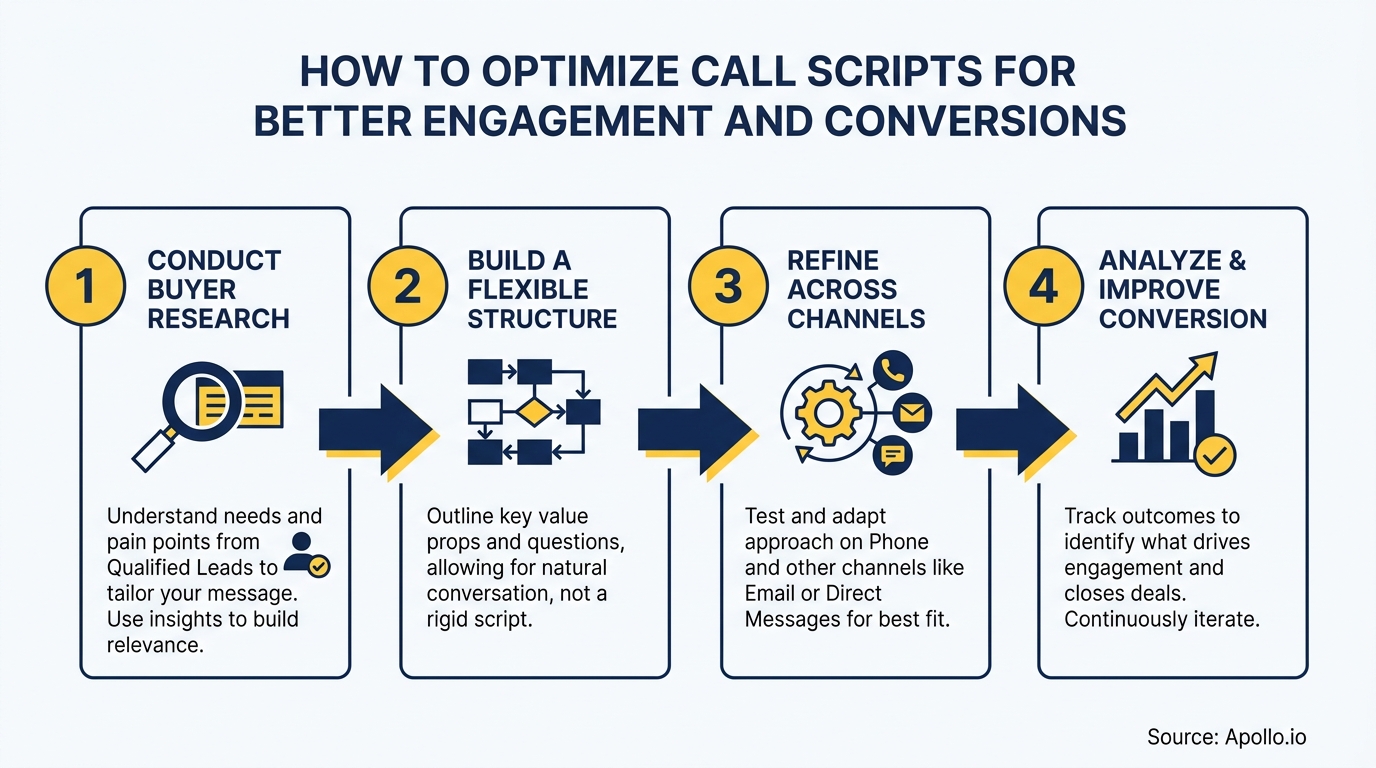
Optimizing call scripts is not a one-time project. It's a continuous loop of signal collection, script testing, and buyer feedback.
The teams winning in 2026 treat scripts as living documents: stage-specific, buyer-validated, and consistent across every channel. SDRs personalize openers with account signals.
AEs use champion enablement modules for committee deals. RevOps tracks conversation quality, not just dial counts.
Apollo gives your entire GTM team the data, sequences, and AI tools to run this loop from one platform, replacing the fragmented stack of separate tools. Ready to build scripts backed by verified contact intelligence and automate the follow-up that most reps abandon too early? Get Leads Now and start converting more calls today.
Prove Pipeline ROI Before Next QBR
ROI pressure killing your tool budget? Apollo delivers measurable pipeline impact fast — so you walk into every budget review with numbers, not excuses. Leadium 3x'd annual revenue. Start yours today.
Start Free with Apollo →Don't miss these
Sales
Inbound vs Outbound Marketing: Which Strategy Wins?
Sales
What Is a Sales Funnel? The Non-Linear Revenue Framework for 2026
Sales
What Is a Go-to-Market Strategy? The 2026 GTM Playbook
See Apollo in action
We'd love to show how Apollo can help you sell better.
By submitting this form, you will receive information, tips, and promotions from Apollo. To learn more, see our Privacy Statement.
4.7/5 based on 9,690 reviews
