
How to Narrow Down B2B Leads by Revenue or Employee Count in 2026
Most B2B lead lists have a structural problem: they're flooded with companies that can't afford your product, don't have the team complexity to need it, or simply aren't the right fit. Filtering by revenue or employee count is the fastest way to fix that, but only if you set your thresholds correctly. Done wrong, size filters create a false sense of precision while your pipeline fills with noise. Done right, they become the foundation of a repeatable outbound prospecting system that consistently surfaces your best-fit accounts.
According to Landbase, inadequate lead qualification results in 67% of lost sales. Revenue and employee count filters are your first line of defense against that waste.

Build Pipeline Faster With Apollo
Tired of burning hours on manual lead research that goes nowhere? Apollo surfaces verified contacts and scales your outreach so your team spends time selling, not searching. Nearly 100K paying customers trust Apollo to hit quota.
Start Free with Apollo →Key Takeaways
- Revenue and employee count are starting constraints, not final qualifiers: combine them with intent signals and buying triggers for best results.
- Business markets are structurally SMB-heavy, so your thresholds must actively filter out noise, not just include targets.
- Firmographic data decays quickly: treat size filters as living signals that require regular enrichment, not a one-time list pull.
- SDRs and RevOps teams that layer revenue filters with job title and intent data book significantly more qualified meetings than those using size alone.
- Enterprise deals involve multiple stakeholders: narrowing by company size must be paired with buying-group mapping to reach the right contacts.
Why Do Simple Size Filters Fail for B2B Lead Qualification?
Simple size filters fail because they don't account for the extreme skew in how businesses are actually distributed. Business markets are overwhelmingly small: at the start of 2024, UK government data showed 99.2% of businesses had 0–49 employees, while only 0.2% had 250 or more. US Census Bureau data tells a similar story, with 6.2 million firms covering 140 million employees across widely varying sizes.
This means a filter set to "50+ employees" still captures a massive volume of companies with limited budgets or minimal buying complexity. The result: reps spend time on accounts that look qualified on paper but aren't ready or able to buy. Reach Marketing reports that 42% of businesses cite low-quality leads as a significant challenge, and naive size filters are a leading cause.
A sales professional shared a firsthand perspective on Reddit that "firmographic filters are too blunt to reliably surface contacts at the right seniority and revenue threshold" for niche markets. The fix: use size as a constraint, then layer additional qualifiers on top.
How Do You Set the Right Revenue and Employee Count Thresholds?
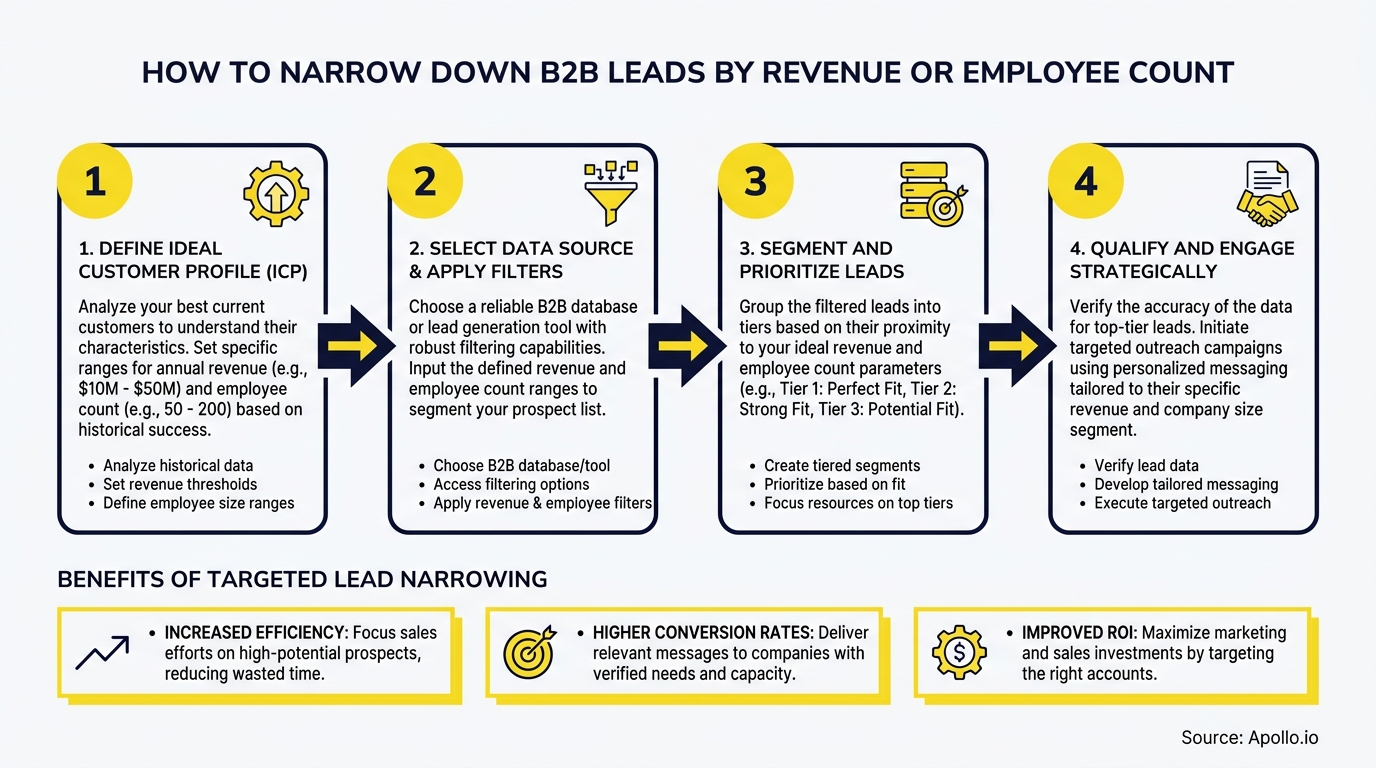
The right thresholds come from your closed-won data, not from industry benchmarks. Start by pulling your last 50 closed deals and mapping them by revenue range and headcount.
Look for clusters: these are your true ICP bands. Then test adjacent bands to find where conversion drops off.
Use this framework as a starting point:
| Segment | Employee Count | Annual Revenue | Typical Sales Motion |
|---|---|---|---|
| SMB | 10–99 | $1M–$10M | Self-serve or low-touch |
| Mid-Market | 100–499 | $10M–$100M | Inside sales, 2–4 stakeholders |
| Enterprise | 500–2,499 | $100M–$1B | Multi-threaded, procurement involved |
| Large Enterprise | 2,500+ | $1B+ | Complex buying groups, long cycles |
Treat these as starting constraints, not fixed rules. As Intent Amplify notes, marketers align firmographic segments like ARR or industry with funnel stages to optimize ad budget allocation and maximize ROI. Your thresholds should match the funnel stage and motion, not just the company size.
Struggling to find qualified leads at the right revenue tier? Search Apollo's 230M+ contacts using 65+ filters including revenue, headcount, and industry to build lists that match your exact ICP.
Turn Funnel Guesswork Into Real Pipeline
Pipeline forecasting a guessing game because leads stall before they ever become opportunities? Apollo surfaces verified, in-market contacts so your team builds pipeline that actually converts. Nearly 100K paying customers trust Apollo to forecast with confidence.
Start Free with Apollo →How Should SDRs and RevOps Teams Layer Filters for Better Pipeline Quality?
SDRs and RevOps leaders get the best results by stacking revenue or headcount filters with at least two additional qualifiers: job title and a buying signal. Size tells you who can buy; intent data and recent triggers tell you who wants to buy right now.
A recommended layering sequence for SDRs building prospecting lists:
- Set size floor and ceiling: Use your ICP bands from closed-won data.
- Add industry or vertical: Eliminates mismatched sectors immediately.
- Filter by job title or department: Reach decision-makers, not bystanders. See how to find B2B leads by title, industry, or company.
- Layer in intent signals: Prioritize accounts showing active buying behavior. Intent data surfaces accounts already researching solutions like yours.
- Apply recency filters: Hiring surges, funding events, or leadership changes signal budget and urgency.
For RevOps leaders managing revenue operations, this layered approach reduces the volume of leads entering the pipeline while increasing the percentage that convert, improving team efficiency without adding headcount.

Why Does Firmographic Data Quality Matter for Size-Based Targeting?
Firmographic data decays fast. Companies grow, downsize, merge, and pivot constantly.
Revenue and employee count figures from a 12-month-old export may be significantly wrong. This is why size filters produce inconsistent results when the underlying data isn't refreshed regularly.
In 2026, leading teams treat firmographic attributes as dynamic signals, not static fields. Best practice for RevOps:
- Enrich records on a scheduled cadence (quarterly at minimum, monthly for high-velocity pipelines).
- Cross-reference revenue and headcount across at least two sources before moving an account to high-priority.
- Flag records where sources disagree: treat them as lower confidence until verified.
- Use automated contact enrichment to keep CRM data current without manual updates.
A Reddit user wrote on Reddit that their team sources niche titles by firm size and AUM filters, then goes "deep not wide" and treats it like ABM rather than volume outbound. That shift from volume to precision is only possible when the underlying data is trustworthy.
How Do Buying Groups Change the Way You Use Size Filters for Enterprise Leads?
Buying groups mean that narrowing to the right-sized company is only the first step: you still need to reach the right people inside it. For enterprise accounts, a single company-level filter surfaces one organization but obscures the 4–10 stakeholders who will actually influence the deal.
When targeting companies above 500 employees, your list-building workflow should include:
- Multi-contact mapping: Build lists that include economic buyers, champions, and technical evaluators within the same account.
- Department-level segmentation: A 1,000-person company has very different buying centers in IT, Finance, and Operations.
- Sequence differentiation: Each persona in the buying group needs different messaging, not the same email blast.
For teams targeting enterprise accounts, the enterprise sales playbook covers how to build executive access and manage multi-threaded deals at scale. Pair it with a solid B2B marketing funnel to nurture multiple contacts from the same target account simultaneously.
How Do You Measure Whether Your Revenue and Headcount Filters Are Working?
Your filters are working when the ratio of qualified-to-unqualified leads improves, not just when list volume increases. Track these metrics by segment tier to validate your thresholds over time:
| Metric | What It Tells You | Target Signal |
|---|---|---|
| Lead-to-meeting rate by size band | Which revenue/headcount tiers convert best | Highest rate = true ICP band |
| Meeting-to-opportunity rate | Whether meetings are with real buyers | Rises when filters are accurate |
| Average deal size by tier | Revenue per segment | Validates ability-to-pay assumptions |
| Sales cycle length by headcount band | Org complexity and procurement friction | Longer = more stakeholders to map |
According to Root Digital, growing a high-quality lead pipeline is the top priority for 37% of B2B marketers. Measuring conversion by segment tier is the only way to know if your filters are delivering on that goal or just moving volume around.

Start Filtering Smarter with Apollo in 2026
Narrowing B2B leads by revenue or employee count works when your thresholds are grounded in closed-won data, your firmographic records are kept current, and you layer intent signals on top of size filters rather than relying on size alone. SDRs, AEs, and RevOps teams that follow this approach build leaner, higher-converting pipelines without chasing accounts that were never a real fit.
Apollo consolidates prospecting, enrichment, and outreach in one platform, so your team stops juggling tools and starts closing. Trusted by nearly 100,000 paying customers including Anthropic, Smartling, and Cyera, Apollo gives GTM teams the data and workflows to build pipeline that actually converts.
Ready to build lists filtered by the exact revenue bands and headcount ranges your ICP requires? Request a Demo and see how Apollo's 65+ filters help you find and engage your best-fit accounts faster.
Prove Pipeline ROI With Apollo
ROI pressure killing your tool budget before it even starts? Apollo delivers measurable pipeline impact fast — so your next renewal is a no-brainer. Nearly 100K paying customers already have the numbers to prove it.
Start Free with Apollo →Don't miss these
Sales
Inbound vs Outbound Marketing: Which Strategy Wins?
Sales
What Is a Sales Funnel? The Non-Linear Revenue Framework for 2026
Sales
What Is a Go-to-Market Strategy? The 2026 GTM Playbook
See Apollo in action
We'd love to show how Apollo can help you sell better.
By submitting this form, you will receive information, tips, and promotions from Apollo. To learn more, see our Privacy Statement.
4.7/5 based on 9,690 reviews
