
How to Map Lead and Account Records Correctly During Integration
Bad lead-to-account mapping is a silent pipeline killer. A lead that routes to the wrong account, duplicates an existing contact, or lands without firmographic context wastes SDR time, corrupts attribution, and breaks AI scoring before it even starts. According to Revefi, Gartner estimates that poor data quality costs organizations an average of $12.9 million per year. In 2026, with AI agents acting on CRM data in real time, a wrong match is no longer just an admin problem — it's a revenue problem.
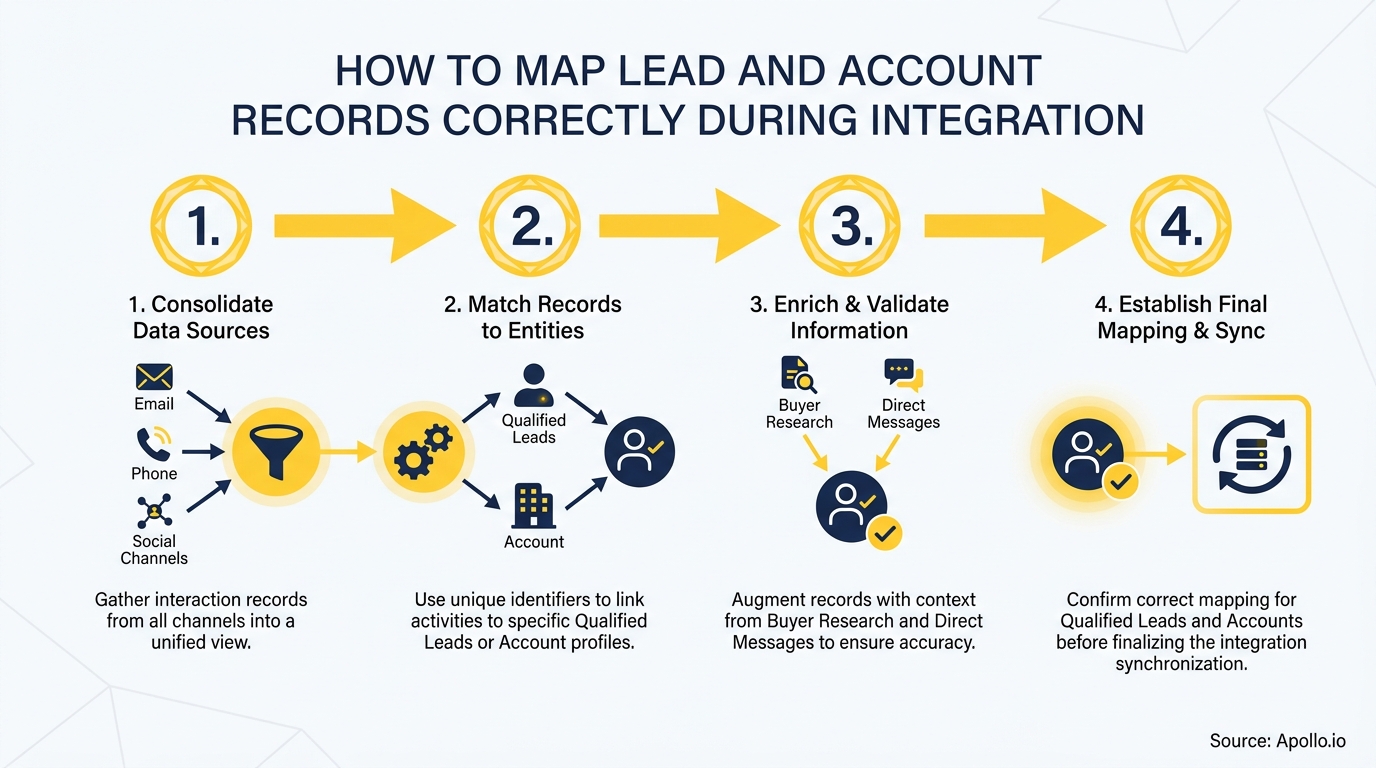
This guide covers how to map lead and account records correctly during integration, from identity resolution and hierarchy-aware matching to QA governance and RevOps accountability. If you're building or auditing a Salesforce, HubSpot, or Dynamics integration, start here. For teams also looking to improve the quality of leads entering the CRM in the first place, data-driven prospecting strategies can reduce dirty data before it ever reaches your pipeline.

Let Apollo Find Your Next Buyer
Tired of your reps burning hours on manual research instead of selling? Apollo surfaces verified contacts and scales your outreach automatically. Over 600K companies have already made the switch.
Start Free with Apollo →Key Takeaways
- Lead-to-account mapping errors are a revenue risk, not just a data hygiene issue — mismatched records break routing, attribution, and AI workflows downstream.
- Exact matching on email domain alone is insufficient. Correct integration requires a layered match hierarchy: email domain, company name (fuzzy), phone, address, and external IDs.
- Parent-child account hierarchy must be defined before go-live. Leads mapped to subsidiary accounts without a parent linkage distort territory reporting and ABM attribution.
- Every integration needs explicit rules for three scenarios: create new, update existing, and convert lead to contact/account. Missing exception handling is the most common cause of duplicate contamination.
- RevOps teams need a RACI, confidence thresholds, and a sampling-based audit plan to maintain match quality over time — not just at launch.
Why Does Lead-to-Account Mapping Matter for Revenue?
Lead-to-account mapping determines whether a new lead record is correctly linked to an existing account, routed to the right owner, and scored with full firmographic context. When it fails, the consequences cascade: duplicate accounts inflate pipeline, misrouted leads miss SLAs, and AI-powered scoring models operate on fragmented signals.
Research from The Data Business shows that poor-quality data costs businesses an average of 15-25% of their revenue. In April 2026, Forrester recognized Rockwell Automation as a B2B "Return on Integration" honoree specifically because improved account match rates produced faster opportunity progression and larger average deal size — confirming that mapping correctness is a measurable growth lever, not a back-office task.
What Are the Core Matching Keys for Lead-to-Account Integration?
Correct lead-to-account matching requires a prioritized hierarchy of identity signals, applied in sequence until a confident match is found or the record is flagged for manual review.
| Match Signal | Match Type | Confidence Level | Notes |
|---|---|---|---|
| Corporate email domain | Exact | High | Exclude free domains (gmail, yahoo, outlook) |
| Company name | Fuzzy | Medium-High | Normalize abbreviations, legal suffixes (Inc., LLC) |
| Phone number | Exact (normalized) | Medium | Strip country codes before matching |
| Billing address | Fuzzy | Medium | Use city + zip + country, not full street |
| External ID (DUNS, CRM ID) | Exact | Highest | Best for enrichment-sourced records |
Deterministic (exact) matching alone fails on messy B2B data. Fuzzy matching on company name is essential but requires normalization rules applied before comparison.
External IDs — such as DUNS numbers or IDs from your data enrichment provider — are the most reliable signal when available, and should take precedence over all other signals in your match logic.
How Does Account Hierarchy Affect Lead Mapping Correctness?
Account hierarchy mapping links leads to the correct organizational node — subsidiary, division, or ultimate parent — before routing and attribution run. Skipping this step is the most common cause of territory conflicts and broken ABM reporting.
Before integration go-live, define these hierarchy rules explicitly:
- Map to the subsidiary first. A lead from a regional office should link to the subsidiary account, with the parent account populated via the account's own parent-child relationship field.
- Set a tie-breaker for multi-match scenarios. When a lead domain matches both a parent and a subsidiary, the subsidiary wins unless the lead's address matches the parent's HQ zip code.
- Propagate owner assignments from parent to child. If territory ownership is defined at the parent level, ensure the lead routing logic reads the parent's owner field, not just the matched subsidiary's owner.
- Flag orphan accounts. Subsidiaries without a populated parent ID should be queued for enrichment before leads map to them.
Tired of leads landing on accounts with missing firmographic context? Apollo's data enrichment fills account records with verified firmographics before leads arrive, reducing hierarchy mapping errors at the source.

What Integration Rules Prevent Duplicate Records?
Every lead entering the CRM during integration must trigger one of three explicit actions: create a new record, update an existing record, or convert the lead to a contact on a matched account. The absence of defined exception handling for edge cases is where duplicate contamination begins.
| Scenario | Correct Action | Common Mistake |
|---|---|---|
| No matching account found | Create new account + lead | Creating lead only, leaving account blank |
| One high-confidence match | Link lead to account; update blank fields only | Overwriting populated fields with lower-quality source data |
| Multiple possible matches | Route to manual review queue | Auto-selecting first result alphabetically |
| Lead matches existing contact email | Merge or update contact; do not create duplicate lead | Creating a second lead record for the same person |
| Free email domain (gmail, etc.) | Skip domain match; use company name + phone | Matching all gmail leads to a single dummy account |
The "search before create" principle — now built into tools like Stibo Systems' MDM SmartSync for Salesforce — prevents duplicates at the point of entry rather than requiring post-sync cleanup. Apply this logic in your integration middleware before any record touches the CRM. For RevOps leaders building lead generation systems that scale, these rules are the foundation of clean pipeline data.
Turn Funnel Guesswork Into Closed Deals
Pipeline forecasting a guessing game because marketing leads never convert? Apollo surfaces verified, in-market buyers so your pipeline reflects real opportunity. Nearly 100K paying customers stopped forecasting on faith.
Start Free with Apollo →How Should RevOps Teams Build QA and Governance for Lead Mapping?
RevOps leaders own lead mapping quality operationally. A QA framework needs confidence thresholds, a sampling plan, audit trails, and a clear RACI to stay effective beyond launch day.
Confidence thresholds:
- Score 90+ (exact domain + fuzzy name match): auto-link
- Score 70-89 (name match only or partial domain): auto-link with flag for 30-day review
- Score below 70: route to manual review queue
Sampling plan: Review a random sample of 5% of auto-linked records weekly for the first 90 days post-launch. Reduce to monthly once error rate falls below 2%.
Audit trail requirements: Log the match signal used, confidence score, timestamp, and source system for every linked record. This is essential for diagnosing routing errors and for AI model trust — Gartner predicts 60% of AI projects unsupported by AI-ready data will be abandoned. Without an audit trail, diagnosing why AI scoring misfired is nearly impossible.
RACI:
- Responsible: RevOps or Marketing Ops analyst
- Accountable: VP Revenue Operations or Head of GTM Systems
- Consulted: Sales leadership (routing rules), IT (integration middleware)
- Informed: SDR managers, AE team leads
According to MarketingOps.com, poor data quality results in inefficient pipeline management for 48% of B2B professionals — a number that drops sharply when governance is formalized rather than ad hoc.
How Do SDRs and RevOps Teams Benefit from Correct Lead Mapping?
SDRs benefit directly when lead-to-account mapping works correctly: every inbound lead arrives with the account owner pre-populated, firmographic context filled, and existing activity visible. There is no manual account lookup, no duplicate outreach to a contact already in an active sequence, and no routing delay.
RevOps leaders find that clean mapping is the prerequisite for reliable attribution. When a lead is correctly linked to its account from first touch, multi-touch attribution across the full buying committee becomes possible.
Without it, marketing influence on closed deals is systematically undercounted, and pipeline forecasts built on account-level engagement signals are unreliable. Teams moving from lead-centric to account-based workflows — as Demandbase's 2025 B2B marketing research recommends — cannot make that shift without correct lead-to-account joins across their CRM, MAP, and BI systems.
Struggling to keep lead quality high before records even hit the CRM? Apollo's sales intelligence platform gives SDRs and RevOps teams verified business contact data with 65+ filters, so leads arrive with accurate firmographics that make account matching faster and cleaner.
How to Map Lead and Account Records Correctly: A Pre-Launch Checklist
Before any integration goes live in Salesforce, HubSpot, or Dynamics, validate these controls are in place:
- Source of truth defined: Which system owns the account record? CRM wins on owner/territory; enrichment source wins on firmographics.
- Match hierarchy documented: External ID first, then corporate email domain, then fuzzy company name with normalization, then phone/address as tiebreakers.
- Free domain exclusion list active: Gmail, Yahoo, Outlook, Hotmail, and other consumer domains excluded from domain-based matching.
- Parent-child hierarchy populated: All account records with a known parent have the parent ID field populated before leads sync.
- Three-action rule enforced: Create, update, or convert — every lead triggers exactly one of these; no silent failures.
- Manual review queue configured: Low-confidence matches route to a named queue, not to a default owner.
- Audit log enabled: Match signal, score, and source system recorded on every linked record.
- Sampling plan scheduled: First 90-day weekly review cadence on the RevOps calendar before go-live.

Start With Clean Data, Then Map With Confidence
Correct lead-to-account mapping is a revenue-protection control. The matching hierarchy, hierarchy-aware linkage rules, three-action integration logic, and governance framework outlined above give RevOps teams a defensible foundation for every Salesforce, HubSpot, or Dynamics integration.
The teams that get this right in 2026 are the ones whose AI scoring, routing automation, and ABM attribution actually work — because the underlying record relationships are trustworthy.
For a stronger foundation, pair your mapping rules with verified contact and account data from the start. Start a free trial of Apollo to enrich leads with accurate firmographics, reduce match errors before integration runs, and give your GTM team a single, consolidated workspace for prospecting, engagement, and pipeline management.
Prove Pipeline ROI From Day One
Budget approval stuck on unclear metrics? Apollo delivers measurable pipeline impact fast — so you walk into every renewal with numbers, not gut feelings. Leadium 3x'd their revenue. Your CFO wants proof. Apollo gives you it.
Schedule a Demo →Don't miss these
Sales
Inbound vs Outbound Marketing: Which Strategy Wins?
Sales
What Is a Sales Funnel? The Non-Linear Revenue Framework for 2026
Sales
What Is a Go-to-Market Strategy? The 2026 GTM Playbook
See Apollo in action
We'd love to show how Apollo can help you sell better.
By submitting this form, you will receive information, tips, and promotions from Apollo. To learn more, see our Privacy Statement.
4.7/5 based on 9,690 reviews
