
How to Manage Prospecting Across Multiple Team Members in 2026
Most prospecting breakdowns aren't effort problems. They're coordination problems. When multiple SDRs, AEs, and marketing ops reps work the same accounts without shared rules, buyers get conflicting messages, reps duplicate work, and pipeline data becomes unreliable. According to G2, more than 40% of salespeople identify prospecting as the most challenging part of the sales process. For teams, that challenge multiplies with every rep you add.
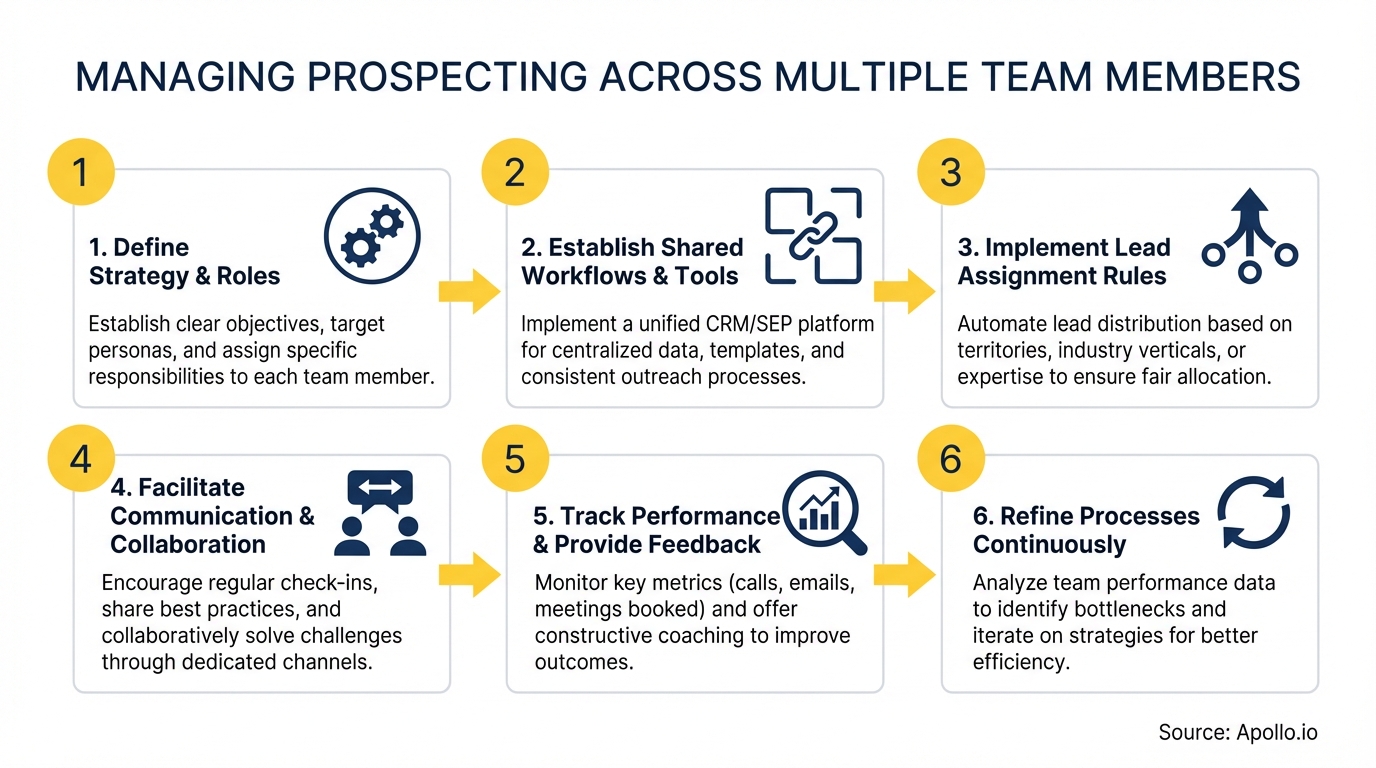
The fix isn't more activity. It's a governance model: clear ownership rules, shared content, routing logic, and handoff checklists that scale as your team grows. This guide covers exactly how to build that system. For foundational strategy, see our outbound prospecting guide.

Research Less, Pipeline More With Apollo
Tired of burning hours verifying contact info that goes nowhere? Apollo delivers 97% email accuracy across 230M+ verified contacts so your team spends time selling, not searching. Start building predictable pipeline today.
Start Free with Apollo →Key Takeaways
- Multi-rep prospecting fails due to coordination gaps, not lack of effort. Ownership rules and handoff checklists prevent duplicate outreach.
- A RACI matrix assigns clear accountability across SDRs, AEs, and RevOps so every account has one owner.
- AI governance is now mandatory: without shared prompt standards and QA checks, AI-assisted outreach creates inconsistent messaging at scale.
- Sales and marketing alignment directly impacts pipeline throughput. Teams with full alignment are far more likely to hit goals.
- Unified platforms eliminate the tool fragmentation that causes coordination breakdowns across multi-rep teams.
Why Is Multi-Rep Prospecting So Hard to Coordinate?
Multi-rep prospecting fails because activity happens faster than ownership rules can keep up. Without a centralized system of record, two SDRs can independently email the same prospect on the same day, an AE can re-prospect an account already in sequence, and managers have no visibility into who touched what.
A 2024 Forrester Consulting study, reported by PR Newswire, found that poor internal collaboration negatively impacted customer experience for 49% of businesses and reduced employee productivity for 40%. In prospecting, those numbers translate directly to burned accounts and missed quota.
The coordination problem gets worse as AI adoption accelerates. With 92% of sales teams planning increased AI investment in 2026 (per Landbase), teams without governance frameworks risk flooding prospects with inconsistent AI-generated messages from multiple reps simultaneously.
How Do You Build a RACI Framework for SDR/AE Prospecting?
A RACI matrix for prospecting assigns four roles to every account and activity: Responsible (does the work), Accountable (owns the outcome), Consulted (provides input), and Informed (receives updates). This eliminates the "who owns this account" debate before it starts.
| Activity | SDR | AE | RevOps | Marketing |
|---|---|---|---|---|
| ICP list building | Responsible | Consulted | Accountable | Consulted |
| First outreach (cold) | Responsible | Informed | Informed | Informed |
| Account handoff | Responsible | Accountable | Consulted | Informed |
| Sequence governance | Consulted | Consulted | Accountable | Consulted |
| Content/asset updates | Informed | Informed | Consulted | Accountable |
Pair this RACI with explicit routing rules: define which accounts go to which rep tier (by company size, territory, or signal type), what triggers a handoff, and what "done" looks like at each stage. For help structuring the team behind these rules, see how to build and lead cross-functional teams.
Struggling to keep prospecting coordinated across your team? Apollo's multi-channel sequences let every rep work from the same playbook, with full visibility into who touched each account.
What Handoff Checklist Should SDRs Use Before Passing to AEs?
A clean SDR-to-AE handoff requires documented context, not just a calendar invite. Without a checklist, AEs re-ask questions the prospect already answered and lose credibility in the first call.
SDR handoff checklist (minimum requirements):
- Contact name, title, direct email, and phone logged in CRM
- Company firmographics: size, industry, tech stack (if known)
- Pain point identified and documented (exact quote from prospect, if possible)
- Sequence history: every touchpoint, channel, and response logged
- Trigger event that prompted engagement (job change, funding, intent signal)
- Next step confirmed: meeting booked, date/time, agenda shared
- Stakeholder map: other contacts touched at the account
RevOps leaders should enforce this checklist as a CRM field requirement, not a best practice suggestion. If the data isn't logged, the handoff doesn't count as complete. Learn how to structure your sales prospecting list to make this data collection systematic from the start.
Turn Funnel Guesswork Into Quota Wins
Pipeline forecasting a guessing game because quality leads stall before they ever become opportunities? Apollo surfaces in-market buyers with precision so your funnel moves with confidence. Nearly 100K paying customers stopped guessing and started closing.
Start Free with Apollo →How Should Revenue Teams Govern AI-Assisted Outbound at Scale?
AI governance for prospecting means defining which AI outputs require human review before sending, which prompt templates are approved for team use, and how messaging quality is audited across reps.
Without this, AI scales inconsistency instead of quality.
In 2026, agentic AI tools can draft, send, and follow up on outreach across multiple workflows simultaneously. The coordination risk is real: multiple agents touching the same account without a shared approval layer creates the same duplication problem as uncoordinated human reps.
AI governance framework for outbound teams:
- Approved prompt library: Standardized prompts for cold email, follow-up, and objection responses. Stored centrally, versioned, and owned by RevOps.
- Human review gates: All AI-generated first touches reviewed before sending (for accounts above a defined revenue threshold).
- QA sampling: RevOps reviews 10-15% of AI-assisted outreach weekly for tone, accuracy, and compliance.
- Account collision rules: CRM flag that prevents any AI sequence from enrolling a contact already active in another rep's workflow.
For teams building a sales tech stack that scales, AI governance belongs in the RevOps charter, not left to individual reps to figure out.

How Do SDRs and RevOps Leaders Align on Prospecting SLAs?
SDRs and RevOps align on prospecting SLAs by defining response time standards, sequence enrollment rules, and coverage expectations in a shared operating agreement, not just a kickoff deck. Without SLAs, managers can't hold reps accountable and reps can't prioritize effectively.
A 2023 study cited by Sales Career Hub found that 87% of sales and marketing leaders agree that collaboration between their teams is crucial for business growth. SLAs are how that collaboration gets operationalized.
Core SLA definitions for multi-rep prospecting:
- Speed-to-lead: Inbound leads contacted within a defined time window (set by lead tier).
- Sequence completion: Every assigned account touches all steps in the approved sequence before being marked inactive.
- Handoff SLA: AE acknowledges and books discovery within a defined window after SDR passes a qualified lead.
- Coverage reporting: RevOps reviews account coverage weekly: what percentage of target accounts are actively in sequence.
For marketing alignment, ensure shared target account lists are updated on a defined cadence and that content assets used in sequences are reviewed quarterly. See how to structure a marketing team for revenue to align content production with prospecting cadences.
Tired of reps working from fragmented tools and stale data? Search Apollo's 230M+ contacts with 65+ filters and assign accounts to your team in one workspace.
What KPIs Should Sales Leaders Track for Team Prospecting Performance?
Sales leaders should track coordination quality metrics alongside activity volume metrics. Volume alone (calls made, emails sent) tells you nothing about whether the team is working the right accounts without collision or gaps.
| Metric | What It Measures | Owner |
|---|---|---|
| Account coverage rate | % of target accounts in active sequence | RevOps |
| Collision rate | % of accounts touched by 2+ reps simultaneously | RevOps |
| Handoff acceptance rate | % of SDR-passed leads accepted by AE within SLA | Sales Manager |
| Sequence completion rate | % of enrolled contacts completing all sequence steps | SDR Manager |
| Meeting-to-pipeline conversion | % of booked meetings that enter pipeline | AE / Sales Leader |
For a comprehensive view of sales performance management, layer these coordination metrics on top of individual rep activity dashboards. The goal is to see where the system breaks, not just which rep is underperforming.

How Does Apollo Help Teams Manage Prospecting at Scale?
Apollo consolidates prospecting, engagement, and pipeline management into one platform, eliminating the tool fragmentation that causes coordination breakdowns. When every rep works from the same database, sequences, and CRM sync, duplication and ownership gaps drop significantly.
Teams using Apollo replace separate tools for contact data, sequencing, dialing, and reporting with a single workspace. "We reduced the complexity of three tools into one," noted Collin Stewart of Predictable Revenue. "Having everything in one system was a game changer," said a team at Cyera.
For data hygiene, Apollo's data synchronization keeps contact records consistent across CRM and engagement tools, so handoff data is accurate when AEs need it. Apollo's sales automation features also let RevOps enforce sequence governance centrally, so reps can't accidentally enroll contacts already in another workflow.
How Should Teams Roll Out Multi-Rep Prospecting Governance in 30-60-90 Days?
Teams should roll out prospecting governance in three phases: foundation, activation, and optimization. Trying to implement everything at once creates adoption resistance and inconsistent execution.
- Days 1-30 (Foundation): Define ICP criteria, build RACI matrix, document routing rules, and audit current tool stack for duplication risks. Assign RevOps as governance owner.
- Days 31-60 (Activation): Launch standardized sequence library, enforce handoff checklist as CRM requirement, establish SLA definitions, and run first weekly coverage review.
- Days 61-90 (Optimization): Review coordination KPIs, identify collision hotspots, refine routing rules based on data, and introduce AI governance policies for teams using automated outreach.
Teams scaling SDR headcount should prioritize the Day 1-30 phase before adding reps. Every new SDR without governance infrastructure adds coordination complexity, not just capacity. Pair this rollout with a clear sales prospecting strategy so every rep understands what good looks like before they start.
Start Managing Prospecting Like a System, Not a Scramble
Managing prospecting across multiple team members is an operational challenge, not a motivation challenge. The teams that scale pipeline efficiently in 2026 are the ones with clear ownership, enforced handoffs, AI governance policies, and unified tooling.
The ones still struggling are running the same playbook they used with two reps, now applied to ten.
Build the RACI. Define the SLAs. Enforce the handoff checklist. And consolidate your tools so every rep works from the same source of truth. Try Apollo free and give your team one workspace for prospecting, sequencing, and pipeline management.
Prove Pipeline ROI Before Next QBR
ROI pressure killing your tool budget? Apollo delivers measurable pipeline impact from day one. Leadium 3x'd annual revenue — see what Apollo can prove for your next budget review.
Start Free with Apollo →Don't miss these
Sales
Inbound vs Outbound Marketing: Which Strategy Wins?
Sales
What Is a Sales Funnel? The Non-Linear Revenue Framework for 2026
Sales
What Is a Go-to-Market Strategy? The 2026 GTM Playbook
See Apollo in action
We'd love to show how Apollo can help you sell better.
By submitting this form, you will receive information, tips, and promotions from Apollo. To learn more, see our Privacy Statement.
4.7/5 based on 9,690 reviews
