
How to Keep Track of Your Sales Pipeline When Leads Move Between Systems
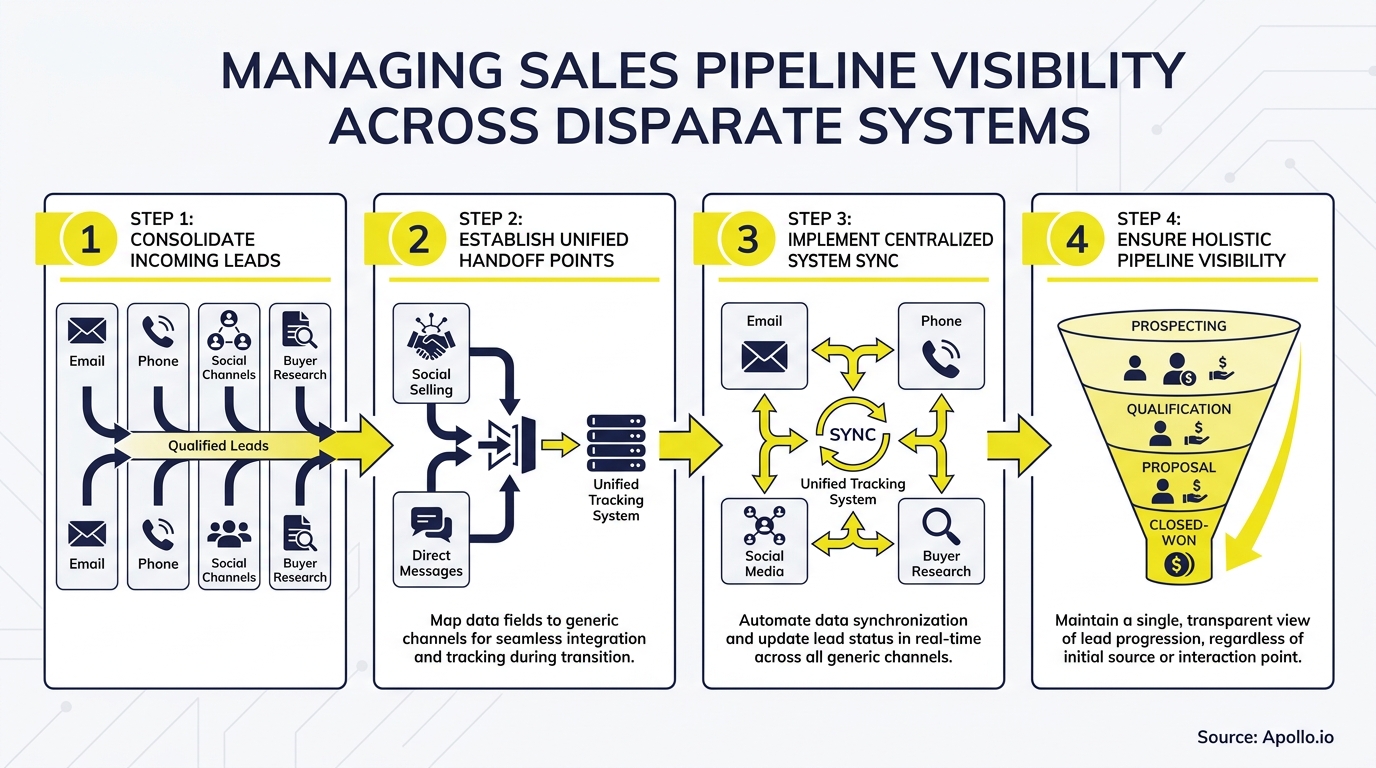
Your pipeline leak isn't at the bottom of the funnel. It's in the handoff. Every time a lead moves from your marketing automation platform to your CRM, from your CRM to a sales engagement tool, or from an SDR queue to an AE's ownership, data degrades, stages drift, and revenue disappears without a trace. Understanding how sales analytics drives revenue growth starts with solving this upstream problem first.
According to B2B Marketing Group, Gartner's Marketing Technology Survey 2024 found that 70% of CMOs cite data silos as a major barrier to revenue attribution and forecasting accuracy. The fix isn't more dashboards. It's a lead chain-of-custody model built on governed field ownership, unique identifiers, and handoff SLAs.

Scale Smarter With Apollo's GTM Engine
Tired of hours lost to manual research and leads that go nowhere? Apollo surfaces verified contacts and automates outreach so your team spends time selling, not searching. Join 600K+ companies building predictable pipeline.
Start Free with Apollo →Key Takeaways
- Pipeline tracking fails at handoff points, not at the bottom of the funnel — fixing field mapping and stage governance is more impactful than adding more reporting tools.
- Every lead needs a persistent unique ID that travels across all systems so duplicates, stage drift, and orphaned records can be detected and resolved.
- RevOps teams should define a single source-of-truth field owner for every critical pipeline field and enforce SLAs for lead acceptance and rejection.
- Buying-group tracking requires account-level context, not just individual lead records — SDRs and AEs need visibility into all contacts engaged at each account.
- Consolidating your GTM stack into fewer systems is the fastest way to reduce handoff failures and restore pipeline confidence.
Why Does Pipeline Tracking Break When Leads Move Between Systems?
Pipeline tracking breaks because each system writes to its own data model without a shared identity layer connecting them. A lead created in your MAP gets a MAP ID.
Your CRM assigns a different ID. Your sales engagement tool creates a third record.
Without a bridge between these identifiers, stage changes in one system never reach the others.
Research from Netguru shows that disconnected sales technology leads to data silos and workflow bottlenecks, causing sales teams to spend only 16% of their workday engaging with customers. The rest is wasted on manual lookups, duplicate cleanup, and chasing down where a lead actually stands.
The most common failure modes include:
- Duplicate records: The same contact enters the CRM multiple times from different sources with no deduplication logic.
- Stage drift: A lead advances in the sales engagement tool but the CRM opportunity stays at the old stage.
- Orphaned leads: Leads routed to a rep who left the company sit uncontacted with no reassignment trigger.
- Lost attribution: UTM parameters and original source fields overwritten on sync, destroying campaign ROI data.
- Silent rejections: SDRs disqualify leads without logging a reason, leaving marketing blind to lead quality issues.
What Is a Lead Chain-of-Custody Model?
A lead chain-of-custody model is a governance framework that assigns every lead a persistent unique ID and tracks every system it enters, every status change it undergoes, and every team member who touches it, with timestamps and rejection reasons at each handoff point.
Think of it as an audit trail for your pipeline. The core components are:
| Component | What It Does | Where It Lives |
|---|---|---|
| Persistent Lead ID | Links the same contact across MAP, CRM, and engagement tools | Custom field synced bidirectionally |
| Lifecycle Stage Field | Single source-of-truth stage owned by one system | CRM (never overwritten by MAP) |
| Handoff Timestamp | Records exact date/time a lead moved between owners or systems | CRM activity log or custom field |
| Rejection Reason Field | Captures why SDR or AE returned a lead to marketing | CRM picklist field, required on rejection |
| Original Source (locked) | Preserves UTM and first-touch attribution permanently | CRM field set to write-once |
This structure lets RevOps leaders query the CRM and answer: where did this lead come from, which systems touched it, when did it move, and why was it rejected? Without it, pipeline reviews are guesswork.

How Do RevOps Teams Build a Field Governance Matrix?
A field governance matrix assigns a single system as the owner of each critical CRM field, preventing conflicting writes from multiple tools from overwriting accurate data. RevOps leaders should build this before any new integration goes live.
A starting governance matrix for pipeline fields:
| Field | Source of Truth | Who Can Write | Sync Direction |
|---|---|---|---|
| Lead Status | CRM | CRM only | CRM → MAP (read-only in MAP) |
| Opportunity Stage | CRM | AE manually or automation rule | CRM internal |
| Original Lead Source | MAP | MAP at creation, locked after | MAP → CRM, write-once |
| Last Engagement Date | Sales Engagement Tool | Engagement tool via API | Engagement → CRM |
| Enrichment Fields (title, industry) | Enrichment platform | Enrichment tool via scheduled sync | Enrichment → CRM (overwrite allowed) |
Without this matrix, every integration is a coin flip: the last system to write wins, and that is rarely the system with the most accurate data. Curious about building the right sales tech stack to support this governance? The architecture decisions you make upfront determine how cleanly leads flow.
Turn Funnel Guesswork Into Pipeline Clarity
Pipeline forecasting a guessing game because marketing leads never convert? Apollo surfaces verified, in-market contacts so your pipeline reflects real opportunity. Nearly 100K paying customers stopped forecasting on hope.
Schedule a Demo →How Should SDRs and AEs Handle Pipeline Handoff SLAs?
SDRs and AEs should operate under defined handoff SLAs that specify the maximum time to accept, work, or reject an inbound lead, with the status and reason logged in the CRM automatically.
Poor lead follow-up is a widespread problem. Data from Sopro shows 41% of marketers struggle to follow up with leads quickly, and without SLA enforcement that number translates directly into pipeline that stalls at the handoff stage.
Recommended SLA structure by lead type:
- Inbound demo request: SDR contact attempt within 5 minutes, accept or reject within 4 hours.
- MQL from MAP: SDR review within 24 hours, accept or return to nurture with reason within 48 hours.
- SDR to AE handoff (qualified): AE accepts and books discovery within 2 business days.
- Rejected lead:Rejection reason required (picklist: bad timing, wrong persona, no budget, not ICP). Triggers MAP re-enrollment automatically.
Speed-to-lead, lead acceptance rate, and SLA breach rate should appear on every RevOps pipeline health dashboard. These metrics reveal where leads get stuck, not just how many reach closed-won. For AEs managing complex accounts, deal management tools that surface SLA status and next-action prompts directly in the pipeline view remove the manual tracking burden entirely.
How Do You Track Pipeline Across a Buying Group, Not Just One Lead?
Tracking pipeline across a buying group means associating all contacts at a target account to a single opportunity record, so SDRs and AEs see every person engaged, every channel touched, and every signal received, regardless of which system generated the interaction.
B2B deals rarely involve one buyer. When leads from the same account enter through different channels (content download, web demo, SDR outreach, event), each creates a separate record in most systems.
Without account-level association, your pipeline shows five separate leads when it should show one opportunity with five engaged stakeholders.
To implement buying-group tracking:
- Use the company domain or account ID as the primary key for deduplication across systems.
- Associate all contacts from the same domain to the same CRM account before creating opportunities.
- Track engagement at the account level (emails sent, calls made, meetings booked) not just the contact level.
- Use intent data signals to detect when multiple stakeholders from the same account are researching your category, even before they submit a form.
Losing visibility on multi-stakeholder accounts is especially costly in enterprise deals. Struggling to see every lead and contact across a complex account? Build and track your pipeline with Apollo's AI-powered pipeline builder, which surfaces account-level engagement in one unified view.
What Is the Fastest Way to Restore Pipeline Data Trust?
The fastest way to restore pipeline data trust is a monthly pipeline audit that scores each open opportunity against a checklist of required fields, recent activity, and stage-appropriate criteria, then flags or auto-updates records that fail the check.
A finding from Defease With Easeputs the scale of this problem in context: 83% of executives believe their companies have silos, and 97% say siloed data has had a negative effect on business. Clean pipeline data isn't a nice-to-have — it's the foundation for forecasting, AI agents, and revenue decisions.
Monthly pipeline audit scorecard checklist:
- Does every open opportunity have a close date set?
- Has there been contact activity (call, email, meeting) in the past 14 days?
- Is the lead source field populated and not overwritten?
- Does the stage match the most recent activity logged?
- Is the opportunity associated with a CRM account (not a floating contact)?
- Has the deal been enriched with current title, industry, and employee count?
Automate this audit using CRM workflow rules or a RevOps automation layer. Opportunities failing three or more checks should route to the owning rep with a required update task. Dirty data in your pipeline also undermines sales automation effectiveness — automated sequences only work correctly when the underlying contact and account data is accurate.
How Does Consolidating Your GTM Stack Fix Pipeline Tracking?
Consolidating your GTM stack fixes pipeline tracking by reducing the number of system-to-system handoffs where data can degrade, duplicates can form, and stage changes can get lost. Fewer tools means fewer integration failure points.
The Salesforce 2026 State of Sales report found only 34% of sales teams use one platform, while the average team relies on eight standalone tools. Every additional tool is a potential handoff failure.
Teams moving toward an all-in-one GTM platform eliminate entire categories of sync errors that no amount of field governance can fully prevent.
Apollo brings prospecting, contact data, sales engagement, deal management, and pipeline analytics into a single workspace. As Cyera put it: "Having everything in one system was a game changer." And Predictable Revenue noted: "We reduced the complexity of three tools into one." Tired of chasing leads across disconnected systems? See how Apollo's deal management keeps your entire pipeline visible in one place.

Take Control of Your Pipeline Handoffs in 2026
Keeping track of the sales pipeline when leads move between systems requires three things working together: a persistent identity layer (unique IDs across every tool), a governance model (field ownership, write rules, and SLA definitions), and a monthly audit habit that catches drift before it becomes a forecasting problem.
The teams winning in 2026 are not the ones with the most integrations. They are the ones with the fewest handoffs, the cleanest data, and a single source of truth for every deal.
Whether you are an SDR managing inbound routing, a RevOps leader standardizing your stack, or an AE trying to understand where a deal actually stands, the answer is the same: consolidate, govern, and audit.
Apollo gives B2B GTM teams one workspace to find leads, engage them across channels, and track every deal through close, without the fragmentation that kills pipeline visibility. Request a Demo and see how Apollo eliminates the handoff failures that are costing your team pipeline today.
Prove Pipeline ROI With Apollo
ROI pressure killing your budget approval? Apollo delivers measurable pipeline impact so you can justify every dollar — fast. Leadium 3x'd annual revenue after switching.
Start Free with Apollo →Don't miss these
Sales
Inbound vs Outbound Marketing: Which Strategy Wins?
Sales
What Is a Sales Funnel? The Non-Linear Revenue Framework for 2026
Sales
What Is a Go-to-Market Strategy? The 2026 GTM Playbook
See Apollo in action
We'd love to show how Apollo can help you sell better.
By submitting this form, you will receive information, tips, and promotions from Apollo. To learn more, see our Privacy Statement.
4.7/5 based on 9,690 reviews
