
How to Keep Leads Engaged Without Coming Across as Pushy
Most leads go cold not because they lost interest, but because your follow-up felt like pressure instead of value. Understanding what buyer leads actually need at each stage is the difference between a deal that closes and a contact that unsubscribes.
The good news: staying engaged without being pushy is a learnable system, not a personality trait. This playbook gives you the exact framework, timing, and messaging to stay visible, relevant, and welcomed in your prospect's inbox.

Research Less, Close More With Apollo
Tired of your reps burning hours hunting down contact info instead of selling? Apollo surfaces verified contacts instantly, so your team spends time closing—not digging. Join 600K+ companies building pipeline faster.
Start Free with Apollo →Key Takeaways
- Pushiness is perceived as irrelevance, not frequency. Generic follow-up feels more intrusive than timely, specific outreach.
- Most of the buyer's journey happens before sales gets involved, so your nurture content must work before prospects raise their hand.
- Buyer-controlled engagement outperforms rep-led sequences. Self-serve resources, intent signals, and trigger-based check-ins convert better than spray-and-pray cadences.
- SDRs and AEs who explicitly remove pressure upfront often close more deals, not fewer.
- Personalized, signal-driven outreach dramatically outperforms generic campaigns on every measurable metric.
Why Does Pushy Outreach Backfire?
Pushy outreach backfires because buyers experience it as irrelevance, not enthusiasm. According to SalesHive, 73% of B2B buyers actively avoid suppliers who send irrelevant outreach, making relevance a conversion issue, not just a preference.
The problem is structural. Salesforce's February 2026 State of Marketing report found 75% of marketers have adopted AI, yet 84% still run generic campaigns.
Teams risk using AI to send more one-way noise, faster, unless they shift from campaigns to conversations grounded in buyer signals.
Pushiness is also a timing problem. Data from Trykondo shows an estimated 67% of the buyer's journey is completed independently before a salesperson is ever engaged. If your outreach arrives before the buyer is ready, it registers as an interruption regardless of how polished it sounds.
What Does Buyer-Controlled Engagement Actually Look Like?
Buyer-controlled engagement means structuring your nurture so prospects can access value on their own terms, with human touchpoints triggered by their behavior rather than your calendar. It is not silence.
It is lower-friction presence.
The framework has three layers:
- Self-serve resource hub: A curated library of case studies, ROI calculators, implementation guides, and comparison content that buyers can explore without a sales call. Ungated when possible.
- Intent-triggered check-ins: Follow up when a prospect revisits your pricing page, opens a proposal, or engages with a specific piece of content. Intent data turns guesswork into signal-based timing.
- Preference-based cadence: Ask early what communication frequency and format the buyer prefers. A simple preference center reduces opt-outs and increases response rates.
A sales professional wrote on Redditthat closing rates improved after explicitly telling prospects upfront: "We don't need to get this figured out right this second." Removing urgency pressure counterintuitively accelerated the deal.
How Do SDRs and AEs Execute Non-Pushy Follow-Up?
SDRs and AEs keep leads engaged without pressure by replacing "just checking in" messages with value-forward touchpoints tied to the prospect's specific situation. The cadence matters as much as the content.
A Reddit user shared a firsthand perspectiveon a tested follow-up framework that works:
| Timing | Message Type | Example Frame |
|---|---|---|
| Day 3 after quote | Open question | "Any questions I can answer?" |
| Week 2 | Relevant resource | Share a case study tied to their stated problem |
| Week 4 | Gentle close | "Happy to pick this up whenever timing makes sense for you." |
For Account Executives managing multiple open opportunities, the key is tracking what you sent last, not just when you sent it. Repeating the same angle twice reads as desperation.
Rotating value (a peer story, a relevant insight, a product update) reads as partnership.
Spending too much time manually building these sequences? Automate your multi-channel sequences with Apollo's sales engagement platform, where you can build signal-triggered workflows that adapt to buyer behavior instead of a fixed calendar.
Turn Funnel Guesswork Into Pipeline Clarity
Tired of watching marketing leads stall before they ever reach your pipeline? Apollo surfaces high-intent prospects ready to convert, so your team stops chasing dead ends. 600K+ companies trust Apollo to fill funnels with quality.
Start Free with Apollo →What Content Keeps Leads Engaged Without Feeling Like a Sales Pitch?
Content keeps leads engaged when it helps them do their job better, build internal consensus, or reduce the risk of a decision, rather than promoting your product. The distinction is the frame: their problem first, your solution second.
Research from Reach Marketing shows personalized email campaigns result in a 29% higher open rate and a 41% higher click-through rate compared to generic sends. Personalization here means relevance to role, industry, and stage, not just inserting a first name.
Content that earns engagement without pressure:
- Stakeholder enablement emails: Help your champion sell internally. Send them a one-page business case or ROI summary they can forward to their CFO.
- Peer proof at the right stage: A case study from their industry matters more than a generic testimonial. Use sales intelligence tools to match proof points to the prospect's vertical.
- Thought leadership, not product sheets: Share a perspective on a trend affecting their market. No pitch. Just value.
- Humorous or human outreach: A well-placed humor-infused touchpoint breaks pattern without breaking trust.
Also worth noting:Salesgenie reports that 71% of consumers abandon irrelevant experiences. Every generic message you send is not neutral; it actively erodes pipeline.

How Can RevOps Teams Make Engagement Scalable and Signal-Driven?
RevOps teams make engagement scalable by replacing time-based sequences with behavior-triggered workflows, ensuring the right message reaches the right lead at the right moment without requiring manual intervention from reps.
The infrastructure required:
- Intent signal routing: Connect your engagement platform to intent data so reps are notified when a lead re-engages with specific content or pages. See how intent data is collected and applied to improve timing.
- Lead scoring tied to engagement depth: Score based on content consumed, pages visited, and email interactions, not just form fills.
- Automated but personalized sequences:Sales automation done right does not mean templated blasts. It means dynamically inserting relevant context from enriched contact data.
Data from SQ Magazineshows companies using automation for lead nurturing generate 50% more sales-ready leads. The caveat: automation amplifies your strategy, not a replacement for one. Generic automation at scale is just faster spam.
Struggling to see which leads are actually ready to buy? Apollo's pipeline platform surfaces engagement signals so your team focuses on leads most likely to convert, not just the ones who filled out a form.
How Do You Know If Your Outreach Is Crossing the Line Into Pushy?
Your outreach is crossing into pushy territory when it prioritizes your timeline over the buyer's readiness, repeats the same message without adding new value, or fails to acknowledge where the prospect actually is in their decision process.
Run this quick audit on any active sequence:
- Relevance check: Does this message reference something specific to this prospect's role, industry, or prior interaction? If not, stop and personalize.
- Pitch density check: Is more than one-third of the message about your product? Reframe around their problem.
- Timing check: Is this message triggered by a buyer signal or by a calendar date? Calendar-only triggers are a red flag.
- Value-add check: What does the prospect gain from reading this message, even if they never buy? If the answer is nothing, rewrite it.
For multi-channel outreach across email, phone, and social, use multi-channel marketing tools that let you coordinate touches without bombarding the same lead on every platform simultaneously.

How Do You Keep Leads Engaged Without Seeming Too Pushy in 2026?
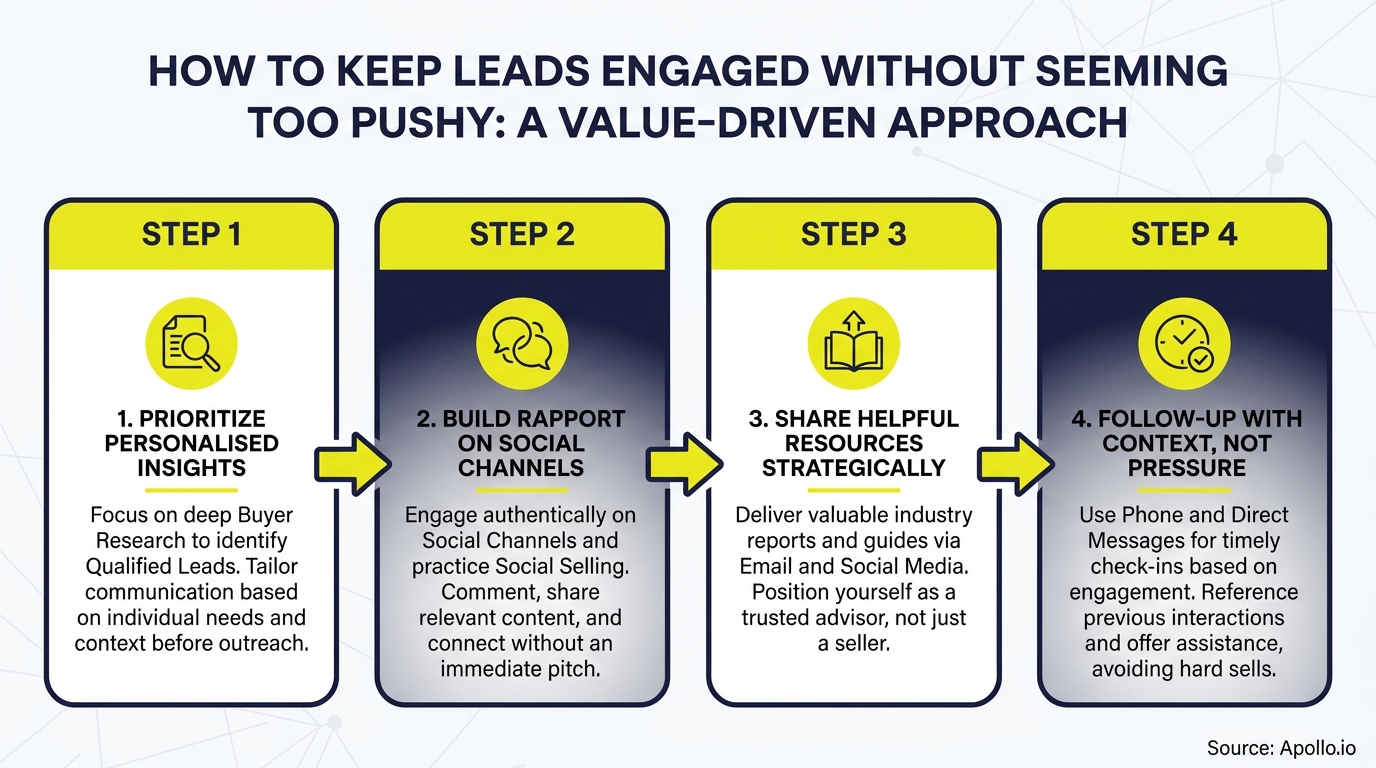
The answer is relevance-first, buyer-controlled engagement: provide value on the buyer's terms, show up based on their signals, and treat every touchpoint as an opportunity to help rather than to close.
The shift is straightforward in principle but requires operational discipline:
- Replace "just checking in" with specific, timely value tied to the buyer's context.
- Build self-serve content assets that work before a prospect ever talks to sales.
- Use intent and engagement signals to time human outreach, not a fixed day-count.
- Give prospects an explicit low-pressure exit: "Happy to revisit whenever timing works for you."
Teams that master this approach stop chasing and start attracting. Trusted by nearly 100K paying customers, Apollo gives SDRs, AEs, and RevOps teams a unified platform to find the right leads, personalize outreach at scale, and trigger follow-ups based on real buyer signals rather than guesswork.
Start Your Free Trial and build a lead engagement system that feels helpful, not pushy.
Prove Pipeline ROI Before Q Ends
Budget approval stuck on unclear metrics? Apollo surfaces measurable pipeline impact from day one—so you walk into every budget review with proof, not promises. Leadium 3x'd their revenue. You're next.
Start Free with Apollo →Don't miss these
Sales
Inbound vs Outbound Marketing: Which Strategy Wins?
Sales
What Is a Sales Funnel? The Non-Linear Revenue Framework for 2026
Sales
What Is a Go-to-Market Strategy? The 2026 GTM Playbook
See Apollo in action
We'd love to show how Apollo can help you sell better.
By submitting this form, you will receive information, tips, and promotions from Apollo. To learn more, see our Privacy Statement.
4.7/5 based on 9,690 reviews
