
How to Turn Past Customer Feedback into Smarter Targeting Criteria
Your next best account list is hiding in your support tickets, win/loss notes, and NPS responses. Most B2B teams leave this gold locked in CX dashboards instead of translating it into targeting criteria that actually improve pipeline quality.
This article gives you a practical framework to convert past customer feedback into structured targeting fields, activate them in your outreach, and close the loop with governance that keeps your ICP sharp.
If you're already investing in defining your Ideal Customer Profile, integrating voice-of-customer data is the next step that separates static personas from dynamic, evidence-backed targeting rules.

Research Smarter, Not Harder With Apollo
Tired of burning hours verifying contact info instead of closing deals? Apollo surfaces accurate leads instantly so your team spends time selling, not searching. Join 600K+ companies building pipeline faster.
Start Free with Apollo →Key Takeaways
- Past customer feedback is zero-party targeting data, not just testimonial copy. Convert it into structured fields like pain point, use case, maturity, objection, and buying stage.
- Feedback sources (reviews, tickets, win/loss calls, NPS) map to different targeting fields. Each source feeds a different layer of your ICP.
- Over-personalization is a real risk. Gartner found it produced negative experiences for more than half of customers surveyed, so governance and suppression rules matter as much as activation.
- RevOps and marketing leaders should align on a shared ICP definition. A 2024 report cited by Kliq Interactive found 53% of teams now share ICP definition across sales and marketing, up from 41% the prior year.
- A closed-loop workflow, from feedback collection through engagement measurement back into criteria updates, is what separates a one-time exercise from a compounding targeting advantage.
What Is Feedback-to-Targeting and Why Does It Matter in 2026?
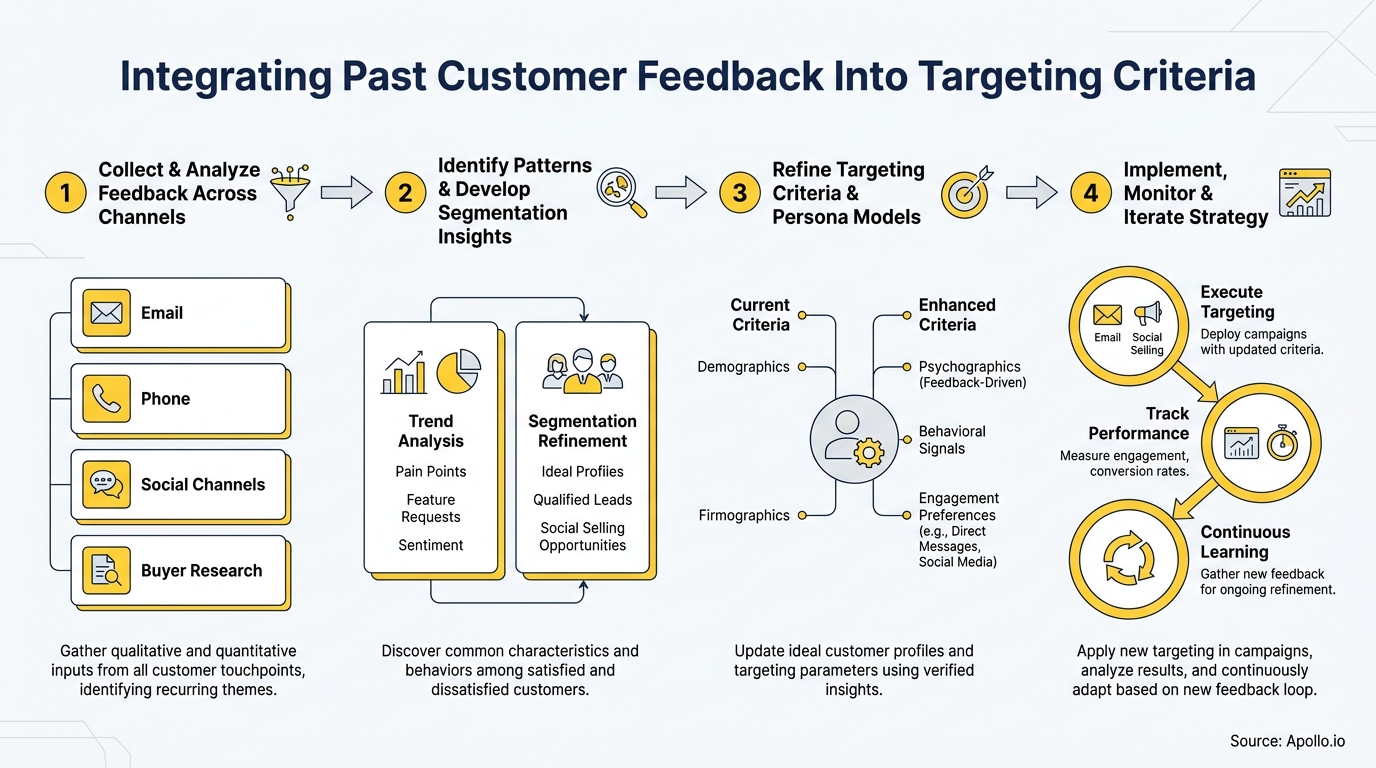
Feedback-to-targeting is the practice of converting structured and unstructured customer feedback into explicit account selection and scoring criteria. Rather than keeping NPS scores in a CX tool and win/loss notes in a spreadsheet, you extract discrete signals and map them to targeting fields your GTM team can act on.
The urgency is real. A McKinsey report cited by Madison Logic found that 71% of B2B buyers expect personalized interactions and become frustrated when those expectations go unmet. Yet Forrester's 2024 research found that over half of B2B buyers describe vendor content as useless. The gap between expectation and execution is a targeting problem, and feedback is the raw material to close it.
McKinsey's May 2026 B2B Pulse reinforces this: market leaders are four times more likely to deploy true one-to-one personalization by translating past customer outcomes into account-selection criteria, not just messaging.
How Do You Build a VOC-to-Targeting Field Taxonomy?
A VOC (voice-of-customer) taxonomy converts raw feedback into discrete, queryable targeting fields. Each feedback source maps to a different field category.
| Feedback Source | Targeting Field | Example Value |
|---|---|---|
| Win/loss interviews | Primary objection | "Worried about implementation time" |
| NPS responses | Use case satisfaction | "Outbound SDR workflow" |
| Support tickets | Friction point / negative-fit signal | "Integration complexity with legacy CRM" |
| Closed-won deal notes | Buying role + decision trigger | "VP Sales, headcount growth" |
| G2 / review sites | Outcome language | "Saved time on manual prospecting" |
| Onboarding surveys | Maturity level | "No prior ABM tooling" |
Once tagged, these fields become filters. Accounts that match your "closed-won" profile get prioritized. Accounts that match your "churn risk" pattern get suppressed or routed to a separate nurture track. For a deeper look at how enriched data feeds this process, see how customer data enrichment works.
According to BOL Agency, analysis of closed-won deals reveals important information about ideal customers, while closed-lost account data helps identify trends where deals stalled, such as customer confusion or a disconnect between product solutions and prospect needs. Both sides of that equation belong in your taxonomy.
Turn Weak Leads Into Pipeline Wins
Pipeline forecasting a guessing game because marketing leads never convert? Apollo surfaces high-intent prospects ready to buy — not just contacts to chase. Nearly 100K paying customers stopped guessing and started closing.
Start Free with Apollo →How Do RevOps Leaders Build the Feedback-to-Targeting Matrix?
RevOps leaders operationalize feedback-to-targeting by creating a matrix that links each feedback tag to a specific targeting action. This is where VOC data becomes a scoring rule rather than a qualitative insight.
Step 1: Extract and tag. Pull feedback from CRM notes, support platforms, and review sites.
Tag each item with: source, buyer role mentioned, pain point category, and signal type (positive fit, negative fit, or objection).
Step 2: Map tags to firmographics. Identify which firmographic or technographic traits co-occur with each tag.
For example, "worried about implementation time" may cluster around companies with fewer than 50 employees and no dedicated IT team. That becomes a targeting qualifier or a suppression rule.
Step 3: Apply quality checks. Tags derived from a single source or a single customer carry lower confidence.
Require at least three corroborating instances before promoting a tag to a scoring rule. Flag inferred signals separately from volunteered (zero-party) signals.
Struggling to find lookalike accounts once your matrix is built? Search Apollo's 230M+ contacts with 65+ filters to match your feedback-derived criteria at scale.
The Intent Amplify ICP guide recommends examining CRM and customer success platforms and identifying profitable accounts by evaluating metrics such as Customer Lifetime Value, NPS, retention, and renewal rates. These same metrics become the scoring weights in your matrix.

How Do SDRs and AEs Activate Feedback Tags in Outreach?
SDRs and AEs activate feedback tags by translating them into content briefs, call talk tracks, and channel selection rules. The goal is to match the right message to the right stage without triggering the over-personalization backlash Gartner documented.
- Pain point tags drive email subject lines and opening sentences. If your closed-won data shows "manual data entry" as the top pain for operations managers, that phrase belongs in your first touch, not buried in email three.
- Objection tags feed rep call prep. AEs handling deals where "security review" appeared in past win/loss notes should receive a pre-built objection-handling asset before their first call.
- Maturity tags determine channel mix. Prospects tagged as "no prior ABM tooling" may need educational content before a demo invite. Those tagged "active ABM user" can skip straight to a comparison asset.
- Buying-role tags guide multi-threading. If finance contacts consistently appear in closed-won deals, SDRs should proactively add a finance stakeholder to their sequence from the start.
Since Gartner's 2025 research found that 61% of B2B buyers prefer a rep-free buying experience, feedback-informed self-serve assets (ROI calculators, comparison pages, objection-handling FAQs) are as important as rep-facing talk tracks. Your B2B marketing funnel should reflect what past customers said they needed at each stage, not just what your team assumed.
For intent data that complements your feedback signals, see how intent data powers smarter B2B targeting.
How Do You Avoid Over-Personalization When Using Feedback Signals?
Over-personalization occurs when targeting signals are applied too aggressively, creating buyer friction instead of reducing it. The antidote is a clear distinction between volunteered signals and inferred signals, combined with suppression rules.
- Volunteered signals(zero-party): survey responses, post-demo questions, preference center selections. These carry the highest trust and can be used in direct personalization.
- Inferred signals: behavioral data, ticket sentiment, review language. Use these for segment-level targeting, not individual-level assumptions.
- Suppression rules: accounts that match churn-risk patterns (high support volume, low NPS, integration friction) should be excluded from acquisition campaigns and routed to a separate track.
Governance also requires auditable reason codes. When an account is prioritized because it matches three closed-won feedback themes, that reason should be visible to the rep and the RevOps leader. This connects to revenue operations best practices around explainability and data trust.
How Do You Measure and Close the Loop on Feedback-Driven Targeting?
Closed-loop measurement means tracking whether accounts targeted using feedback signals convert at higher rates, and feeding those results back into your taxonomy to update scoring weights.
Key metrics to track:
- Meeting-to-opportunity rate for feedback-tagged segments vs. baseline
- Win rate by feedback tag cluster (e.g., "integration pain" vs. "scale pain")
- Time-to-close for accounts matched to closed-won feedback profiles
- Churn rate for accounts that matched suppressed risk patterns but were still targeted
Set a quarterly review cadence. Compare your feedback taxonomy against new closed-won and closed-lost data. Retire tags that no longer predict outcomes. Add tags that surface in recent deal notes. This is what turns a static ICP into a dynamic, feedback-enriched targeting system. Track customer engagement metrics alongside pipeline metrics to capture early signals of fit or friction.
Ready to move from manual account research to automated, criteria-driven prospecting? Apollo's AI sales automation lets you encode your feedback-derived ICP criteria and run targeted outreach without building and maintaining a separate tool stack.

How Do You Start Integrating Customer Feedback into Targeting Today?
Start with three actions this week. First, pull your last 20 closed-won and 10 closed-lost deal notes and tag each by pain point, objection, and buyer role.
Second, cross-reference those tags with firmographic data to find two or three co-occurring traits that define your highest-fit segment. Third, build one suppression rule based on your most common churn-risk signal and apply it to your next prospecting run.
Teams that treat feedback as a targeting input, not just a retention metric, build ICP definitions that compound over time. Each new customer adds another data point.
Each deal note sharpens the next campaign. The result is a pipeline that reflects evidence, not assumptions.
Apollo gives B2B GTM teams a unified platform to search, enrich, engage, and measure, all in one workspace. As Collin Stewart at Predictable Revenue put it: "We reduced the complexity of three tools into one." Start a free trial and bring your feedback-driven targeting criteria to life against a database of 230M+ verified business contacts.
Prove Pipeline ROI From Day One
ROI pressure killing your next tool renewal? Apollo delivers measurable pipeline impact fast — 46% more meetings, trackable from week one. Nearly 100K paying customers closed the ROI gap. Start free today.
Start Free with Apollo →Don't miss these
Sales
Inbound vs Outbound Marketing: Which Strategy Wins?
Sales
What Is a Sales Funnel? The Non-Linear Revenue Framework for 2026
Sales
What Is a Go-to-Market Strategy? The 2026 GTM Playbook
See Apollo in action
We'd love to show how Apollo can help you sell better.
By submitting this form, you will receive information, tips, and promotions from Apollo. To learn more, see our Privacy Statement.
4.7/5 based on 9,690 reviews
