
How to Integrate AI-Driven Suggestions with Personalization Features
Most B2B teams have AI tools. Few have AI-driven personalization that actually moves pipeline. According to Contentful, over 92% of businesses are leveraging AI-driven personalization to drive growth, yet the gap between using AI and integrating it into governed personalization workflows remains wide. The real challenge is not generating suggestions. It's connecting those suggestions to the right buyer, at the right stage, through the right channel, with approval controls that protect your brand.
This guide gives B2B GTM teams, SDRs, AEs, RevOps leaders, and marketers a step-by-step workflow for doing exactly that. Start with email personalization fundamentals before layering in AI suggestions, and you'll build a system that scales without breaking brand consistency.

Build Pipeline Faster With Apollo
Tired of your reps burning hours on manual research instead of selling? Apollo surfaces verified contacts and ICP-fit leads instantly. Join 600K+ companies turning research time into revenue.
Start Free with Apollo →Key Takeaways
- AI-driven suggestions only deliver value when they are connected to unified account, intent, and CRM data, not isolated campaign data.
- Buying-group personalization outperforms individual hyper-personalization for B2B deals involving multiple stakeholders.
- A governed workflow with clear approval gates prevents brand-safety failures and builds trust in AI-generated recommendations.
- Next-best-action outputs, not just content variants, are where AI personalization creates measurable pipeline impact.
- RevOps teams that consolidate their tech stack report faster personalization insights and cleaner data for AI to act on.
What Does It Mean to Integrate AI-Driven Suggestions with Personalization Features?
Integrating AI-driven suggestions with personalization features means connecting AI recommendation outputs directly into the workflows, tools, and content delivery systems that shape what each buyer sees, reads, or receives. This is distinct from using AI to generate content in isolation.
The integration point is where the suggestion becomes a governed, context-aware action inside your CRM, MAP, CDP, or sales engagement platform.
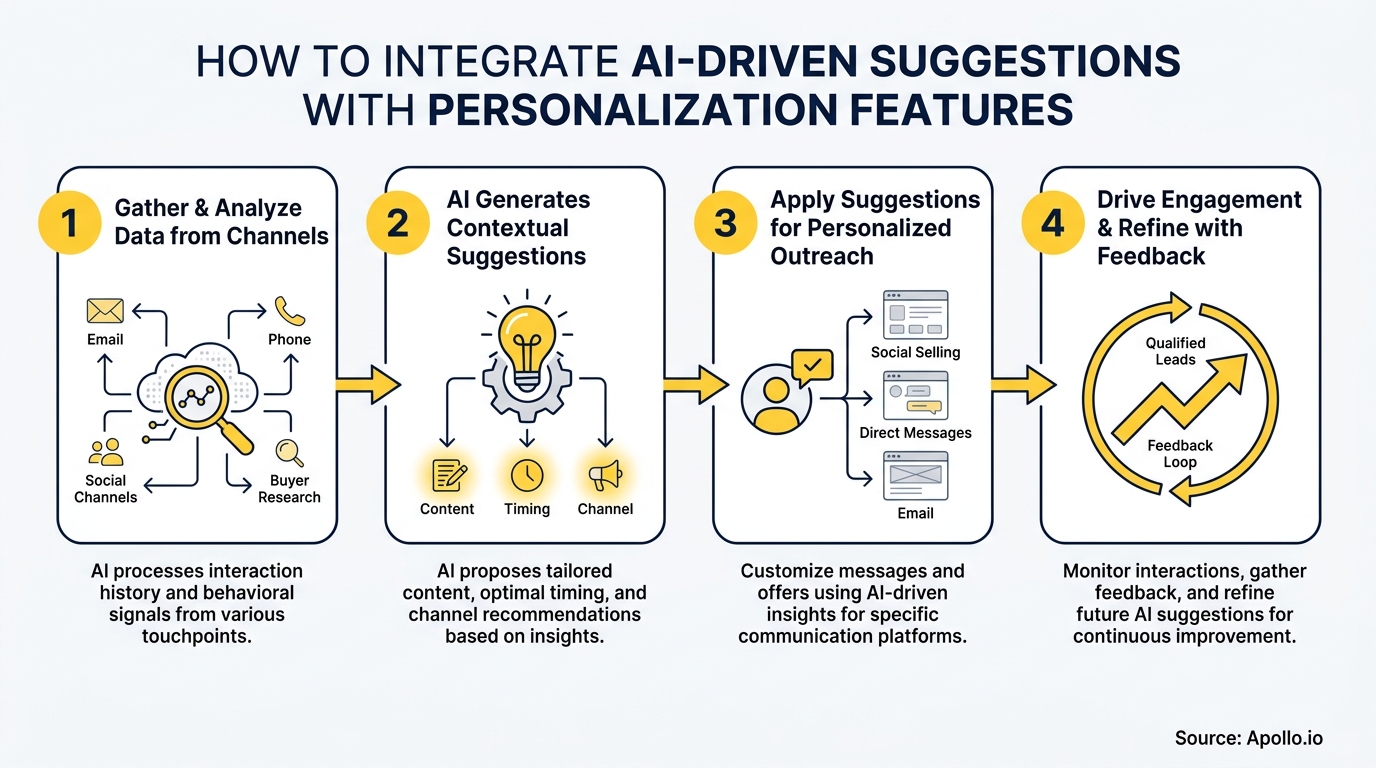
Think of it as a four-layer stack:
- Data inputs: CRM records, intent signals, firmographics, engagement history, and product usage data
- AI suggestion engine: Recommends next-best content, outreach timing, messaging angle, or channel
- Governance layer: Brand-safety review, compliance checks, and approval gates before deployment
- Personalization orchestration: Delivers the approved suggestion through the right channel to the right person
Understanding how intent data powers smarter B2B sales is foundational before configuring any AI suggestion engine.
Why Does AI Personalization Fail Without a Unified Data Foundation?
AI personalization fails when the underlying data is fragmented, stale, or siloed across disconnected tools. AI suggestions are only as relevant as the context fed into them.
If your CRM holds one version of an account, your MAP holds another, and your CDP has a third, the AI synthesizes noise, not signal.
A solid data enrichment strategy is the prerequisite. Without it, AI suggestions misfire on industry, buying stage, or persona, eroding rep trust in the recommendations. Solving data synchronization across systems is a practical first step before any AI personalization layer goes live.
Struggling to keep contact data clean across your GTM stack? Start free with Apollo's 230M+ verified business contacts and give your AI suggestions a reliable context layer to work from.
How Do You Build a Governed AI Personalization Workflow Step by Step?
A governed AI personalization workflow moves through five sequential steps, each with defined inputs, outputs, and controls.
| Step | Action | Governance Control |
|---|---|---|
| 1. Signal Ingestion | Unify CRM, intent, engagement, and firmographic data into a single account profile | Data quality threshold: require minimum field completeness before AI activation |
| 2. AI Suggestion Generation | AI recommends next-best content, channel, timing, or message angle per account/persona | Confidence score floor: suppress suggestions below defined accuracy threshold |
| 3. Brand-Safety Review | Human or automated review checks tone, compliance, and messaging fit | Approval gate: route flagged suggestions to marketing or legal before deployment |
| 4. Personalization Orchestration | Approved suggestions deploy via CRM, MAP, or sales engagement platform to the right contact | Audience lock: prevent duplicate outreach to same contact within defined windows |
| 5. Monitoring and Rollback | Track engagement, pipeline influence, and conversion at each touchpoint | Rollback trigger: auto-pause suggestions with negative engagement signals |
Each step maps to a specific system owner. RevOps typically owns steps 1 and 5.
Marketing owns steps 2 and 3. Sales owns step 4 execution.
Clear ownership prevents gaps and prevents AI suggestions from deploying without review.

How Should SDRs and AEs Use the Buyer-Committee Personalization Matrix?
SDRs and AEs should configure AI suggestions at the buying-group level, not just the individual contact level. Research from Digital Marketing Institute shows that 73% of business leaders agree AI will fundamentally reshape personalization strategies, and the shift is already moving toward committee-level targeting.
For SDRs prospecting into enterprise accounts, use this matrix to map AI suggestions:
| Stakeholder Role | Department | Buying Stage | AI Suggestion Type |
|---|---|---|---|
| Economic Buyer | Finance / C-Suite | Late / Decision | ROI calculator, business case content, risk mitigation messaging |
| Champion | Revenue / Sales Ops | Mid / Evaluation | Product comparison, peer case studies, workflow integration guides |
| Technical Evaluator | IT / Engineering | Mid / Evaluation | Security documentation, API references, integration specs |
| End User | Sales / Marketing | Early / Awareness | How-to content, quick wins, productivity use cases |
AEs managing active opportunities should use AI suggestions to surface consensus-building content that addresses shared objections across the committee, not just personalized messages for each individual. For deeper outreach personalization tactics, see how to write cold email introductions that get replies.
Spending hours manually researching each stakeholder before outreach? Apollo's AI sales automation surfaces account signals and suggests personalized messaging angles, so reps spend time selling, not researching.
Turn Funnel Gaps Into Pipeline Wins
Pipeline forecasting a guessing game? Apollo surfaces in-market buyers the moment they're ready, so your reps stop chasing cold leads and start closing. Over 600K companies use Apollo to build predictable pipeline.
Schedule a Demo →What Metrics Prove AI Personalization Is Working?
AI personalization ROI should be measured against pipeline actions, not content engagement alone. Data from Envive citing McKinsey's research indicates that personalization often drives a 5% to 15% revenue lift and can improve marketing-spend efficiency by 10% to 30%. Those outcomes require tracking the right signals.
Focus measurement on these pipeline-connected metrics:
- Stage conversion rate: Are AI-suggested touchpoints moving accounts from awareness to evaluation faster?
- Buying-group engagement score: Are multiple stakeholders from target accounts engaging with personalized content?
- Response rate by suggestion type: Which AI-recommended messages or channels drive the highest reply rates?
- Sales-cycle compression: Do accounts touched by AI-personalized sequences close in fewer days?
- Pipeline influence: What percentage of closed-won deals had at least one AI-suggested touchpoint in the sequence?
RevOps leaders should build these into a shared dashboard so marketing, sales, and leadership can see which AI suggestions are generating pipeline and which need adjustment. Pair this with return-on-sales benchmarks to frame AI personalization impact in revenue terms for leadership.
How Does Apollo Help GTM Teams Integrate AI Suggestions with Personalization at Scale?
Apollo consolidates the data, AI suggestion, and outreach execution layers into one platform, eliminating the fragmentation that breaks most personalization workflows. Instead of stitching together a CDP, a separate enrichment tool, a sales engagement platform, and an AI layer, GTM teams work from a single workspace.
As Cyera put it: "Having everything in one system was a game changer."
Apollo's AI-powered selling capabilities combine 230M+ verified business contacts, 65+ search filters, intent signals, and AI-powered messaging suggestions into one workflow. SDRs use it to identify target accounts, enrich contact records, and launch personalized multi-channel sequences without switching tools. RevOps leaders use it to maintain a clean, unified data layer that feeds accurate signals to AI recommendations.
The result is what Census described as cutting costs in half, and what Predictable Revenue called "reducing the complexity of three tools into one." For teams building or scaling a B2B marketing funnel, that consolidation is the difference between AI suggestions that inform decisions and AI suggestions that actually deploy, personalized, at scale.

Start Integrating AI-Driven Suggestions with Personalization Today
The teams winning with AI personalization in 2026 are not the ones with the most tools. They are the ones with the clearest workflow: unified data in, governed AI suggestions out, personalized execution at every buyer touchpoint.
Build that workflow with the steps and frameworks above, and measure it against pipeline, not just clicks.
Apollo gives B2B GTM teams the unified platform to run this entire workflow without the tech-stack complexity. Trusted by nearly 100K paying customers, including Anthropic, Smartling, and Autodesk, Apollo puts AI suggestions, verified contact data, and multi-channel engagement in one place. Get Leads Now and see how AI-driven personalization works when the data, the AI, and the outreach are finally in the same system.
Prove Pipeline ROI With Apollo
ROI pressure killing budget approvals before your tools even get a chance? Apollo delivers measurable pipeline impact fast. Teams like Leadium 3x'd annual revenue — giving leaders the proof they need to close the case.
Start Free with Apollo →Don't miss these
Sales
Inbound vs Outbound Marketing: Which Strategy Wins?
Sales
What Is a Sales Funnel? The Non-Linear Revenue Framework for 2026
Sales
What Is a Go-to-Market Strategy? The 2026 GTM Playbook
See Apollo in action
We'd love to show how Apollo can help you sell better.
By submitting this form, you will receive information, tips, and promotions from Apollo. To learn more, see our Privacy Statement.
4.7/5 based on 9,690 reviews
