
How to Implement Multi-Touch Sequences for High-Value Accounts
Most multi-touch sequences fail high-value accounts for one reason: they treat a 13-person buying committee like a single contact. A linear cadence sent to one champion while the economic buyer, technical evaluator, and procurement lead remain untouched is not a sequence. It is a gamble. To learn what high-performing sequences actually look like, you need to start with the buying group, not the inbox.
According to HockeyStack, B2B SaaS companies required an average of 266 touchpoints to close a deal in 2024, a 19.8% increase from the prior year. Implementing multi-touch sequences for high-value accounts means orchestrating those touches across roles, channels, and buying stages, not just increasing email volume.

Build Pipeline, Not Spreadsheets
Tired of burning hours on manual research instead of closing deals? Apollo surfaces verified contacts and scales your outreach so your team spends time selling. Join 600K+ companies building predictable pipeline.
Start Free with Apollo →Key Takeaways
- High-value account sequences must map touches to buying-group roles, not just a single lead contact.
- Buyers want fewer but better-timed touches: generic outreach actively drives prospects away from your shortlist.
- A touch matrix (role x stage x channel x content x owner) is the operational backbone of any effective sequence.
- Rep-free and seller-assisted touches serve different jobs. Mixing them without a clear trigger model creates noise.
- Measurement should track account-level progression and pipeline influence, not just MQL volume.
Why Do Standard Cadences Fail High-Value Accounts?
Standard cadences fail high-value accounts because they are lead-based, not account-based, and they ignore the buying committee entirely. A Gartner survey in 2025 found that 73% of B2B buyers actively avoid suppliers that send irrelevant outreach, and 69% report inconsistencies between what a supplier's website says and what their sellers communicate.
Both problems stem from the same root: sequences built for speed, not relevance.
High-value accounts involve multiple departments, longer timelines, and buyers who have already done significant research before your SDR sends a first email. Research from Marketing LTB shows that 71% of B2B buyers consume four or more pieces of content before contacting sales. Your sequence needs to meet them where they already are, not introduce concepts they dismissed months ago.
The fix is not more touches. It is smarter orchestration tied to role, buying stage, and signal.
How Do You Map a Buying Committee Before Building Sequences?
Map your buying committee by identifying every buying job that must be satisfied before a deal closes, then assign a stakeholder role to each job. For most high-value accounts, five buying jobs cover the critical path:
- Champion: Builds internal support, drives urgency, owns the evaluation
- Economic Buyer: Approves budget, evaluates ROI and risk
- Technical Evaluator: Assesses integration, security, and implementation feasibility
- End User Lead: Validates usability and workflow fit
- Procurement / Legal: Manages contract, compliance, and vendor approval
Once roles are mapped, assign an account owner or AE to each stakeholder thread. This is the foundation of your touch matrix.
For AEs managing enterprise deals, this mapping exercise often reveals three to five untouched stakeholders who could accelerate or kill the deal.
Understanding intent data signals helps prioritize which accounts to build full committee maps for first.
What Is a Touch Matrix and How Do You Build One?
A touch matrix is a structured grid that maps every planned touch by stakeholder role, buying stage, channel, content asset, and sequence owner. It replaces the intuition-driven cadence with a documented, repeatable plan that the whole GTM team can execute consistently.
| Buying Stage | Champion | Economic Buyer | Technical Evaluator | Channel | Content Type |
|---|---|---|---|---|---|
| Awareness (Days 1-30) | Personalized email + social | Account-based ad + exec email | Technical blog + ad retargeting | Email, social, paid | Industry challenge content |
| Consideration (Days 31-60) | Phone call + case study | ROI model + peer reference | Security doc + demo invite | Phone, email, events | Role-specific proof content |
| Decision (Days 61-90) | Exec sponsor meeting | Business case review | Implementation roadmap | Direct seller, phone | Validation and risk-reduction assets |
Each cell in the matrix should specify who sends or triggers the touch, what asset is used, and what signal or action moves the account to the next stage. This is how a repeatable sales system gets built for your highest-value segment.
Turn Funnel Gaps Into Forecast Wins
Quota stress keeping you up at night? Apollo surfaces verified, in-market buyers so your pipeline stops guessing and starts closing. Nearly 100K paying customers trust Apollo to hit their numbers.
Schedule a Demo →How Do SDRs and AEs Orchestrate Rep-Free Versus Seller-Assisted Touches?
Rep-free touches run automatically based on account behavior and buying stage. Seller-assisted touches require a human to act, and they should be reserved for moments where context, judgment, or relationship matters.
Conflating the two is one of the most common sequencing mistakes SDRs and AEs make on high-value accounts.
Use this split as a starting framework:
- Rep-free (automated): Account-based ads, retargeting, nurture emails triggered by content consumption, event invitations, ROI calculator access
- Seller-assisted: Personalized cold email (researched, role-specific), phone calls, executive introductions, custom demo requests, contract-stage outreach
A Gartner 2025 survey found that while 61% of B2B buyers prefer a rep-free overall buying experience, they still prefer seller input for contextual decisions like product fit. SDRs should trigger seller-assisted touches only when an account signals active evaluation, not on a fixed Day 3 schedule.
Spending hours manually sequencing each stakeholder? Automate your multi-channel sequences with Apollo's sales engagement platform and let your reps focus on the touches that actually require human judgment.

What Governance Rules Keep Sequences Consistent Across GTM Teams?
Sequence governance prevents the message fragmentation that kills deals. When an economic buyer receives a different value narrative from the SDR, the AE, and the marketing nurture stream, trust erodes.
Gartner's 2025 data showing 69% of buyers flagging message inconsistencies is a governance failure, not a content failure.
Three governance rules every team implementing multi-touch sequences for high-value accounts should enforce:
- Single message source of truth: One shared document (or CRM field) defines the approved value narrative, proof points, and objection responses for each account tier. SDRs, AEs, and marketers pull from the same source.
- Asset approval before launch: No new email template, one-pager, or ad creative enters a high-value account sequence without review. This prevents rogue personalization that contradicts the approved narrative.
- Sequence ownership per role: Each stakeholder thread has a named owner. If the champion thread and the economic buyer thread are both owned by the same SDR with no AE involvement, the sequence lacks the seniority match for executive-level touches.
RevOps leaders find that connecting governance rules directly to CRM integration workflows is the fastest way to enforce them without adding manual process overhead.
How Do You Measure Multi-Touch Sequence Performance on High-Value Accounts?
Measure multi-touch sequence performance using account-level progression metrics, not individual email open rates. Open rates tell you nothing about whether the buying committee is moving forward.
Pipeline influence, stakeholder coverage, and stage velocity tell you whether the sequence is working.
Core metrics for high-value account sequences:
- Stakeholder coverage rate: What percentage of buying-group roles have received at least one qualified touch?
- Account stage progression: How many accounts advanced from awareness to consideration, or consideration to decision, within the sequence window?
- Pipeline influence: What is the total pipeline value touched by the sequence versus pipeline that converted to closed-won?
- Win-rate lift: Do accounts that completed the full sequence win at a higher rate than those that dropped out early?
- Sequence-to-meeting rate: What percentage of sequenced accounts booked a discovery or evaluation call?
Research from Accelera Agency shows that marketers using ABM strategies report up to 85% higher ROI compared to traditional marketing methods, a result that depends on measuring the right signals. Tracking MQLs instead of account progression is why many teams underreport the true impact of their sequences. Connecting your sequence data to sales performance management frameworks makes attribution cleaner and reporting more defensible.
Need a cleaner pipeline view across all your high-value account sequences? Track every deal and sequence touchpoint in Apollo's deal management platform without switching between tools.

How Do You Implement Multi-Touch Sequences for High-Value Accounts in 2026?
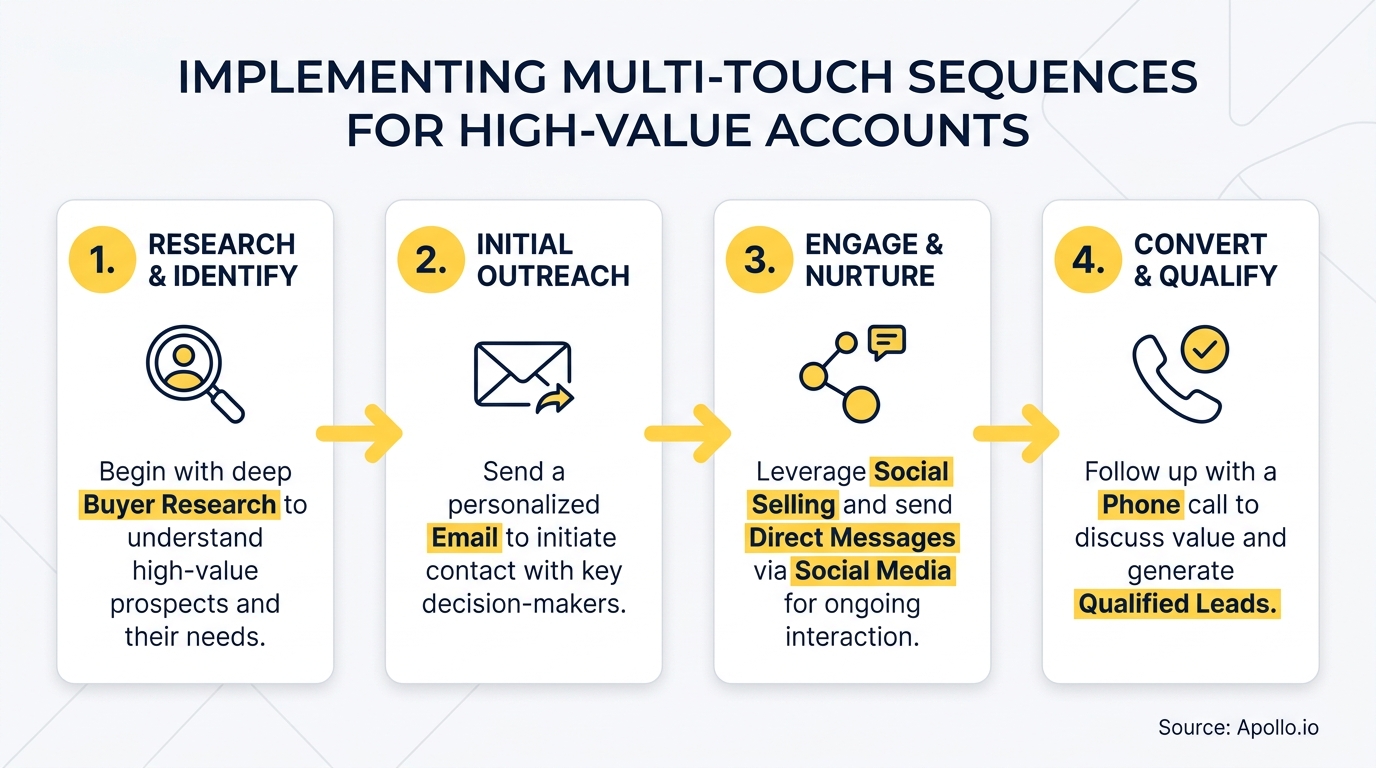
Implementing multi-touch sequences for high-value accounts in 2026 requires a buying-group-first architecture, a documented touch matrix, clear governance, and account-level measurement. Generic cadences sent to a single contact will not move a 13-person buying committee.
Signal-triggered, role-specific sequences will.
The teams winning on high-value accounts today share three traits: they map the full buying committee before writing a single email, they use a unified platform to coordinate rep-free and seller-assisted touches without tool sprawl, and they measure account progression instead of activity volume. As Cyera put it after consolidating their GTM stack: "Having everything in one system was a game changer."
Apollo gives SDRs, AEs, RevOps, and marketing teams one workspace to find verified contacts across 230M+ people, build role-specific sequences, automate multi-channel outreach, and track pipeline influence, all without stitching together five separate tools. Start your free trial and build your first high-value account sequence today.
Prove Pipeline ROI Before Next QBR
ROI pressure killing your tool budget? Apollo delivers measurable pipeline impact from day one. Leadium 3x'd annual revenue — see your own numbers before the next approval meeting.
Start Free with Apollo →Don't miss these
Sales
Inbound vs Outbound Marketing: Which Strategy Wins?
Sales
What Is a Sales Funnel? The Non-Linear Revenue Framework for 2026
Sales
What Is a Go-to-Market Strategy? The 2026 GTM Playbook
See Apollo in action
We'd love to show how Apollo can help you sell better.
By submitting this form, you will receive information, tips, and promotions from Apollo. To learn more, see our Privacy Statement.
4.7/5 based on 9,690 reviews
