
How to Identify Companies Expanding in Your Target Market
Expanding companies are the highest-value prospects in any B2B market. They're actively hiring, opening new offices, acquiring tools, and signing vendor contracts — often all at once.
Knowing how to identify companies expanding in your target market before your competitors do is the difference between a warm pipeline and a cold list. This playbook shows you exactly how to read the signals, score the accounts, and act fast enough to win the deal.
Start with your B2B marketing funnel — expansion signals only generate revenue when they feed a structured, conversion-ready process. And before diving into signals, make sure you've sized your opportunity correctly using the TAM SAM SOM framework.

Research Less, Close More With Apollo
Tired of your reps burning hours hunting down contact info instead of selling? Apollo surfaces verified contacts instantly so your team spends time closing, not researching. Join 600K+ companies building pipeline faster.
Start Free with Apollo →Key Takeaways
- Expansion signals (hiring surges, funding rounds, new office announcements) are public and actionable — the edge is in combining them, not just collecting them.
- Multi-signal scoring outperforms any single data stream; correlate job postings, tech changes, and intent behavior for higher-precision targeting.
- SDRs and AEs who act on expansion triggers within days of the signal see meaningfully higher response rates than those working static lists.
- The sales intelligence market is growing rapidly, making tooling for expansion identification more accessible across team sizes.
- Bottom-up market analysis, not top-down TAM math, produces the most accurate account prioritization for expansion-stage targets.
What Are the Best Signals That a Company Is Expanding?
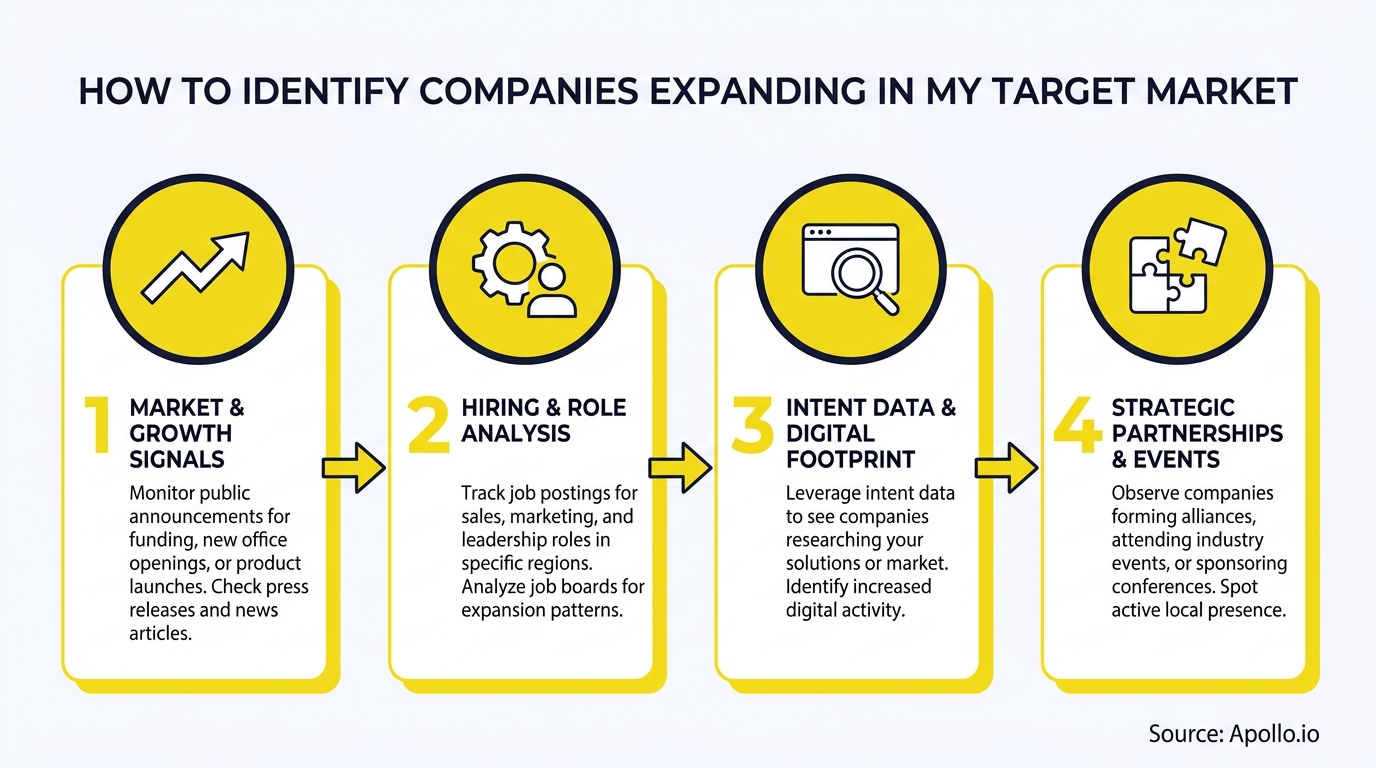
The strongest expansion signals are hiring velocity, funding announcements, new office or facility openings, technology stack changes, and regulatory filings like building permits or FDI disclosures. No single signal is reliable on its own.
The market has moved toward multi-signal scoring — combining job posts, intent network activity, tech-change data, and first-party site behavior — because any one stream is too noisy to act on alone.
| Signal Type | What It Indicates | Where to Find It |
|---|---|---|
| Hiring surge (10%+ headcount growth) | New market entry, capacity expansion | Job boards, professional networks, Apollo filters |
| Funding round (Series A–D) | Budget available, vendor evaluation imminent | Crunchbase, press releases, news alerts |
| New office or facility announcement | Geographic expansion, new supplier needs | Business press, permit databases, BEA reports |
| Tech stack change | Modernization, process overhaul underway | BuiltWith, job description analysis |
| Intent topic spikes | Active research on solutions in your category | Intent data providers, first-party analytics |
Understanding how intent data is collected helps you evaluate which signals are truly behavioral versus which are inferred — a critical distinction when building a scoring model.
How Do SDRs Build a Repeatable Expansion-Signal System?
SDRs build a repeatable system by setting up automated alerts for each signal type, routing matched accounts into a scored list, and triggering outreach sequences within days of signal detection. Speed matters: expanding companies evaluate vendors quickly, and waiting even a week can mean losing to a faster-moving competitor.
A Reddit user shared a firsthand perspectiveon an often-overlooked research source: public libraries with access to Pitchbook, Business Journal archives, and business directories — free tools that rival paid databases for identifying expanding companies, particularly at the regional level.
Structure your system in three layers:
- Public signals: BEA greenfield expenditure data, permit filings, press releases, job board aggregators
- Third-party intelligence: Sales intelligence platforms, intent data, funding databases
- First-party signals: Your own product analytics, pricing page visits, documentation traffic
Assign point values to each signal (e.g., funding = 30 pts, hiring surge = 20 pts, intent spike = 25 pts) and set a threshold score for SDR outreach. Review and recalibrate scores monthly based on conversion data.
Struggling to turn signals into a prioritized pipeline? Search Apollo's 230M+ contacts with 65+ filters to find expanding accounts by headcount growth, funding stage, job postings, and more — in one workspace.

How Do You Use Public Economic Data to Find Expanding Companies?
Public economic data — particularly BEA and UNCTAD reports — provides sector- and region-level expansion indicators that most sales teams ignore entirely. Mapping these macro signals to your ICP gives you a head start before company-level signals even appear.
According to Precedence Research, the global sales intelligence market was valued at USD 3.31 billion in 2024 and is projected to reach USD 9.02 billion by 2034, growing at a CAGR of 10.54%. This growth reflects how critical data-driven account targeting has become across teams of every size.
Practical ways to operationalize public data:
- Monitor BEA's annual FDI reports for sector-level greenfield investment trends by U.S. state
- Cross-reference UNCTAD country-level data with your target verticals to spot inbound expansion waves
- Set Google Alerts for "[your industry] + new facility" or "[target city] + headquarters" to catch local announcements
- Use state economic development agency press releases — they publish expansion announcements before the business press does
Turn Funnel Gaps Into Qualified Pipeline
Pipeline forecasting a guessing game because quality leads never convert? Apollo surfaces in-market buyers with precision timing so your reps act on real signals, not hunches. Join 600K+ companies building predictable revenue.
Start Free with Apollo →How Can AEs and RevOps Teams Score and Prioritize Expansion Accounts?
AEs and RevOps teams prioritize expansion accounts by building a composite score that weights recency, signal strength, and ICP fit — then routing high-scoring accounts directly into active sequences. A scoring model prevents SDRs from chasing noise while ensuring AEs focus on accounts with genuine buying urgency.
A commenter added in a Reddit discussion that bottom-up analysis — building from individual account potential rather than top-down TAM percentages — produces far more accurate prioritization. Top-down math creates optimistic but impractical forecasts; bottom-up forces you to count real accounts with real signals.
RevOps leaders find that buying intent signals layered on top of firmographic filters dramatically improve the signal-to-noise ratio. Pairing intent with expansion triggers (hiring + funding + tech change at the same account) produces the highest-confidence tier for outreach prioritization.
For a structured approach to building your target list, see the Apollo guide to building, segmenting, and automating target account lists.
What Tools Do B2B Teams Use to Identify Expanding Companies in 2026?
B2B teams use sales intelligence platforms, intent data providers, job board aggregators, and CRM-connected alert systems to identify expanding companies at scale. Research from Fortune Business Insights valued the global sales intelligence market at USD 4.85 billion in 2025, with growth expected to continue through 2034 — reflecting the mainstream adoption of these tools across sales teams of all sizes.
Key tool categories:
- Sales intelligence platforms: Filter accounts by headcount growth, funding stage, and technology used
- Intent data providers: Identify accounts actively researching your category right now
- Workflow automation: Route matched accounts into sequences automatically when signals fire
- CRM enrichment: Keep existing account records updated with current expansion signals
Apollo consolidates prospecting, intent data, enrichment, and multi-channel engagement into a single platform. As Cyera put it, "Having everything in one system was a game changer." Spending too much time stitching tools together? Automate your expansion outreach with Apollo's AI-powered sequences and act on signals the moment they surface.
For a broader view of the category, see the full breakdown of best B2B marketing tools for 2026.
How Do You Turn Expansion Signals Into a Go-to-Market Motion?
Turning expansion signals into a GTM motion means connecting your signal system directly to your outreach engine — so that when an account crosses your score threshold, a tailored sequence launches automatically. This closes the gap between insight and action that kills most signal-based programs.
Your expansion GTM motion should include:
- Trigger-based sequences: Different messaging for "just funded" vs. "new office opening" vs. "tech stack change" — each signal implies a different pain point
- Multi-channel coverage: Email, phone, and social outreach coordinated around the same signal event
- Content aligned to expansion stage: Case studies, ROI frameworks, and onboarding timelines that address the specific buying questions expansion-stage companies ask
- Internal alignment: RevOps routing rules that assign the right rep based on account score, territory, and signal type
Review your go-to-market strategy to ensure your expansion motion fits within a coherent GTM plan — signal detection without downstream process is just noise.

Start Identifying Expanding Companies Before Your Competitors Do
The companies expanding in your target market are leaving signals everywhere: job postings, funding announcements, intent spikes, and public filings. The teams that win are the ones with a system to collect, score, and act on those signals faster than anyone else.
Apollo gives SDRs, AEs, and RevOps teams one workspace to find expanding accounts, enrich them with verified contact data, and launch multi-channel sequences the moment a signal fires. Trusted by nearly 100K paying customers — including Anthropic, Smartling, and Redis — Apollo replaces the fragmented tool stack with a unified platform built for exactly this kind of targeted, signal-driven outreach.
Get Leads Now and start building your expansion signal system inside Apollo today.
Prove Pipeline ROI With Apollo
ROI pressure killing your tool budget? Apollo delivers measurable pipeline impact from day one — no guesswork, no waiting. Teams like Leadium 3x'd annual revenue. Start your free trial and show results fast.
Start Your Free Trial →Don't miss these
Sales
Inbound vs Outbound Marketing: Which Strategy Wins?
Sales
What Is a Sales Funnel? The Non-Linear Revenue Framework for 2026
Sales
What Is a Go-to-Market Strategy? The 2026 GTM Playbook
See Apollo in action
We'd love to show how Apollo can help you sell better.
By submitting this form, you will receive information, tips, and promotions from Apollo. To learn more, see our Privacy Statement.
4.7/5 based on 9,690 reviews
