
How to Get Started with AI Features in Your Small Sales Team
Most small sales teams are already using AI in some form. But there's a gap between casual AI use and operational AI adoption that actually moves revenue. According to the U.S. Chamber of Commerce, 58% of small businesses reported using generative AI in 2025, up from 40% in 2024. Yet most teams are still running one-off experiments instead of repeatable workflows. If you want to sell with AI effectively, you need a structured plan, not just a ChatGPT tab.
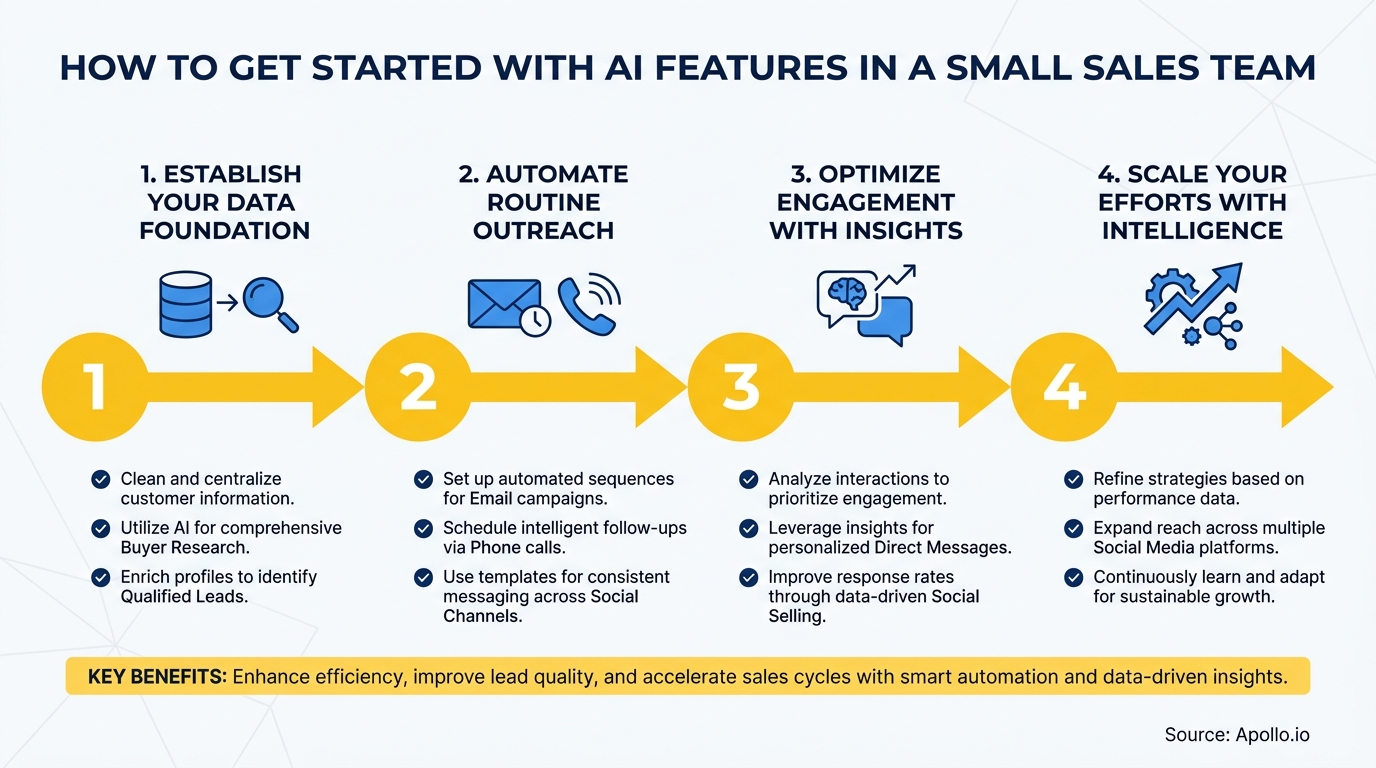
This guide gives small sales teams a practical 30-day framework to get started with AI features inside the tools you already use, starting with the work that eats your reps' time most.

Let Apollo Find Your Next Buyer
Tired of burning hours on manual research just to hit dead ends? Apollo surfaces verified contacts instantly so your reps spend time selling, not searching. Join 600K+ companies building pipeline faster.
Start Free with Apollo →Key Takeaways
- The highest-value first use case for a small sales team is AI-assisted lead research and qualification, not email writing.
- Teams using AI are significantly more likely to report revenue growth than those without it, making adoption a competitive priority.
- Start with AI features already connected to your CRM, not standalone tools that require separate workflows.
- Clean data and defined ICP criteria are prerequisites before scaling any AI feature.
- SDRs and AEs benefit most from automating non-selling tasks: research, note-taking, CRM updates, and email drafts.
What Is the Difference Between Personal AI Use and Operational AI?
Personal AI use means individual reps running ad hoc prompts; operational AI means AI features embedded in your sales workflow, triggered consistently, and measured against outcomes. The distinction matters because personal use creates inconsistent results, while operational AI compounds over time. A sales professional wrote on Reddit that their team uses ChatGPT to write outbound messages "but it's been a mixed bag" — a common symptom of personal AI use without a repeatable process behind it.
Operational AI looks different. It means AI is wired into your CRM fields, your sequences, your call summaries, and your pipeline stages. The goal is workflow coverage, not tool count.
What Should a Small Sales Team Automate First?
The best first use case for a small sales team is lead research and qualification. It is the most time-consuming pre-sales task, and it is the one where AI can act without risking a live prospect relationship. Data from Salesforce's 2024 State of Sales found that 83% of sales teams using AI saw revenue growth, compared to 66% without it — and AI adoption correlates directly with reducing non-selling work.
Prioritize these workflows in order:
- Lead research and qualification: AI agents that pull firmographic data, intent signals, and recent news before a rep ever touches a prospect.
- Call summaries and CRM updates: Auto-generated notes from recorded calls, pushed directly into contact records.
- Email drafts with human review: AI-generated first drafts that a rep edits and approves before sending.
- Meeting scheduling: AI-assisted booking that eliminates back-and-forth.
Do not automate autonomous outreach, objection handling, or pricing conversations in your first 30 days. Those require human judgment and relationship context.
Spending too much time on manual research before every call? Search Apollo's 230M+ contacts with 65+ filters and let AI surface your best-fit prospects automatically.
How Do SDRs and AEs Get Started with AI Features in 30 Days?
A 30-day rollout works best when it follows three phases: audit, pilot, and measure. Each phase builds on the last without requiring new tools or budget.
Week 1: Audit Your Non-Selling Work
SDRs should track every task they complete in a day and tag each one as either selling (prospect conversations, demos, proposals) or non-selling (research, data entry, email formatting, scheduling). Most teams find the majority of time falls into the non-selling bucket.
That gap is your AI roadmap.
- Log tasks by category for three days
- Identify the top two or three time sinks
- Check which of those tasks have an existing AI feature in your CRM or sales platform
- Define your ICP criteria in writing before enabling any AI filter or scoring model
Week 2: Pilot One AI Workflow
Pick the single highest-impact use case from your audit and run it for one week with two or three reps. For most small teams, this is call recording with AI summaries or AI-assisted lead research. A sales practitioner shared a firsthand perspective on Redditdescribing a layered workflow: AI for cold email copywriting, Perplexity for company research, a call recorder for capturing pain points, and AI agents for account qualification. That layered approach is the target state, but start with just one piece.
Weeks 3-4: Measure and Expand
For Account Executives managing active pipelines, the expansion phase should focus on pre-meeting research summaries and deal stage updates. Set a baseline metric before the pilot (time spent on research per week, emails sent per day, meetings booked per rep) and compare after two weeks.
If the pilot workflow is working, document the process and roll it to the full team.
Turn Funnel Guesswork Into Real Pipeline
Pipeline forecasting a guessing game because your leads never convert? Apollo surfaces quality prospects already showing buying signals so your funnel fills with opportunities, not noise. Top teams forecast with confidence.
Start Free with Apollo →What Is a CRM Integration Checklist for AI Features?
AI features only work as well as the data feeding them. Before enabling any AI automation in your CRM, complete this data-readiness checklist:
| Checklist Item | Why It Matters |
|---|---|
| ICP criteria defined in writing | AI scoring and filtering depends on explicit firmographic rules |
| Contact and account fields standardized | Inconsistent data produces inconsistent AI outputs |
| Lifecycle stages mapped | AI deal progression needs stage definitions to recommend next steps |
| Sales and marketing activity history connected | AI personalization requires full engagement context |
| Human review step built into AI email workflows | Prevents unreviewed AI content reaching prospects |
| AI output quality check assigned to a team lead | Maintains accuracy and brand voice standards |
Major CRM platforms including Salesforce, HubSpot, and Microsoft Dynamics are all embedding AI natively into qualification, pipeline progression, and research workflows. In May 2026, Anthropic launched a small-business offering connecting Claude to tools like HubSpot, Google Workspace, and Microsoft 365.
The trend is clear: the best AI features for small teams are the ones already inside the tools you use, not standalone apps that require separate integrations.
RevOps leaders often find the governance step is where AI rollouts stall. Assigning a single owner to review AI output quality in the first 30 days prevents bad data from compounding in your CRM.

What Is a Governance Checklist for AI Sales Features?
A governance checklist ensures AI features stay accurate, on-brand, and measurable before you scale them. Small teams do not need a formal AI policy document on day one, but they do need three things: a source-checking rule, a review loop, and a rollback plan.
- Source-checking rule: Any AI-generated fact about a prospect or company must be verified by a rep before it enters a CRM record or outbound message.
- Review loop: AI-drafted emails require one human edit before sending. AI call summaries require rep sign-off before they update the opportunity record.
- Rollback plan: If an AI feature produces consistently inaccurate outputs, define who can disable it and what the manual fallback process is.
- Usage guidelines: Document which AI features are approved for rep use, which are in pilot, and which are off-limits until further review.
This matters more than most teams realize. Forrester predicted B2B companies could face significant losses in 2026 from ungoverned generative AI use.
A simple review loop prevents the most common failure mode: AI acting autonomously with prospects before the team has validated its output quality.
How Do You Measure AI Impact on Quota Attainment?
Measuring AI impact on quota starts with setting a baseline before enabling any AI workflow. Track these metrics for two weeks before the pilot, then compare after two weeks of AI-assisted work.
- Meetings booked per rep per week (leading indicator for SDRs)
- Time from lead to first contact (measures qualification speed)
- Emails sent and reply rate (measures outreach efficiency)
- CRM field completion rate (measures data quality from AI-assisted logging)
- Pipeline coverage ratio (measures whether AI is expanding or just shifting workload)
According to Cirrus Insight, AI adoption among sales representatives rose from 24% in 2023 to 43% in 2024, nearly doubling in a single year. Teams that measure from day one will have the data to justify expanding AI to more workflows. Teams that skip measurement end up unable to prove ROI and stall at the pilot stage.
For a deeper look at how sales analytics drives revenue growth, tracking the right leading indicators from the start is what separates teams that scale AI from those that stay stuck in experimentation.
How Should Small Sales Teams Build Their AI Sales Workflow in 2026?
The right AI sales workflow for a small team consolidates tools rather than adding them. The common mistake is layering five separate AI tools on top of an existing stack, creating more context-switching and more integrations to maintain.
The smarter path is enabling AI features inside platforms you already pay for, then filling specific gaps with purpose-built tools only when the built-in options are insufficient.
Apollo's all-in-one GTM platform consolidates prospecting, outreach, AI-powered research, call intelligence, and pipeline management in a single workspace. As Cyera put it, "Having everything in one system was a game changer." For small teams under budget pressure, eliminating redundant tools while gaining AI-native workflows is the fastest path to measurable impact. To explore the AI sales tools that actually close more deals, start with platforms that connect data, outreach, and pipeline in one place.
For SDRs building outbound from scratch, the right sales automation setup paired with AI features can turn a two-person team into a high-output prospecting engine. And for teams thinking about how AI fits into a broader go-to-market motion, the sales tech stack playbook is the right starting point for scoping what to consolidate and what to cut.
Spending hours on manual outreach when you could be closing? Automate your sequences with Apollo's AI-powered sales workflows and let your reps focus on conversations that convert.

Start Building Your AI Sales Workflow Today
Getting started with AI features in a small sales team is a sequencing problem, not a technology problem. Audit your non-selling work, pick one workflow to pilot, clean your CRM data, add a human review step, and measure before you expand.
That 30-day loop is how small teams move from ad hoc AI experiments to repeatable, quota-moving workflows.
Apollo gives SDRs, AEs, and RevOps leaders everything they need in one platform: AI-powered prospecting across 230M+ contacts, multi-channel sequences, call intelligence, and pipeline management. No fragmented stack, no redundant subscriptions. Start Prospecting and see how fast your team can move when AI is built into every step of the workflow.
Prove Pipeline ROI With Apollo
ROI pressure killing your tool budget approvals? Apollo delivers measurable pipeline impact — fast. Teams like Leadium 3x'd annual revenue after switching. Start free and show results before your next review.
Start Free with Apollo →Don't miss these
Sales
Inbound vs Outbound Marketing: Which Strategy Wins?
Sales
What Is a Sales Funnel? The Non-Linear Revenue Framework for 2026
Sales
What Is a Go-to-Market Strategy? The 2026 GTM Playbook
See Apollo in action
We'd love to show how Apollo can help you sell better.
By submitting this form, you will receive information, tips, and promotions from Apollo. To learn more, see our Privacy Statement.
4.7/5 based on 9,690 reviews
