
How to Gather Feedback from Prospects to Improve Future Outreach in 2026
Most outreach optimization advice focuses on send times, subject lines, and sequence length. But the real lever is feedback: understanding why prospects respond, ignore, or disengage. Without a structured feedback system, SDRs and AEs are guessing. With one, every campaign becomes a learning loop that sharpens the next.
The challenge in 2026 is that buyers rarely tell you what they think. They self-serve, research independently, and form opinions before your first touchpoint. That means your feedback strategy needs to go beyond post-call surveys. It needs to capture behavioral signals, micro-responses, and explicit input across every channel. Pair that with smart intent data and you can turn raw prospect behavior into actionable outreach improvements.

Build Pipeline Faster With Apollo
Tired of hours lost to manual research and dead-end contact data? Apollo delivers verified contacts so your team spends time selling, not searching. Join 600K+ companies building predictable pipeline.
Start Free with Apollo →Key Takeaways
- Prospect feedback comes from three layers: explicit asks, behavioral signals, and conversation intelligence. Most teams only use one.
- A significant share of buyers never reveal their true objections to reps, making passive signal capture essential.
- Micro-surveys and one-click polls embedded in assets outperform long post-call surveys for response rate and data quality.
- RevOps teams that route feedback into CRM fields and sequence logic create compounding improvements to outreach relevance.
- Intent signals and behavioral data are replacing generic non-response analysis as the primary feedback mechanism for high-volume teams.
Why Is Prospect Feedback So Hard to Collect?
Prospect feedback is hard to collect because most buyers disengage silently rather than explain their reasoning. According to Sales Growth, 60% of buyers indicate their seller failed to uncover the true business problem, which points to a structural gap in how discovery and feedback are captured.
Three factors make feedback collection harder in 2026:
- Rep-free buying preferences: Buyers increasingly self-direct their research and evaluation without engaging reps until late in the process.
- Deliverability noise: Stricter email authentication requirements mean non-response may reflect inbox placement issues, not message-market fit.
- Content overload: Buyers cite too much available content and overly promotional messaging as reasons for tuning out, making it harder to attribute silence to any single cause.
What Are the Most Effective Ways to Gather Prospect Feedback?
The most effective ways to gather prospect feedback combine passive behavioral observation with low-friction explicit asks. No single method gives complete signal; layering them gives you a reliable picture.
| Method | Best For | Friction Level |
|---|---|---|
| One-click in-email polls | Volume sequences, cold outreach | Very low |
| Post-demo micro-surveys (1-3 questions) | AEs after discovery or demo calls | Low |
| In-asset embedded prompts | Content hubs, ROI calculators, webinars | Low |
| Conversation intelligence review | SDRs and AEs mining call transcripts | Zero (passive) |
| Behavioral signal tracking | RevOps teams identifying intent patterns | Zero (passive) |
| In-depth interviews (lost deals) | Win/loss analysis, ICP refinement | High |
As noted by Zigpoll, in-depth interviews help explore motivations, objections, and decision criteria of stakeholders, making them valuable for strategic ICP work even if they don't scale for daily outreach optimization.
Struggling to know which prospects are worth following up with? Apollo's buying intent signals surface accounts actively researching solutions like yours, so your feedback efforts focus on the right targets.

How Do SDRs and AEs Build a Practical Feedback Loop?
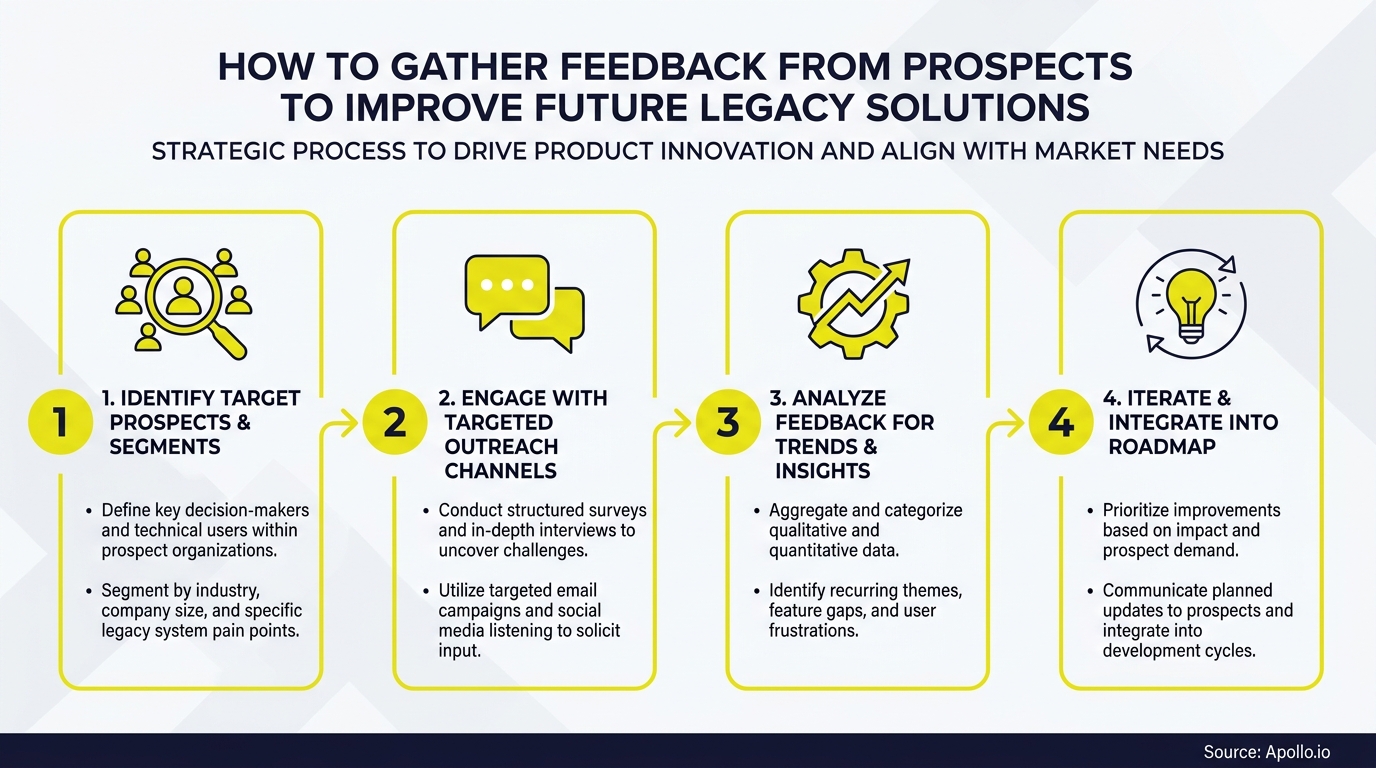
SDRs and AEs build a practical feedback loop by tagging every meaningful prospect interaction with a reason code and routing that data back into their sequence logic and messaging templates.
Here is a simple three-step loop any rep can implement:
- Capture:After each touchpoint (email reply, call, demo), log one of four outcomes: interested, objection raised, wrong timing, or no signal. Add a brief note on the specific friction or reason.
- Categorize: Group notes weekly by objection type (budget, priority, competitor, fit). This reveals patterns that individual reps miss.
- Apply: Update sequence templates and call scripts to address the top two objections from the previous week. Test the updated version against the original.
For Account Executives managing active pipeline, post-demo micro-surveys (sent within 30 minutes of the call) capture candid reactions before buyers discuss internally. Keep them to three questions maximum: what resonated, what was unclear, and what they need next to move forward.
Research from Questback confirms that listening to prospects and collecting feedback throughout their journey provides sales representatives with insight into risks such as insufficient budget, unmet expectations, and misaligned positioning, all of which can be addressed before they kill a deal.
Turn Funnel Guesswork Into Pipeline Clarity
Tired of watching marketing leads die before they ever reach your pipeline? Apollo surfaces high-intent prospects and puts sales-ready opportunities in front of your team. Join 600K+ companies forecasting with confidence.
Start Free with Apollo →How Does Behavioral Signal Capture Replace Traditional Surveys?
Behavioral signal capture replaces traditional surveys by turning every digital interaction into implicit feedback: which pages a prospect visited, which assets they downloaded, where they dropped off, and which comparisons they consumed.
This matters because buyers now use an average of ten interaction channels across their journey (McKinsey B2B Pulse, 2024). Asking them to fill out a survey after each touchpoint is unrealistic.
But instrumenting your content hub, ROI calculator, and demo follow-up page gives you continuous signal without any prospect effort.
Key behavioral signals to track:
- Content drop-off points: Where buyers stop reading or watching reveals what isn't resonating.
- Comparison page visits: Indicates active evaluation and competitive consideration.
- ROI calculator completions: High-intent signal; the inputs they use reveal their real priorities.
- Re-engagement after silence: A prospect returning to your pricing page weeks after going cold is a buying signal, not a coincidence.
Combine these behavioral signals with intent data to prioritize which accounts deserve direct follow-up and which need nurture content first.
What Feedback Templates Should SDRs Use in High-Volume Outreach?
SDRs running high-volume outreach should use three specific feedback templates: a one-click reply prompt, a single-question poll, and a breakup email with an explicit reason ask.
Template 1: One-Click Reply Prompt (mid-sequence)
Add to step 3 or 4 of a cold sequence:
"Quick question: which of these best describes where you're at? (A) Not the right time, (B) Not the right fit, (C) Still evaluating, (D) Ready to talk. Just reply with the letter."
Template 2: Post-Demo Micro-Survey (3 questions)
- What was most useful about today's conversation?
- What's your biggest remaining question or concern?
- What would need to be true for this to be a priority in the next 90 days?
Template 3: Breakup Email with Reason Ask
"I'll stop reaching out after this. If you have 10 seconds, it would genuinely help me: was it (A) bad timing, (B) not relevant, (C) already working with someone else, or (D) something else? No obligation."
Data from Leads at Scale shows that 40% of B2B marketers use audience feedback and sentiment analysis to measure thought leadership content effectiveness, reinforcing that structured feedback collection is not just a sales tactic but a broader GTM discipline.
Spending hours personalizing outreach without a feedback loop to validate what works? Apollo's multi-channel sales engagement platform lets you A/B test sequences, track reply reasons, and refine messaging from one workspace, so every campaign improves the next.
How Should RevOps Teams Systematize Prospect Feedback?
RevOps teams systematize prospect feedback by creating standardized CRM fields, routing rules, and reporting dashboards that turn individual rep observations into team-level intelligence.
A practical RevOps feedback architecture includes:
- Objection taxonomy: A closed list of 8-12 objection categories logged on every lost or stalled opportunity.
- Sequence exit tags: When a prospect exits a sequence (unsubscribe, reply, no response after final step), tag the reason. Route tagged data to a shared dashboard.
- Monthly win/loss review: Pull the top three objection categories from the previous month. Assign one content or messaging update per category.
- ICP signal scoring: Use feedback patterns to refine ideal customer profile attributes. If a particular industry or company size consistently raises budget objections, adjust targeting criteria upstream.
According to Flowlu, by 2026, 65% of B2B sales organizations are projected to shift from intuition-based to data-driven decision-making. A structured feedback system is the mechanism that makes that shift possible.
For teams looking to consolidate feedback capture, engagement tracking, and sequence management, Apollo's AI sales automation connects contact data, outreach sequences, and engagement analytics in one platform, eliminating the need to stitch together separate tools for each layer of the feedback loop.
Once you have clean feedback data flowing into your CRM, pair it with structured objection handling frameworks so reps know exactly how to respond when common objections surface live.
How Do You Turn Prospect Feedback into Better Outreach?
You turn prospect feedback into better outreach by closing the loop: feedback in, messaging update out, then test the change against a control group before rolling it out to the full sequence.
A four-week improvement cycle works well for most teams:
- Week 1-2: Collect and tag feedback from active sequences using templates above.
- Week 3: Identify the single most common friction point. Rewrite the relevant email or call script to address it directly.
- Week 4: Run the updated version alongside the original for 50 contacts each. Compare reply rates and positive response rates.
- Week 5+: Adopt the winner, archive the loser, repeat the cycle.
This approach also applies to email deliverability improvements. If feedback suggests prospects aren't seeing your messages at all, deliverability fixes belong in the same optimization cycle as messaging changes.
For deeper personalization informed by feedback, review best time to email and call prospects to layer timing optimization on top of message improvements.

Start Building Your Prospect Feedback Loop Today
Gathering feedback from prospects is not a one-time project. It is an ongoing system that makes every outreach campaign smarter than the last.
Start with one feedback template in your current sequence, route the data to a shared CRM field, and review it monthly.
Small, consistent loops compound into measurable outreach improvement over time.
Apollo gives B2B GTM teams, from SDRs to RevOps leaders, a unified workspace to run sequences, capture engagement signals, and refine messaging without managing five separate tools. As Cyera put it: "Having everything in one system was a game changer."
Start Your Free Trial and build a feedback-driven outreach system that improves with every send.
Get Pipeline ROI You Can Prove
Budget approval stuck on unclear metrics? Apollo surfaces measurable pipeline impact from day one. Leadium 3x'd their annual revenue — see your ROI before you ever talk to finance.
Start Free with Apollo →Don't miss these
Sales
Inbound vs Outbound Marketing: Which Strategy Wins?
Sales
What Is a Sales Funnel? The Non-Linear Revenue Framework for 2026
Sales
What Is a Go-to-Market Strategy? The 2026 GTM Playbook
See Apollo in action
We'd love to show how Apollo can help you sell better.
By submitting this form, you will receive information, tips, and promotions from Apollo. To learn more, see our Privacy Statement.
4.7/5 based on 9,690 reviews
