
How to Ensure Follow-Ups Are Timely Across Multiple Time Zones in 2026
Your 9 a.m. follow-up email may land in a prospect's inbox at 6 a.m. their time. That single mismatch quietly kills response rates across global pipelines. With nearly half of B2B teams now spread across different work locations, multi-time-zone follow-up isn't a remote-work edge case anymore. It's a core revenue operation. Understanding the best time to email and call prospects is now inseparable from understanding where they actually are.

Let Apollo Find Your Leads Instantly
Tired of burning hours manually researching contacts and verifying emails? Apollo delivers accurate, ready-to-contact leads so your team sells instead of searches. Join 600K+ companies building pipeline faster.
Start Free with Apollo →Key Takeaways
- "Timely" means within the recipient's local business hours, not the sender's. Define two SLA tiers: automated acknowledgment within minutes, and qualified human follow-up within their working day.
- Responding within 1 minute can lead to a 391% higher conversion rate, making speed-to-lead a revenue priority, not just a courtesy metric.
- 88% of leads expect a response within 60 minutes. Most B2B teams miss this window by hours or days.
- Volume alone doesn't fix timing. Pairing time-zone-aware automation with intent signals and account context drives results that more touches cannot.
- A follow-the-sun routing model with clear queue ownership and async handoff notes eliminates the coverage gaps that let global leads go cold.
Why Do Time-Zone Follow-Up Failures Cost Revenue?
Delayed follow-up costs revenue because buyers evaluate vendors before first contact and move quickly once active. According to Trysidekick, 88% of leads expect a response within 60 minutes, with 30% preferring one in under 15 minutes. Most B2B teams fall far short of that benchmark.
The core failure isn't effort. It's timing architecture. When a rep in New York schedules follow-ups at 8 a.m. EST, those messages hit Sydney inboxes at 11 p.m. local time. By the time the prospect starts their day, the window has closed and a faster competitor has already responded. Sales automation software built around sender-local time perpetuates this problem at scale.
Data from ainora.lt confirms that responding within 1 minute can lead to a 391% higher conversion rate. That standard is only achievable with recipient-local timing logic built into your sequences from the start.
What Is a Time-Zone-Aware Follow-Up SLA?
A time-zone-aware follow-up SLA defines two separate response tiers based on the recipient's local time, not the sender's clock. This distinction is what most teams miss.
| SLA Tier | Trigger | Target Window | Owner |
|---|---|---|---|
| Acknowledgment | Form fill, inbound signal, or reply | Within 5 minutes (automated) | Automation / AI agent |
| Qualified Handoff | Acknowledgment sent | Within recipient's next business hours | Regional rep or queue owner |
The acknowledgment SLA buys goodwill and preserves the lead while a human gets context. The handoff SLA ensures a qualified conversation happens when the prospect is actually at their desk. Pairing this with intent data lets you prioritize which handoffs are urgent versus routine.
How Does a Follow-the-Sun Routing Model Work?
A follow-the-sun model assigns lead ownership to the rep team whose business hours align with the prospect's local time, so no lead sits unworked overnight. It requires three operational pieces: territory mapping, queue ownership rules, and async handoff notes.
- Territory mapping: Segment your CRM by prospect time zone (AMER, EMEA, APAC). Tag each record with a
prospect_tzfield and map it to the appropriate regional queue. - Queue ownership: Assign a primary owner and a backup for each regional queue. Escalation triggers if no action is taken within two hours of the prospect's business day opening.
- Async handoff notes:Before end-of-day, the outgoing rep logs a brief context note in the CRM: last touchpoint, prospect's stated concern, recommended next action. The incoming rep picks up without losing context.
This directly addresses what Atlassian's 2024 State of Teams research identified: 55% of knowledge workers struggle to track down information and 50% have discovered another team was working on the same project only after the fact. Structured handoff notes eliminate both failure modes. For teams also dealing with data sync challenges across systems, solving data synchronization across multiple business systems is a prerequisite for this model to work reliably.

How Should SDRs and BDRs Sequence Follow-Ups Across Regions?
SDRs and BDRs should build sequences with recipient-local send times as the default, not an optional setting. Research shows that sales automation configured around sender-local time consistently underperforms in multi-region programs.
A practical 5-touch structure for cross-time-zone outbound:
- Day 1 (8–10 a.m. recipient local): Personalized first-touch email referencing a specific trigger or intent signal.
- Day 2 (within business hours): Automated acknowledgment if no reply, with a short value-add resource.
- Day 4: Phone call attempt during recipient's mid-morning window. Log outcome in CRM immediately.
- Day 7: Follow-up email with a different angle, not a re-send of day one.
- Day 12: Break-up message with a clear opt-out path.
Note that Yesware reports 80% of sales require five to twelve contact attempts, and only 2% of sales close on the first contact. Persistence matters, but only when each touch lands at the right local time and carries relevant context.
Spending hours manually adjusting send times for each region? Automate your multi-region sequences with Apollo's sales engagement platform and set recipient-local timing once across your entire cadence.
Turn Funnel Guesswork Into Pipeline Clarity
Forecasts feel unreliable when leads stall before they ever become opportunities. Apollo surfaces high-intent prospects and moves them forward — so your pipeline reflects reality, not wishful thinking. Trusted by 600K+ companies.
Schedule a Demo →What Automation and AI Rules Enable Time-Zone-Aware Follow-Up?
Time-zone-aware follow-up automation works by encoding recipient local time into your CRM and sequence logic, then triggering outreach only within defined local business hours. This prevents after-hours messages that feel intrusive and underperform.
Key automation rules to configure:
- Send-time override: Set sequences to deliver at 8–10 a.m. recipient local time by default. Override only when intent signals indicate urgency.
- After-hours hold queue: Any lead that enters the pipeline outside a prospect's 8 a.m.–6 p.m. local window gets queued for next-day delivery, not immediate send.
- Escalation triggers: If a prospect opens an email three or more times without replying, trigger an in-queue alert to the regional rep for same-day outreach.
- CRM field hygiene: Require
prospect_tzas a mandatory field on all contact records. Use enrichment to auto-populate from company HQ location when missing.
In 2026, AI agents are taking this further. Salesforce's March 2026 Agentforce announcement cited customers who previously took four to eight hours to follow up with leads, with AI agents closing that window to near-real-time.
The same logic applies to global coverage: agents can acknowledge, qualify, and route 24/7 while human reps handle high-value conversations during the prospect's business hours.
How Do RevOps Teams Measure Time-Zone Follow-Up Performance?
RevOps teams measure time-zone follow-up performance using a four-metric dashboard that separates speed from quality and local timing from sender timing.
| Metric | What It Measures | Target Benchmark |
|---|---|---|
| Acknowledgment time (recipient local) | Minutes from lead creation to first automated touch | Under 5 minutes |
| Qualified handoff time | Hours from acknowledgment to first human interaction | Within recipient's next business day |
| Regional reply rate | Reply rate by prospect time zone segment | Benchmark per region, review monthly |
| After-hours send rate | % of sequence touches landing outside 8 a.m.–6 p.m. local | Target under 5% |
For RevOps leaders managing global pipelines, these metrics connect directly to pipeline health. Combining this dashboard with lead scoring software lets teams prioritize which time-zone gaps to fix first based on revenue impact rather than volume.

How to Start Fixing Time-Zone Follow-Up in 2026
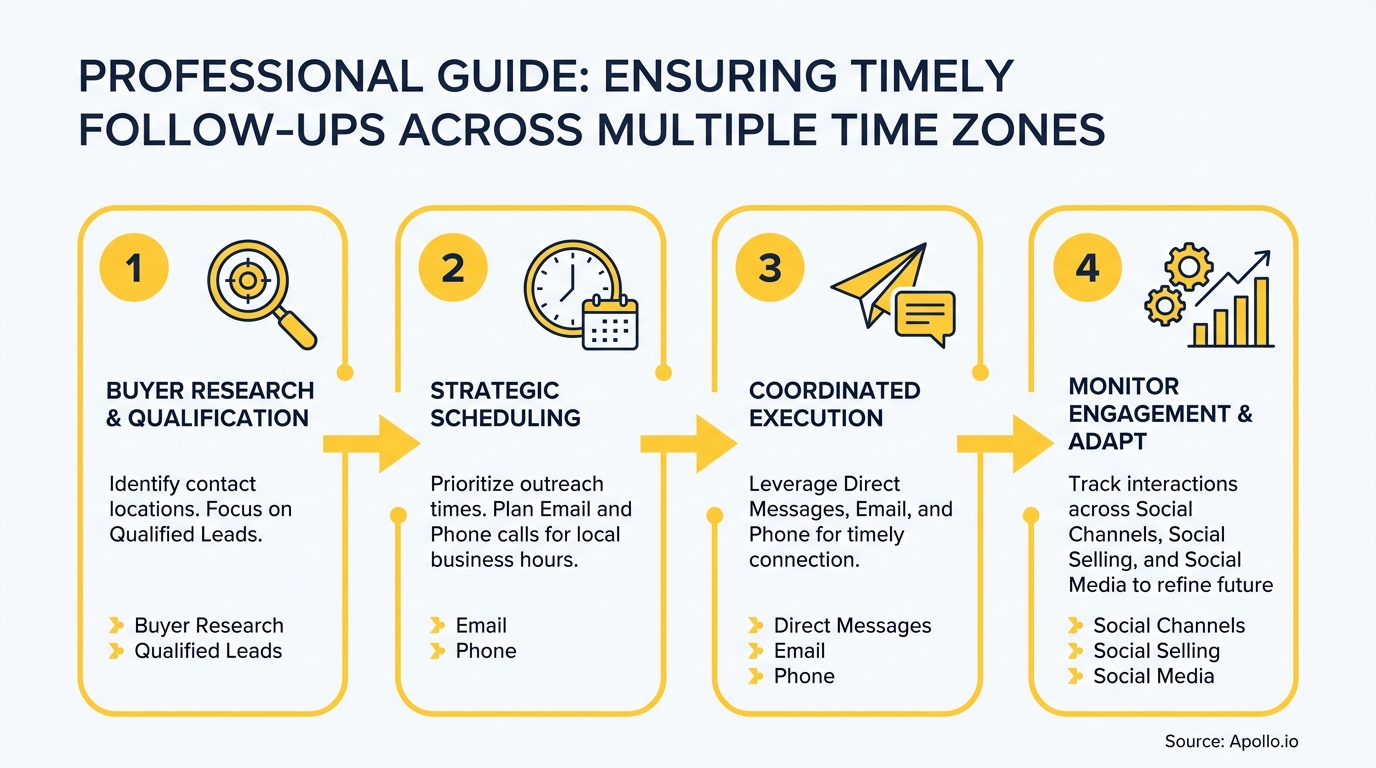
Timely cross-time-zone follow-up requires three changes working together: recipient-local send time logic, follow-the-sun queue ownership, and async handoff notes that preserve context between regional teams. None of these require a large team.
They require the right tooling and clear ownership rules.
The 6sense 2026 State of BDR Report found that outreach volume nearly doubled to about 33 touches per contact, but volume alone had no reliable relationship with quota attainment. More touches at the wrong local time won't fix a timing problem.
Smarter architecture will.
Apollo consolidates the sequence automation, contact data, pipeline tracking, and AI-powered workflows global GTM teams need into a single workspace. As Cyera put it, "Having everything in one system was a game changer." Struggling to keep multi-region follow-ups coordinated across disconnected tools? See how Apollo's AI sales automation handles time-zone-aware outreach in one unified platform.
Ready to make every follow-up land at the right time, in every region? Get Leads Now and start building time-zone-aware sequences with Apollo today.
Prove Pipeline ROI From Day One
ROI pressure killing your tool budget before you even see results? Apollo delivers measurable pipeline impact fast — 46% more meetings with AI, real wins leadership can't ignore. Start free, show value immediately.
Start Free with Apollo →Don't miss these
Sales
Inbound vs Outbound Marketing: Which Strategy Wins?
Sales
What Is a Sales Funnel? The Non-Linear Revenue Framework for 2026
Sales
What Is a Go-to-Market Strategy? The 2026 GTM Playbook
See Apollo in action
We'd love to show how Apollo can help you sell better.
By submitting this form, you will receive information, tips, and promotions from Apollo. To learn more, see our Privacy Statement.
4.7/5 based on 9,690 reviews
