
How to Ensure Consistency in Brand Tone While Personalizing Messages in 2026
AI didn't kill brand voice. Bad governance did. According to the Salesforce 2026 State of Marketing report, 75% of marketers have adopted AI, yet 84% still run generic campaigns and 78% say they need more personalized content than they can produce. The gap isn't effort. It's structure. Teams scaling outreach without a brand voice governance model end up with inconsistent tone across every channel, every rep, and every AI-generated variant. That erodes trust faster than silence.
This guide gives B2B GTM teams a practical operating model: a brand voice matrix, a consensus-first personalization framework, and AI governance gates that keep every message on-brand while still being relevant to the recipient. If you're learning how to use sales automation the right way, brand-tone consistency is the foundation everything else is built on.

Let Apollo Find Your Best Leads Fast
Tired of burning hours on manual research just to hit dead ends? Apollo surfaces verified contacts and scales your outreach instantly. Over 600K companies use Apollo to build predictable pipeline — start free today.
Start Free with Apollo →Key Takeaways
- Brand tone consistency is a revenue issue, not just a style preference. Companies with consistent brand presentation report revenue increases of 23% to 33%, per multiple industry sources.
- Role-only personalization can backfire. Gartner found buying groups are 40% less likely to complete a high-quality purchase when outreach targets only one buyer's role.
- Most AI governance lags behind AI adoption. Nearly half of B2B organizations still have no AI usage guidelines, creating serious tone-drift risk at scale.
- Consensus-first messaging reduces buying-committee conflict and improves deal quality for SDRs, AEs, and marketing teams running multi-stakeholder campaigns.
- A brand voice matrix and QA checklist let teams personalize freely within guardrails, without losing the recognizable voice that builds trust.
Why Does Brand Tone Break Down During Personalization?
Brand tone breaks down during personalization when teams prioritize variant volume over voice governance. Research from Shoutout Studio shows companies that maintain consistent brand presentation across all platforms report revenue increases of 23% to 33%. Yet most B2B teams are moving in the opposite direction: creating more variants, faster, with less review.
Three root causes drive tone drift:
- AI volume without guardrails. CMI/MarketingProfs found 81% of B2B teams use generative AI, but 45% still have no AI usage guidelines. More output, no standards.
- Fragmented data. When SDRs, marketing, and RevOps pull from different contact records, they personalize from different facts and inadvertently contradict each other.
- Role-only targeting. Gartner's 2025 research found buying groups are 40% less likely to complete a high-quality purchase when outreach is tailored only to the buyer's role. Personalization without a shared narrative fragments the committee.
The fix isn't less personalization. It's structured personalization within defined brand voice boundaries.
What Is a Brand Voice Personalization Matrix?
A brand voice personalization matrix is a two-axis framework that defines what stays fixed (brand tone principles) and what can flex (personalization variables). It gives every SDR, AE, and marketing manager a shared reference point so they can adapt messages without drifting off-brand.
| Layer | Fixed (Never Change) | Flexible (Personalize Here) |
|---|---|---|
| Tone | Confident, direct, no jargon | Formal vs. conversational by industry |
| Messaging | Core value proposition and approved proof points | Pain points and use cases by persona |
| Language | Prohibited terms, compliance constraints | Industry terminology and role-specific vocabulary |
| Structure | Opening hook, CTA format, subject line style | Body content, specific examples, context references |
Red flags that signal tone drift: competitor comparisons not in approved messaging, urgency language not in brand guidelines, claims without approved proof points, or tone that shifts from direct to apologetic under pressure.
Spending hours crafting personalized sequences only to have them sound off-brand? Apollo's multi-channel sales engagement platform lets teams build sequences with approved templates, ensuring every touchpoint stays on-brand while still reaching the right contact at the right moment.
How Do SDRs and AEs Apply Consensus-First Personalization?
Consensus-first personalization means building a shared narrative the full buying committee can align around, then layering role-specific relevance on top. Gartner's 2025 survey of 632 B2B buyers found 74% of buying teams experience unhealthy conflict during the decision process, while groups that reach consensus are 2.5x more likely to report a high-quality deal outcome.
For SDRs running multi-threaded outreach and AEs managing complex accounts, this changes how you sequence messages:
- Define the committee narrative first. What is the shared business problem every stakeholder agrees exists? Lead with that.
- Map role-specific relevance second. The CFO cares about cost. The VP of Sales cares about pipeline velocity. The IT lead cares about integration. Address each role's lens without contradicting the shared narrative.
- Use consistent proof points across all touches. If your SDR emails cite one customer outcome and the AE's deck cites a different one, the committee notices the inconsistency.
A buying-committee messaging map should list: shared narrative, role-specific pain points, approved proof points per role, and the one CTA that moves the group forward together. This is also where intent data becomes critical. Knowing which stakeholders are actively researching lets you sequence consensus-building touches at the right moment.
Turn Funnel Gaps Into Closed Deals
Pipeline forecasting a guessing game? Apollo surfaces high-intent prospects before they go cold, turning weak lead flow into a predictable revenue engine. Top GTM teams use Apollo to hit quota with confidence.
Start Free with Apollo →How Do You Build AI Governance Gates for Brand Voice?
AI governance gates are defined checkpoints in your content workflow that verify brand-tone compliance before any AI-generated message reaches a prospect. Without them, personalization at scale becomes tone drift at scale.
According to Wiserreview, 60% of companies found that brand consistency added 10% to 20% to their revenue growth. That return depends on governance infrastructure, not just good intentions.
A practical four-gate model for B2B teams:
| Gate | What It Checks | Who Owns It |
|---|---|---|
| 1. Prompt library | AI prompts use approved tone instructions and prohibited terms list | Marketing or RevOps |
| 2. Template approval | All sequence templates reviewed against brand voice matrix before activation | Content or Enablement |
| 3. Pre-send QA check | Spot-check 10% of AI-generated variants for tone, claims, and compliance | Team lead or RevOps |
| 4. Monthly audit | Review reply sentiment, unsubscribe language, and rep edits for tone drift signals | RevOps or Marketing Ops |
McKinsey's May 2026 Global B2B Pulse found that market leaders are 4x more likely to use true one-to-one personalization. The differentiator isn't more AI prompts.
It's integrated data, governance, and workflow. Your brand guide needs to become machine-readable: approved proof points, prohibited language, tone parameters, and review workflows embedded directly into your sales engagement tools, not sitting in a PDF no one opens.
RevOps leaders building this infrastructure should also review what revenue operations is and how it drives growth to understand how governance connects to pipeline performance metrics.

What Is a Tone QA Checklist for Personalized Outreach?
A tone QA checklist is a pre-send review tool that confirms each personalized message meets brand voice standards before it reaches a prospect.
Use it at the template approval stage and during spot-check audits.
- Voice check: Does the message sound like your brand, or like a generic AI output?
- Claim check: Are all statistics and proof points from the approved library?
- Tone range check: Is formality level appropriate for the recipient's industry and seniority?
- Personalization check: Is the personalized element (company name, pain point, trigger) accurate and relevant?
- Prohibited language check: Does the message contain any banned terms, unverified claims, or compliance-risk language?
- Committee alignment check: If multi-threading, does this message align with the shared narrative sent to other stakeholders?
Building a B2B email list that converts matters far less if the messages sent to that list sound inconsistent or untrustworthy. Quality of governance and quality of data are equally foundational. Need accurate contact data to personalize from? Apollo's contact enrichment tools keep your records verified so your personalization variables are always accurate, not fabricated.
How Do You Measure Brand Tone Consistency Across Campaigns?
Brand tone consistency is measurable through both qualitative signals and quantitative proxies. Tracking it regularly closes the loop between governance effort and revenue impact.
Key metrics to monitor:
- Reply sentiment ratio: Are positive replies consistent across sequences, or do certain rep variants generate more negative or confused responses?
- Unsubscribe language analysis: Phrases like "too salesy" or "doesn't feel right" are tone drift signals.
- Template deviation rate: How often are reps editing approved templates before sending? High deviation suggests templates don't fit, or governance isn't enforced.
- Multi-thread consistency score: When multiple stakeholders at one account receive outreach, do the messages share the same narrative and proof points?
For marketing leaders building a B2B marketing funnel that converts, tone consistency metrics belong in the same dashboard as open rates and conversion rates. They are leading indicators of pipeline quality, not lagging style metrics.

How Do You Scale Brand-Consistent Personalization in 2026?
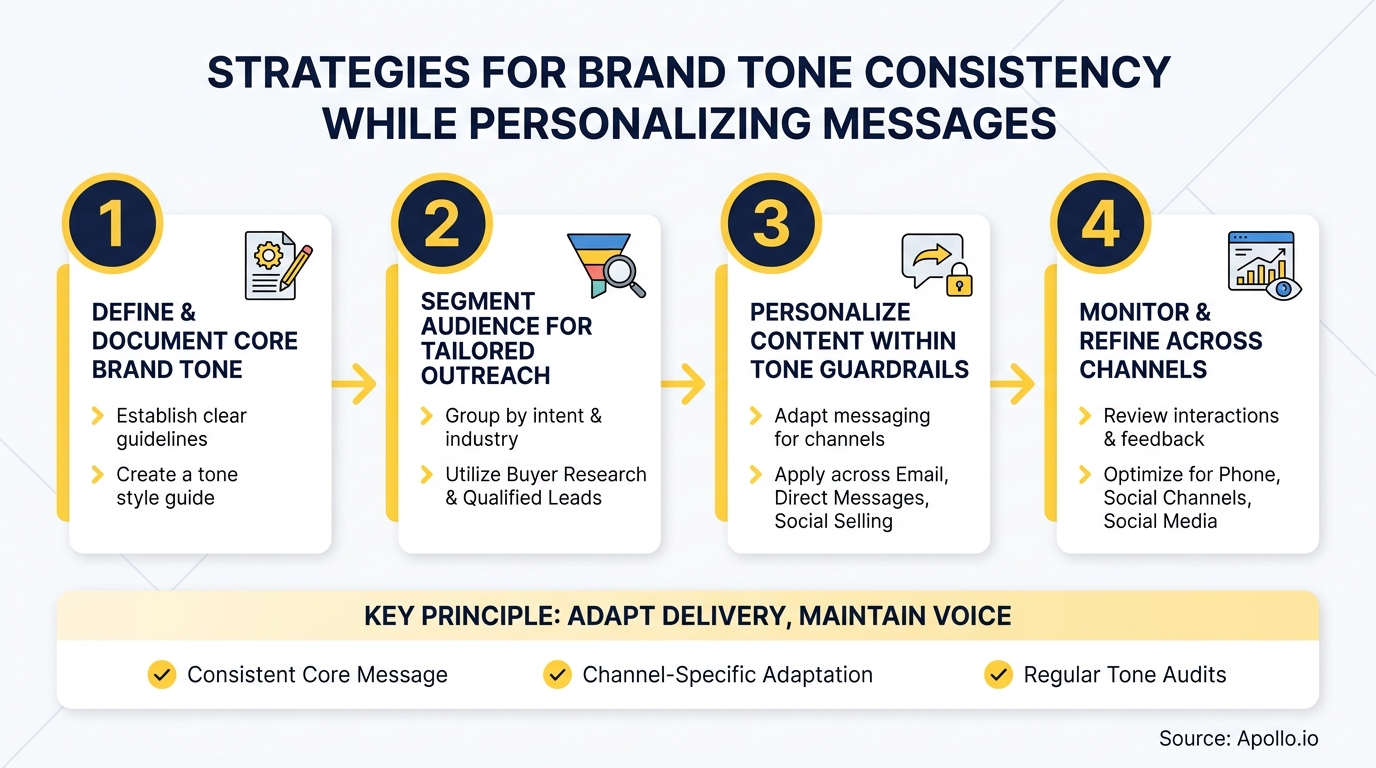
Scaling brand-consistent personalization requires treating it as a revenue-operations discipline, not a copywriting task. The framework is straightforward: fix the voice matrix, govern the AI, align the committee narrative, and audit regularly.
The business case is clear. Data from Coalition Technologies shows 80% of B2B buyers are more likely to purchase after a highly personalized experience. But personalization that fragments the buying committee or drifts off-brand erases that advantage. The goal is relevance within a recognizable, trustworthy voice, across every channel, every rep, and every AI-generated touch.
For B2B GTM teams looking to consolidate their outreach, sequencing, and data into one governed workflow, Apollo provides the all-in-one platform that replaces the fragmented stack. As Cyera put it: "Having everything in one system was a game changer." Request a demo to see how Apollo helps your team personalize at scale without losing the brand voice that earns trust.
Prove Pipeline ROI With Apollo
Budget approval stuck on unclear metrics? Apollo delivers measurable pipeline impact from day one — no guesswork, no slow ramp. Leadium 3x'd annual revenue after switching. Start free and show ROI fast.
Start Free with Apollo →Don't miss these
Sales
Inbound vs Outbound Marketing: Which Strategy Wins?
Sales
What Is a Sales Funnel? The Non-Linear Revenue Framework for 2026
Sales
What Is a Go-to-Market Strategy? The 2026 GTM Playbook
See Apollo in action
We'd love to show how Apollo can help you sell better.
By submitting this form, you will receive information, tips, and promotions from Apollo. To learn more, see our Privacy Statement.
4.7/5 based on 9,690 reviews
