

How to Customize AI Lead Scoring to Match Your Ideal Customer Profile in 2026
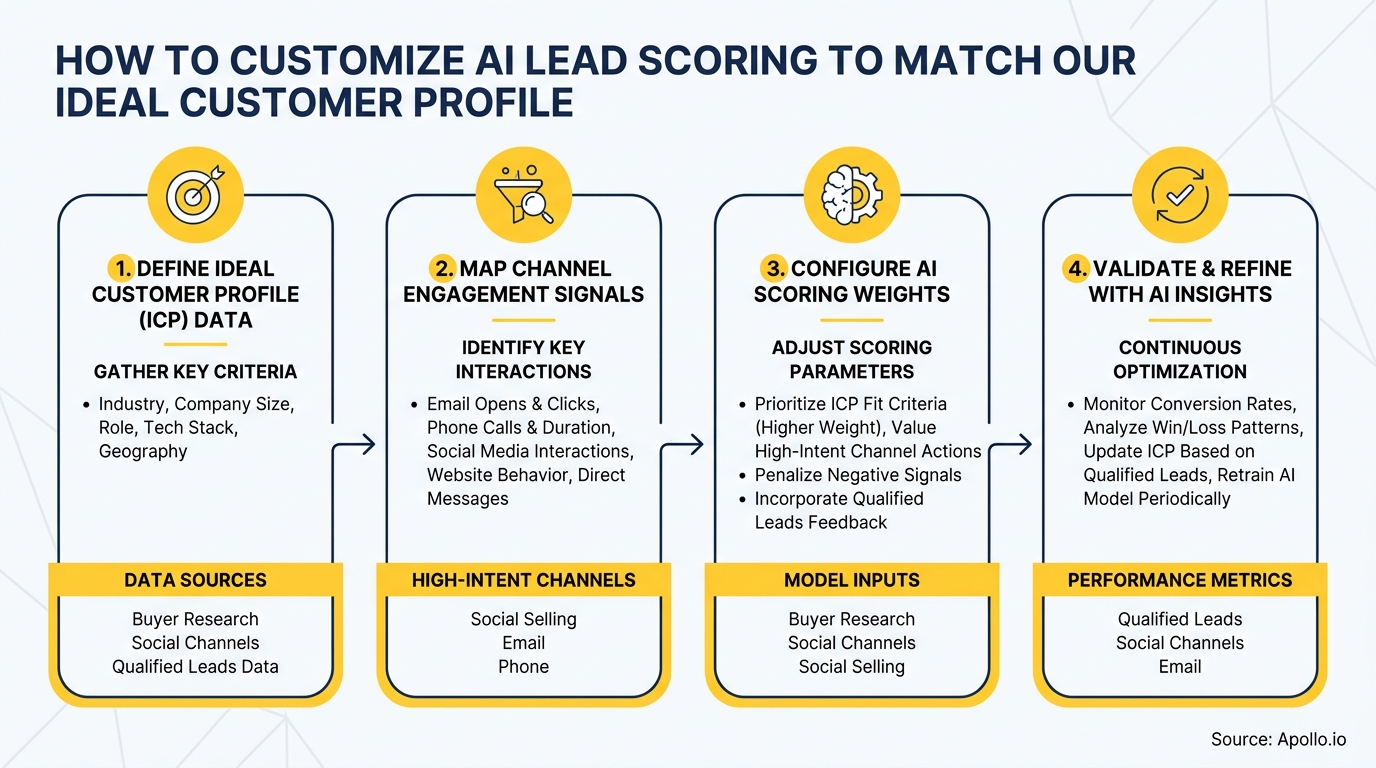
Most AI lead scoring implementations fail not because the technology is wrong, but because the model was never trained to reflect your ICP. Generic engagement scoring treats a webinar attendee from a 5-person startup the same as a VP of Sales at a 500-person SaaS company actively researching solutions. To learn what makes an ideal customer profile and why it matters before you score anything, start there. Then use this guide to turn that ICP into a working AI model.

Research Less, Close More With Apollo
Tired of burning hours on manual lead research instead of selling? Apollo surfaces verified contacts and ICP-fit prospects instantly. Join 600K+ companies turning research time into revenue.
Start Free with Apollo →Key Takeaways
- Static rule-based scoring is becoming a competitive liability — AI models that weigh fit, intent, and timing together outperform point-based systems.
- Your ICP attributes (firmographics, tech stack, buying stage, account type) must be explicitly mapped to model features before training begins.
- Negative-fit rules are as important as positive signals — disqualifying wrong-fit leads early protects SDR capacity.
- Data readiness is the real bottleneck: clean, labeled CRM records with outcome data are required before any model produces reliable scores.
- AI scoring should trigger action — routing, personalized outreach, and seller alerts — not just produce a number that sits in a dashboard.
Why Does Generic AI Lead Scoring Miss Your Best Buyers?
Generic AI lead scoring misses your best buyers because it optimizes for engagement patterns rather than ICP fit. A contact who downloads three ebooks but works at a company outside your target industry will outscore a cold but perfectly matched VP who just started evaluating vendors. Research from Tatvic shows that advanced AI and machine learning models boost the accuracy of lead qualification by 30–40% — but only when trained on the right features.
The core problem is feature selection. Out-of-the-box scoring tools use activity signals (opens, clicks, page visits) as proxies for intent.
Your ICP definition contains richer signals: industry vertical, company headcount band, revenue range, tech stack, buying committee structure, and historical closed-won patterns. Until those attributes become model inputs, you are scoring engagement, not fit.
Struggling to identify which leads actually match your ICP? Search Apollo's 230M+ contacts using 65+ filters to build a list of accounts that match your exact ICP criteria before you score a single lead.
How Do You Build an ICP-to-Model Feature Mapping Matrix?
An ICP-to-model feature mapping matrix converts each ICP attribute into a structured input field your AI scoring model can process. Start by listing every dimension of your ICP, then assign each one a feature type, weight tier, and encoding method.
| ICP Attribute | Feature Type | Weight Tier | Encoding Method |
|---|---|---|---|
| Industry vertical | Firmographic | High | One-hot encoding (target verticals = 1) |
| Employee headcount | Firmographic | High | Banded numeric (e.g., 100–500 = 1, outside = 0) |
| Annual revenue range | Firmographic | High | Banded numeric |
| Tech stack match | Technographic | Medium | Boolean (uses complementary tool = 1) |
| Lead source | Behavioral | Medium | Categorical (inbound demo = 2, content download = 1) |
| Buying stage / intent signal | Timing | High | Ordinal (active research = 3, awareness = 1) |
| Account type | Firmographic | Medium | Categorical |
| Number of stakeholders engaged | Behavioral | High | Numeric count |
Negative-fit rules belong in this matrix too. Identify the firmographic and behavioral signals that consistently predict churn or no-close — wrong geography, below minimum revenue threshold, competitor employees, single-contact accounts in a buying-committee deal — and encode them as disqualifying flags. These exclusions protect your SDR team's time as much as positive scoring improves it.
For RevOps leaders building this matrix: pull your last 12–24 months of closed-won and closed-lost data from CRM. The fields that differ most between those two groups are your highest-weight features.
This is the ICP validation step most teams skip.
Turn Weak Leads Into Pipeline Wins
Pipeline forecasting a guessing game because marketing leads never convert? Apollo surfaces ICP-fit prospects with real buying signals — so your team stops chasing dead ends. Nearly 100K paying customers trust Apollo to build pipeline that actually closes.
Schedule a Demo →How Do SDRs and RevOps Teams Use ICP Scores Differently?
SDRs use ICP scores to prioritize outreach order and personalize messaging, while RevOps teams use the same scores to set routing rules, MQL thresholds, and pipeline quality benchmarks. The score means different things at each handoff stage.
- SDRs: Sort daily prospect queues by composite ICP + timing score. High-fit, high-intent accounts get same-day outreach. Mid-fit accounts enter automated nurture sequences. Learn more about outbound prospecting strategies that pair with ICP scoring.
- AEs: Use ICP fit scores as pre-meeting intelligence. A score breakdown showing strong firmographic fit but weak buying-stage signal tells an AE to lead with discovery, not a demo.
- RevOps: Set MQL-to-SQL routing thresholds based on ICP score bands. Accounts scoring above a defined threshold route directly to an AE. Accounts below threshold enter a nurture track tied to proven prospect nurturing strategies.
- Marketing leaders: Use ICP score distributions across campaigns to measure lead quality, not just volume — the shift that justifies AI scoring investment to leadership.
According to B2B Marketing Group, Forrester reported that predictive scoring can increase sales acceptance rates by up to 35% compared to rules-based scoring. That lift depends on sales and RevOps agreeing on what a high-ICP score actually means before the model goes live.

What Data Readiness Steps Are Required Before Training Your Model?
Before training an AI lead scoring model, your CRM data must meet three readiness criteria: sufficient labeled records, clean field values, and outcome tracking. Skipping these steps produces a model that confidently scores the wrong leads.
- Minimum record volume: Aim for at least 1,000–2,000 labeled closed-won and closed-lost records with consistent field population. Models trained on sparse or inconsistently filled data amplify noise rather than signal.
- Field hygiene: Standardize categorical fields (industry, account type, lead source) before encoding. Free-text fields with 40 variants of "SaaS" cannot be modeled reliably. Use data enrichment to fill gaps in firmographic fields.
- Outcome labeling:Every record needs a ground-truth label: converted or not, and at which stage. MQL-to-SQL conversion and SQL-to-close are the two most useful outcome signals for B2B ICP scoring.
- Enrichment integration: Connect your CRM to a verified contact and company database so ICP fields like headcount, revenue, and tech stack are populated automatically, not manually entered.
Worried your contact data has too many gaps to train a reliable model? Enrich your CRM records with Apollo's verified B2B data across 65+ attributes before you build your scoring model.
How Do You Validate and Retrain Your ICP Scoring Model?
Validate your ICP scoring model by measuring whether higher-scored leads convert at higher rates through each pipeline stage — not just whether the model produces scores. A model that generates scores but does not improve MQL-to-SQL or SQL-to-close rates is not working.
Baseline and validation checklist:
- Set a pre-launch baseline: current MQL-to-SQL rate, average deal size by lead source, and SDR connect rate by segment.
- After 60–90 days, compare conversion rates for leads in the top score tier versus bottom score tier. The gap should widen over time.
- Track seller adoption: if SDRs are ignoring the score queue and working leads in their own order, the model lacks credibility — usually because scores are not explained.
- Set retraining triggers: model refresh when win rate shifts more than 10 percentage points, when a new ICP segment is added, or quarterly as a default cadence.
Explainability for sales:Black-box scores get ignored. Every scored lead should display the top three contributing factors (e.g., "Industry: SaaS / Headcount: 200–500 / Active buying signal detected"). Sellers trust scores they can interrogate. Data from InsightMark Research shows companies using AI-driven lead scoring have experienced a 51% increase in lead-to-deal conversion rates — a result that depends on sales teams actually using the scores.
For a practical foundation on the different lead scoring models available before you commit to an AI approach, review the tradeoffs between predictive, behavioral, and firmographic-first models.
How to Put It All Together: ICP Scoring as a GTM Workflow
Customized AI lead scoring produces compounding returns only when it connects to the rest of your GTM motion: enrichment, routing, sequencing, and pipeline review. A score that sits in a field no one reads is not an asset.
The winning workflow in 2026 looks like this:
- Enrich on entry: Every new lead is automatically enriched with firmographic and technographic data at the point of capture.
- Score against ICP matrix: The model evaluates fit + timing signals and assigns a composite score with visible contributing factors.
- Route by score band: High-fit leads go to SDRs for immediate outreach. Mid-fit leads enter automated sequences. Low-fit or negative-flag leads are suppressed or deprioritized.
- Trigger personalized outreach: Score tier determines messaging — ICP-matched accounts receive industry-specific sequences, not generic templates.
- Feed outcomes back to model: Closed-won and closed-lost outcomes update training data so the model improves with every cycle.
For data-driven prospectingteams, this workflow replaces three separate tools with a single connected system. As Cyera's team put it: "Having everything in one system was a game changer."
Start Scoring Leads That Actually Match Your ICP
Customizing AI lead scoring to your ICP is not a one-time configuration — it is an ongoing process of mapping attributes, cleaning data, validating outcomes, and retraining as your market evolves. The teams winning in 2026 are the ones connecting ICP definitions directly to model inputs, routing logic, and seller workflows rather than running AI scoring as a standalone experiment.
Apollo's unified GTM platform brings together the verified contact data, lead scoring software, prospecting filters, and sales engagement tools your team needs in one workspace — so your ICP scoring model has clean inputs and your SDRs have a clear action queue from day one. "We cut our costs in half" — Census. "We reduced the complexity of three tools into one" — Predictable Revenue.
Schedule a Demo to see how Apollo helps B2B GTM teams build ICP-matched scoring into a complete, consolidated pipeline workflow.
Prove Pipeline ROI With Apollo
ROI pressure killing your next tool approval? Apollo delivers measurable pipeline impact your leadership can see — fast. Leadium 3x'd annual revenue. Get results that justify every dollar.
Start Free with Apollo →Don't miss these
Sales
Inbound vs Outbound Marketing: Which Strategy Wins?
Sales
What Is a Sales Funnel? The Non-Linear Revenue Framework for 2026
Sales
What Is a Go-to-Market Strategy? The 2026 GTM Playbook
See Apollo in action
We'd love to show how Apollo can help you sell better.
By submitting this form, you will receive information, tips, and promotions from Apollo. To learn more, see our Privacy Statement.
4.7/5 based on 9,690 reviews
