
How to Coordinate Calls and Emails Around Holiday Blackouts
Sending calls and emails during holiday weeks is one of the fastest ways to burn pipeline, damage sender reputation, and frustrate prospects who are already out of office. Yet most B2B teams still rely on gut instinct rather than a structured framework to coordinate their outreach around public holidays, vacation blackouts, and OOO windows.
This guide gives SDRs, AEs, and RevOps leaders a practical, data-backed system for holiday outreach coordination in 2026, covering timing rules, sequencing playbooks, OOO routing, and the metrics that actually matter. For a deeper look at crafting messages that land, see our guide on how to write sales emails that get responses.

Research Less, Close More With Apollo
Tired of your reps burning hours on manual lead research instead of selling? Apollo surfaces verified contacts instantly so your team spends time closing, not hunting. Join 600K+ companies building pipeline faster.
Start Free with Apollo →Key Takeaways
- Holiday weeks measurably suppress reply rates and inbox placement, making timing coordination a revenue issue, not just a courtesy issue.
- OOO reply rates spike dramatically during major holidays, signaling that prospects are unavailable and sequences should pause or reroute.
- The best outreach windows are the two weeks before a major holiday and the first full week after, not the holiday itself.
- SDRs and BDRs should shift from calls to lower-friction channels during holiday blackout windows to protect connect rates and DNC compliance.
- Measuring replies, meetings booked, and inbox placement gives a more accurate holiday performance picture than open rates alone.
Why Does Holiday Timing Matter for Sales Outreach?
Holiday timing directly affects deliverability, reply rates, and pipeline quality. According to Demand Gen Report, a ZoomInfo analysis of millions of emails sent globally in 2023 found that OOO reply rates surged to 6.1% during the week of Christmas, compared to a yearly median OOO rate of 2.7%. That means more than double the normal share of your list is simply unreachable during peak holiday windows.
The problem compounds when you factor in deliverability. Sending high volumes to unresponsive inboxes signals low engagement to email providers, which can suppress your sender reputation heading into Q1.
Holiday weeks are increasingly treated as a deliverability risk, not just a response-rate risk.
Research from Smarte.pro shows that the week of Christmas experiences a staggering 78% decrease in sign rates, confirming that prospect intent collapses alongside availability during major holidays.
What Is the Holiday Blackout Calendar for B2B Outreach?
A holiday blackout calendar marks the specific weeks when B2B outreach should be paused, throttled, or redirected to lower-friction channels. These windows vary by region, industry, and prospect territory.
| Period | Risk Level | Recommended Action |
|---|---|---|
| Dec 23 – Jan 1 | High | Pause sequences; switch to nurture emails only |
| Nov 27 – Dec 1 (Thanksgiving week, US) | High | Throttle calls; shift to email with low-friction CTAs |
| Late June – Early July (Summer + US Independence Day) | Medium | Reduce cadence frequency; monitor OOO reply rates |
| Memorial Day week (US) | Medium | Avoid Monday; compress sequence to Tue–Thu |
| School holiday weeks (varies by region/territory) | Low–Medium | Adjust based on territory-level OOO data |
A Reddit user shared a firsthand perspectivethat resonates with sales planning: mapping holidays in January and working backward to find bridgeable gaps can turn just two PTO days into a ten-day absence window. The same logic applies to your prospects: a cluster of public holidays plus adjacent vacation days can hollow out an entire target account's decision-making team for two weeks.
How Should SDRs Adjust Their Sequencing Around Holidays?
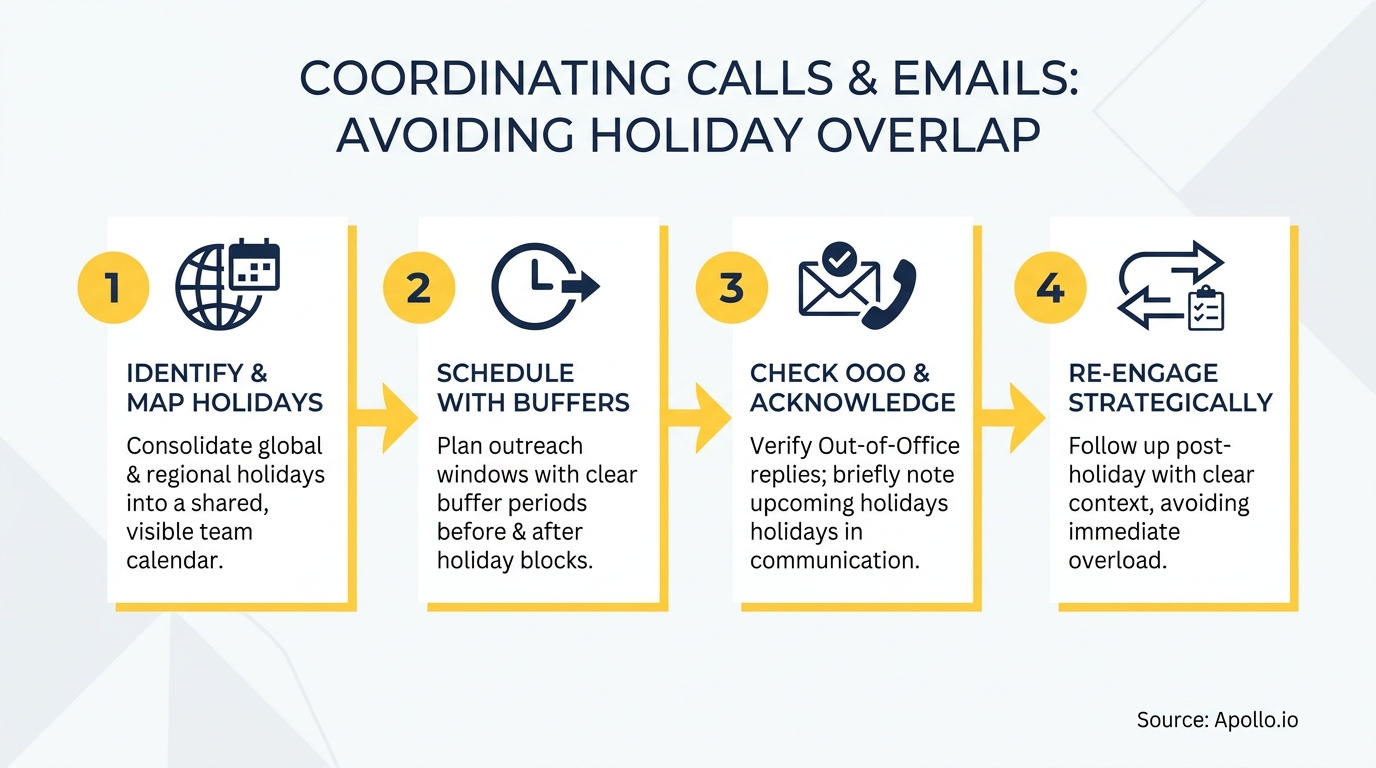
SDRs should compress their active outreach into the two weeks before a holiday and the first full week after it, treating the holiday window itself as a planning and prep period rather than an active prospecting window.
Use this week-by-week framework:
- T-2 weeks (pre-holiday): Accelerate outreach. Send pre-holiday emails with concise, valuable messages. Per Salaria Sales, reaching out before major holidays with concise, valuable messages captures attention before prospects take leave.
- T-1 week (shoulder period): Throttle call volume. Switch to email-only sequences. Avoid Friday sends as inboxes wind down.
- Holiday week: Pause active sequences. Monitor OOO replies and tag contacts for post-holiday re-engagement.
- T+1 week (post-holiday return): Re-engage with a warm, context-aware follow-up. Reference the time gap naturally without being pushy.
For calls specifically, SDRs should avoid holiday-adjacent Mondays and Fridays. Data from Bika.ai confirms that Mondays and Fridays are often less effective for broad outreach, with inboxes crowded on Mondays and recipients winding down on Fridays. During holiday weeks, this effect intensifies.
Struggling to manage multi-channel sequences without overlap? Apollo's sales engagement platform lets you build holiday-aware sequences with automatic pausing and channel switching built in.
Turn Funnel Gaps Into Pipeline Gold
Tired of watching marketing leads stall before they ever reach your pipeline? Apollo surfaces in-market buyers the moment they're ready, so your team stops guessing and starts closing. Nearly 100K paying customers trust Apollo to build predictable pipeline.
Start Free with Apollo →How Do You Handle OOO Replies Without Losing the Lead?
OOO replies should trigger an automatic pause in your sequence and a tag or task for re-engagement after the contact's stated return date. Failing to handle OOO replies means sending additional touches to someone who cannot respond, which wastes credits, annoys prospects, and hurts deliverability.
A practical OOO routing system has three components:
- Detection: Flag OOO replies automatically in your engagement platform. Most modern platforms support this natively.
- Pause: Stop all sequence steps for that contact until their return date plus one business day.
- Re-engage: Resume with a warm, brief touchpoint referencing their absence window. Keep it low-pressure.
A Reddit user wrote on Reddit about managing scheduling overlaps by sending only three calendar slots per request and blocking them with placeholder holds, then releasing unused slots within 24 hours. The same principle applies to sales: limit your active touchpoints during uncertain availability windows, and build in a quick release mechanism when the window closes.
For AEs managing active deals, OOO periods are also a good time to advance intent data research on the account so you re-enter the conversation with stronger context.

What Are the Right Metrics to Track During Holiday Outreach Periods?
Reply rate, meetings booked, and inbox placement are the right metrics to track during holiday windows. Open rates are increasingly unreliable because a large share of opens are generated by email privacy proxies rather than real human engagement.
| Metric | Why It Matters During Holidays | What to Watch For |
|---|---|---|
| Reply rate | Direct signal of real engagement | Drop signals high OOO rate; pause sequences |
| OOO reply rate | Measures prospect unavailability | Spike above 4% = pause and reroute |
| Inbox placement rate | Low engagement can suppress deliverability | Monitor for drops; reduce send volume |
| Meetings booked | The ultimate conversion signal | Prioritize pre- and post-holiday booking windows |
RevOps leaders should set a holiday-period baseline in their dashboards by comparing the same weeks year-over-year. This lets you distinguish a genuine pipeline slowdown from expected seasonal noise, and helps you build the case for adjusting team targets during blackout periods. Good email deliverability practices become even more critical during holiday periods when engagement naturally dips.
How Can RevOps Build Enforceable Holiday Guardrails in Their Tech Stack?
RevOps teams can enforce holiday outreach rules by configuring blackout dates, scheduled-send defaults, and OOO detection rules directly inside their sales engagement platform, rather than relying on individual rep discipline.
Key configuration steps:
- Blackout dates: Block specific holiday weeks at the sequence level so steps cannot fire during restricted windows.
- Scheduled sends: Pre-schedule post-holiday re-engagement emails to land on the first Tuesday or Wednesday after the holiday ends. Research from Salesforge.ai confirms that evenings, weekends, and holidays typically see lower engagement for B2B outreach, reinforcing the value of scheduling sends for optimal mid-week windows.
- Territory calendars: Build region-specific holiday rules for global teams. A US Thanksgiving blackout should not apply to prospects in EMEA.
- Call routing rules: Suppress autodial lists for territories observing a public holiday on that calendar date.
Want to stop reps from accidentally firing sequences into holiday blackout windows? Apollo's AI sales automation lets teams build sequence rules with built-in scheduling controls, OOO handling, and multi-channel orchestration in one platform.As Cyera put it: "Having everything in one system was a game changer."
Pairing these guardrails with strong sequence diagnostics ensures your sender reputation stays protected even when volume fluctuates across holiday periods.

How Do You Build a Smarter Holiday Outreach Strategy in 2026?
The smartest holiday outreach strategy in 2026 treats holiday windows as a planning asset rather than a lost week. Compress your active sequences into the pre- and post-holiday windows, use the quiet period to enrich data and build stronger messaging, and return with context-aware outreach that acknowledges the gap.
Quick-reference checklist for every major holiday:
- Mark blackout weeks in your engagement platform at least 30 days in advance
- Front-load outreach two weeks before the holiday window opens
- Set OOO detection to auto-pause and tag affected contacts
- Suppress call lists for territories observing the holiday
- Schedule post-holiday re-engagement to land Tuesday or Wednesday of the return week
- Review reply rate and inbox placement, not just open rates, to assess performance
- Debrief after each major holiday window and update your territory calendar for next year
For email personalizationthat cuts through post-holiday inbox clutter, lead with relevance: reference a recent trigger, acknowledge the time gap briefly, and make the ask small. The goal is a reply, not a close, on that first post-holiday touch.
Holiday coordination is ultimately a systems problem. The teams that get it right are not relying on individual reps to remember blackout dates. They have built the rules into their engagement platform, their CRM, and their weekly RevOps cadence. Try Apollo free and build holiday-aware sequences, OOO routing, and multi-channel orchestration in one unified workspace.
Prove Pipeline ROI With Apollo
Budget approval stuck on unclear metrics? Apollo delivers measurable pipeline impact from day one — so you walk into every renewal conversation with hard numbers. Leadium 3x'd their revenue. You're next.
Start Free with Apollo →Don't miss these
Sales
Inbound vs Outbound Marketing: Which Strategy Wins?
Sales
What Is a Sales Funnel? The Non-Linear Revenue Framework for 2026
Sales
What Is a Go-to-Market Strategy? The 2026 GTM Playbook
See Apollo in action
We'd love to show how Apollo can help you sell better.
By submitting this form, you will receive information, tips, and promotions from Apollo. To learn more, see our Privacy Statement.
4.7/5 based on 9,690 reviews
