
How to Capture Prospect Responses and Move Them in the Sales Pipeline
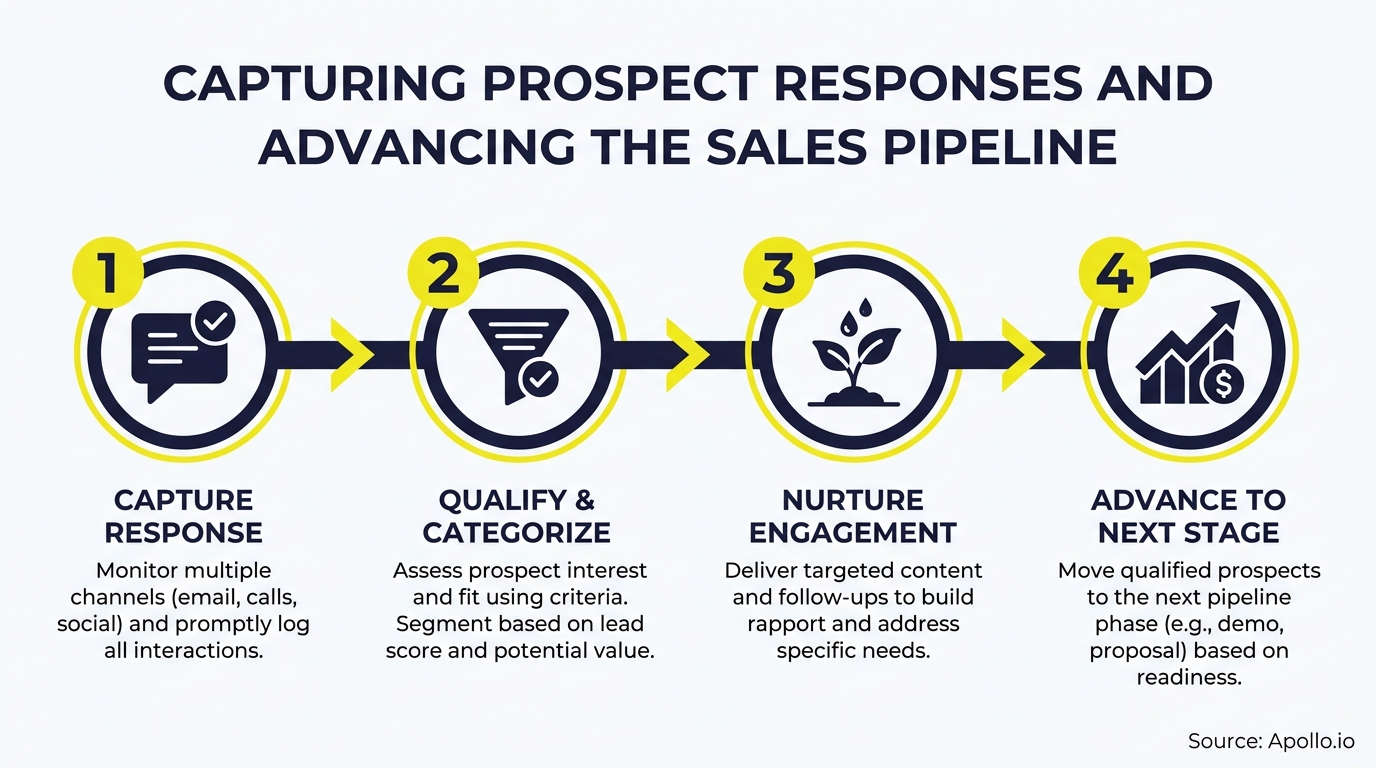
Most pipeline leakage happens after a prospect responds, not before. SDRs and AEs spend hours generating replies, then lose deals because those signals never get properly captured, routed, or acted on. Understanding the sales acceleration formulastarts with one principle: every response is a revenue signal that needs a next step within minutes, not days.
According to Trysidekick, responding after 5 minutes reduces the odds of qualifying a lead by 80%. Yet most teams lack the systems to act that fast across every channel.

Research Less. Pipeline More With Apollo.
Tired of your reps burning hours verifying contact info instead of closing deals? Apollo surfaces accurate, ready-to-contact leads instantly. Join 600K+ companies turning research time into revenue.
Start Free with Apollo →Key Takeaways
- Speed-to-next-step matters more than speed-to-first-response: automate task creation and stage changes the moment a reply lands.
- B2B buyers now engage across email, chat, social, events, and forms — capture systems must unify all channels into one CRM timeline.
- Post-SAL leakage is a structural problem: define stage-entry criteria, handoff SLAs, and required CRM fields to stop deals from stalling.
- Signal-based prioritization (intent + engagement + enrichment) is replacing static lead scoring for pipeline movement decisions.
- Consolidating prospecting, engagement, and pipeline tracking into one platform removes the routing gaps that kill conversion.
Why Do Prospect Responses Get Lost Before Reaching the Pipeline?
Responses get lost because most GTM teams use disconnected tools with no unified routing logic. An email reply lands in a rep's inbox, a form fill sits in a marketing queue, and a chat message times out — none of them automatically trigger a CRM stage change or next task.
Research from Influ2 shows that 53% of companies experience a broken handoff between marketing and sales, where prospects engaging with ads are never followed up on by sales. That gap costs pipeline at the top of every funnel.
The fix is systematic: define what a "captured response" means for each channel, map it to a CRM field, and trigger a workflow automatically. Manual hand-raising and rep memory are not a pipeline process.
What Channels Require Response Capture Systems in 2026?
Every channel where a prospect can signal interest needs a defined capture-and-route workflow. In 2026, B2B buyers interact across more touchpoints than ever, making fragmented capture a critical revenue risk.
| Channel | Response Signal | CRM Action |
|---|---|---|
| Email sequences | Reply, click, OOO | Pause sequence, create task, log sentiment |
| Web forms | Form submission | Create contact, assign owner, trigger nurture |
| Live chat / chatbot | Conversation started | Route to rep or book meeting directly |
| Phone / voicemail | Callback request, live answer | Log call outcome, update stage |
| Social / events | DM, comment, badge scan | Enrich contact, add to sequence |
Struggling to keep all these signals organized? Apollo's multi-channel sales engagement platform unifies email, phone, and social responses into one workspace so no signal gets missed.
How Do SDRs and AEs Move a Response into an Active Pipeline Stage?
SDRs move responses into the pipeline by qualifying the signal, enriching the contact record, and triggering a stage-entry action within a defined SLA. AEs then take ownership once a meeting is booked or a qualification threshold is met.
A sales professional wrote on Redditthat their cadence includes 11 calls, 5 emails, and 2-3 social messages in a month, all automated: "I've gotten people on the first call. I've also scheduled meetings after 13 touches. If the prospect is a key decision maker, keep going until you've gotten a hard no." The key word is automated — manual tracking at that volume fails.
For AEs managing active opportunities, sales analytics tied to stage movement data tells you which response types convert and which stall. Use that data to set realistic stage-entry criteria and coach reps accordingly.
Stage-entry checklist for SDRs:
- Response type logged (positive, neutral, objection, timing)
- Contact enriched with title, company size, and intent signals
- Next step created with due date within 24 hours
- Opportunity owner assigned
- Sequence paused or branched based on reply sentiment
Turn Weak Funnels Into Qualified Pipeline
Pipeline forecasting a guessing game? Apollo surfaces high-intent prospects the moment they're ready to buy. 600K+ companies use Apollo to convert more leads into real opportunities.
Start Free with Apollo →What Is the Post-SAL Anti-Leakage Framework?
The post-SAL anti-leakage framework is a set of required CRM fields, handoff SLAs, and stage-entry criteria that prevent qualified responses from stalling after Sales Accepts a Lead. Most pipeline leakage occurs at this exact handoff point.
Data from Salesgenieconfirms the alignment stakes: companies where sales and marketing are highly aligned have 19% faster growth and 15% more profitability. The handoff is where alignment either holds or breaks.
Required CRM fields at SAL stage:
- Response source (channel + campaign)
- Pain point or use case mentioned
- Decision-maker confirmed (yes/no)
- Timeline indicator (now, 30-90 days, future)
- Next meeting date or follow-up task deadline
RevOps leaders find that enforcing field completion at stage transitions (not just at close) is the single highest-leverage change for improving pipeline accuracy. Build required fields into your CRM stage gates so reps cannot advance a deal without capturing the signal data.

How Can RevOps Use Automation to Prevent Pipeline Drop-Off?
RevOps prevents pipeline drop-off by automating the "time-to-next-step" metric: the elapsed time between a prospect response and the creation of the next rep action. This replaces the old SLA of "time-to-first-response" with a more precise, downstream measure.
Conversation intelligence is now a first-class pipeline signal, not just call recording. Teams convert call transcripts, objections, and stated timelines into structured CRM fields that trigger stage changes and coaching workflows automatically.
AI agents draft follow-up emails and suggest stage updates, but RevOps must define governance rules: what the system can update automatically versus what requires human approval before it affects forecast data.
When a prospect says "let me think about it," that response needs a defined workflow, not a rep's judgment call. A sales professional shared on Reddita direct script: "When my clients say they need to think about it, they either have questions I haven't answered yet, or they're trying to say no nicely. Is there something I can explain better? Or are you genuinely not interested?" That script surfaces real intent and gives the CRM a definitive signal to act on.
Can't track deals effectively across your team? Apollo's deal management tools give RevOps and sales leaders full pipeline visibility with automated stage tracking.
What Metrics Prove That Response Capture Is Working?
The metrics that prove response capture is working are reply-to-task time, reply-to-meeting time, reply-to-stage-change time, and ultimately, response-sourced pipeline as a percentage of total pipeline. Vanity metrics like open rate and reply rate are insufficient without downstream stage movement data.
| Metric | What It Measures | Target |
|---|---|---|
| Reply-to-task time | Speed of next action after response | Under 30 minutes |
| Reply-to-meeting rate | % of positive replies that book | Benchmark against your segment |
| SAL-to-SQL conversion | Post-handoff qualification rate | Track trend, not absolute |
| Stage velocity | Average days per pipeline stage | Identify stall points by stage |
| Response-sourced revenue | Closed-won tied to captured responses | Primary attribution metric |
For teams building outbound motions, outbound prospecting guides that include reply-rate benchmarks help set realistic targets. Pair those benchmarks with your CRM stage data to identify where the pipeline actually breaks.

How Do You Build a Response-to-Pipeline System That Scales?
A scalable response-to-pipeline system combines unified capture across all channels, automated routing rules, defined stage-entry criteria, and a single platform that connects prospecting data to pipeline outcomes. The goal is to eliminate the gaps between tools where signals get dropped.
Understanding the difference between sales and marketing workflows is the starting point for designing handoff rules that actually hold. Once those rules are defined, the platform choice determines whether they scale.
"Having everything in one system was a game changer" — Cyera. "We reduced the complexity of three tools into one" — Predictable Revenue. Apollo consolidates prospecting, multi-channel engagement, conversation intelligence, and pipeline tracking into one workspace, removing the routing gaps that kill conversion between tools.
Trusted by nearly 100K paying customers including Anthropic, Smartling, and Redis, Apollo gives B2B GTM teams from startups through enterprise the unified platform needed to turn every prospect response into a tracked pipeline movement.
Ready to capture every response and move it through your pipeline without switching tools? Start prospecting free with Apollo and build a response-to-pipeline system that scales.
Prove Pipeline ROI With Apollo
ROI pressure making every tool renewal a battle? Apollo delivers measurable pipeline impact your leadership can see — faster meetings, higher win rates, real numbers. Join 600K+ companies that made the business case stick.
Start Free with Apollo →Don't miss these
Sales
Inbound vs Outbound Marketing: Which Strategy Wins?
Sales
What Is a Sales Funnel? The Non-Linear Revenue Framework for 2026
Sales
What Is a Go-to-Market Strategy? The 2026 GTM Playbook
See Apollo in action
We'd love to show how Apollo can help you sell better.
By submitting this form, you will receive information, tips, and promotions from Apollo. To learn more, see our Privacy Statement.
4.7/5 based on 9,690 reviews
