
How to Balance Outbound Activities with Responding to Inbound Leads in 2026
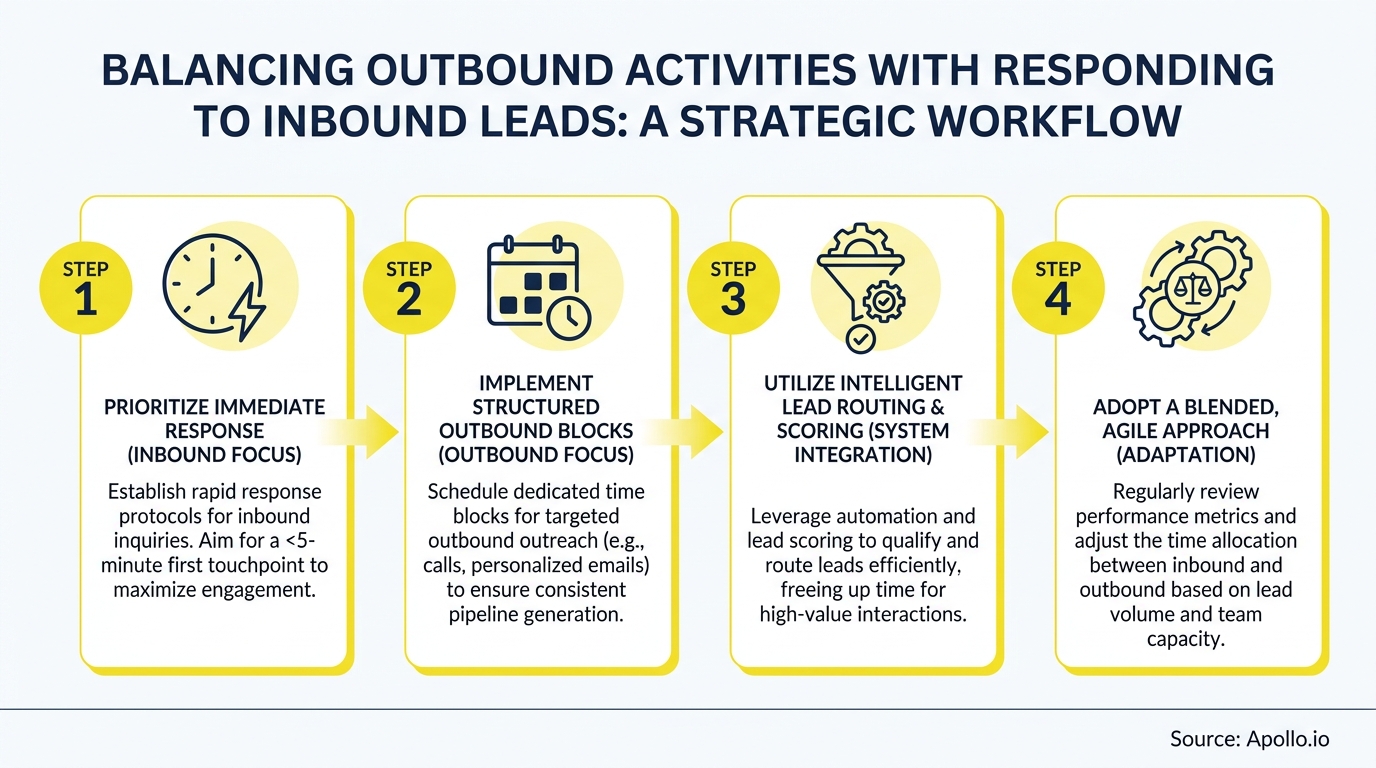
Most B2B sales teams treat inbound and outbound as competing priorities. They shouldn't. The real problem is workflow fragmentation: reps context-switching between reactive inbound follow-up and proactive outbound prospecting with no system governing either. The result is slow lead response, inconsistent pipeline, and quota risk on both sides.
The fix is an operating model, not a time-management tip. This guide gives you the mechanics: SLA thresholds, triage logic, daily structure, and automation levers that let your team do both without sacrificing either. For a broader strategic lens, see our breakdown of inbound vs. outbound marketing.

Research Smarter, Not Harder With Apollo
Tired of hours lost chasing down contact info before a single email goes out? Apollo surfaces verified contacts instantly so your reps spend time selling, not searching. Join 600K+ companies building pipeline faster.
Start Free with Apollo →Key Takeaways
- Responding to inbound leads within 5 minutes dramatically outperforms waiting even 30 minutes — speed-to-lead is the single highest-leverage inbound lever.
- Protecting daily outbound time beats sporadic prospecting bursts: consistent habits produce significantly more prospecting hours per year.
- Tech stack fragmentation is a hidden revenue killer — unified platforms eliminate the context-switching that degrades both inbound response speed and outbound throughput.
- SDRs and AEs need separate operating rhythms: SDRs own triage and first-touch SLAs; AEs own qualification depth and deal progression.
- Signal-based prioritization is replacing static lead lists — the best teams work a unified next-best-action queue, not two separate inbound/outbound lists.
Why Is Balancing Inbound and Outbound So Hard?
Balancing inbound and outbound is hard because both motions compete for the same scarce resource: rep time. Inbound demands immediate response; outbound demands consistent daily execution.
Without a governing system, inbound urgency always wins — and outbound slowly dies.
The data makes the cost of inbound neglect clear. According to DemandLocal, leads contacted within 5 minutes are 21 times more likely to convert and 100 times more likely to qualify compared to those contacted after 30 minutes. Miss that window and your inbound investment is largely wasted. At the same time, abandoning outbound whenever inbound spikes creates pipeline valleys two quarters later.
The underlying structural issue is tool fragmentation. When inbound alerts live in one system, outbound sequences in another, and contact data in a third, reps spend time navigating tools instead of selling.
This is the compounding tax that makes both motions underperform simultaneously.
What Is the Right Speed-to-Lead SLA?
The right speed-to-lead SLA is under 5 minutes for high-intent inbound leads during business hours. Research from Sidekick confirms that responding after 5 minutes can decrease the odds of qualifying a lead by 80%. That threshold should be treated as a hard operational floor, not a best-effort target.
Use this tiered SLA framework based on lead intent:
| Lead Type | SLA Target | Response Owner |
|---|---|---|
| Demo request / pricing page | <5 minutes | SDR or AI first-touch |
| Content download / webinar signup | <1 hour | Automated sequence + SDR follow-up |
| Newsletter / top-of-funnel | <24 hours | Automated nurture sequence |
| Re-engagement / cold inbound | Next business day | SDR outbound sequence |
Meeting these SLAs consistently requires routing automation, not heroics. Inbound form submissions should auto-enrich, auto-route, and trigger an immediate first-touch task or automated message — without waiting for a rep to notice a CRM notification. Apollo's inbound form optimization handles enrichment and routing in real time, so your SLA clock starts from submission, not from when someone checks their queue.

How Do SDRs Protect Outbound Time Without Dropping Inbound SLAs?
SDRs protect outbound time by time-blocking it as a non-negotiable calendar commitment, separate from inbound monitoring windows. The two activities require different cognitive modes; mixing them degrades both.
A sales professional wrote on Reddit that doing 30 minutes of prospecting every day produces roughly 130 hours of outbound activity per year, while doing 2-hour bursts only at the end of each quarter yields just 40 hours annually. Consistency compounds. Protect the daily block.
A practical daily structure for SDRs managing both motions:
- 8:00–9:00 AM: Inbound triage — respond to overnight and pre-work submissions within SLA
- 9:00–11:00 AM: Outbound prospecting block — protected, no inbound interruptions
- 11:00 AM–12:00 PM: Inbound follow-up round two + sequence tasks
- 1:00–3:00 PM: Calls, demos, and AE handoffs
- 3:00–4:00 PM: Outbound research and sequence building for next day
Struggling to keep outbound sequences running while managing inbound volume? Automate your outbound sequences with Apollo so prospecting continues even during inbound-heavy days.
Turn Funnel Guesswork Into Pipeline Clarity
Pipeline forecasting a guessing game because leads stall before they ever reach your AEs? Apollo surfaces high-intent prospects and moves them faster from first touch to real opportunity. Nearly 100K paying customers stopped flying blind.
Start Free with Apollo →How Should RevOps Teams Build the Inbound-Outbound Workflow?
RevOps teams should build a unified work queue that combines inbound triage tasks and outbound sequence steps into a single prioritized view — eliminating the cognitive overhead of managing two separate systems. Signal-based prioritization, not list-based assignment, is the modern standard.
According to Surface, 78% of customers purchase from the business that responds first. This means routing and prioritization logic are revenue infrastructure, not admin work. RevOps leaders should own this architecture.
Core workflow components RevOps must configure:
- Auto-enrichment on inbound submission: Append firmographic and technographic data before the lead reaches a rep
- ICP scoring at intake: Automatically tier leads so reps know which get the 5-minute response versus the 1-hour nurture
- Outbound sequence triggers from inbound signals: When a target account visits a pricing page, auto-enroll the outbound contact in a higher-priority sequence
- Unified task queue: One view showing both inbound follow-up tasks and outbound sequence steps, prioritized by signal strength
For building the outbound side of this system, see how to build winning outbound sales cadences. For the inbound side, Apollo's inbound lead conversion tools give RevOps teams the routing and enrichment infrastructure to make SLAs achievable at scale.
How Does Intent Data Change the Inbound-Outbound Balance?
Intent data changes the balance by collapsing the distinction between inbound and outbound — a prospect researching your category is functionally a warm lead even if they haven't filled out a form. Acting on intent signals early is how outbound motions convert at inbound rates.
Data from 6sense's 2025 B2B Buyer Experience report shows that the point of first seller contact has shifted roughly 6 to 7 weeks earlier in the buying journey compared to 2024. Buyers are still initiating most conversations, but they're doing so earlier. Outbound teams that use intent data can reach those buyers before they submit a form to a competitor.
A sales rep shared a firsthand perspective that focusing on fewer, higher-quality opportunities — even at the cost of overall conversion rate — made a significant difference in outcomes. Intent signals are the filter that makes that selectivity systematic rather than arbitrary.
What Tools Help Teams Run Both Motions Without Adding Stack Complexity?
The tools that best support both inbound and outbound motions are unified GTM platforms that handle prospecting, engagement, enrichment, and pipeline tracking in a single workspace. Adding separate point solutions for each motion creates the exact fragmentation that destroys SLA performance.
Apollo consolidates the core tools most B2B teams currently run separately: a 230M+ contact database for finding high-quality buyer leads, multi-channel engagement sequences, inbound form enrichment, intent signals, and deal management — all in one platform. As Cyera noted, "Having everything in one system was a game changer," and Census reported cutting costs in half after consolidating their stack.
Key capabilities for running both motions from one platform:
- Inbound: Auto-enrich form submissions, score against ICP criteria, route to the right rep, trigger immediate first-touch
- Outbound: Build targeted prospect lists, launch multi-channel sequences, track engagement signals, prioritize follow-up by intent
- Shared infrastructure: One contact record, one activity timeline, one pipeline view — no data reconciliation between tools
Spending too much time switching between tools to manage both inbound and outbound? Apollo's AI sales automation runs both motions from a single workspace, so your team stays in flow instead of context-switching.

How to Start Balancing Inbound and Outbound Today
Balancing inbound and outbound starts with one diagnostic question: what percentage of your inbound leads receive a response within 5 minutes? If that number is below 50%, fixing your response infrastructure will generate more revenue than any new outbound campaign.
From there, work through this prioritized action list:
- Audit your current SLA performance by lead source and time-of-day — identify where leads are falling through
- Set up auto-enrichment and routing so high-intent leads never wait in a queue
- Time-block outbound prospecting as a protected daily calendar commitment for every SDR
- Consolidate your inbound and outbound tools into a unified platform to eliminate context-switching
- Add intent signals to your outbound targeting so you're reaching buyers who are already in-market
The teams that win in 2026 aren't choosing between inbound and outbound — they're running both from a single, automated, signal-driven system. For a deeper look at building this infrastructure, explore how to build a B2B marketing funnel that converts and how to use sales automation the right way.
Ready to run inbound and outbound from one platform without adding complexity? Schedule a Demo and see how Apollo unifies your entire GTM motion.
Prove Pipeline ROI With Apollo
ROI pressure killing your next tool renewal? Apollo delivers measurable pipeline impact so you can walk into budget reviews with hard numbers. Leadium 3x'd their revenue — your CFO conversation just got easier.
Start Free with Apollo →Don't miss these
Sales
Inbound vs Outbound Marketing: Which Strategy Wins?
Sales
What Is a Sales Funnel? The Non-Linear Revenue Framework for 2026
Sales
What Is a Go-to-Market Strategy? The 2026 GTM Playbook
See Apollo in action
We'd love to show how Apollo can help you sell better.
By submitting this form, you will receive information, tips, and promotions from Apollo. To learn more, see our Privacy Statement.
4.7/5 based on 9,690 reviews
