
How to Automate Report Generation Using Data from Both CRM and the Sales Platform
Most B2B revenue teams are sitting on two separate data universes: their CRM holds deal records and contact history, while their sales platform captures sequences, calls, meetings, and engagement signals. Neither system tells the full story on its own. Manual exports and copy-paste dashboards create a governance nightmare and a reporting lag that costs quota attainment. Learning how to use sales automation the right way starts with connecting these two data sources into a single, trustworthy reporting pipeline.
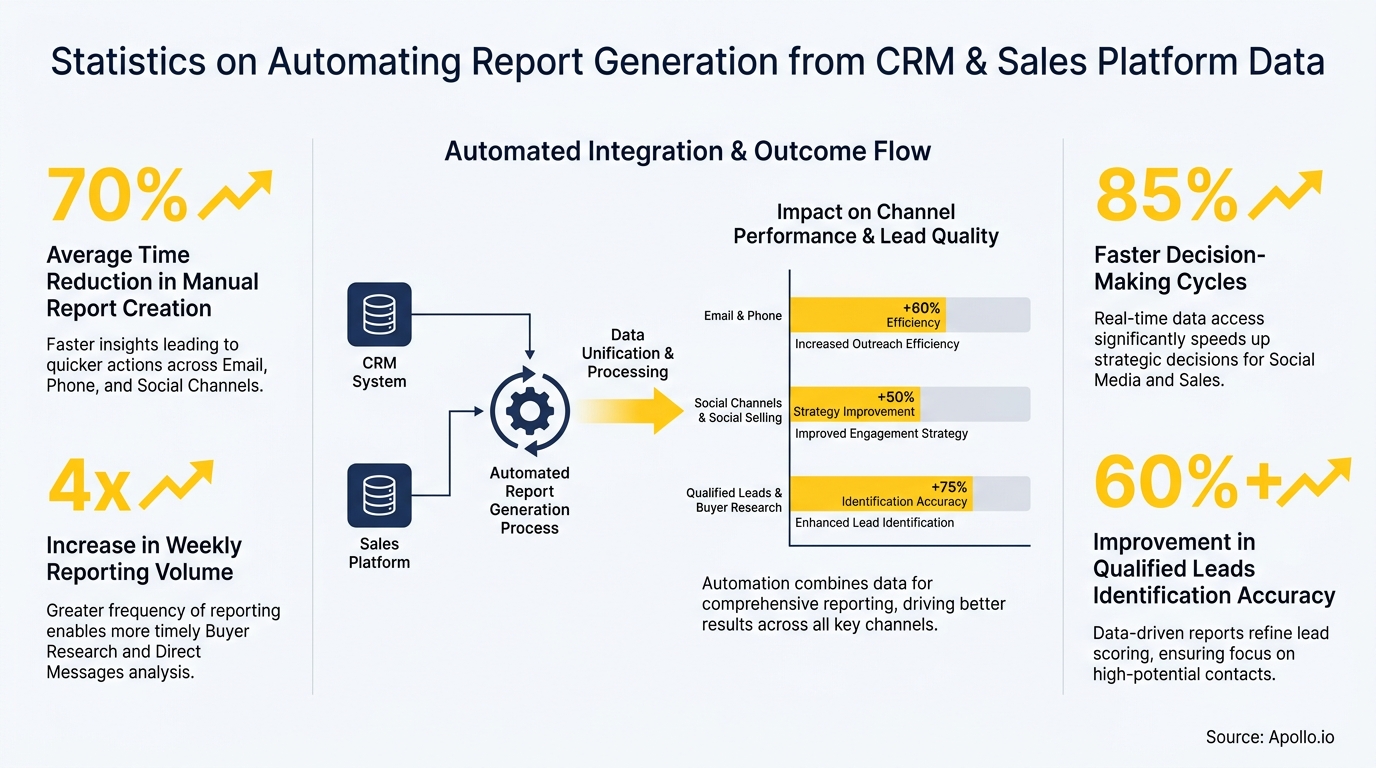
According to Awebautomate, 85% of businesses leveraging CRM automation report a dramatic surge in operational efficiency. The opportunity is clear. The challenge is doing it without creating new data quality problems in the process.

Research Less, Close More With Apollo
Tired of burning hours hunting down contact info that's already outdated? Apollo delivers verified emails and direct dials so your team sells instead of searches. Join 600K+ companies building pipeline faster.
Start Free with Apollo →Key Takeaways
- Automated cross-platform reporting requires a defined source-of-truth architecture before any scheduling or AI layer is added.
- Data quality is the primary bottleneck: governance and field mapping must come before automation.
- RevOps leaders who connect CRM and sales engagement data unlock executive KPIs that neither system can produce alone.
- AI-generated report summaries require human validation workflows, not blind trust.
- Gartner's May 2026 research found sales organizations providing AI-enabled next-best actions are 2.6x more likely to achieve commercial growth, making automated reporting a direct growth lever.
Why Does Cross-Platform Report Automation Fail?
Cross-platform report automation fails primarily because the CRM and the sales platform use different data models, object IDs, and sync cadences, producing conflicting numbers that no one trusts. Gartner's 2024 sales analytics survey found 84% of sales leaders said analytics had less influence on performance than expected, with poor data quality cited as a top barrier by 44% of respondents.
The most common failure points:
- Duplicate contact records across CRM and sales engagement inflate activity counts
- Mismatched deal stages between systems create forecast discrepancies
- Undefined field ownership means the same field gets written by two systems simultaneously
- No reconciliation schedule leaves stale data sitting in reports for days
Understanding how data sync improves B2B sales and marketing ROI is the prerequisite for any automation project. Fix the plumbing before adding the analytics layer.
What Is the Reference Architecture for CRM and Sales Platform Reporting?
The reference architecture for automating reports across CRM and sales platform data uses a central landing zone (data warehouse or reverse-ETL layer) where both systems write, rather than each system querying the other directly.
| Layer | Function | Common Tools |
|---|---|---|
| Source connectors | Pull CRM objects and sales engagement events on a defined cadence | Native sync, Fivetran, Census |
| Landing zone / warehouse | Unified schema where both data sets are normalized | Snowflake, BigQuery, Redshift |
| Transformation layer | Applies business logic, deduplication, and field mapping | dbt, custom SQL |
| Reporting / BI layer | Scheduled report generation and distribution | Tableau, Looker, native dashboards |
| AI summary layer | Draft narrative summaries, flag anomalies, suggest actions | LLM APIs with human approval gate |
For teams using Apollo, the Apollo CRM integration with Salesforce and HubSpot provides native bi-directional sync, reducing the connector layer complexity significantly.
How Do You Build a Data Contract Between CRM and the Sales Platform?
A data contract is a formal agreement defining which system owns each field, how often it syncs, and what happens when values conflict. Without one, automated reports inherit every data quality problem from both systems simultaneously.
Data contract checklist for RevOps teams:
- Field ownership table: For each shared field (e.g., company name, deal stage, last activity date), designate one system as the source of truth
- Sync cadence:Define real-time vs. batch sync per object (contacts: real-time; deals: every 15 min; activity logs: hourly)
- Conflict resolution rule: Specify which system wins on a write conflict (usually CRM wins for deal data; sales platform wins for activity data)
- Null handling: Define whether a blank field in one system overwrites a populated field in the other
- Audit log requirement: Every sync event writes a timestamp and source identifier to a log table
Building a solid data enrichment strategy alongside your data contract prevents stale or incomplete records from degrading your automated reports over time.

How Do RevOps Leaders Automate Reports with Built-In QA?
RevOps leaders automate cross-platform reports with quality assurance by embedding automated checks directly into the pipeline before any report is distributed. Research from Cirrus Insight shows organizations implementing comprehensive automation frameworks report 25-50% increases in productivity, but only when the underlying data is validated.
QA automation layer: what to build
- Row count checks: Flag reports where record counts deviate more than 10% from the prior period without a known cause
- Null rate thresholds: Alert when key fields (email, deal stage, close date) exceed a defined null percentage
- Duplicate detection: Run deduplication logic before report generation, not after
- Anomaly detection: Flag statistical outliers in pipeline value, activity volume, or conversion rates for human review
- Rollback triggers: If QA fails, the prior validated report version is distributed with a data-quality warning attached
Struggling to keep pipeline data clean and actionable? Get complete pipeline visibility with Apollo's deal management, where CRM and engagement data stay in one validated workspace.
Turn Funnel Gaps Into Qualified Pipeline
Pipeline forecasting a guessing game because quality leads never convert? Apollo surfaces in-market buyers with precision targeting so your funnel fills with opportunities, not noise. 600K+ companies forecast with confidence.
Schedule a Demo →How Should SDRs and AEs Use Automated Reports Without Losing Trust in the Data?
SDRs and AEs should treat automated reports as a starting point for action, not a final answer, using a validation-first workflow that flags low-confidence outputs before they influence decisions. Kixie reports that 90% of knowledge workers say automation improved their jobs, but trust requires knowing when automation is wrong.
AI-safe reporting workflow:
- LLMs draft, humans approve: Use AI to generate narrative summaries and flag pipeline risks, but require a RevOps or sales manager sign-off before board-level distribution
- Confidence scoring:Attach a data completeness score to each report section (e.g., "Pipeline forecast: 94% field coverage" vs. "Sequence attribution: 61% field coverage")
- Separate computed metrics from AI narratives: Hard numbers (ARR, win rate, deal velocity) come from the validated warehouse layer, not from LLM inference
- Audit trail: Every AI-generated summary logs the source data snapshot it used, enabling retroactive verification
For SDRs, the most actionable automated reports surface next-best-action alerts: accounts with intent signals but no recent outreach, deals stalled beyond the average sales cycle, or contacts missing from CRM after a meeting was logged. This aligns with Gartner's May 2026 finding that sales organizations providing AI-enabled next-best actions are 2.6x more likely to achieve commercial growth. Understanding how intent data powers smarter B2B sales helps teams prioritize which alerts deserve immediate action.
What KPIs Should Automated Cross-Platform Reports Cover?
Automated cross-platform reports should cover KPIs that neither the CRM nor the sales platform can produce independently, specifically metrics that connect activity inputs to revenue outcomes.
| KPI | CRM Field | Sales Platform Field | Report Output |
|---|---|---|---|
| Sequence-to-opportunity rate | Opportunity created date, source | Sequence enrollment, reply date | % of sequences that generated a CRM opportunity |
| Deal velocity by outreach channel | Deal stage, close date | Touch channel (email, call, social) | Average days to close by first-touch channel |
| Rep activity-to-quota coverage | Quota, pipeline value | Emails sent, calls made, meetings booked | Activity volume required per $1 of pipeline coverage |
| Forecast risk score | Close date, deal stage, amount | Last engagement date, sentiment | Deals at risk due to engagement gap or stage stall |
For Account Executives managing active pipelines, the forecast risk score is the highest-value automated report: it surfaces deals that look healthy in the CRM but show zero engagement activity in the sales platform. Connecting Apollo with HubSpot and Salesforce gives AEs this cross-system view without manual data reconciliation.
How Do You Get Started Automating CRM and Sales Platform Reports in 2026?
Start automating cross-platform sales reports by completing these steps in order, not in parallel. Skipping the data contract phase to jump straight to scheduling is the most common mistake.
- Audit both systems: Document every shared field, its current owner, and its null rate
- Write your data contract: Define source-of-truth rules, sync cadence, and conflict resolution for each shared object
- Build or configure your connector: Native integrations (like Apollo's CRM integration) reduce setup time; warehouse-based approaches give more control
- Add QA checks before scheduling: Row counts, null thresholds, and duplicate detection run before any report is distributed
- Schedule and distribute: Set report cadence by audience (daily for SDRs, weekly for managers, monthly for executives)
- Add AI summaries with approval gates: AI drafts the narrative; a human approves before external or executive distribution
Teams that consolidate their GTM stack reduce the complexity of this process significantly. As Predictable Revenue put it: "We reduced the complexity of three tools into one." Apollo's unified platform keeps contact data, sequence activity, CRM sync, and pipeline data in one workspace, so the cross-platform reporting problem becomes a single-platform reporting problem. Spending too much time reconciling data across disconnected tools? Explore Apollo's AI sales automation to unify your GTM data and reporting in one place.

Start Reporting on Revenue, Not Just Activity
Automating report generation from both CRM and sales platform data is a governance project first and a technology project second. Teams that define field ownership, build data contracts, and add QA before scheduling reports will produce outputs their executives trust.
Teams that skip those steps will automate noise.
Apollo's all-in-one GTM platform consolidates prospecting, engagement, CRM sync, and pipeline data in a single system, cutting the source-mapping complexity that slows most RevOps automation projects. Trusted by nearly 100K paying customers including Anthropic, Cyera, and DocuSign, Apollo gives revenue teams the unified data foundation that makes automated reporting actionable.
Schedule a Demo and see how Apollo consolidates your GTM data for reports that drive revenue decisions.
Prove Pipeline ROI Before Next Quarter
ROI pressure killing your tool budget? Apollo delivers measurable pipeline impact from day one — faster time-to-value than any point solution. Teams like Leadium 3x'd revenue. See your ROI now.
Schedule a Demo →Don't miss these
Sales
Inbound vs Outbound Marketing: Which Strategy Wins?
Sales
What Is a Sales Funnel? The Non-Linear Revenue Framework for 2026
Sales
What Is a Go-to-Market Strategy? The 2026 GTM Playbook
See Apollo in action
We'd love to show how Apollo can help you sell better.
By submitting this form, you will receive information, tips, and promotions from Apollo. To learn more, see our Privacy Statement.
4.7/5 based on 9,690 reviews
