
How to Align Sales Outreach with the Buyer's Decision-Making Process in 2026
Your buyer has already chosen a favorite before your SDR ever sees the account. According to Highspot, around four out of five (81%) B2B buyers already have a preferred vendor before they speak to sales reps. That means most outreach arrives too late, too generic, or both. Aligning sales outreach with how buyers actually decide is no longer optional. It is the difference between being considered and being ignored.

Research Less, Close More With Apollo
Tired of your reps burning hours hunting down contact info instead of selling? Apollo surfaces verified contacts instantly so your team spends time closing, not researching. Join 600K+ companies building pipeline faster.
Start Free with Apollo →Key Takeaways
- Most of the buyer's decision happens before your first outreach, so pre-contact content visibility is as important as the sequence itself.
- The average buying group now includes 13 people, meaning role-specific messaging and committee enablement assets are essential for deals to move.
- Irrelevant outreach actively damages supplier relationships, making relevance filtering and message governance non-negotiable.
- Buyers prefer digital self-service but still turn to sellers for validation, risk reduction, and internal consensus support at critical moments.
- Sales and marketing alignment produces measurably better close rates, and unified platforms accelerate that alignment.
What Does Decision-Stage Sales Outreach Actually Mean?
Decision-stage sales outreach means delivering the right message at the right moment based on where a buyer is in their internal decision process, not where they are in your CRM funnel. The buyer's journey has three distinct phases that require different outreach goals.
| Buyer Stage | What Buyers Are Doing | Outreach Goal |
|---|---|---|
| Problem Recognition | Researching symptoms, building internal case | Build awareness through content, social proof, peer channels |
| Solution Evaluation | Comparing vendors, defining requirements | Provide comparison, ROI proof, and risk reduction assets |
| Validation and Decision | Securing internal consensus, engaging procurement | Enable champion with business case, stakeholder-specific proof |
Research from Corporate Visions shows that buyers still largely or fully define their purchase requirements 83% of the time before speaking with sales. Your outreach must influence that definition phase, not just respond after it.
How Do SDRs Avoid Triggering the Irrelevant Outreach Penalty?
SDRs avoid irrelevant outreach by filtering on behavioral and firmographic signals before sending a single message. A May 2026 Gartner survey found that 67% of B2B buyers prefer a rep-free experience, but 69% still turn to sales reps to validate AI-generated insights. The implication: outreach should not try to insert sellers everywhere. It should appear when buyers need validation, fit assessment, or internal consensus support.
Use this three-question relevance filter before any contact attempt:
- Signal: Is there a behavioral trigger (content engagement, intent data, hiring signal, product trial)?
- Fit: Does the account match your ICP on firmographic, technographic, and timing criteria?
- Value: Can you offer information the buyer cannot easily find through self-service research?
If the answer to any of these is no, hold the outreach. Intent data is the fastest way to upgrade signal quality and stop burning contact capacity on accounts that are not yet in-market.
Spending hours building sequences manually? Automate stage-specific sequences with Apollo's multi-channel sales engagement platform and let intent signals trigger the right message at the right moment.
Turn Funnel Guesswork Into Qualified Pipeline
Tired of watching marketing leads stall before they ever reach your pipeline? Apollo surfaces verified, in-market contacts so your team acts on real buying signals — not gut feel. Nearly 100K paying customers stopped guessing and started closing.
Start Free with Apollo →How Do You Build a Buying Committee Alignment Kit?
A buying committee alignment kit is a set of role-specific outreach messages, internal-selling collateral, and objection-handling assets designed for each stakeholder in the purchasing group. According to The Growth Syndicate, the average B2B buying group now includes 13 people. A single generic sequence cannot serve all of them.
Build your kit around four stakeholder types:
- Champion (usually your primary contact): ROI narrative, competitive comparison, implementation timeline
- Economic Buyer (CFO, VP Finance): Total cost of ownership, payback period, risk mitigation summary
- Technical Evaluator (IT, Security, RevOps): Integration specs, security documentation, data governance details
- Procurement: Vendor comparison matrix, compliance checklist, contract flexibility terms
For AEs managing complex deals, equip your champion with a pre-built internal email template they can forward to each stakeholder type.
This is buyer enablement: making internal selling easier so the deal does not stall during consensus building.
Research from SalesGrowth found that 86% of B2B purchases stall during the buying process.
Most stalls happen at the consensus stage, not during initial evaluation.

How Do You Maintain Message Consistency Across the Buyer Journey?
Message consistency means every touchpoint, from your website to a sales call to a follow-up email, tells the same story with the same proof points. A June 2025 Gartner report found that 69% of B2B buyers report inconsistencies between supplier website information and seller-provided information.
That gap destroys trust before a deal even starts.
A practical message governance checklist for RevOps and sales leaders:
- Audit your top five outreach sequences against current website claims and pricing
- Create a shared objection-handling document that sales, marketing, and CS all reference
- Lock approved proof points (customer ROI quotes, case study metrics) in your sales engagement platform
- Review for consistency every time a product update or pricing change goes live
Platforms that unify prospecting, sequencing, and analytics in one workspace make this governance dramatically easier. As Cyera noted: "Having everything in one system was a game changer." Sales analytics built into the same platform where reps execute outreach closes the loop between what marketing publishes and what sales says.
How Do You Make Outreach AI-Ready for the Modern Buyer?
AI-ready outreach is structured so that both human buyers and AI research tools can extract, verify, and summarize your key claims. Forrester's 2026 buyer insights confirmed that genAI is fundamentally changing how buyers discover, evaluate, and purchase, with nearly all B2B buyers expecting to use AI to support their decision process.
If AI tools cannot find consistent, specific, verifiable content about your solution, you lose the shortlist before a conversation ever starts.
Structure your buyer-facing content using this framework:
- ROI Proof: Specific, attributed customer outcomes (linked to case studies, not paraphrased)
- Comparison Clarity: Published feature comparisons with clear differentiation statements
- Risk Reduction: Trial access, security documentation, implementation guides available without a sales call
- FAQ Coverage: Answers to integration, pricing, onboarding, and support questions in scannable, citable format
Your follow-up outreach should reference and reinforce what buyers find through AI-mediated research, not contradict it. This is where the consistency work from the prior section pays off directly. Learn how to operationalize this with Apollo's guide to selling with AI.
How Does Sales and Marketing Alignment Improve Close Rates?
Sales and marketing alignment improves close rates by ensuring outreach content, timing, and messaging reflect what buyers are actually researching, not what the sales team assumes they need. Data from Soproshows companies are 67% better at closing deals when sales and marketing are aligned. The mechanism is simple: aligned teams produce consistent content, better-timed outreach, and shared intelligence that reduces wasted contact attempts.
Practical alignment touchpoints for revenue leaders:
- Weekly pipeline reviews that include content performance data alongside deal stage movement
- Shared ICP definition updated quarterly based on closed-won and closed-lost analysis
- Joint ownership of the buying committee kit so marketing produces assets sales actually uses
- A single platform for prospecting, sequencing, and reporting so both teams see the same data
Struggling to find qualified accounts that match your ICP at the right buying stage? Search Apollo's 230M+ contacts with 65+ filters to target accounts showing active buying signals.

How Do You Put This Into Practice in 2026?
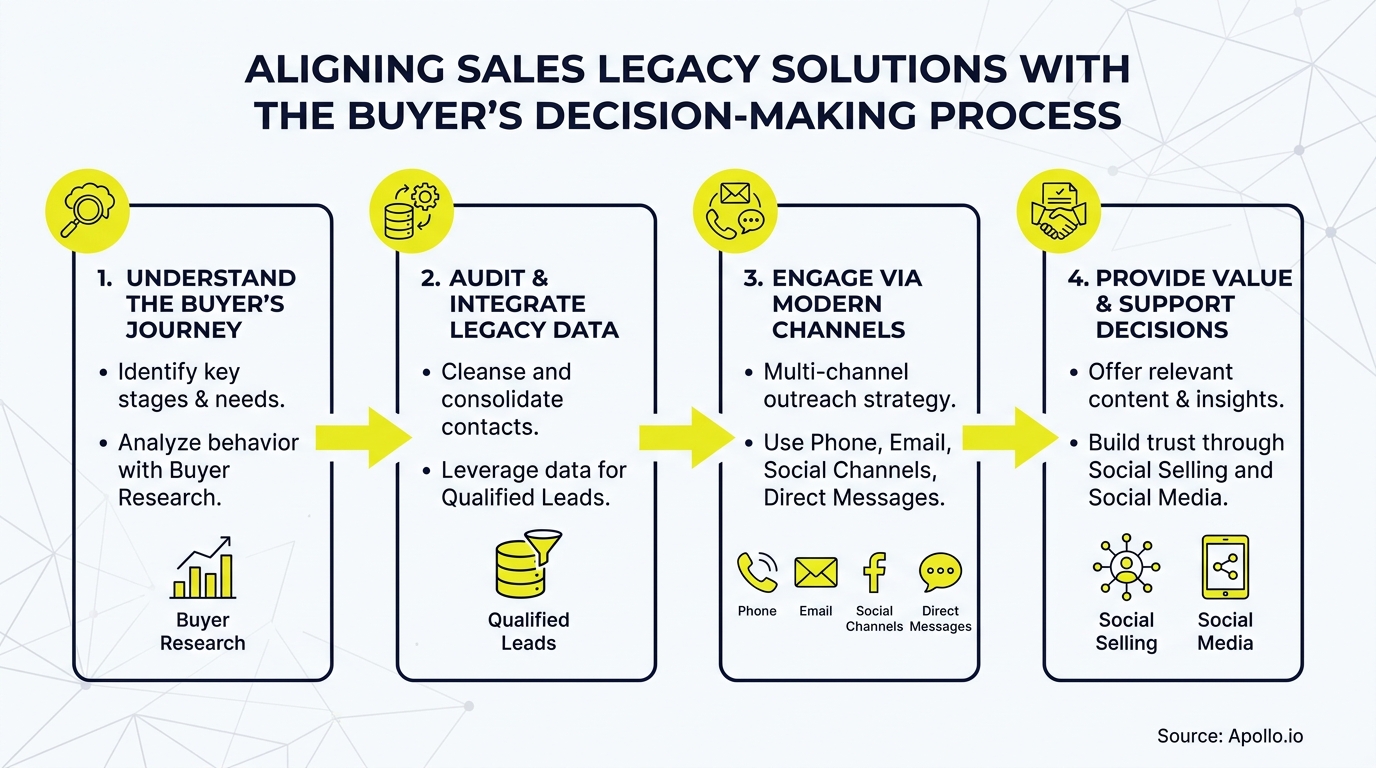
Aligning sales outreach with the buyer's decision-making process requires four operational changes: map outreach to decision stages, build role-specific committee kits, enforce message governance, and structure content for AI-mediated discovery. None of these require a complete process overhaul.
They require a unified system where prospecting data, outreach execution, and analytics live in one place.
Teams that consolidate these functions stop the message drift that costs deals at the consensus and validation stages. As Predictable Revenue put it: "We reduced the complexity of three tools into one." The result is faster ramp, better alignment, and outreach that meets buyers where they actually are.
Apollo brings together contact intelligence, sales automation, multi-channel sequencing, and analytics in a single GTM platform trusted by nearly 100K paying customers. SDRs, AEs, RevOps, and marketing leaders use it to run coordinated, stage-specific outreach without juggling multiple vendors.
Ready to align your outreach with how buyers actually decide? Start a free trial with Apollo and build your first decision-stage sequence today.
Prove Pipeline ROI With Apollo
ROI pressure killing your next budget approval? Apollo delivers measurable pipeline impact your leadership can see — faster. Leadium 3x'd annual revenue. Your CFO wants proof. Apollo provides it.
Start Free with Apollo →Don't miss these
Sales
Inbound vs Outbound Marketing: Which Strategy Wins?
Sales
What Is a Sales Funnel? The Non-Linear Revenue Framework for 2026
Sales
What Is a Go-to-Market Strategy? The 2026 GTM Playbook
See Apollo in action
We'd love to show how Apollo can help you sell better.
By submitting this form, you will receive information, tips, and promotions from Apollo. To learn more, see our Privacy Statement.
4.7/5 based on 9,690 reviews
