
How Important Is Data Freshness in the Lead Generation Process?
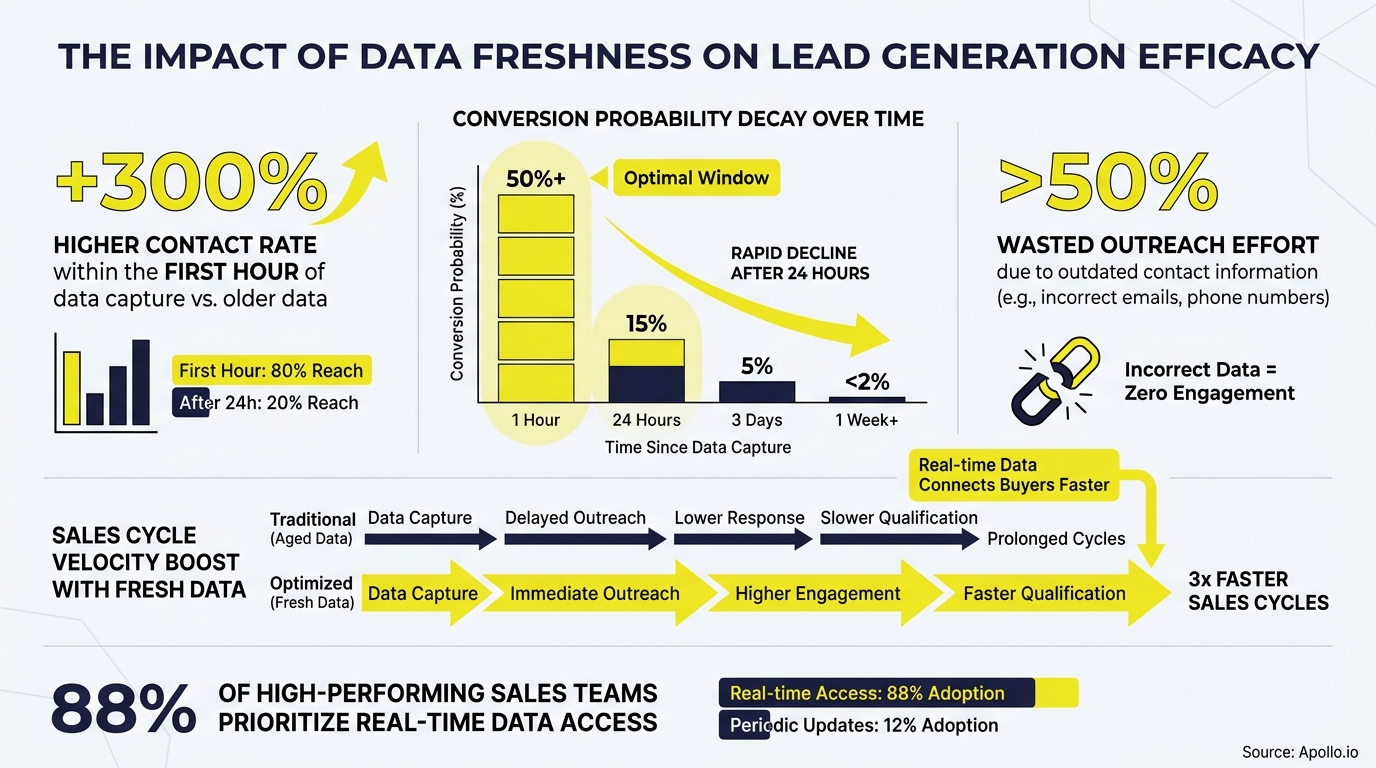
Data freshness is one of the most critical factors in effective lead generation. Stale contact data doesn't just waste budget; it breaks deliverability, corrupts routing, and silently inflates your cost-per-lead. For smarter lead generation, the quality and recency of your data determines whether your outreach reaches the right person at the right time, or disappears into a void.
According to KeepSync, the average monthly B2B data decay rate is 2.1%, which compounds to significant database degradation by year's end. The downstream effects touch every stage of your pipeline, from deliverability to deal close.

Let Apollo Find Your Leads Instantly
Tired of burning hours verifying contact info that goes nowhere? Apollo delivers accurate business contacts so your team spends time selling, not searching. Nearly 100K paying customers scaled pipeline without the manual grind.
Start Free with Apollo →Key Takeaways
- B2B contact databases can lose accuracy rapidly without continuous enrichment, with nearly three-quarters becoming outdated within 12 months.
- Stale data disrupts lead handoffs, damages deliverability, and makes AI-powered workflows produce confidently wrong results.
- SDRs and RevOps teams both feel the impact directly: lower connect rates, wasted sequences, and broken attribution.
- Refresh cadences should be triggered by real-world events (job changes, funding rounds) rather than calendar schedules alone.
- An always-on enrichment and verification layer protects pipeline health more effectively than annual cleanup projects.
Why Does B2B Data Go Stale So Fast?
B2B data decays quickly because people change jobs, companies restructure, and contact details shift constantly. Research from Landbase confirms that nearly three-quarters of prospect databases can become outdated within 12 months. At 2.1% monthly decay, a list of 10,000 contacts loses roughly 200 valid records every 30 days.
The structural driver is workforce churn. With median employee tenure at record lows, the titles, email addresses, and direct dials in your CRM are degrading faster than most teams refresh them.
Macro job-market mobility means that a contact who was a perfect ICP fit six months ago may now be at a different company entirely.
- Job changes: Title, employer, and email all change simultaneously
- Company restructuring: Department mergers shift routing and buying authority
- Email domain changes: Acquisitions and rebrands invalidate entire contact batches
- Phone number updates: Direct dials go cold faster than email addresses
What Happens to Lead Gen Performance When Data Goes Stale?
Stale data triggers a cascade of failures across the entire lead generation model, from email bounces to misrouted leads to broken attribution. According to Demand Gen Report, over 60% of teams report that poor data disrupts lead handoffs and slows sales productivity.
The deliverability impact is particularly severe. Tightening sender requirements from major email providers mean that high bounce rates and spam complaints directly threaten your domain reputation and outbound access.
Stale lists produce more bounces, which push complaint rates toward thresholds that trigger filtering or blacklisting.
| Data Quality Issue | Lead Gen Impact | Downstream Effect |
|---|---|---|
| Invalid email addresses | Hard bounces, domain penalties | Deliverability degradation |
| Wrong job titles | Misrouted leads | Wasted SDR sequences |
| Outdated company data | ICP mismatch | Inflated cost-per-lead |
| Duplicate records | Attribution failures | Measurement mistrust |
A sales professional shared on Reddita firsthand example of this exact problem: "I'd find a brand that just migrated from Magento to Shopify Plus but the VP of Ops in Apollo hadn't worked there for 4 months." A perfect intent signal, completely undermined by a stale contact record.
Tired of burning outreach budget on contacts who've moved on? Keep your pipeline clean with Apollo's continuously verified B2B contact database.
Turn Funnel Guesswork Into Pipeline Wins
Tired of watching marketing leads stall before they ever reach your pipeline? Apollo surfaces high-intent prospects and arms your team with the signals to act fast. Nearly 100K paying customers stopped guessing and started closing.
Start Free with Apollo →How Do SDRs and RevOps Teams Feel the Impact Directly?
SDRs carry the sharpest pain from stale data because they interact with contact records daily. Bad data means bounced emails, wrong-number dials, and sequences that reach the wrong person at a company. Research cited by data quality analyst Serghei Pogor shows sales representatives spend only about 35% of their time actually selling, and bad data makes that problem worse by adding research rework to every sequence.
RevOps leaders face the measurement side of this failure. When contact records are stale, attribution joins break: a lead might be tied to the wrong account, the wrong owner, or a contact who no longer exists.
This corrupts pipeline reporting and makes it impossible to optimize campaigns with confidence. The result is measurement mistrust that blocks sound decisions on channel spend and ICP targeting.
- SDRs: Wasted sequences, low connect rates, manual re-research on every bad record
- AEs: Pre-meeting intelligence is wrong, creating awkward first impressions
- RevOps: Attribution joins fail, dashboards show misleading pipeline data
- Marketing: Suppression lists miss churned contacts, driving spam complaints higher
What Is the Right Cadence for Refreshing B2B Lead Data?
The right refresh cadence is event-triggered, not calendar-based. Quarterly list pulls are too slow for a market where job changes, funding events, and tech migrations can invalidate a record overnight.
In 2026, leading GTM teams treat "signal decay" as a live KPI, using triggered enrichment workflows that fire when a contact changes roles, when a target account raises funding, or when a tech install is detected.
A practical tiered approach balances automation with coverage:
- Continuous (triggered): Enrich on form submission, CRM record creation, or intent signal fire
- Monthly: Validate email addresses across active sequences; suppress hard bounces immediately
- Quarterly: Audit ICP fields (title, seniority, department) across top-of-funnel segments
- Annually: Full database review for dormant records and duplicate consolidation
For automated lead generation systems, continuous enrichment is the baseline, not a premium feature. AI-powered workflows amplify the cost of stale inputs: a scoring model fed outdated titles will route leads to the wrong rep with full confidence.

What Does a Freshness-to-Pipeline Governance Framework Look Like?
A freshness-to-pipeline framework connects data quality directly to revenue outcomes by treating each field as having a defined shelf life and refresh trigger. This moves data hygiene from a one-time cleanup project to an always-on governance layer embedded in your GTM motion.
Key components of an effective framework:
- Field-level SLAs:Assign acceptable staleness thresholds per field type (email: 90 days; title: 180 days; company headcount: 12 months)
- Enrichment triggers: Auto-enrich on inbound form fills, CRM record changes, or intent signal activation
- Suppression logic: Remove hard bounces, unsubscribes, and known job-changers from active sequences immediately
- Attribution integrity checks: Deduplicate records before reporting joins to prevent inflated or missing pipeline attribution
- Verification layer: Run outbound lists through email validation before each send cycle
A Reddit user shared in a B2B marketing discussiona practical approach that delivered results: combining a primary data source with a dedicated verification step kept their team under a 3% bounce rate. That kind of layered hygiene is what a governance framework operationalizes at scale.
For teams building this into contact data enrichment workflows, the goal is eliminating manual refresh steps entirely by embedding enrichment logic into the systems your team already uses daily.
How Does Apollo Help GTM Teams Maintain Data Freshness?
Apollo addresses data freshness as a platform-level capability, not a bolt-on feature. With a database of 230M+ people and 30M+ companies, Apollo continuously verifies contact information to deliver 97% email accuracy, giving SDRs, AEs, and RevOps teams a single source of verified data rather than a patchwork of stale exports and manual updates.
Apollo consolidates what most teams currently manage across multiple tools: prospecting, enrichment, sequencing, and pipeline tracking in one workspace. As Cyera noted, "Having everything in one system was a game changer." For RevOps leaders managing data governance, that consolidation means fewer sync failures, fewer duplicate records, and cleaner attribution.
- Prospecting: Search 230M+ verified contacts with 65+ filters for precise ICP targeting
- Enrichment: Auto-enrich CRM records on trigger events, not just scheduled batch runs
- Sequences: Launch outreach directly from verified data without export-import delays that introduce staleness
- Reporting: Clean, deduplicated records produce attribution data RevOps teams can actually trust
Struggling to build outbound sequences on data you can trust? Search Apollo's verified B2B database with 65+ filters and launch sequences in one platform.

Start Treating Data Freshness as a Revenue Metric
Data freshness in the lead generation process is not a data hygiene problem. It is a revenue problem.
Stale records inflate cost-per-lead, break deliverability, disrupt handoffs, and corrupt the attribution data your team relies on to make channel decisions.
The teams winning in 2026 have moved from annual cleanups to always-on enrichment governance, field-level SLAs, and triggered verification workflows. They treat signal decay as a live GTM KPI, not a quarterly checklist item. For sustainable lead generation that scales, verified and continuously refreshed data is the foundation everything else depends on.
Apollo gives B2B GTM teams the verified data, enrichment automation, and engagement tools to run this end-to-end from a single platform. Request a Demo and see how Apollo keeps your pipeline built on data you can trust.
Prove Pipeline ROI Before Next Review
Budget approval stuck on unclear metrics? Apollo surfaces measurable pipeline impact so you walk into every review with hard numbers. Leadium 3x'd annual revenue — your ROI story starts now.
Start Free with Apollo →Don't miss these
Sales
Inbound vs Outbound Marketing: Which Strategy Wins?
Sales
What Is a Sales Funnel? The Non-Linear Revenue Framework for 2026
Sales
What Is a Go-to-Market Strategy? The 2026 GTM Playbook
See Apollo in action
We'd love to show how Apollo can help you sell better.
By submitting this form, you will receive information, tips, and promotions from Apollo. To learn more, see our Privacy Statement.
4.7/5 based on 9,690 reviews
