
How Effective Is Searching by Company Funding Status or Size?
Searching by company funding status or size is one of the most effective first filters in B2B prospecting — but only when used correctly. On its own, a size or funding filter narrows a massive universe of potential accounts into a workable list. Layered with intent signals and change-event triggers, it becomes a precision targeting engine that puts your outreach in front of buyers at exactly the right moment. If you're building a B2B marketing funnel that converts, firmographic filters are the foundation.

Research Less, Close More With Apollo
Tired of your reps burning hours on manual lead research instead of selling? Apollo surfaces verified contacts instantly so your team spends time closing, not digging. Join 600K+ companies building pipeline faster.
Start Free with Apollo →Key Takeaways
- Funding status works best as a timing signal, not just an ICP attribute — recent rounds indicate active budgets and change-driven buying windows.
- Company size filters are essential for prioritization, but headcount growth rate is often a stronger proxy for urgency than static headcount alone.
- Firmographic filters are most powerful when layered with intent data, technographics, and CRM first-party signals.
- Win rates vary significantly by deal size, making size-tier targeting critical for forecasting and pipeline health.
- SDRs and RevOps teams that combine size and funding filters with multi-signal enrichment see measurably better conversion and reply rates.
How Effective Is Searching by Company Funding Status or Size?
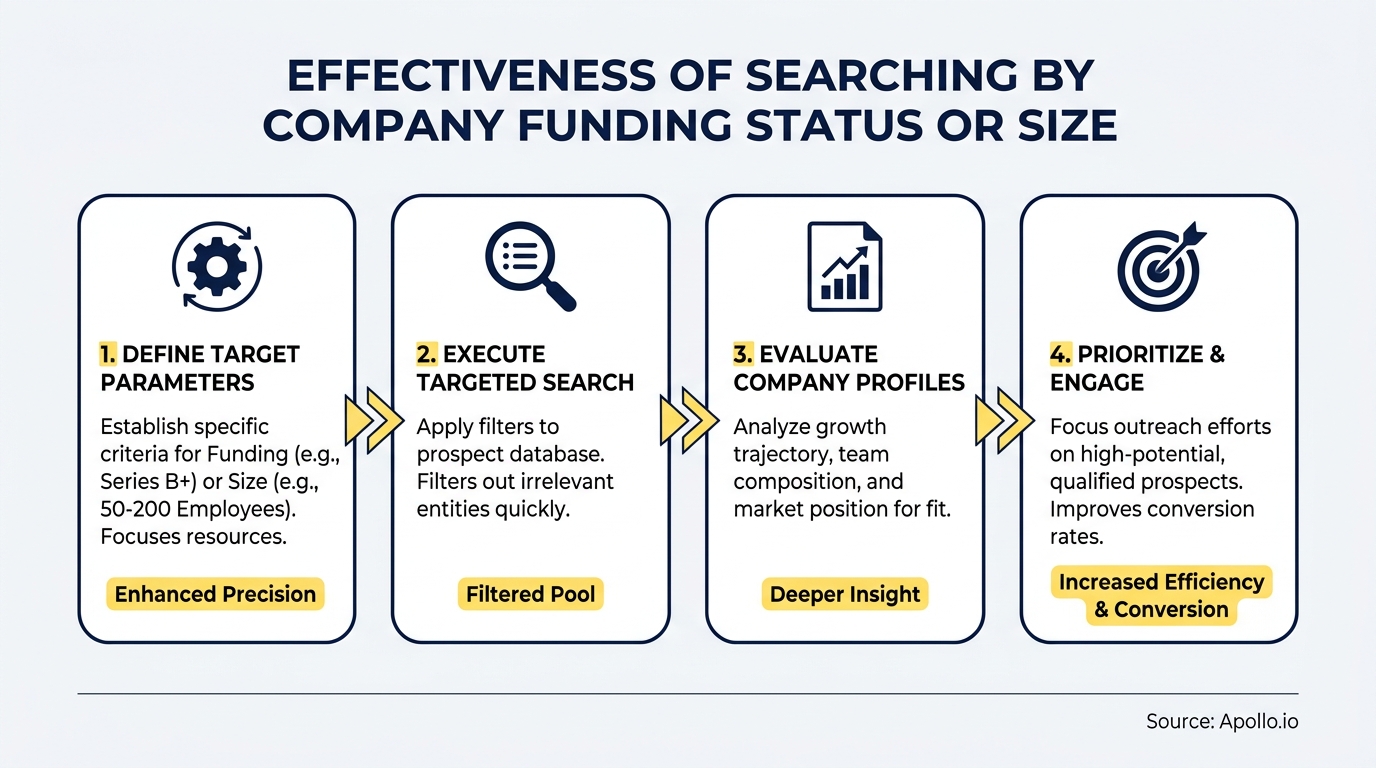
Searching by company funding status or size is highly effective as a first-cut filter — it eliminates irrelevant accounts quickly and surfaces prospects most likely to have budget authority and buying urgency. According to AI-Ark, firmographic targeting, which includes attributes like company size, industry, revenue, location, ownership type, and growth rate, is crucial for B2B segmentation. Without it, outreach campaigns spray effort across accounts that will never convert.
That said, firmographic filters are a starting point, not a complete strategy. Static company size alone is increasingly blunt.
The more effective approach combines size and funding filters with behavioral and intent signals to identify accounts that are not just a good fit, but actively in a buying cycle.
Why Does Funding Status Signal Buying Readiness?
Funding status signals buying readiness because it indicates a change event — and B2B purchases are overwhelmingly triggered by organizational change. A newly funded company is hiring, evaluating vendors, and committing budget.
That creates a window competitors who arrive later will miss.
A sales professional shared a firsthand perspective on Reddit that monitoring SEC Form D filings each morning delivers fresher funding signals than waiting for Crunchbase or Dealroom updates — and that arriving first in the inbox produces noticeably better reply rates. Speed of signal matters as much as the signal itself.
For SDRs and BDRs building outbound sequences, funding rounds are among the highest-value triggers to sequence around. Pair them with intent data to confirm the account is actively researching solutions in your category before investing outreach effort.
How Does Company Size Affect Win Rates and Deal Velocity?
Company size directly affects win rates and deal velocity — smaller companies close faster at higher rates, while larger organizations involve more stakeholders and longer cycles. According to TryKondo, win rates vary significantly by deal size: small deals (under $25k) often close at 30%, mid-market deals ($50–100k) closer to 20%, and large enterprise deals sometimes below 15%.
This has a direct implication for how SDRs and AEs should prioritize their pipeline. Targeting only enterprise accounts without sufficient volume produces long, low-probability cycles.
A balanced size-tier strategy keeps pipeline moving at all stages.
| Company Size Tier | Typical Buying Group | Deal Velocity | Best Filter Combination |
|---|---|---|---|
| 1–49 employees | 1–2 decision-makers | Fast (often under 90 days) | Size + industry + funding stage |
| 50–249 employees | 3–5 stakeholders | Medium (60–120 days) | Size + headcount growth + intent |
| 250+ employees | 6–10+ stakeholders | Slow (90–365 days) | Size + funding + intent + technographics |
Struggling to identify which accounts are worth prioritizing? Search Apollo's 230M+ contacts using 65+ filters including funding stage, headcount, and growth signals to build lists that match your exact ICP.

How Do SDRs Use Funding and Size Filters to Book More Meetings?
SDRs use funding and size filters to prioritize accounts most likely to convert quickly, then personalize outreach to the specific change context — a new funding round, a headcount surge, or a recent leadership hire. This combination dramatically improves relevance and reply rates compared to cold list blasts.
A practical workflow for SDRs:
- Set a size floor and ceiling that matches your product's sweet spot (e.g., 20–200 employees for mid-market).
- Layer funding stage to find companies that recently raised Series A or B — active budget, active evaluation.
- Add department-level hiring signals as a proxy for active initiatives (e.g., a company hiring 5+ engineers signals a tech investment cycle).
- Validate with intent data to confirm the account is researching your category before you reach out.
- Personalize the opening line around the trigger — reference the funding round or growth signal directly in your first email. See how to write sales copy that gets replies for templates.
For founders and AEs managing named accounts, the same logic applies when preparing for discovery calls. Knowing a prospect's funding trajectory helps frame ROI conversations and anticipate budget objections before they surface.
When Should You Layer Intent Data on Top of Firmographic Filters?
You should layer intent data on top of firmographic filters whenever your ICP is large enough that size and funding alone produce more accounts than your team can work. Intent signals tell you which of those ICP-fit accounts are actively in-market right now. According to Sanguinesa, businesses using intent data enriched with firmographics can increase conversion rates by 2.5 times compared to traditional lead generation campaigns.
Firmographics-only targeting is steadily losing ground to multi-signal approaches that combine size and funding filters with technographic fit, CRM first-party engagement data, and behavioral intent. The most effective B2B teams treat firmographic filters as the account qualification layer, and intent as the timing layer. Used together, they tell you who to target and when to reach out. Learn more about how intent data is collected and used to sharpen your targeting further.
For RevOps leaders managing territory design and scoring models, this combination also improves lead routing accuracy. When size, funding, and intent signals align, those accounts should jump to the top of the rep's queue automatically.
Turn Weak Leads Into Real Pipeline
Tired of marketing leads that never convert to opportunities? Apollo surfaces in-market buyers with precision targeting so your team fills the funnel with prospects that actually close. Trusted by 600K+ companies.
Start Free with Apollo →What Are the Limitations of Searching by Size or Funding Alone?
The main limitation of searching by size or funding alone is data quality — stale headcount figures, mismatched company records, and delayed funding updates can silently degrade your results without any obvious signal that something is wrong. A Reddit user shared a firsthand perspective on estimating company valuation from public funding data, noting that ARR multipliers and funding round math can give rough but useful ballpark figures when private financial data isn't available — but these are estimates, not ground truth.
Common limitations to account for:
- Stale headcount data: Employee counts in third-party databases often lag reality by months. Cross-reference with active job postings.
- Funding lag: Many rounds appear in databases weeks after close. SEC Form D filings and direct press monitoring can give earlier signals.
- Entity matching errors: Multi-entity companies (subsidiaries, holding structures) often have fragmented or duplicated records that inflate or deflate apparent size.
- Static size vs. growth rate: A 50-person company growing 40% YoY is a very different prospect than a 50-person company that has been flat for three years.
Investing in contact data enrichment and regular database hygiene directly addresses these issues and protects the value of your filters over time.
How to Build a Practical Size and Funding Filter Strategy in 2026
A practical strategy combines size and funding filters as your account qualification layer, then stacks additional signals to prioritize outreach timing and personalization. The goal is a tiered account list where the top tier meets all criteria: right size, recent funding or growth signal, intent match, and CRM engagement history.
Start with your TAM/SAM/SOM frameworkto define the realistic addressable universe before setting filter parameters. Then apply this filter stack in order:
- Size range matching your product's economic fit (e.g., deals under $25k close fastest in smaller accounts).
- Funding stage as a change-event trigger (Seed through Series B for growth-stage products; later stages for enterprise).
- Headcount growth rate to identify companies in active expansion mode.
- Industry and geography to match your go-to-market motion.
- Intent signals to confirm active research in your category.
This layered approach is also what powers effective sales automation workflows — clean, well-filtered account lists feed automation sequences that feel personalized rather than generic. Need to reach the right person once you've identified the right account? See how to find a hiring manager's email without being spammy.
Want to automate this entire filter stack and trigger outreach the moment a prospect matches your criteria? Apollo's AI sales automation builds and works your pipeline with size, funding, and intent filters built in — so your team focuses on conversations, not list-building.

Start Filtering Smarter in 2026
Searching by company funding status or size is highly effective — but the teams that get the most from these filters treat them as a starting layer, not a complete strategy. Funding events signal change-driven buying windows.
Size tiers predict deal velocity and buying group complexity. Combined with intent data and enrichment, they form the backbone of a high-precision prospecting motion that scales.
Apollo gives SDRs, AEs, RevOps leaders, and founders a unified platform to apply these filters across 230M+ contacts, enrich records automatically, and trigger outreach the moment an account matches your ICP. As Cyera put it: "Having everything in one system was a game changer."
Request a Demo to see how Apollo's filtering, enrichment, and engagement tools work together in one platform.
Prove Pipeline ROI From Day One
ROI pressure killing your tool adoption? Apollo delivers measurable pipeline impact fast — with 35% more bookings from AI-powered messaging. Nearly 100K paying customers saw results before the first renewal conversation.
Start Free with Apollo →Don't miss these
Sales
Inbound vs Outbound Marketing: Which Strategy Wins?
Sales
What Is a Sales Funnel? The Non-Linear Revenue Framework for 2026
Sales
What Is a Go-to-Market Strategy? The 2026 GTM Playbook
See Apollo in action
We'd love to show how Apollo can help you sell better.
By submitting this form, you will receive information, tips, and promotions from Apollo. To learn more, see our Privacy Statement.
4.7/5 based on 9,690 reviews
