
How RevOps Teams Build Automated Enrichment Workflows That Run Without Manual Intervention
Most automated enrichment workflows fail not because of bad tools, but because of missing governance, incomplete triggers, and no plan for continuous updates. RevOps teams that solve these foundational gaps first can run enrichment pipelines that operate without manual intervention across the entire contact and account lifecycle. If you want to understand how to build a data enrichment strategy that actually scales, the answer starts with architecture, not automation.

Rich Data. Real Leads. Zero Guesswork.
Tired of sending generic outreach because your data is spotty and incomplete? Apollo delivers enriched firmographic and technographic context so every message lands. Join 600K+ companies turning smarter data into more pipeline.
Start Free with Apollo →Key Takeaways
- Automated enrichment requires governance-first design: schema standards, field provenance, and exception routing before any workflow is built.
- Enrichment must run at every lifecycle stage, not just at lead creation. Ingest, form fill, nightly batch, and lifecycle events all need separate triggers.
- Identity resolution is the foundation for omnichannel attribution. Without it, enrichment data fragments across channels and records stay incomplete.
- Data quality monitoring with defined SLAs prevents silent enrichment failures that corrupt downstream lead scoring and forecasting.
- RevOps teams that consolidate enrichment into a unified platform eliminate manual rework and reduce tech stack complexity significantly.
What Is an Automated Enrichment Workflow for RevOps?
An automated enrichment workflow is a system that continuously appends, validates, and updates contact and account data without human input at each step. It connects data sources, CRM records, and downstream systems through trigger-based logic that fires on ingest, record creation, field changes, and scheduled intervals. As explained in our overview of what revenue operations is and how it drives growth, RevOps owns the data infrastructure that makes every GTM motion work. Enrichment automation is central to that infrastructure.
According to Kixie, the average sales representative spends 19% of their time updating CRMs and nearly a third of their workday on administrative duties. Automated enrichment, call logging, and data syncing directly eliminate this overhead.
Why Do Most RevOps Enrichment Workflows Require Manual Intervention?
Enrichment workflows revert to manual processes when governance, triggers, and data quality controls are missing from the initial design. The three most common failure points are:
- No field provenance: Teams cannot tell which source populated a field, so conflicts require human review.
- Single-trigger design: Workflows fire only at lead creation, leaving records stale after job changes, company moves, or ownership transfers.
- Missing exception routing: Unmatched or low-confidence records pile up in queues with no automated fallback logic.
Research from Openprise shows multi-vendor waterfall methodologies for B2B data enrichment can achieve up to 75% match rates while automating cleanup and validation. That headroom only exists when exception handling is built into the workflow from the start.
Tired of dirty CRM data forcing your team into constant manual fixes? Start free with Apollo's 230M+ verified business contacts and run enrichment that stays clean automatically.
How Does a RevOps Team Build the Enrichment Trigger Architecture?
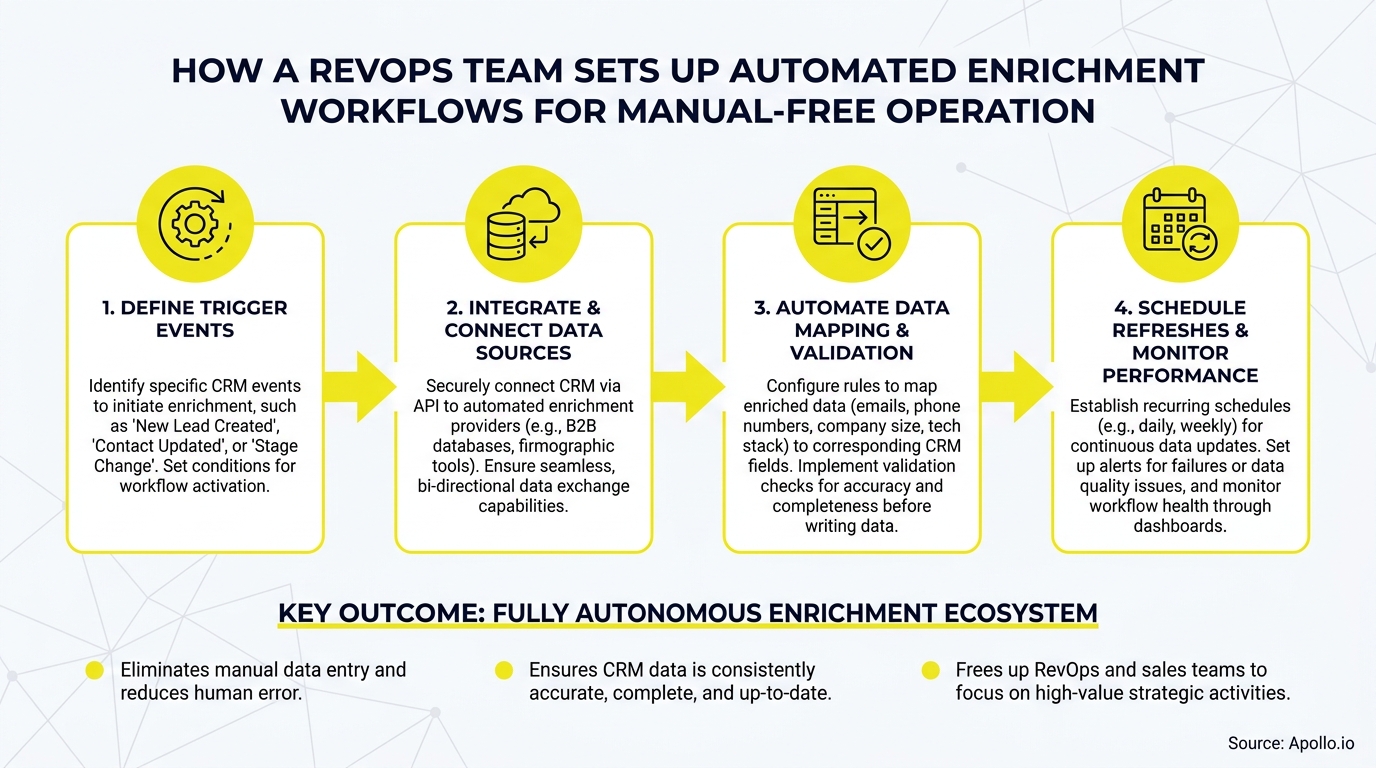
A trigger architecture defines when enrichment fires, not just once but continuously across the record lifecycle. RevOps teams should map four distinct trigger types:
| Trigger Type | When It Fires | Data Enriched |
|---|---|---|
| Ingest / Form Fill | New lead enters via form, import, or API | Firmographics, title normalization, email validation |
| Record Creation | CRM contact or account created | Industry, headcount, tech stack, intent signals |
| Scheduled Batch | Nightly or weekly cadence | Job change detection, email decay, account signals |
| Lifecycle Event | Stage change, deal opened, renewal approaching | Buying committee, champion verification, expansion signals |
Each trigger should write to a provenance field that logs the source, timestamp, and confidence score. This eliminates manual conflict resolution because the workflow already knows which source to trust. For a deeper look at how contact data enrichment drives ROI, the trigger architecture is where the compounding value begins.

How Do RevOps Leaders Set Up Governance for Enrichment Pipelines?
Governance for enrichment pipelines means establishing schema standards, source priority rules, and audit trails before connecting any enrichment vendor. RevOps leaders should define these governance artifacts first:
- Canonical field schema: Agreed field names, formats, and allowed values across CRM, MAP, and data warehouse.
- Source hierarchy: Which data provider wins when two sources conflict on the same field.
- Consent and minimization rules: Which fields can be auto-enriched based on regulatory context and what requires opt-in.
- Exception queue routing: Low-confidence matches auto-route to a review queue, not to reps.
- Change log: Every field update is timestamped with the triggering event and source for full auditability.
Konnectify reports that automated data management using AI improves data quality by identifying and merging duplicate records, enriching profiles with external data, and standardizing data transfer to prevent inconsistencies. Governance artifacts make that automation reliable rather than fragile.
Turn Funnel Guesswork Into Real Pipeline
Pipeline forecasting a guessing game because leads stall before they ever reach your AEs? Apollo surfaces high-intent prospects and keeps your funnel moving. Join 600K+ companies building pipeline they can actually predict.
Start Free with Apollo →What Role Does Identity Resolution Play in Always-On Enrichment?
Identity resolution is the process of matching a contact or account record across multiple data sources and channels into a single authoritative profile. Without it, the same buyer appears as multiple fragmented records, enrichment writes to the wrong object, and attribution breaks. For RevOps teams building customer data enrichment workflows, identity resolution is the prerequisite for omnichannel accuracy.
A working identity resolution layer includes:
- Deterministic matching on email and domain as primary keys
- Probabilistic matching on name, title, and company for records without email
- Account-level clustering that links contacts to the correct company object
- Cross-channel ID stitching that connects web, CRM, and marketing automation records
How Do SDRs and RevOps Teams Benefit from Continuous Enrichment?
SDRs benefit directly when enrichment runs continuously because their prospect records are always current, eliminating pre-call research and reducing bounce rates on outreach sequences. RevOps leaders benefit because downstream workflows like lead scoring, routing, and forecasting operate on clean, complete data. According to MarketsandMarkets, companies utilizing data-driven lead enrichment experience 25% higher conversion rates and a 15% reduction in customer acquisition costs.
For SDRs specifically, always-on enrichment means:
- Job title and company data reflect the prospect's current role, not what they held six months ago
- Sequences auto-pause when a champion leaves and resumes when their replacement is identified
- Routing rules fire correctly because firmographic fields are populated before assignment
Struggling to keep prospect data fresh for your SDR team? Apollo's contact enrichment keeps records updated automatically so reps always reach out with accurate information.
What Metrics Should RevOps Monitor for Enrichment Pipeline Health?
Enrichment pipeline observability requires tracking data quality metrics and SLA compliance, not just workflow completion rates. Key metrics to monitor:
- Match rate: Percentage of records successfully enriched per trigger type (target varies by vendor and data tier)
- Field fill rate: Percentage of priority fields populated across CRM objects
- Enrichment latency: Time from trigger to enriched record available downstream
- Decay rate: Percentage of records flagged as stale on scheduled batch runs
- Exception queue volume: Volume of records routed to manual review (high volume signals a governance gap)
As Forecastio notes, improving data quality is a core benefit of RevOps tools, fixing duplicates, standardizing customer data, and eliminating inconsistent records for more accurate downstream workflows like lead scoring and sales forecasting. These metrics make that improvement visible and actionable. For teams building the broader infrastructure, our playbook on how to build a sales tech stack that scales revenue covers how enrichment fits into the full GTM architecture.

How Should RevOps Teams Get Started with Automated Enrichment in 2026?
The fastest path to fully automated enrichment is consolidating data, engagement, and workflow tooling into a unified platform rather than stitching together point solutions. Apollo gives RevOps teams a single workspace for contact data, enrichment, sequencing, and pipeline management, eliminating the integration overhead that causes enrichment pipelines to break.
As the team at Cyera put it: "Having everything in one system was a game changer."
To get started:
- Audit your current field schema and identify the top 10 fields that drive routing and scoring
- Map all four trigger types to existing CRM events
- Establish source priority rules and provenance logging before connecting enrichment vendors
- Build exception queue routing so unmatched records never reach reps
- Set SLAs for match rate and enrichment latency, then monitor weekly
Apollo's workflow automation engine and enrichment capabilities let RevOps teams implement this blueprint without managing multiple vendors. Trusted by nearly 100K paying customers including Anthropic, Smartling, and Redis, Apollo consolidates your sales tech stack so enrichment, prospecting, and outreach run from one place. Start your free trial and set up your first automated enrichment workflow today.
Prove Pipeline ROI With Apollo
Budget approval stuck on unclear metrics? Apollo delivers measurable pipeline impact your leadership can't ignore. Teams like Leadium 3x'd annual revenue — see your ROI from day one.
Start Free with Apollo →Don't miss these
Sales
Inbound vs Outbound Marketing: Which Strategy Wins?
Sales
What Is a Sales Funnel? The Non-Linear Revenue Framework for 2026
Sales
What Is a Go-to-Market Strategy? The 2026 GTM Playbook
See Apollo in action
We'd love to show how Apollo can help you sell better.
By submitting this form, you will receive information, tips, and promotions from Apollo. To learn more, see our Privacy Statement.
4.7/5 based on 9,690 reviews
