
How Do SDR Teams Use Job Change and Promotion Signals to Time Their Outreach?
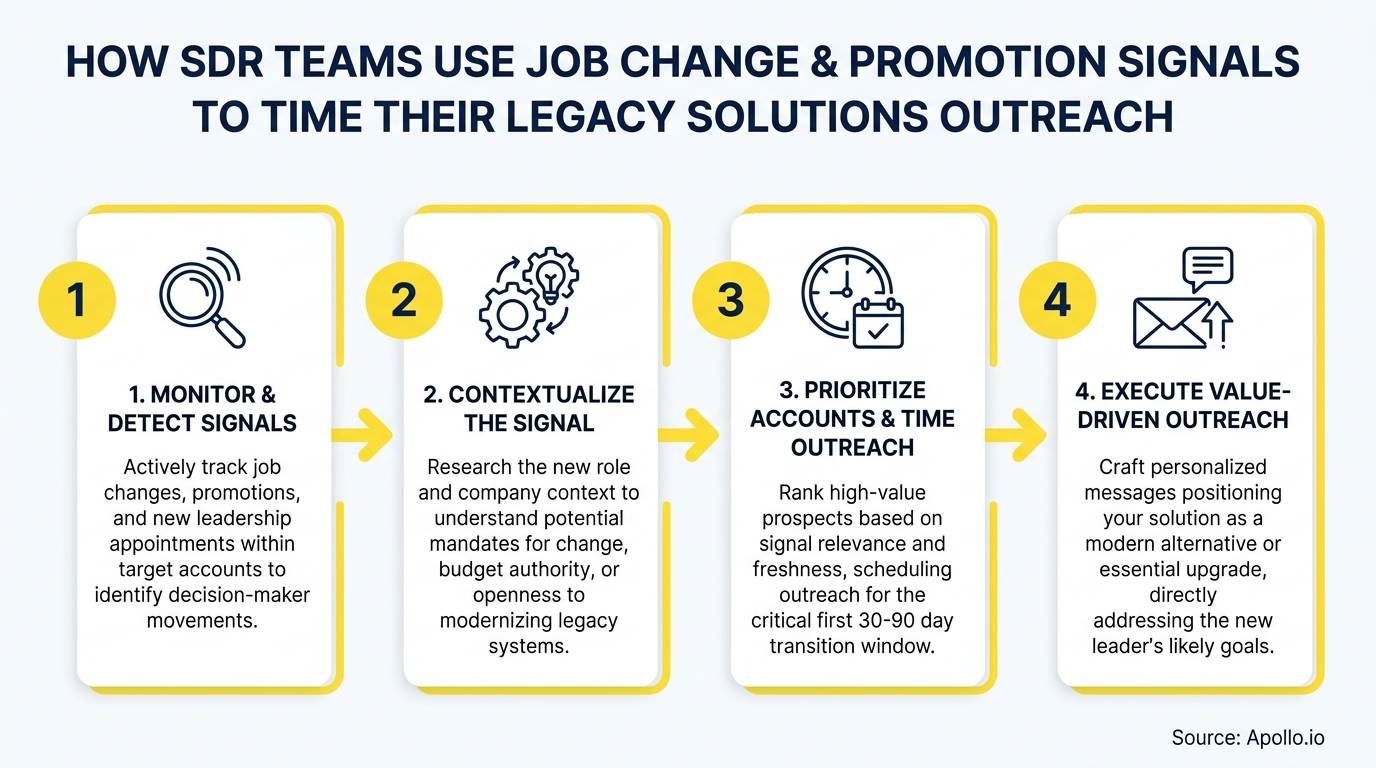
Job change and promotion signals are among the highest-intent triggers available to SDR teams because they mark a moment when a new leader is actively evaluating vendors, resetting budgets, and building their own playbook. Miss that window and you may never get a fair hearing.
Act fast, and you can earn a spot on the shortlist before competitors even know the role changed.
According to 6sense's 2025 B2B Buyer Experience Report, 95% of B2B purchases ultimately go to one of the four vendors on the buyer's Day One shortlist. Getting there requires acting on signals the moment they fire, not days later. Job change alerts give SDR teams the real-time data they need to be first in the door.

Research Less, Pipeline More With Apollo
Tired of your reps burning hours on manual lead research instead of closing deals? Apollo surfaces verified contacts instantly so your team spends time selling, not searching. Join 600K+ companies building pipeline faster.
Start Free with Apollo →Key Takeaways
- Job change outreach consistently outperforms cold prospecting, with reply rates and conversion rates significantly higher for recent job changers than for tenured contacts.
- The first 90 days of a new role is the highest-leverage window: new leaders are actively evaluating solutions and forming vendor preferences.
- Speed matters. Outreach within 24-48 hours of a signal firing dramatically improves the odds of landing on a buyer's shortlist before it hardens.
- Signals without a workflow are wasted. SLA-driven routing, auto-enrichment, and automated sequences turn raw alerts into consistent pipeline.
- Because most buyers prefer to self-educate before speaking to a rep, the best job-change sequences lead with value assets, not meeting requests.
Why Do Job Change and Promotion Signals Outperform Cold Outreach?
Job change and promotion signals outperform cold outreach because they identify a person at a moment of active re-evaluation, not passive awareness. A new VP of Sales joining a company will reassess their entire tech stack in the first few months.
That is not a cold prospect; it is a warm one disguised as an unfamiliar name.
The data supports this clearly. Research from Boomerang shows that job change tracking can lead to 2-4x higher response rates than cold outreach, with reply rates ranging from 15-25% compared to 5-8% for cold contacts. Lonescale also reports a 3x higher chance of selling to past users when they move to a new role, making champion tracking one of the most reliable pipeline sources available to SDRs.
Cold email reply rates collapsed to 5.1% in 2025 according to SalesS0. Against that backdrop, job-change sequences offer a structural advantage that SDR teams cannot afford to ignore.
What Is the Signal Shelf-Life and When Should SDRs Reach Out?
The signal shelf-life is the period during which a job change or promotion signal drives meaningfully higher conversion rates. It starts the day the signal fires and narrows quickly, making timing a core part of the strategy, not an afterthought.
The "honeymoon period" within the first 90 days of a new role is when new leaders are most actively evaluating solutions and establishing vendor relationships. Within that window, the practical SLA for SDR first touch should be:
| Signal Type | Ideal First Touch | Follow-Up Cadence | Shelf-Life Cutoff |
|---|---|---|---|
| Champion moves to new company | Within 24 hours | Days 2, 5, 10, 21 | Day 30 |
| New executive hired externally | Within 48 hours | Days 3, 7, 14, 30 | Day 45 |
| Internal promotion to decision-maker role | Within 72 hours | Days 5, 10, 21, 45 | Day 60 |
| Lateral move within ICP account | Within 1 week | Days 7, 14, 30 | Day 90 |
The 6sense report cited above also found that time spent per vendor during evaluation fell from 2.6 months to 2.0 months in 2025. The evaluation cycle is getting shorter, which means late outreach is not just suboptimal; it is often disqualifying.
How Do SDRs Build a Promotion-to-Pipeline Workflow?
An effective promotion-to-pipeline workflow automates the steps between signal detection and first-touch outreach, so no job change alert sits unactioned in a dashboard. The biggest gap most teams have is not data; it is the workflow that converts data into conversations.
Struggling to act on signals fast enough? Apollo's Job Change Alerts and Data Enrichment automatically detects role changes across your contact database and routes them directly into sequences, so your team reaches out before competitors do.
A practical automation checklist for SDR teams:
- Signal detection: Connect job change data to your CRM via field sync or native integration.
- Auto-enrichment: Pull updated title, company, email, and phone the moment a change is detected. Use contact enrichment tools to keep records current without manual work.
- Routing rules: Route champion moves to the owning AE within 1 hour. Route new external hires to the assigned SDR within 4 hours.
- Sequence enrollment: Auto-enroll into a job-change-specific sequence with personalized first-line referencing the new role.
- Escalation SLA: If no reply in 5 business days, escalate to manager queue for review.
For RevOps leaders, the operational priority is field mapping and deduplication. Ensure your CRM updates title and company fields when a signal fires, so trigger-based automation does not launch on stale records.
Turn Funnel Guesswork Into Real Pipeline
Tired of watching marketing leads stall before they ever reach your pipeline? Apollo surfaces high-intent buyers the moment they're ready, so your team acts fast. 600K+ companies stopped guessing and started closing.
Start Free with Apollo →How Do SDRs Write Outreach That Converts on Job Change Signals?
Job-change outreach converts when the message is anchored in the new leader's immediate priorities, not in your product's feature list. The goal of the first touch is to demonstrate relevance, not to pitch.
Because Gartner found that 61% of B2B buyers prefer a rep-free buying experience, the most effective job-change sequences lead with a self-serve asset: a first-90-days checklist, a benchmark report relevant to their new role, or a short framework document. The meeting ask comes later, after value is established.
A proven three-step message structure for promotion signals:
- Congratulations hook: One sentence acknowledging the new role. Specific, not generic.
- Relevant POV: A single observation about what leaders in this role typically prioritize in the first quarter, tied to a problem your product solves.
- Value asset: Offer a checklist, template, or short resource. Link to it. No meeting ask in email one.
For outbound prospecting that uses multi-channel sequences, pairing email with a social touchpoint increases reach. Social outreach by a human boasts a 42% response rate according to Pulse Recruitment, making it a high-value complement to email in job-change cadences.

How Can SDRs Scale This Motion Without Adding Tools?
SDR teams scale the job-change motion without adding tools by consolidating signal detection, enrichment, and sequencing into a single platform. Point tools for job-change alerts plus a separate sequencer plus a separate enrichment layer create integration debt and slow the response time that makes this motion work.
Apollo surfaces intent data and job change signals alongside 230M+ contacts and a built-in multi-channel sales engagement platform, so SDRs can go from signal to sequence without leaving a single workspace. As Cyera put it: "Having everything in one system was a game changer."
For teams evaluating their current stack, the core question is whether your job-change signal fires in the same system where you enroll contacts into sequences. If not, that gap is where pipeline leaks. See how modern teams build a sales tech stack that scales without layering on complexity.
What KPIs Should SDR Teams Track for Signal-Based Outreach?
SDR teams should track signal-specific KPIs separately from general outbound metrics, because job-change sequences should consistently outperform baseline benchmarks and the comparison reveals whether the motion is being executed correctly.
| KPI | Job-Change Sequence Target | Why It Matters |
|---|---|---|
| First-touch reply rate | 9%+ (vs. ~5% cold baseline) | Validates signal quality and message relevance |
| Meeting booking rate | 1.5%+ per sequence | Measures conversion from signal to pipeline |
| Signal-to-first-touch SLA | Under 24 hours for champion moves | Ensures timing advantage is captured |
| Champion re-engagement rate | Track separately by past user status | Past users convert at 3x the rate of cold contacts |
| Sequence coverage rate | 90%+ of fired signals enrolled within SLA | Reveals workflow gaps and routing failures |
Data from Databees shows that sequences targeting recent job changers achieve a 9.39% reply rate and 1.89% meeting booking rate, compared to 2.21% and 0.2% respectively for prospects who have been in their roles for over seven months. If your job-change sequences are not beating those cold benchmarks, the problem is usually timing, routing, or message relevance, not the signal itself.

Start Turning Job Change Signals Into Pipeline Today
Job change and promotion signals give SDR teams one of the clearest buying signals in B2B sales. The 90-day honeymoon window is real, the reply rate lift is documented, and the workflow to capture it is straightforward.
The teams winning this motion in 2026 are not doing more research; they are automating faster routing, enrolling contacts the day the signal fires, and leading with value before the meeting ask.
Apollo combines job change alert detection, contact enrichment, and multi-channel sequencing in one platform, so your SDR team can go from signal to booked meeting without switching tools or waiting on integrations. As Predictable Revenue shared: "We reduced the complexity of three tools into one."
Ready to act on every job change signal before your competitors do? Start Prospecting with Apollo for free and put your job-change motion on autopilot.
Prove Pipeline ROI Before Next Quarter
ROI pressure killing your tool budget approval? Apollo delivers measurable pipeline impact fast — so you walk into every budget review with hard numbers. 600K+ companies close the loop between outreach and revenue.
Start Free with Apollo →Don't miss these
Sales
Inbound vs Outbound Marketing: Which Strategy Wins?
Sales
What Is a Sales Funnel? The Non-Linear Revenue Framework for 2026
Sales
What Is a Go-to-Market Strategy? The 2026 GTM Playbook
See Apollo in action
We'd love to show how Apollo can help you sell better.
By submitting this form, you will receive information, tips, and promotions from Apollo. To learn more, see our Privacy Statement.
4.7/5 based on 9,690 reviews
