
How Do Sales Leaders Explain AI SDR Tools to Their Boards Without Overpromising in 2026
Boards are skeptical of AI promises, and for good reason. The pressure to show AI ROI is real, but the path from vendor demo to boardroom credibility requires a different playbook than most sales leaders use. If you're preparing to pitch AI SDR tools internally, the goal isn't to inspire excitement — it's to earn trust through a staged, measurable narrative. Tools like Apollo's AI Sales Assistant are built for exactly this kind of disciplined, end-to-end GTM execution, not just point-in-time automation. Understanding how to use sales automation the right way is the foundation of a credible board presentation.

Research Less, Pipeline More With Apollo
Tired of your reps burning hours verifying contact info instead of selling? Apollo delivers 230M+ accurate contacts instantly, so your team spends time closing—not researching. Start building real pipeline today.
Start Free with Apollo →Key Takeaways
- Frame AI SDR tools as a staged experiment with explicit stop/go gates, not a guaranteed revenue lift.
- Lead with leading indicators (reply rates, time-to-first-touch, meeting-to-opportunity conversion) before claiming pipeline impact.
- Boards increasingly expect governance narratives: data controls, human oversight, and audit trails alongside performance goals.
- The measurement design matters as much as the tool — holdout groups and cohort tracking separate real uplift from noise.
- Adoption is not the same as realized value; boards will ask for both, and conflating them destroys credibility.
Why Do Boards Push Back on AI SDR Pitches?
Boards push back because overpromising on AI has become a pattern, not an exception. They have seen adoption announcements that didn't translate into revenue. According to Optif.ai, Gartner's 2025 Sales Technology Report found that 89% of revenue organizations now use AI-powered tools, up from 34% in 2023. That rapid spread means boards are no longer asking "should we use AI" — they're asking "why haven't we seen results yet."
The credibility gap is real. Coverage of enterprise AI tools has reinforced a board-level skepticism pattern: adoption claims are not the same as realized value.
Sales leaders must walk in with a benefits-realization plan, not a product brochure.
What Is the Right Framework for Presenting AI SDR Tools?
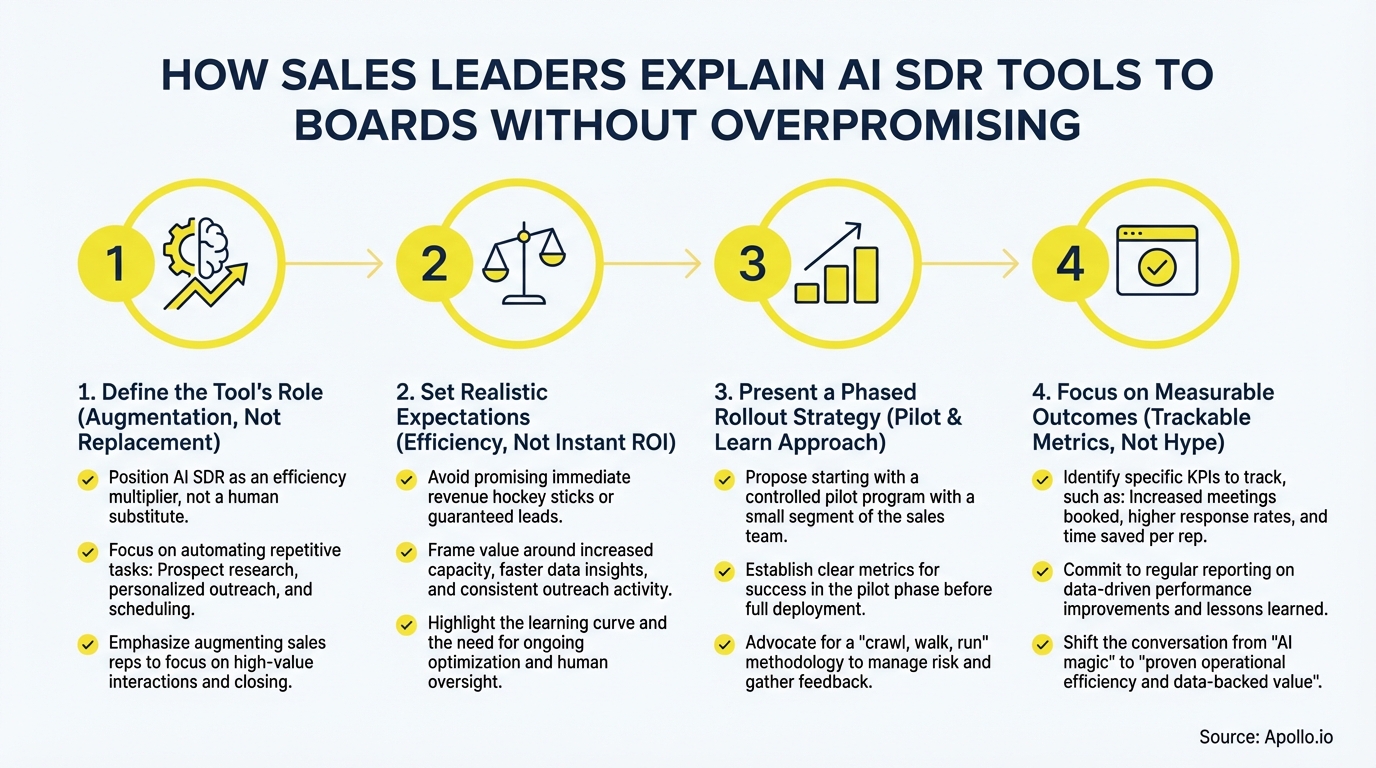
The right framework is a staged experiment model: baseline, pilot, scale — with explicit stop/go gates at each phase. This replaces "we'll 10x outbound" with "here's what we'll learn in 60 days and what we'll do with that data."
| Phase | Duration | Key Metrics | Gate Criteria |
|---|---|---|---|
| Baseline | 30 days | Current reply rate, time-to-first-touch, meetings booked per rep | Instrumentation confirmed, control group defined |
| Pilot | 60 days | Reply rate delta, meeting-to-opportunity conversion, rep time reclaimed | Statistically meaningful cohort, governance controls live |
| Scale | Ongoing | Incremental pipeline per territory, stage velocity, cost per qualified meeting | Pilot results exceed gate threshold; governance signed off |
Research from TryKondo shows reps can reclaim 4-7 hours per week by automating research, personalization, and inbox management. Present that as the pilot hypothesis — not as a guaranteed outcome, but as the specific behavior change you're instrumenting for.
How Do Sales Leaders Build a Governance Narrative Boards Will Accept?
Governance is now part of the board-ready AI story, not an afterthought. PwC's 2026 governance trends guidance explicitly flags AI oversight integration and the need for guidelines, guardrails, and board education as priority items.
Sales leaders pitching AI SDR tools need to answer four governance questions before walking into the room:
- Data boundaries: What contact data does the tool access, and what CRM fields are in scope?
- Human-in-the-loop: Which actions require rep approval before sending?
- Audit trail: How are AI-generated messages logged, reviewed, and attributed in the CRM?
- Incident playbook: What happens if the tool sends an incorrect or off-brand message to a customer?
Platforms with built-in approval workflows and credit-cost transparency before each run make the governance story easier to tell. Apollo's Outbound Copilot, for example, supports manual or automatic approval before adding prospects to sequences, giving RevOps leaders a clear control point without blocking SDR productivity.
Struggling to demonstrate pipeline accountability to your board? See how Apollo's pipeline tools give revenue leaders full visibility from first touch to close.

How Do CROs and Sales Leaders Measure AI SDR Impact Credibly?
Credible measurement separates AI SDR performance from rep performance using holdout testing. Assign a control group of reps or accounts that does not use the AI tooling during the pilot.
Measure incremental pipeline and stage velocity in the test cohort versus the control group. This approach prevents vendor math from inflating results and gives your board an independent signal.
The metrics that matter most to boards in 2026 are not activity counts. They are:
- Meeting-to-opportunity conversion rate (did AI-sourced meetings actually progress?)
- Stage velocity (did AI-assisted accounts move faster through the funnel?)
- Cost per qualified meeting (what did it actually cost to generate each meeting?)
- Rep time reclaimed (hours shifted from admin to selling activity)
For sales analytics to support this level of reporting, your CRM instrumentation must be clean before the pilot starts. RevOps leaders who invest in data hygiene before launching AI tools generate more defensible results.
Turn Weak Leads Into Real Pipeline
Tired of watching marketing leads stall before they ever reach your pipeline? Apollo surfaces high-intent buyers the moment they're ready to talk. Nearly 100K paying customers stopped guessing and started closing.
Start Free with Apollo →How Do SDRs and Sales Leaders Frame AI as Augmentation, Not Replacement?
SDRs and sales leaders should frame AI tools as handling coverage tasks — research, first drafts, routing, follow-up — while humans retain ownership of discovery quality, deal context, and relationship risk. This framing reduces board pushback rooted in headcount concerns and positions AI as a force multiplier for the team already in place.
Data from Cirrus Insight shows that sales professionals who use AI daily are twice as likely to exceed their sales targets compared to non-users. That's the board-ready proof point: AI users outperform, which means the investment compounds the value of your existing headcount rather than replacing it.
Customer-facing evidence helps here. Ian Kistner, Head of Sales Development at Crusoe, noted: "We're using Apollo's AI Assistant to score and tier accounts, which makes it much easier to prioritize outbound in a quickly expanding market." That's augmentation language — AI handles prioritization, humans handle the conversation.
For SDRs building targeted lists at scale, Apollo's AI Assistant enables natural-language list building, account research, and sequence creation in one workflow. This consolidation is itself a governance win: fewer tools mean fewer data boundaries to manage and a cleaner audit trail for the board.
Spending too much time stitching together prospecting tools? See how Apollo's AI sales automation consolidates your GTM stack into one governed workflow.
What Are the Most Common Board Questions About AI SDR Tools — and How Should Sales Leaders Answer Them?
Boards ask predictable questions. Preparing crisp answers in advance is the difference between a confident presentation and a deflecting one.
| Board Question | Recommended Answer Frame |
|---|---|
| "What's the ROI timeline?" | Leading indicators in 60 days; pipeline attribution in 90-120 days with holdout data. |
| "How do we control what AI sends?" | Human approval gates before sequences launch; all messages logged in CRM with AI attribution. |
| "What happens if it goes wrong?" | Defined incident playbook: pause sequence, review logs, notify affected contacts if needed. |
| "Are competitors already doing this?" | Yes — and the risk of inaction is a competitive coverage gap, not just a missed efficiency gain. |
| "How is this different from what we tried before?" | This is a governed pilot with explicit stop/go gates, not a broad rollout. We measure before we scale. |
For deeper context on handling objections in the boardroom and in the field, see how to handle sales objections in 2026 and review which AI sales tools actually close more deals for third-party validation you can reference in your presentation.

How Do Sales Leaders Build Long-Term Board Confidence in AI SDR Investments?
Long-term board confidence comes from consistent reporting discipline, not one-time wins. Establish a quarterly AI SDR dashboard that tracks the metrics defined in your pilot gates.
Report both successes and failures. Boards trust leaders who surface problems early and adjust — not leaders who only report upside.
The market context supports sustained investment. According to Fortune Business Insights, the global AI SDR market was valued at USD 4.27 billion in 2025 and is projected to reach USD 24.32 billion by 2034. Boards approving AI SDR pilots in 2026 are not taking a speculative bet — they're making a timed entry into an established market trajectory.
Build your reporting cadence around three layers: activity (what the AI did), behavior (how reps changed), and outcome (what moved in the funnel). That separation makes it easy for boards to see where value is accumulating and where the next investment case is forming. For sales leaders building this discipline from the ground up, Apollo for Sales Leaders provides the team performance visibility and pipeline tracking that supports exactly this kind of structured reporting.
Ready to Build a Board-Ready AI SDR Narrative?
The boards that approve AI SDR investments in 2026 are not buying hype — they're approving governed experiments with credible measurement plans. Sales leaders who walk in with staged rollout frameworks, governance controls, and holdout-tested metrics earn the trust that converts pilot budgets into scale investments.
Apollo's all-in-one GTM platform gives revenue teams the prospecting, engagement, AI research, and analytics capabilities to run a defensible pilot without stitching together multiple vendors. As Tory Kindlick from RapidSOS put it: "Work that would've taken me hours was done before I even got off the train." That's the kind of concrete, rep-level evidence that translates into board-level confidence.
Try Apollo Free and build your pilot case with real data before your next board presentation.
Prove Pipeline ROI Before Next QBR
Budget approval stuck on unclear metrics? Apollo delivers measurable pipeline impact fast — so you walk into every QBR with hard numbers, not gut feelings. Leadium 3x'd revenue. Your turn.
Schedule a Demo →Don't miss these
Sales
Inbound vs Outbound Marketing: Which Strategy Wins?
Sales
What Is a Sales Funnel? The Non-Linear Revenue Framework for 2026
Sales
What Is a Go-to-Market Strategy? The 2026 GTM Playbook
See Apollo in action
We'd love to show how Apollo can help you sell better.
By submitting this form, you will receive information, tips, and promotions from Apollo. To learn more, see our Privacy Statement.
4.7/5 based on 9,690 reviews
