
How Multi-Channel Sales Engagement Platforms Unify Email, Phone, and Social Outreach
B2B buyers now engage across an average of 10 or more channels throughout their purchase journey, according to outreach.ai. Yet most sales teams still manage email, phone, and social outreach in separate tools, creating fragmented data and inconsistent messaging. Multi-channel sales engagement platforms solve this by orchestrating every touchpoint inside a single, signal-driven workflow.
If you're evaluating how these platforms actually work under the hood, this guide breaks down the architecture, channel integration logic, and what SDRs, AEs, and RevOps leaders need to know before choosing one in 2026.

Apollo Turns Hours of Research Into Minutes
Tired of your reps burning the day on manual lead research instead of selling? Apollo surfaces verified contacts instantly, so your team spends time closing—not digging. Nearly 100K paying customers already made the switch.
Start Free with Apollo →Key Takeaways
- Multi-channel platforms unify email, phone, and social outreach into sequenced, signal-triggered plays rather than fixed day-by-day cadences.
- Multi-channel campaigns using three or more channels achieve dramatically higher purchase rates than single-channel strategies.
- Companies with strong omnichannel strategies retain far more customers than those with weak channel integration.
- The biggest barrier to multi-channel success is tech stack fragmentation, not strategy — 70% of companies can't integrate sales plays into their revenue tools.
- Apollo consolidates prospecting, sequencing, dialing, and analytics into one platform, eliminating the need to stitch together multiple tools.
How Do Multi-Channel Sales Engagement Platforms Combine Email, Phone, and Social Outreach?
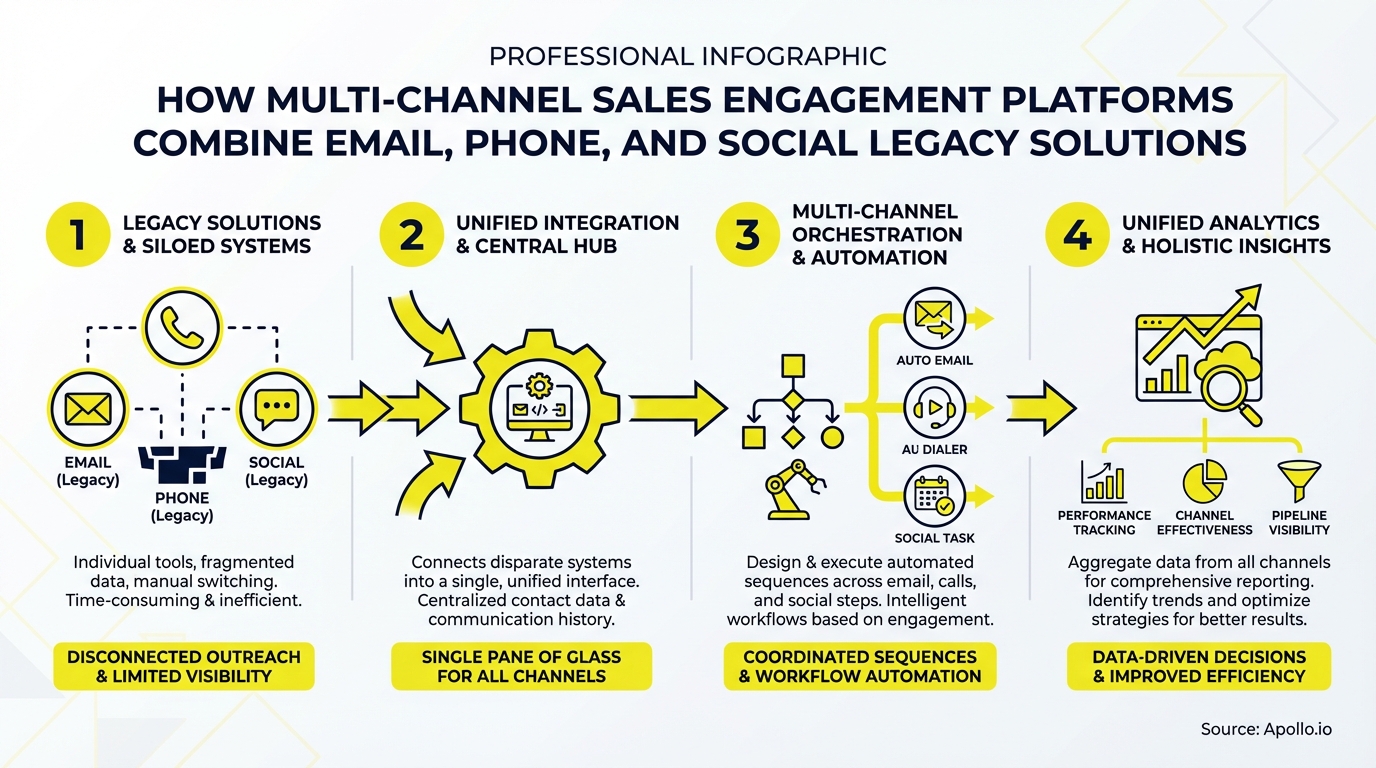
Multi-channel sales engagement platforms combine email, phone, and social outreach by building a unified sequence engine that treats each channel as a trigger-aware step, not an isolated action. When a prospect opens an email, that signal can automatically promote the next step from a follow-up email to a call task or a social connection request, depending on the rules set inside the platform.
The architecture has three core layers:
- Data layer: Verified contact records, intent signals, and enrichment data that inform who gets which message on which channel.
- Orchestration layer: The sequence engine that queues tasks, fires automated steps, and routes manual actions (like calls or social touches) to rep task lists.
- Feedback layer: Open rates, reply rates, call outcomes, and social responses feed back into the system to adjust future steps or branch the sequence.
This closed-loop design is what separates true orchestration from running three separate tools in parallel. Learn more about the underlying mechanics in our guide to what a sales cadence is and how AI powers it.
Why Does Multi-Channel Coordination Matter More in 2026?
Multi-channel coordination matters because irrelevant, poorly timed outreach actively destroys pipeline. A 2025 Gartner survey found that 73% of B2B buyers actively avoid suppliers who send irrelevant outreach, and 61% prefer a rep-free buying experience overall.
That means every mismatched touchpoint is a relationship risk, not just a missed reply.
Data from Landbase reinforces the opportunity: multi-channel campaigns using three or more channels achieve 287% higher purchase rates compared to single-channel strategies. The math strongly favors coordinated, context-aware outreach over volume-based spray-and-pray tactics.
Meanwhile, Martal reports that companies with strong omnichannel strategies retain 89% of their customers, versus just 33% for those with weak channel integration. For RevOps leaders, that retention gap has direct implications for net revenue retention and forecasting accuracy.
Turn Funnel Guesswork Into Real Pipeline
Tired of watching marketing leads stall before they ever reach your pipeline? Apollo surfaces in-market buyers the moment they're ready, so your team stops chasing cold leads and starts closing real opportunities. 600K+ companies trust Apollo to forecast with confidence.
Start Free with Apollo →How Do SDRs Manage Email, Phone, and Social in One Workflow?
SDRs manage all three channels in one workflow by working from a unified task queue that surfaces the next best action based on prospect behavior, not a fixed calendar. Instead of logging into separate tools for email, a power dialer, and social tasks, the platform consolidates everything into a single prioritized list.
A typical multi-channel sequence for an SDR might look like this:
| Day | Channel | Step Type | Trigger Logic |
|---|---|---|---|
| 1 | Automated send | Sequence enrollment | |
| 3 | Phone | Manual call task | Email opened or no reply |
| 5 | Social | Manual connection task | Call went to voicemail |
| 7 | Automated follow-up | No social acceptance after 48 hrs | |
| 10 | Phone | Manual call task | Email replied or opened 2x |
Modern platforms are moving beyond fixed-day sequences toward signal-triggered orchestration, where a prospect's behavior (site visit, email click, intent spike) can dynamically advance or branch the sequence. Spending hours managing this manually? Automate your multi-channel sequences with Apollo's sales engagement platform.

What Is the Integration Architecture Behind These Platforms?
The integration architecture behind multi-channel platforms connects a CRM, email provider, dialer, social task manager, and enrichment data source into a single data model where every touchpoint is logged automatically. Auto-logging is the critical piece: without it, reps manually record call outcomes and email replies, which is where execution breaks down.
A 2025 Bain survey of 1,200+ senior commercial executives found that 70% of companies don't effectively integrate their sales plays into CRM and revenue technologies. The integration checklist that separates working platforms from broken ones includes:
- Bi-directional CRM sync: Contacts, activities, and sequence status flow both ways without manual exports.
- Native dialer with auto-logging: Call outcomes, recordings, and notes write back to the contact record automatically.
- Social task management: Connection requests, messages, and profile views are tracked as sequence steps, not ad hoc actions.
- Enrichment and intent signals: Real-time data updates trigger re-enrollment or sequence branching without rep intervention.
- Analytics across all channels: Sequence performance reports show drop-off by channel, not just aggregate open rates.
For a deeper look at how Apollo handles sequence design, see the top 3 sales sequences in Apollo with examples.
How Does AI Change Multi-Channel Outreach Execution?
AI changes multi-channel outreach by shifting the platform's role from a task scheduler to a next-best-action engine. Instead of following a rigid sequence, AI analyzes call recordings, email reply sentiment, intent signals, and pipeline stage to recommend whether the next touch should be an email, a call, or a social message, and what that message should say.
For Account Executives managing active opportunities, this matters most at the deal level. AI can surface which stakeholders in an account haven't been contacted recently, flag intent spikes that suggest a buying committee is actively evaluating, and recommend messaging aligned to the prospect's role and stage.
Apollo's AI platform has seen 500% year-over-year growth, with teams reporting 46% more meetings booked using the AI Research Agent.
The practical output for AEs: less time deciding what to do next, more time in front of buyers. Explore how sales automation works and how to use it correctly without losing the human touch that closes deals.
How Does Apollo Unify Email, Phone, and Social in One Platform?
Apollo unifies email, phone, and social outreach inside a single GTM platform that combines a 230M+ contact database, multi-channel sequence builder, native dialer, and AI-powered messaging, eliminating the need to stitch together separate tools. Trusted by nearly 100,000 paying customers including Anthropic, Smartling, and Cyera, Apollo gives SDRs, AEs, and RevOps teams one workspace for everything from prospecting to pipeline.
Key capabilities that make multi-channel execution work inside Apollo:
- Sequence builder: Create email, call, and social steps with branch logic based on prospect behavior.
- Native dialer: Make calls directly in the platform with auto-logged outcomes and AI call summaries.
- Social task management: Queue and track professional network outreach as a structured sequence step.
- AI Research Agent: Automates prospect research and personalizes messaging across all channels.
- CRM integrations: Bi-directional sync keeps every touchpoint recorded without manual data entry.
As Cyera put it: "Having everything in one system was a game changer." Apollo replaces the fragmented stack with a single platform, which is exactly what Census found when they said, "We cut our costs in half." See how Apollo compares to other platforms in our Apollo vs. Outreach vs. Salesloft comparison.

Start Running Coordinated Multi-Channel Outreach Today
Multi-channel sales engagement platforms combine email, phone, and social by unifying them inside a single sequence engine with shared data, auto-logging, and AI-driven next-best-action guidance. The teams winning in 2026 are not sending more outreach — they're sending better-coordinated, signal-triggered touchpoints that respect where each buyer is in their journey.
Apollo gives B2B GTM teams everything they need in one place: verified contact data, multi-channel sequences, a native dialer, and AI-powered personalization. No fragmented tech stack.
No manual logging. Just pipeline.
Start Prospecting Free with Apollo
Apollo Turns ROI Guesswork Into Proof
ROI pressure killing your next budget approval? Apollo delivers measurable pipeline impact from day one — no slow ramp, no guesswork. Leadium 3x'd annual revenue. Your CFO will notice.
Start Free with Apollo →Don't miss these
Sales
Inbound vs Outbound Marketing: Which Strategy Wins?
Sales
What Is a Sales Funnel? The Non-Linear Revenue Framework for 2026
Sales
What Is a Go-to-Market Strategy? The 2026 GTM Playbook
See Apollo in action
We'd love to show how Apollo can help you sell better.
By submitting this form, you will receive information, tips, and promotions from Apollo. To learn more, see our Privacy Statement.
4.7/5 based on 9,690 reviews
