
Build, Buy, or Blend: How Mid-Market B2B Companies Decide on AI SDR Capability in 2026
The AI SDR decision is no longer binary. Mid-market B2B revenue leaders, SDR managers, and RevOps teams are navigating a three-way choice: build custom AI workflows internally, buy a dedicated AI SDR platform, or blend both. Getting this wrong means wasted budget, stalled pipelines, and a rep team that's more frustrated than empowered. Getting it right means faster pipeline, lower cost-per-meeting, and a GTM motion that scales. Tools like Apollo's AI Sales Assistant illustrate what "blend" can look like in practice: an end-to-end GTM AI embedded in your existing workflow that handles research, list building, sequencing, and scoring without requiring a dedicated engineering team.
The market is moving fast. According to Insight Mark Research, the AI SDR market is projected to grow from approximately $4.12 billion in 2025 to $15.01 billion by 2030 at a 29.5% CAGR. Understanding how the B2B buyer journey has shifted in 2026 is equally critical before committing to any deployment model.

Let Apollo Find Your Next Buyer
Tired of burning hours on manual research just to hit dead ends? Apollo surfaces verified contacts instantly so your reps spend time selling, not searching. Nearly 100K paying customers have already made the switch.
Start Free with Apollo →Key Takeaways
- Most mid-market teams end up in a "blend" model: vendor platform plus internal configuration, not full custom builds.
- Buying is the fastest path to value, but governance and compliance accountability always stay with the sender regardless of vendor.
- Building in-house makes sense only when you have a proprietary data advantage, dedicated AI/RevOps engineering, and 6-12 months of runway before pipeline pressure hits.
- The real differentiator in 2026 is signals-to-action speed: intent data, scoring, and routing logic matter more than copy generation alone.
- Success metrics that predict pipeline (meeting show rate, SQL-to-opportunity conversion, domain health) outperform vanity metrics like emails sent.
What Is the Build vs. Buy vs. Blend Framework for AI SDR?
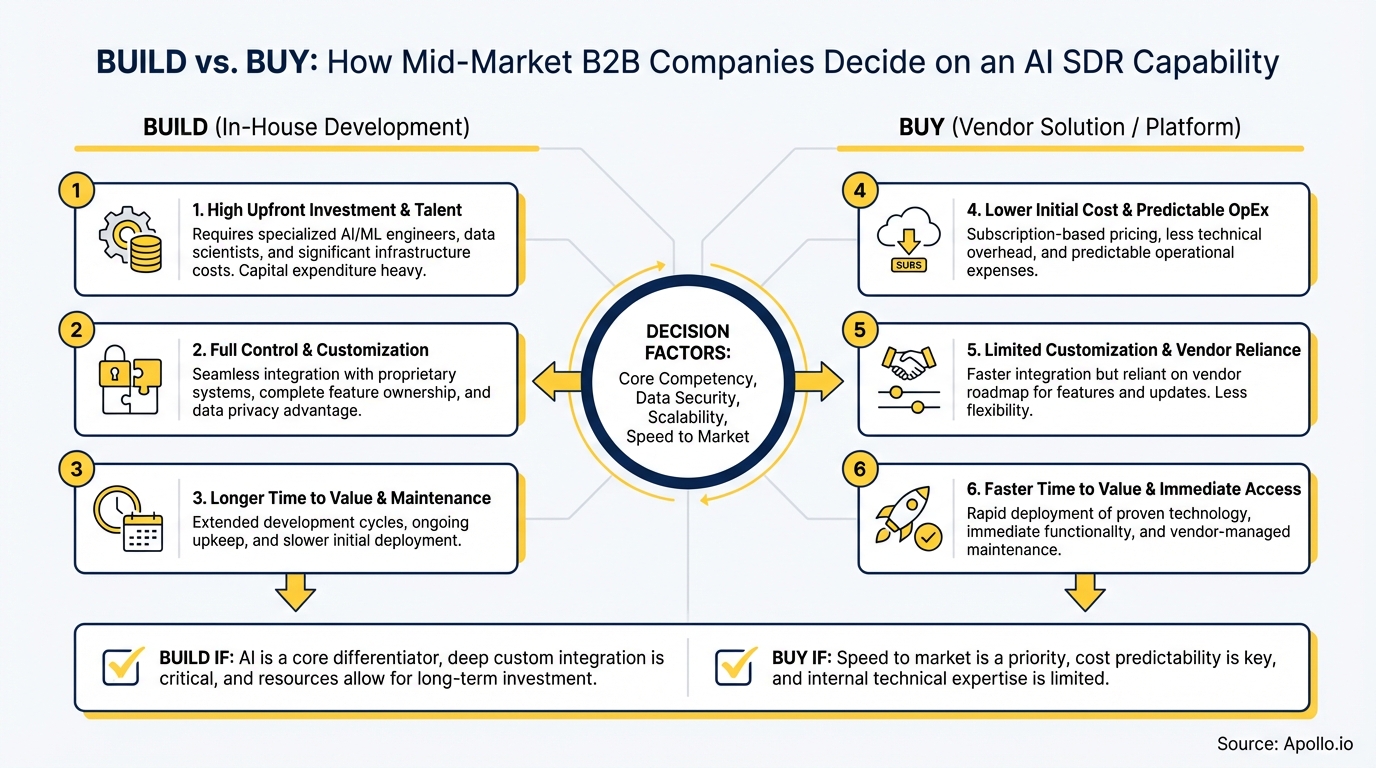
The build vs. buy vs. blend framework is a structured decision model that helps mid-market B2B teams allocate resources and choose the right AI SDR deployment path based on their specific constraints and goals.
| Path | What It Means | Best For | Key Risk |
|---|---|---|---|
| Build | Custom AI agents, internal data pipelines, proprietary LLM workflows | Teams with AI/RevOps engineering, proprietary data moat, 12+ month horizon | High time-to-value; Gartner estimates 30% of GenAI POCs are abandoned before production |
| Buy | Dedicated AI SDR platform or point solution | Teams needing speed-to-pipeline in under 90 days, limited internal AI resources | Vendor lock-in; compliance accountability stays with your org regardless |
| Blend | Vendor platform configured with internal ICP logic, intent signals, and governance rules | Most mid-market teams: RevOps-led, moderate technical capacity, ROI-focused | Integration complexity; requires clear ownership of configuration and QA |
Data from beam.ai shows that by 2025, only 24% of AI solutions were built internally, with 76% being purchased — a clear signal that mid-market teams are defaulting to buy-first or blend approaches rather than full custom development.
What Are the Key Criteria Mid-Market Teams Use to Decide?
Mid-market B2B companies evaluate AI SDR deployment using five primary criteria: time-to-value, internal AI expertise, data ownership, governance requirements, and cost structure.
- Time-to-value: Buying is generally the fastest route to market, while building requires significantly longer deployment cycles, as noted by MSI Publishers.
- Internal expertise: Research from Isometrik identifies limited AI skills (33%), data complexity (25%), and integration challenges (22%) as the top barriers to internal AI deployment.
- Data ownership: Teams with unique CRM history, proprietary intent signals, or niche ICP data have more reason to build custom routing and scoring layers.
- Governance and compliance: The FTC's guidance is clear: compliance accountability cannot be contracted away. Opt-out handling, audit logs, and message QA remain your responsibility regardless of vendor.
- Cost structure:SalesMotion reports that AI SDR tools typically cost $24,000 to $60,000 per year, compared to $75,000 to $110,000 annually for a fully loaded human SDR.
Struggling to identify which accounts to prioritize first? Search Apollo's 230M+ contacts with 65+ filters to build your ICP target list before committing to a deployment model.
Turn Funnel Gaps Into Predictable Pipeline
Tired of watching MQLs stall before they ever reach your AEs? Apollo surfaces high-intent prospects and keeps your pipeline moving with verified contacts that actually convert. Nearly 100K paying customers stopped guessing and started closing.
Schedule a Demo →How Do SDRs and RevOps Leaders Evaluate the Blend Model?
SDRs and RevOps leaders evaluate the blend model based on handoff quality, QA controls, and whether the AI augments rep judgment or attempts to replace it entirely.
The "AI SDRs failed" narrative surfaced in 2025 when investors began arguing that fully autonomous outreach underperforms augmented workflows. The pivot is toward what some call "sales superintelligence": AI that handles research, prioritization, scoring, and follow-up drafting while human reps own high-stakes conversations and complex deal navigation.
For SDRs, this means tools that reduce research time without removing human judgment from the sequence. For RevOps, it means fewer integration points and cleaner data lineage.
Apollo's Outbound Copilot exemplifies this approach: it automatically identifies ICP-matching prospects, builds sequences, and sets cadence schedules, but allows manual or automatic approval before adding new contacts. SDRs stay in control; the AI eliminates the busywork.
"Apollo's AI Assistant filters and cleans prospect data for me, so I can find the right people faster and run better searches. It saves me about an hour per prospecting session." — Erik Fernando Nieto, BDR, JumpCloud
Understanding how intent data powers smarter B2B sales is foundational for any blend model: without reliable signals, AI generates volume without precision.
What ROI Metrics Actually Predict Pipeline for AI SDR?
The metrics that predict pipeline for AI SDR deployments are meeting show rate, SQL-to-opportunity conversion, domain health score, and rep time recaptured, not emails sent or sequences launched.
- Meeting show rate: Measures whether AI-sourced meetings actually happen. Low show rates signal targeting or personalization failure.
- SQL-to-opportunity rate: Tracks whether AI-qualified leads convert downstream. Validates ICP scoring accuracy.
- Domain health score: Aggressive automation can damage sender reputation. Monitor bounce rates, spam complaints, and deliverability weekly.
- Rep time recaptured: Measures hours shifted from research and admin to selling conversations. This is the efficiency dividend the blend model promises.
- Governance pass/fail rate: Percentage of AI-generated messages approved without revision. High rates indicate well-configured content context; low rates signal misaligned messaging.
Research from Zartis, citing a McKinsey study, found that organizations delivering quick AI wins in their first year were twice as likely to achieve long-term success compared to those focused solely on developing internal platforms. This reinforces the case for starting with a vendor platform that can show measurable impact within a 90-day pilot.
For AEs managing deal pipeline, a structured data enrichment strategy ensures the contacts feeding your AI SDR are accurate enough to produce reliable scoring and personalization outputs.

What Governance Controls Does a Mid-Market AI SDR Deployment Require?
A production-grade mid-market AI SDR deployment requires opt-out enforcement, approval workflows, prompt versioning, message QA gates, and role-based access controls.
- Opt-out handling: Automated suppression lists synced in real time across all outreach channels. Non-negotiable under CAN-SPAM and similar frameworks.
- Approval workflows: Human review gates before AI-generated sequences go live, particularly for new segments or messaging angles.
- Prompt and content versioning: Track which AI prompts and message templates are in production. Enables rollback if quality degrades.
- Hallucination mitigation: Ground AI outputs in verified contact data and CRM history. Apollo's AI Content Center anchors messaging to your actual value proposition, ICP pain points, and product differentiators rather than generic outputs.
- Role-based permissions: Limit who can modify ICP filters, sequence cadence, and send volumes. Prevents well-intentioned reps from overriding safety guardrails.
Spending too much time stitching together outreach tools without governance built in? See how Apollo's AI sales automation consolidates your outbound stack with approval controls, ICP scoring, and deliverability safeguards in one platform.
How Should Mid-Market Teams Structure a 90-Day AI SDR Pilot?
A 90-day AI SDR pilot should follow three phases: instrument and baseline (days 1-30), activate and govern (days 31-60), and measure and decide (days 61-90).
- Days 1-30: Establish baseline metrics (current meeting show rate, SQL conversion, rep research time). Configure ICP scoring, content context, and suppression lists. Define governance gates.
- Days 31-60: Launch AI-assisted sequences to a controlled segment. Monitor domain health daily. Require human approval on all AI-drafted messages in week one before moving to selective review.
- Days 61-90: Compare pilot segment performance against baseline. Calculate cost-per-meeting and rep time recaptured. Evaluate vendor vs. build path based on measured gaps, not assumptions.
RevOps leaders running this pilot alongside a broader sales tech stack rationalization often find that a well-configured blend model eliminates the need for three to five separate point tools. "Having everything in one system was a game changer" — Cyera. "We cut our costs in half" — Census.

What Is the Right AI SDR Decision for Mid-Market B2B Teams in 2026?
For most mid-market B2B teams in 2026, the right AI SDR decision is a structured blend: a vendor platform configured with your ICP logic, intent signals, and governance controls, with humans owning high-stakes conversations and pilots governed by pipeline-predictive metrics.
Pure builds carry high time-to-value risk and require AI engineering capacity most mid-market teams don't have. Pure autonomous outreach platforms carry brand and deliverability risk without the augmentation layer reps actually need.
The blend model, anchored by a unified platform that connects data, sequencing, scoring, and governance, delivers faster pipeline with fewer integration risks.
Apollo's AI Assistant, Outbound Copilot, and full AI capabilities give mid-market GTM teams a practical starting point: research accounts, build targeted lists, generate signal-grounded sequences, and score leads from one workspace. "Work that would've taken me hours was done before I even got off the train." — Tory Kindlick, Head of Revenue Ops, RapidSOS.
Ready to run your 90-day pilot with a platform built for mid-market scale? Get Leads Now and see how Apollo's unified GTM platform supports the blend model from day one.
Prove Pipeline ROI With Apollo
ROI pressure killing your next budget approval? Apollo delivers measurable pipeline impact your leadership can't ignore. Teams like Leadium 3x'd annual revenue — get your proof of value fast.
Start Free with Apollo →Don't miss these
Sales
Inbound vs Outbound Marketing: Which Strategy Wins?
Sales
What Is a Sales Funnel? The Non-Linear Revenue Framework for 2026
Sales
What Is a Go-to-Market Strategy? The 2026 GTM Playbook
See Apollo in action
We'd love to show how Apollo can help you sell better.
By submitting this form, you will receive information, tips, and promotions from Apollo. To learn more, see our Privacy Statement.
4.7/5 based on 9,690 reviews
