
How to Use Data Enrichment to Improve Lead Scoring Accuracy in Your CRM (2026)
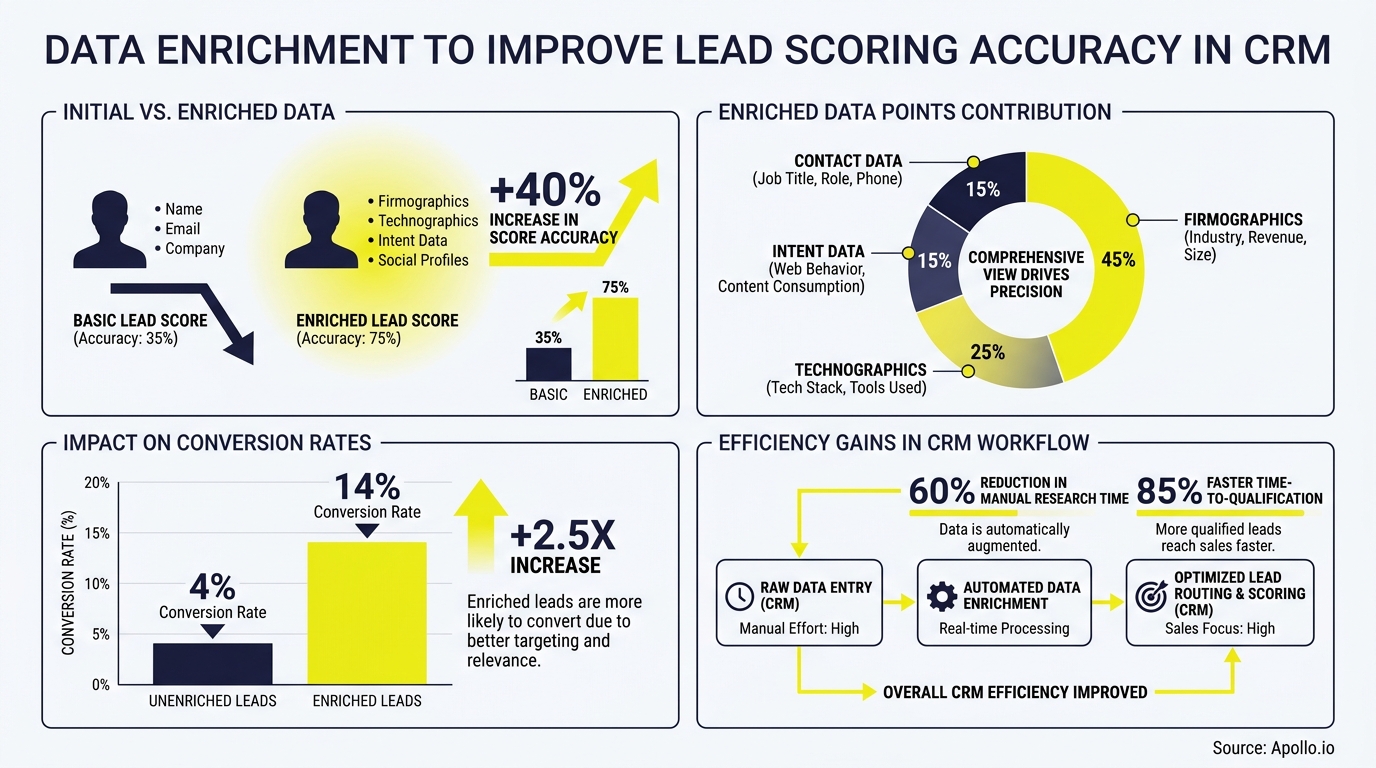
Your lead scoring model is only as accurate as the data feeding it. When CRM records are incomplete, outdated, or missing key firmographic fields, scores mislead your team, misroute deals, and waste SDR time on leads that will never convert. Data enrichment fixes the root cause by filling gaps, standardizing fields, and keeping records current so every score reflects reality.
According to Cleanlist.ai, 88% of B2B marketers state that enriched data substantially improves lead quality and conversion rates. The challenge is doing it systematically, not as a one-time data append.

Accurate Data, More Deals Closed
Tired of burning hours verifying contact info that goes nowhere? Apollo delivers 97% email accuracy so your team spends time selling, not searching. 600K+ companies have already made the switch.
Start Free with Apollo →Key Takeaways
- Data enrichment improves lead scoring only after you address baseline data quality issues like duplicates and missing fields.
- B2B contact records decay rapidly, making trigger-based re-enrichment more effective than batch updates.
- A blended scoring model combining firmographic fit, behavioral engagement, and intent signals outperforms any single-dimension score.
- RevOps leaders who govern enrichment fields with clear ownership and SLAs get more consistent, trustworthy scores.
- Enriching only at key funnel moments (MQL creation, routing, pre-SDR touch) controls costs while maximizing scoring lift.
Why Does Data Enrichment Improve Lead Scoring Accuracy?
Data enrichment improves lead scoring accuracy by adding verified firmographic, technographic, and intent data to CRM records that scoring models need to rank leads correctly. Without enriched fields like industry, employee count, tech stack, and job seniority, scoring models assign arbitrary weights to incomplete profiles and produce unreliable rankings.
The decay problem compounds this. Outbound System reports that B2B contact databases lose approximately 2.1% of their accuracy monthly, equating to about 22.5% annually, meaning nearly 1 in 4 records becomes inaccurate or outdated each year. Enrichment must be ongoing to keep scoring models calibrated.
Research from MarketsandMarkets shows companies utilizing data-driven lead enrichment experience 25% higher conversion rates and a 15% reduction in customer acquisition costs.
What Fields Should You Enrich to Boost Lead Score Quality?
The fields that most directly improve scoring accuracy fall into three categories: firmographic fit, technographic signals, and behavioral context.
| Category | Key Fields to Enrich | Scoring Impact |
|---|---|---|
| Firmographic | Industry, employee band, revenue range, geography | ICP fit score |
| Technographic | Current tech stack, integrations, platform type | Solution relevance |
| Role/Seniority | Job title, department, decision-making level | Persona match |
| Intent Signals | Buying intent topics, funding events, hiring spikes | In-market readiness |
| Contact Quality | Verified email, direct phone, social profile | Reachability score |
Prioritize fields your scoring model already uses but that are frequently blank or stale. A field that is 40% populated contributes noise, not signal. Building a structured enrichment strategy means auditing field completeness before adding new scoring dimensions.
Struggling with incomplete CRM records that tank your scoring accuracy? Fill the gaps with Apollo's CRM enrichment tool and get 65+ verified data attributes per record.
Turn Funnel Gaps Into Qualified Pipeline
Pipeline forecasting a guessing game because leads stall before they ever reach your reps? Apollo surfaces high-intent prospects and powers smarter qualification. 600K+ companies use Apollo to build pipeline they can actually count on.
Start Free with Apollo →How Do RevOps Teams Build a Continuous Enrichment Cadence?
RevOps teams build a continuous enrichment cadence by enriching at defined funnel trigger points rather than running blanket batch updates. This approach controls costs, improves score freshness, and focuses enrichment spend where it creates the most pipeline impact.
The shift from "enrich everything" to event-based, just-in-time enrichment is now a leading RevOps practice. Instead of refreshing all records monthly, teams enrich only when a lead crosses a threshold or enters a critical handoff stage.
Recommended enrichment trigger points:
- MQL creation: Enrich immediately so routing rules fire on complete data.
- Pre-SDR assignment: Refresh firmographic and contact fields before the first outreach touch.
- MQL to SQL handoff: Re-enrich to confirm role, company size, and tech stack before AE engagement.
- Trigger events: Re-enrich on funding announcements, leadership changes, or hiring spikes that signal buying readiness.
- Scoring threshold crossed: Enrich records that hit a defined fit score to validate intent before routing.
For teams using Salesforce or HubSpot, enrichment workflows can be automated so triggers fire in real time without manual intervention.
How Do SDRs and AEs Benefit From Enrichment-Driven Scoring?
SDRs benefit directly because enrichment-driven scoring surfaces the highest-fit, most-ready leads first, eliminating the manual research that consumes prospecting time. AEs benefit because enriched records mean every deal entering the pipeline has verified company context, decision-maker data, and tech stack information already populated.
For SDRs specifically, enriched scoring means fewer cold calls to wrong-fit accounts and more conversations with prospects who match the ICP. Salesmotion.io reports that companies investing in data enrichment see a 25% increase in sales productivity. That lift comes directly from SDRs spending time on pre-qualified, correctly scored leads rather than manually verifying stale CRM fields.
AEs managing late-stage deals benefit from enrichment that flags technographic or organizational changes at target accounts, enabling timely re-engagement before a competitor fills the gap. Explore how contact data enrichment drives measurable ROI across the full sales cycle.

What Is a Blended Scoring Model and Why Does It Outperform Single Scores?
A blended scoring model assigns separate scores for ICP fit, behavioral engagement, and intent signals, then combines them into a composite score that reflects both who a lead is and whether they are actively in-market. Single-dimension models that score only on firmographics miss timing; models that score only on behavior miss fit.
The most effective 2026 approach uses three inputs:
- Fit Score: Firmographic and technographic enrichment fields (industry, size, tech stack, role seniority).
- Engagement Score: Behavioral signals from product, site, and email interaction data.
- Intent Score: Third-party intent topics, trigger events (funding, hiring), and buying-signal data.
This three-signal approach prevents high-fit, low-intent leads from flooding SDR queues, and stops behavioral signals from over-scoring low-fit accounts. Landbase reports that machine learning lead scoring results in 75% higher conversion rates, with high-performing companies achieving 6% conversion rates compared to the 3.2% industry average. Blended enrichment is the foundation that makes that lift possible.
Need richer lead intelligence to power a blended model? Enrich your CRM with Apollo's 230M+ verified contacts and intent data.
What Governance Practices Keep Enrichment Trustworthy?
Data governance keeps enrichment trustworthy by establishing field ownership, refresh SLAs, source lineage, and quality KPIs so scoring models draw from consistent, auditable inputs. Without governance, adding more enrichment sources increases inconsistency and model noise rather than improving accuracy.
Minimum viable governance for enrichment-driven scoring:
- Field ownership: Assign a RevOps owner to each enriched field with a defined refresh frequency.
- Source priority rules: Establish which data source wins when enrichment vendors return conflicting values.
- Completeness KPIs: Track % of ICP fields populated, bounce/undeliverable rate, and days since last enrichment per segment.
- Deduplication standards: Run identity resolution before enrichment to prevent duplicate records from splitting score history.
- Privacy minimization: Enrich only the fields your scoring model requires. Storing unreferenced data creates compliance exposure.
Governance is not optional for teams using AI-assisted scoring. A 2024 Hitachi Vantara survey found that 37% of U.S. companies identify data quality as their top concern when implementing AI projects. Enriched but ungoverned data undermines predictive models as quickly as missing data does. Review how data sync improves B2B sales and marketing ROI when governance keeps CRM fields current.

How Do You Start Improving Lead Scoring With Data Enrichment in 2026?
Start by auditing your current CRM for field completeness on the attributes your scoring model weights most heavily. Fix baseline quality issues like duplicates and missing industry or role fields before adding new enrichment sources.
Then implement trigger-based enrichment at the funnel moments that matter most: MQL creation, pre-SDR routing, and MQL-to-SQL handoff.
Apollo consolidates data enrichment, lead scoring, prospecting, and CRM integration into one platform, eliminating the need to stitch together separate enrichment vendors, scoring tools, and outreach systems. Teams like Cyera note that "having everything in one system was a game changer." Explore Apollo's lead scoring software and B2B data enrichment for smarter routing to see how the full workflow connects.
Ready to build a scoring model your team can trust? Try Apollo free and enrich your CRM with verified data across 65+ attributes, starting today.
Prove Pipeline ROI Before Next QBR
ROI pressure killing your tool adoption? Apollo surfaces measurable pipeline impact fast — so budget conversations shift from justification to expansion. Leadium 3x'd annual revenue. Your proof starts now.
Start Free with Apollo →Don't miss these
Sales
Inbound vs Outbound Marketing: Which Strategy Wins?
Sales
What Is a Sales Funnel? The Non-Linear Revenue Framework for 2026
Sales
What Is a Go-to-Market Strategy? The 2026 GTM Playbook
See Apollo in action
We'd love to show how Apollo can help you sell better.
By submitting this form, you will receive information, tips, and promotions from Apollo. To learn more, see our Privacy Statement.
4.7/5 based on 9,690 reviews
