
How to Use Account Intent Data to Prioritize Outbound Sequences
Most outbound teams treat intent data as a targeting list. The real unlock is using it as a routing and timing engine that tells you which sequence to activate, for which account, right now. Get that distinction right, and intent data stops being a reporting tool and starts driving pipeline.
According to G2, 91% of B2B technology marketers use intent data to prioritize accounts and build target account lists — yet most teams still activate the same sequence for every account regardless of buying stage. This playbook closes that gap with buying-window frameworks, gating thresholds, and governance rules you can implement this quarter. For a primer on how signals are collected in the first place, see What Is Intent Data? How It Works, Uses, and Top Providers.

Research Less, Pipeline More With Apollo
Tired of burning hours verifying contacts before a single email goes out? Apollo surfaces accurate, ready-to-reach prospects so your reps spend time selling, not searching. Join 600K+ companies building pipeline faster.
Start Free with Apollo →Key Takeaways
- Intent data should act as a timing and routing signal, not just a targeting filter — the buying window an account is in determines which sequence to launch.
- High-touch outbound sequences should be gated by a composite score (fit + intent score + recency + topic intensity), not SDR capacity alone.
- Single-signal intent spikes are noisy; require a cluster of signals across multiple personas and topics before activating premium plays.
- Omnichannel orchestration (email, phone, social, ads) should be determined by intent stage — not defaulted to email-only cadences.
- Measurement should track pipeline velocity and journey progression, not just open rates — proving ROI requires downstream metrics.
Why Does Intent Data Alone Fail to Prioritize Outbound Sequences?
Intent data fails to drive outbound prioritization when teams lack the activation workflow to translate signals into stage-appropriate plays. Having access to intent signals is not the same as operationalizing them.
The gap is governance, not data.
Two structural problems cause most intent programs to underperform:
- Timing mismatch: Teams route all intent-flagged accounts into short-cycle "book a meeting now" sequences. Most accounts are not that close to buying. Research published by MarketsandMarkets shows that intent data lets sales professionals focus on the 15–20 prospects most likely to convert — but only when those prospects are matched to the right sequence for their stage.
- Signal noise: A single intent spike from one contact is rarely meaningful. In 2026, bot and AI agent traffic has increased the rate of false positives, pushing teams to require signal clusters (multiple contacts, multiple sessions, multiple topics) before activating high-cost plays.
The fix is a three-layer model:ICP fit decides if the account is worth pursuing, recency decides if now is the right time, and intent topic and intensity decides which sequence motion to run.
How Do You Map Buying Windows to Outbound Sequences?
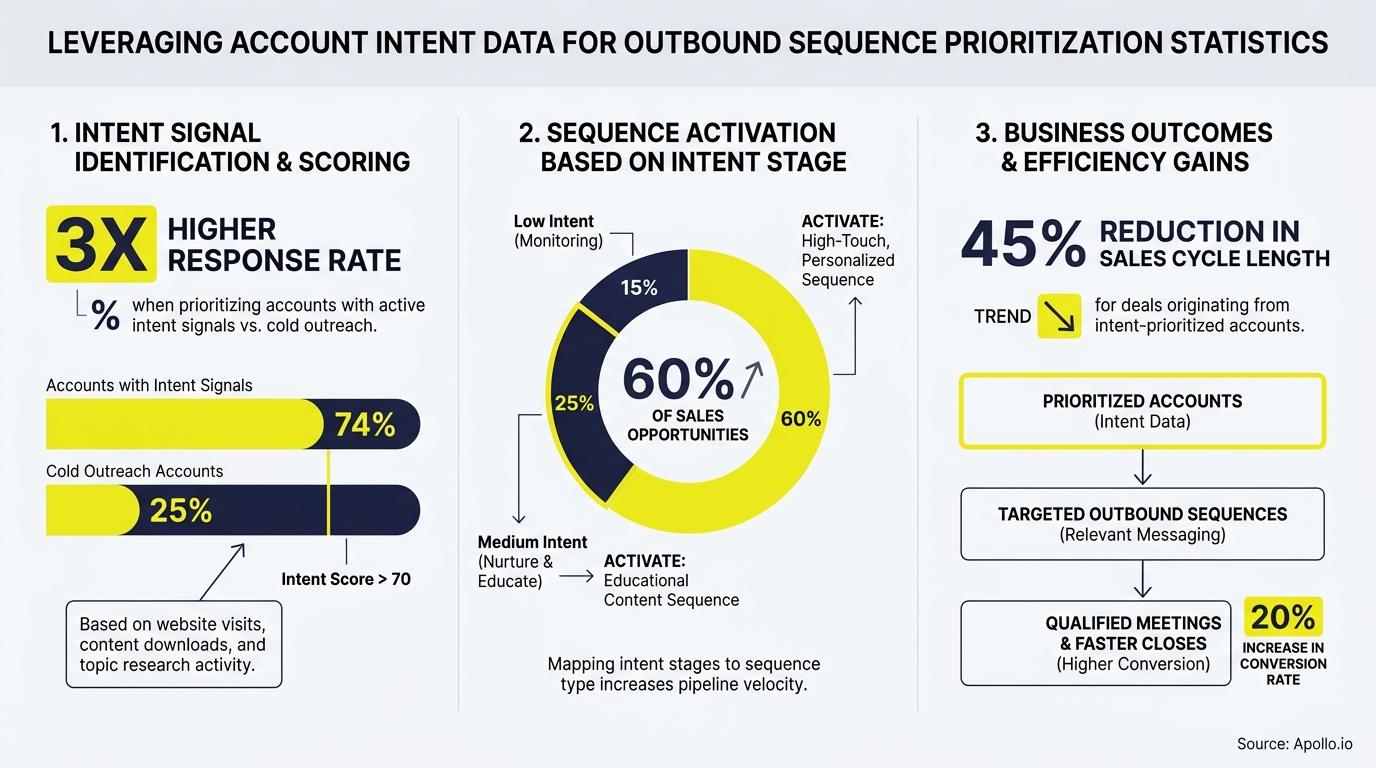
Buying-window mapping assigns each intent-flagged account to a sequence tier based on how close they are to a purchase decision. The window determines the sequence motion, the CTA, and the channel mix.
| Buying Window | Intent Signal Pattern | Sequence Motion | Primary CTA |
|---|---|---|---|
| 0–30 days | High score, recent spike, pricing/demo topics, 2+ personas | High-touch: direct outreach, phone + email + social | "Book a demo this week" |
| 31–90 days | Medium score, sustained research, solution/comparison topics | Mid-touch: value-led email sequence + retargeting | "See how [use case] works" |
| 3–12 months | Low-moderate score, early education topics, single persona | Nurture: educational content sequence + light social | "Read this benchmark report" |
Most intent-flagged accounts belong in the 31–90 day or 3–12 month tier. Routing them all into 0–30 day high-touch sequences wastes SDR capacity and burns goodwill with accounts that are not ready.
Reserve your highest-touch plays for accounts that clear your intent gating threshold — described in the next section.
Spending too much SDR time on accounts that aren't ready to buy? Automate intent-triggered sequences with Apollo's multi-channel engagement platform and let the right play launch at the right time.
What Thresholds Should Gate High-Touch Outbound Sequences?
Gating thresholds define the minimum signal conditions an account must meet before a high-touch outbound sequence is activated. Without explicit thresholds, SDRs manually decide who to contact — introducing inconsistency and wasted effort.
A practical gating model combines four dimensions:
- ICP fit score: Account must meet a minimum firmographic and technographic fit score (e.g., 70+/100).
- Intent score: Intent platform score must exceed a defined threshold — not just "above baseline."
- Recency: Signals must have occurred within a defined freshness window (e.g., last 7–14 days for 0–30 day plays).
- Signal cluster: Require activity from at least 2 contacts at the account, across at least 2 intent topics, in at least 2 separate sessions. Single-contact spikes are suppressed.
The cluster requirement is now an industry standard practice. Community practitioners and data providers alike are tightening what qualifies as a "sequence-worthy" trigger in response to noisier signal environments.
Accounts that pass all four dimensions enter the sequence queue; those that don't are held in a monitoring state and re-evaluated weekly.
For SDRs, this means their daily queue is pre-qualified — every account they see has cleared the threshold. For RevOps, it means sequence activation is auditable and consistent. Learn more about how Apollo's buying intent signals can feed directly into this gating model.
Turn Funnel Guesswork Into Closed Deals
Pipeline forecasting a guessing game? Apollo surfaces quality leads that actually convert, giving your team real pipeline clarity. Top revenue teams use Apollo to move from gut-feel forecasting to predictable revenue.
Schedule a Demo →How Should SDRs and RevOps Govern Sequence Activation and Routing?
Activation governance defines who routes each intent-flagged account, how quickly they act, and what suppression rules prevent double-touching. Without governance, intent data creates chaos — duplicate outreach, missed SLAs, and accounts falling through the cracks.
Core governance components:
- Routing rules: Accounts with an existing owner route to that rep. Unowned accounts route to the SDR assigned to that segment or territory.
- SLA by tier:0–30 day accounts: first touch within 4 business hours of threshold crossing. 31–90 day accounts: enrolled in automated sequence within 24 hours. 3–12 month accounts: added to nurture track within 48 hours.
- Suppression logic: Accounts currently in an active sequence, in a closed-lost status within 90 days, or flagged as a customer are suppressed from new sequence activation.
- Escalation trigger: If a 31–90 day account shows a sudden spike matching 0–30 day criteria, it escalates to the high-touch tier automatically.
RevOps leaders find that documenting these rules in a shared playbook — and enforcing them through workflow automation — dramatically reduces the manual overhead of intent-based prioritization. See how building winning outbound sequences ties into this governance model.

How Does Intent Stage Determine Your Omnichannel Sequence Design?
Intent stage determines which channels to activate and in what order — not just whether to send an email. McKinsey's 2024 B2B Pulse Survey found buyers used an average of 10 interaction modes across their buying journey, making email-only sequences structurally inadequate for most intents.
| Intent Stage | Channel Mix | Sequence Length |
|---|---|---|
| 0–30 days (high-touch) | Email + phone + social outreach + direct mail (strategic accounts) | 8–12 touches over 14–21 days |
| 31–90 days (mid-touch) | Email + retargeting ads + social engagement | 6–8 touches over 30–45 days |
| 3–12 months (nurture) | Email + content syndication + light social | 4–6 touches over 60–90 days |
The intent topic also shapes messaging. An account researching competitor comparisons gets a competitive displacement sequence. An account researching implementation best practices gets an educational sequence. An account revisiting pricing content gets a direct demo-offer sequence. Intent decides the motion, not just the target.
According to Forrester, over 85% of companies using intent data have achieved business benefits — but realizing those benefits requires matching the channel orchestration to the intent signal, not running a generic cadence.
How Do You Measure ROI from Intent-Driven Sequence Activation?
ROI from intent-driven sequencing is measured through pipeline velocity, sequence-to-meeting conversion by tier, and journey stage progression — not open rates or reply rates alone.
Key metrics to track by sequence tier:
- Sequence-to-meeting rate: Track separately for each buying-window tier. 0–30 day accounts should convert at a materially higher rate than 3–12 month nurture accounts.
- Pipeline velocity: Measure average days from sequence enrollment to opportunity creation, segmented by intent tier. High-intent tiers should show shorter cycles.
- Threshold accuracy: Track what percentage of accounts that cleared your gating threshold actually converted to an opportunity. Adjust thresholds quarterly based on this signal.
- Suppression effectiveness: Measure how often suppressed accounts re-enter the queue at a higher tier — this validates your escalation logic.
Research from The Insight Collective found that 99% of businesses reported an increase in sales or ROI after implementing intent data in their strategies — but that outcome depends on having measurement infrastructure that tracks downstream pipeline, not just top-of-funnel activity.
Ready to activate intent-driven sequences without stitching together five separate tools? Apollo's buying intent data surfaces in-market accounts directly inside the same platform where you build and launch sequences — no manual export required. "Having everything in one system was a game changer" — Cyera.

Start Activating Intent-Driven Sequences in 2026
The teams pulling ahead in 2026 are not the ones with more intent data — they are the ones with better activation workflows. That means buying-window tiers, gating thresholds, governance rules, omnichannel orchestration, and downstream measurement all working together as a system.
Start with the framework in this article: define your three sequence tiers, set your composite gating criteria, document your routing SLAs, and measure velocity not vanity metrics. Each layer you add compounds the ROI of the signals you are already paying for.
Apollo brings intent signals, contact data, and multi-channel sequences into one unified platform — so your SDRs work from a pre-prioritized queue instead of a raw export. Start free with Apollo and activate your first intent-driven sequence today.
Prove ROI Before Budget Review
ROI pressure killing your tool adoption? Apollo delivers measurable pipeline impact fast — so your next budget conversation leads with wins, not guesses. Leadium 3x'd their revenue. Your turn.
Start Free with Apollo →Don't miss these
Sales
Inbound vs Outbound Marketing: Which Strategy Wins?
Sales
What Is a Sales Funnel? The Non-Linear Revenue Framework for 2026
Sales
What Is a Go-to-Market Strategy? The 2026 GTM Playbook
See Apollo in action
We'd love to show how Apollo can help you sell better.
By submitting this form, you will receive information, tips, and promotions from Apollo. To learn more, see our Privacy Statement.
4.7/5 based on 9,690 reviews
