
How to Use Account-Based Signals to Trigger Outbound Outreach at the Right Time
Most outbound teams collect account-based signals. Few act on them before the buying window closes.
The gap between signal and sequence is where pipeline dies, and in 2026, that gap is a competitive liability.
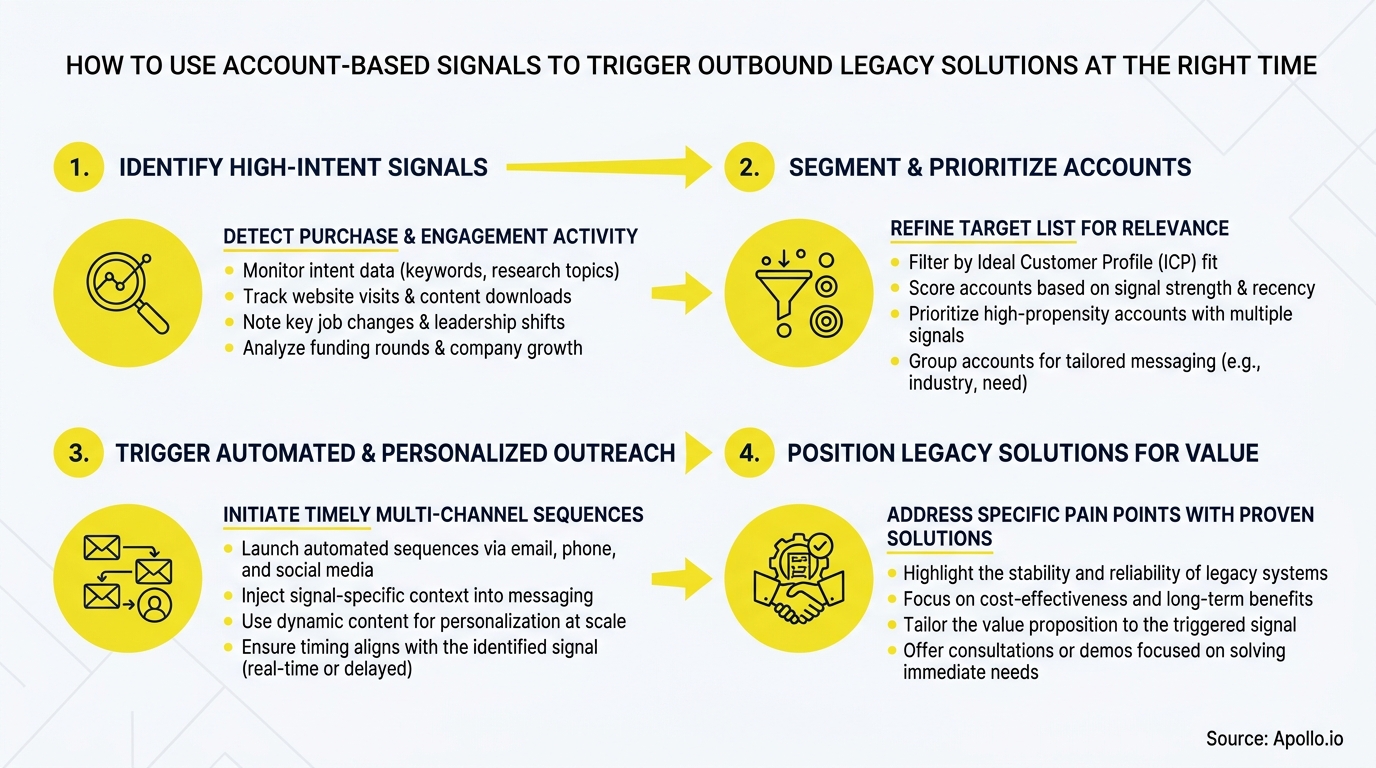
The fix is not more data. It is a structured framework that maps signals to buying-group milestones, assigns SLA-governed routing rules, and fires the right outreach motion within hours, not days. This guide gives you that framework. For broader context on outbound prospecting strategy, see our full playbook.

Research Less, Close More With Apollo
Tired of burning hours verifying contacts that go nowhere? Apollo delivers 230M+ accurate business contacts so your reps spend time selling, not searching. Start building real pipeline today.
Start Free with Apollo →Key Takeaways
- Account-based signals are most valuable when mapped to buying-group milestones, not individual lead scores.
- Signal stacking (multiple corroborating signals) produces more reliable outbound triggers than a single intent spike.
- SLA-governed routing rules prevent high-intent moments from expiring while waiting in SDR queues.
- Buyers who receive highly customized, signal-driven outreach are significantly more receptive than those who receive generic sequences.
- Intent data delivers measurable pipeline impact only when operationalized into automated plays, not manual reviews.
What Are Account-Based Signals and Why Do They Matter for Timing?
Account-based signals are behavioral, firmographic, and technographic data points that indicate an account is actively moving through a buying journey. They matter for timing because outbound sent to an account mid-evaluation outperforms outbound sent to a cold account by a wide margin.
According to Martal, 79% of companies using AI and intent data report revenue growth, indicating that timing outreach around buying signals converts interest into revenue. The key is knowing which signals to act on and when.
Common account-based signal categories include:
- Intent signals: Third-party topic research spikes on relevant keywords
- Engagement signals: Website visits, pricing page views, demo page revisits, content downloads
- Firmographic triggers: Funding rounds, leadership changes, hiring surges in relevant departments
- Technographic signals: New tool adoption or incumbent tech removal
- Buying-group signals: Multiple stakeholders from the same account engaging across channels
Understanding how intent data works is the foundation for using these signals effectively.
How Do You Build a Signal Taxonomy for Buying Groups?
A signal taxonomy organizes triggers by buying-group milestone rather than by lead score, ensuring outreach aligns with where the account is in its decision process.
Buying groups in B2B rarely move as one. Research from Gartner found that buying groups reaching internal consensus were 2.5 times more likely to report a high-quality deal outcome.
This means your signal thresholds should watch for cross-functional participation spikes, not just a single contact's activity.
| Buying-Group Milestone | Signal to Watch | Recommended Outreach Motion |
|---|---|---|
| Problem awareness | Intent spike on pain-point keywords | SDR email sequence (educational) |
| Solution evaluation | Pricing page + demo page revisits | AE direct outreach with ROI framing |
| Vendor comparison | Review-site activity + competitor research | Multi-thread: champion + economic buyer |
| Risk validation | Security/compliance content engagement | Technical evaluator outreach + case study |
| Consensus building | 3+ stakeholders from same account active | Executive outreach + business case asset |
Signal stacking improves reliability. A single intent spike is noise.
An intent spike combined with a pricing page visit and a hiring signal for a relevant role is a trigger worth acting on within 24 to 48 hours.
Turn Funnel Gaps Into Pipeline Wins
Pipeline forecasting a guessing game? Apollo surfaces in-market buyers the moment they're ready, so your team stops chasing cold leads and starts closing warm ones. 600K+ companies trust Apollo to call their shots.
Start Free with Apollo →How Do SDRs and AEs Activate Signals with SLA-Governed Routing?
SDRs and AEs activate signals effectively when routing rules automatically assign ownership, define the expected action, and set a decay window that escalates if no action is taken.
Without routing SLAs, high-intent signals expire in queues. A practical SLA framework works as follows:
- Tier 1 (hot signal cluster): Route to owning SDR within 4 hours. Required action: personalized email + call task. Decay: escalate to AE if no action in 24 hours.
- Tier 2 (single strong signal): Route within 24 hours. Required action: enroll in signal-specific sequence. Decay: reassign after 48 hours.
- Tier 3 (weak/early signal): Add to nurture. No immediate SDR action required.
For AEs managing active accounts, firmographic triggers (leadership change, funding event) should create a same-day task to re-engage the economic buyer with a relevant angle. Building the right outbound sequence structure ensures reps know exactly which steps to take once routing fires.
Struggling to keep your outreach moving fast enough? Automate your signal-triggered sequences with Apollo's multi-channel sales engagement platform and stop letting buying windows close while signals sit in your inbox.

What Does a Signal-Triggered Outreach Message Look Like?
A signal-triggered message names the specific signal, connects it to a relevant problem, and proposes a clear next step, all in three sentences or fewer.
Buyers accept signal-driven outreach when reps make the "why now" visible. Generic sequencing performs significantly worse than customized outreach in buyer preference studies.
Here are three message templates by signal type:
Template 1: Pricing page revisit (evaluation stage)
"[Name], noticed [Company] has been revisiting our pricing page a few times this week. Teams in [industry] at your stage often have questions about how we structure pricing for [specific use case]. Worth a 15-minute call this week?"
Template 2: Funding event trigger
"Congrats on the Series B, [Name]. Companies scaling past this stage typically prioritize [pain point your product solves]. Happy to share how [similar company] handled this in the first 90 days post-raise."
Template 3: Consensus-building signal (multi-stakeholder activity)
"[Name], it looks like a few folks from [Company] have been exploring [topic area] recently. If there's an internal evaluation underway, I can put together a business case template your team can use. Interested?"
For more on email personalization strategies that improve reply rates, see our dedicated guide.
How Do You Ensure Signal Data Quality Before Triggering Outreach?
Signal data quality requires identity resolution, freshness validation, and source corroboration before any outbound motion fires.
Poor signal quality is the most common reason intent programs fail to generate pipeline. Key governance practices include:
- Identity resolution: Match anonymous intent signals to named accounts using firmographic matching, not just domain matching.
- Freshness thresholds: Signals older than 14 days should not trigger Tier 1 outreach. Set automated decay rules in your workflow engine.
- Source corroboration: Require at least two independent signal sources before routing to an SDR (e.g., third-party intent plus first-party web activity).
- Contact verification: Ensure the contacts being enrolled in signal-triggered sequences have verified emails. Learn how to verify business email addresses before sending.
Data from Techinformed shows that 65% of marketers report intent signals have improved their pipeline forecasting accuracy, but that improvement depends entirely on the quality of the signals being ingested.
Tired of manually verifying contact data before every campaign? Enrich and verify your account data automatically with Apollo so every signal-triggered sequence starts with clean, accurate contact information.
How Do You Measure Whether Signal-Based Outbound Is Working?
Measure signal-based outbound by tracking signal-to-meeting rate, signal-to-pipeline rate, and time-to-first-contact per routing tier.
Research from FinalFunnel notes that in Q2 2024, 71% of B2B organizations began using external intent signals to time their outreach, making measurement a competitive differentiator for teams that instrument it correctly.
Core KPIs to track by signal tier:
- Signal-to-contact rate: What percentage of triggered signals result in a rep reaching out within the SLA window?
- Signal-to-meeting rate: Of accounts reached via signal-triggered outreach, what percentage book a meeting?
- Signal-to-pipeline rate: What revenue is generated from signal-sourced opportunities versus non-signal outbound?
- SLA compliance rate: What percentage of Tier 1 signals are actioned within the 4-hour window?
- Signal decay impact: Does pipeline rate drop when signals are acted on beyond the SLA window? (It typically does.)
RevOps leaders should build a signal attribution dashboard that connects CRM opportunity source to the triggering signal type. This allows you to rank signal categories by pipeline contribution and reallocate budget toward the highest-performing sources. For a broader view of sales automation best practices that support attribution, see our automation guide.

Start Triggering Outbound at the Right Time with Apollo
Signal-based outbound works when it is systematic, not reactive. The teams winning pipeline in 2026 are not those with the most intent data subscriptions.
They are the ones with the tightest signal-to-sequence workflows and the strictest SLA discipline.
Apollo consolidates your prospecting data, signal filtering, sequence enrollment, and outreach automation into one platform, so you stop stitching together five tools to do what one workspace can handle. As Cyera's team put it: "Having everything in one system was a game changer."
Ready to build signal-triggered outbound that actually converts? Start Prospecting with Apollo and put your account-based signals to work today.
Prove Pipeline ROI With Apollo
ROI pressure killing your tool budget approval? Apollo delivers measurable pipeline impact from day one — so you walk into every budget review with numbers, not guesses. Leadium 3x'd revenue. You're next.
Start Free with Apollo →Don't miss these
Sales
Inbound vs Outbound Marketing: Which Strategy Wins?
Sales
What Is a Sales Funnel? The Non-Linear Revenue Framework for 2026
Sales
What Is a Go-to-Market Strategy? The 2026 GTM Playbook
See Apollo in action
We'd love to show how Apollo can help you sell better.
By submitting this form, you will receive information, tips, and promotions from Apollo. To learn more, see our Privacy Statement.
4.7/5 based on 9,690 reviews
