
How to Run an Outbound A/B Test Across Subject Lines, Messaging, and Call-to-Actions in 2026
Most outbound A/B tests produce misleading results. Not because the hypothesis was wrong, but because deliverability failures, undersized samples, or open-rate noise corrupted the data before a single reply came in. If you're an SDR, BDR, or RevOps leader trying to improve reply rates and booked meetings, this playbook gives you a validity-first framework for testing subject lines, messaging, and CTAs that actually holds up. Start with your outbound prospecting foundation before layering in experimentation.

Research Less. Pipeline More With Apollo.
Tired of your reps burning hours verifying contact info instead of selling? Apollo delivers 230M+ accurate business contacts so your team hits the phones faster. Start building real pipeline today.
Start Free with Apollo →Key Takeaways
- Deliverability must be confirmed before creative testing begins. SPF/DKIM/DMARC failures can make one variant look like a winner simply because it got delivered.
- According to SalesHive, nearly 65% of businesses that systematically use A/B testing tools report conversion rate improvements of 10% or more.
- Test one variable per experiment. Subject line, opening line, or CTA, never all three at once without a proper multivariate design.
- Downstream metrics (meeting show rate, multi-thread rate) reveal more than open rate, which is increasingly unreliable as a primary signal.
- AI accelerates variant generation, but humans must own hypotheses, guardrails, and stopping rules to avoid false positives.
Why Do Most Outbound A/B Tests Fail Before They Start?
Most outbound A/B tests fail because they skip the deliverability baseline. If your SPF, DKIM, or DMARC records are misconfigured, variant A might land in the inbox while variant B routes to junk.
That's not a messaging result, it's an authentication failure masquerading as one. Microsoft enforced strict bulk sender requirements for Outlook.com domains in May 2025, meaning any team sending high volume without proper authentication may be invalidating their own test conclusions right now.
Before running any experiment, confirm these prerequisites:
- Authentication: SPF, DKIM, and DMARC all passing
- List hygiene: Bounce rate below 2%, complaint rate below 0.1%
- Baseline metrics: At least 2 weeks of clean send data per sender domain
- Unsubscribe mechanics: One-click unsubscribe active and functional
- Sample size: Minimum 200 contacts per variant for statistical significance
How Do You Design a Multivariate Outbound Email Test?
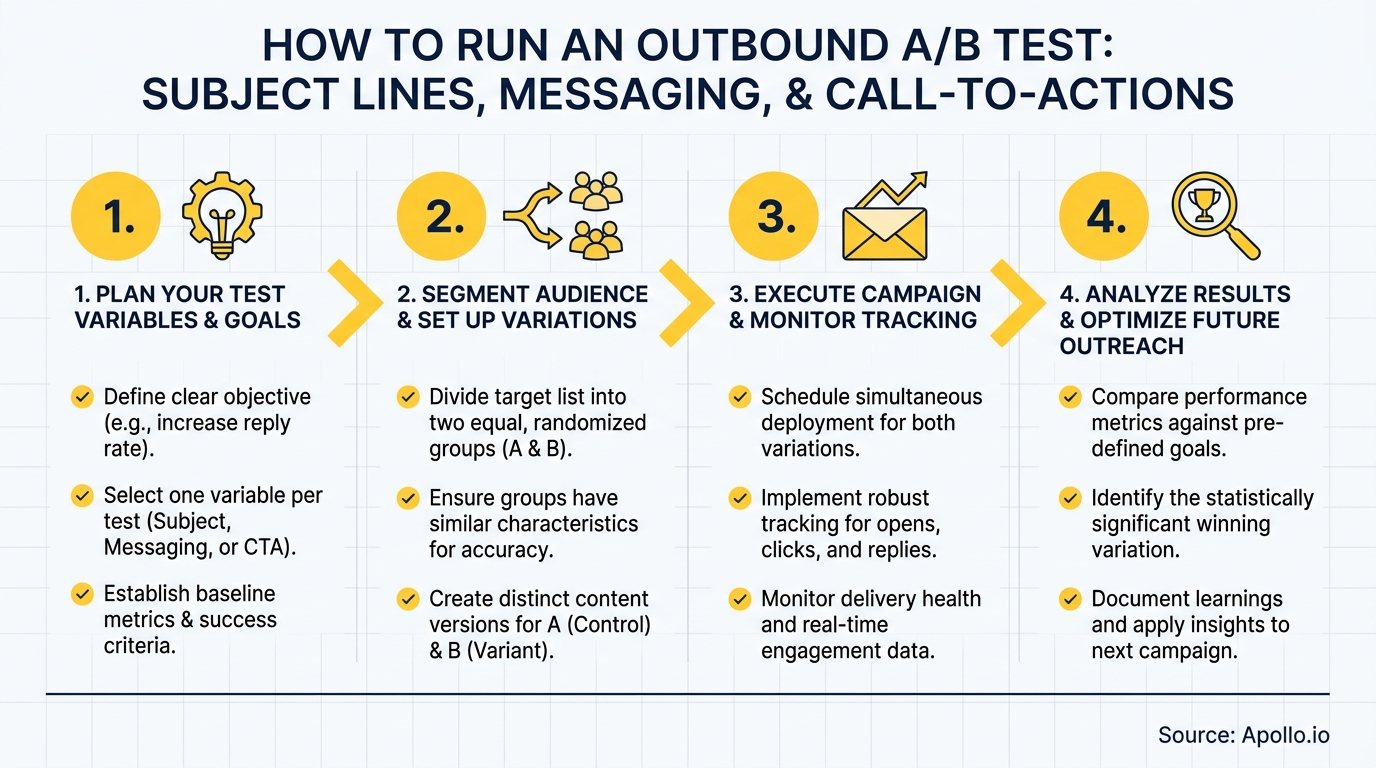
A properly designed outbound A/B test isolates one variable per experiment, or uses a full factorial design if testing multiple variables simultaneously. Testing subject line AND CTA in the same send creates interaction effects that make it impossible to attribute the result to either change.
| Test Layer | Variable to Isolate | Primary Metric |
|---|---|---|
| Subject Line | Curiosity vs. specificity vs. personalization | Open rate (secondary), reply rate (primary) |
| Opening Line | Trigger event vs. pain statement vs. peer proof | Positive reply rate |
| CTA | Micro-commitment vs. meeting ask vs. referral ask | Meeting booked rate |
| Personalization Depth | First name only vs. contextual detail vs. trigger-based | Reply rate, meeting show rate |
Research from Allegrow shows that 33% of recipients decide whether to open emails based solely on the subject line, making it a high-leverage first test. Run subject line experiments first to establish open-rate lift, then move downstream to opening lines and CTAs once your inbox placement is confirmed. See 40+ sales email subject lines that actually convert for proven starting variants.
What Metrics Should SDRs and RevOps Track Beyond Open Rate?
SDRs should use reply rate and meeting booked rate as their primary success metrics. Open rate is increasingly unreliable due to bot opens, Apple Mail Privacy Protection, and provider prefetching.
RevOps leaders should layer in downstream signals that reflect buying group behavior, not just individual responses.
- Positive reply rate: Replies that express interest, not just unsubscribes or auto-responders
- Meeting booked rate: Variant-to-calendar conversions
- Meeting show rate: Confirms the quality of the promise made in the email
- Multi-thread rate: Were additional stakeholders CC'd or did a forward occur?
- Pipeline influenced: Did contacted accounts enter opportunity stage within 30 days?
Tracking multi-thread rate matters because B2B deals rarely close from a single contact. A/B test variants that generate more internal forwards indicate message relevance to the broader buying group, not just the individual recipient. Pair this data with your intent data signals to understand whether timing or messaging drove the result. Spending too much time manually tracking these signals? Automate your sequences and track variant performance in Apollo's multi-channel platform.
Turn Funnel Gaps Into Predictable Pipeline
Tired of watching marketing leads stall before they ever reach your AEs? Apollo surfaces high-intent prospects and arms your team with the signals to act first. 600K+ companies trust Apollo to build pipeline that actually converts.
Start Free with Apollo →How Should You Test Personalization Depth in Outbound Emails?
Personalization testing should move from shallow (first name) to contextual (trigger event or role-specific pain) to deep (account-specific research). Each level has a different cost-to-reply ratio, and deeper personalization doesn't always win at scale.
Outreaches.ai reports that personalization beyond the first name increases reply rates by 340%. However, deep personalization at scale requires either manual research time or AI-assisted enrichment. The practical framework is:
- Tier 1 (High volume): Role + industry pain point, no manual research
- Tier 2 (Mid volume): Trigger event (funding, hire, product launch) sourced from enrichment
- Tier 3 (Low volume, high value): Account-specific research, custom opening line per contact
Test each tier against a matched segment. Use the same CTA across all three to isolate personalization depth as the variable. For subject lines specifically, SalesHive reports that adding personalization such as a name or contextual detail typically increases open rates by around 26%.

How Do SDRs Use AI to Generate and Govern Test Variants?
SDRs and sales teams use AI to generate multiple on-brand variants rapidly, then apply governance rules to prevent false positives and variant bloat. The human role shifts to defining the hypothesis, setting guardrails, and enforcing stopping rules.
A practical AI-assisted testing workflow:
- Define hypothesis: "Trigger-based opening lines will outperform generic pain statements for VP-level contacts in SaaS."
- Generate variants: Use AI to produce 4-6 subject line variants and 4-6 opening line variants per hypothesis
- Set stopping rules: Declare a winner only after reaching statistical significance (p < 0.05) OR after your minimum sample size is exhausted
- Holdout group: Keep 10-15% of your list in a control group receiving your current best-performing template
- Evaluate cadence: Review results weekly, not daily. Early data is noisy.
Pair AI-generated variants with sales automation that can route each variant to the correct segment without manual list splitting. This is where a unified platform eliminates the coordination overhead that breaks most experiments. Struggling to keep your contact data clean enough for reliable segmentation? Enrich and verify your contacts with Apollo's 230M+ person database.
What CTA Types Should You Test in Outbound Sequences?
The most impactful CTA tests in outbound compare micro-commitments against direct meeting asks. Micro-commitments ask for a low-friction response and often outperform "book a 30-minute call" in cold outreach, particularly for senior buyers.
| CTA Type | Example | Best Used For |
|---|---|---|
| Micro-commitment | "Worth a 2-minute read?" | Cold first touch, VP+ |
| Direct ask | "Open to a 15-minute call Thursday?" | Warm follow-up, Director level |
| Single-question reply | "Is [pain point] on your radar this quarter?" | High-volume sequences |
| Referral ask | "Who on your team handles [X]?" | Wrong contact, multi-thread |
| Fast-value offer | "I have a 1-page benchmark for your industry." | Content-led sequences |
Fast-value CTAs align with current buyer preferences. Demand Gen Report's 2024 Content Preferences Benchmark Survey found short-form content was the most valuable format for 67% of B2B buyers, suggesting CTAs that promise quick consumption outperform those leading with long-form assets. Pair CTA testing with your outbound sequence cadence strategy to test CTA placement across touch points, not just the first email.
How Do You Declare a Winner and Scale the Winning Variant?
Declare a winner only when your sample size is sufficient and results are statistically significant. Ending a test early because one variant looks promising is the single most common error in outbound experimentation.
- Minimum sample: 200+ contacts per variant before reviewing results
- Significance threshold: p < 0.05 for business-critical decisions
- Practical significance: A lift of less than 5 percentage points in reply rate may not justify a full rollout
- Scaling: Roll the winner into your primary sequence, then start the next test on the next variable in the stack
- Documentation: Log every test result in a shared sheet. Negative results are as valuable as positive ones.
According to SQ Magazine, 77% of B2B marketers conduct A/B tests on email campaigns at least monthly. The teams that compound those learnings over time build a durable messaging advantage that one-off campaigns can't replicate. Connect your testing results to revenue operations workflows so winning variants get documented, shared across reps, and tracked to pipeline impact.

Start Testing Smarter with Apollo
Running a valid outbound A/B test requires clean contact data, reliable sequencing infrastructure, and a unified view of what happens after the email is sent. Apollo consolidates prospecting, sequencing, and engagement analytics in one platform, so SDRs and RevOps teams can run structured experiments without stitching together three separate tools.
As Cyera put it, "Having everything in one system was a game changer."
Ready to build sequences worth testing? Get Leads Now and start your first experiment with verified contacts and built-in sequence analytics.
Prove Pipeline ROI With Apollo
ROI pressure killing your next budget approval? Apollo delivers measurable pipeline impact from day one — so you walk into every renewal conversation with proof, not promises. Leadium 3x'd their revenue. You're next.
Start Free with Apollo →Don't miss these
Sales
Inbound vs Outbound Marketing: Which Strategy Wins?
Sales
What Is a Sales Funnel? The Non-Linear Revenue Framework for 2026
Sales
What Is a Go-to-Market Strategy? The 2026 GTM Playbook
See Apollo in action
We'd love to show how Apollo can help you sell better.
By submitting this form, you will receive information, tips, and promotions from Apollo. To learn more, see our Privacy Statement.
4.7/5 based on 9,690 reviews
