
How Do I Prevent Duplicate Outreach When My Sales Team Shares Lists in 2026?
Duplicate outreach is not just an annoyance. It damages prospect relationships, wastes rep capacity, and signals to buyers that your team lacks basic coordination. As AI-powered sequencing scales outbound volume faster than governance keeps pace, the collision risk compounds daily. The fix starts with treating your CRM deduplication rules as an anti-spam system for your brand, not a periodic cleanup task. If you're also thinking about building a sales tech stack that scales revenue, list governance is where that foundation either holds or cracks.

Scale Smarter With Apollo's AI Engine
Tired of your reps burning hours on manual research instead of closing deals? Apollo surfaces verified contacts and automates outreach so your team scales without the chaos. Join 600K+ companies building predictable pipeline.
Start Free with Apollo →Key Takeaways
- Duplicate outreach is a governance problem, not just a tooling problem. The fix requires rules, ownership, and cadence, not just better software.
- According to Findstack, an estimated 91% of CRM data is incomplete, stale, or duplicated annually, making always-on dedup essential.
- RevOps must own the single customer view as a routing and suppression control plane, not just a data hygiene project.
- A decay-aware ingest cadence (validate before import, verify before send) stops duplicates at the source rather than after the fact.
- Unified platforms that combine prospecting, enrichment, and sequencing in one workspace eliminate the list-sharing problem at its root.
Why Does Duplicate Outreach Happen When Teams Share Lists?
Duplicate outreach happens when multiple reps work from separate, unconnected lists without a shared system of record enforcing ownership and suppression rules. The most common triggers are CSV-based list sharing, manual CRM imports without dedup checks, and disconnected tools where prospecting data and engagement history live in separate platforms. A RevOpsCoop survey found that 99% of RevOps respondents encounter technical data issues including duplicate and floating lead records. The root cause is almost always structural: no single source of truth, no import guardrails, and no ownership assignment at the record level.
What Does Duplicate Outreach Actually Cost Your Team?
The cost shows up in three areas: rep capacity, prospect trust, and revenue. Research from Sopro shows that 37% of CRM users have reported direct revenue loss as a result of poor data quality. Beyond lost deals, duplicate touches burn rep hours on contacts already in active sequences and create internal friction between SDRs, AEs, and marketing when ownership is unclear. For teams scaling with AI-assisted outreach, the problem multiplies: agentic automation sends messages faster than a human could catch collisions manually. This is why sales analytics and data governance need to operate together, not in separate silos.

How Should RevOps Leaders Build a Dedup Governance Framework?
RevOps leaders should build dedup governance around four control points: ingest, match, route, and suppress. Each point needs an owner, a rule set, and an exception-handling process.
| Control Point | What Happens Here | Who Owns It |
|---|---|---|
| Ingest | Validate contacts before import; block known duplicates at the door | RevOps / Sales Ops |
| Match | Apply fuzzy-match rules on email, domain, and name to identify existing records | RevOps |
| Route | Assign record ownership immediately; unowned records create duplicate touches | Sales Ops |
| Suppress | Block contacts already in active sequences or owned by another rep from entering new ones | RevOps + Platform Admin |
A 2025 study cited by MarketingOps.com found that 75% of RevOps professionals identify data inconsistencies as the most frustrating aspect of their tech stack. The fastest path to fixing this is assigning explicit ownership at each control point and documenting it in a RACI before touching tooling.
Tired of managing duplicate lists across disconnected tools? Apollo's multi-channel engagement platform keeps sequence suppression and contact ownership in one workspace, so reps never unknowingly touch the same prospect twice.
Turn Funnel Guesswork Into Pipeline Clarity
Quota stress keeping you up at night? Apollo surfaces quality leads and real-time deal signals so your team stops guessing and starts closing. Nearly 100K paying customers trust Apollo to build predictable pipeline.
Start Free with Apollo →How Do SDRs and RevOps Teams Implement a Decay-Aware Ingest Cadence?
SDRs and RevOps teams prevent duplicate outreach at scale by validating contact data before it enters the system, not after sequences have already fired. B2B contact data decays continuously, which means lists shared via spreadsheet weeks after export carry compounding overlap and stale fields.
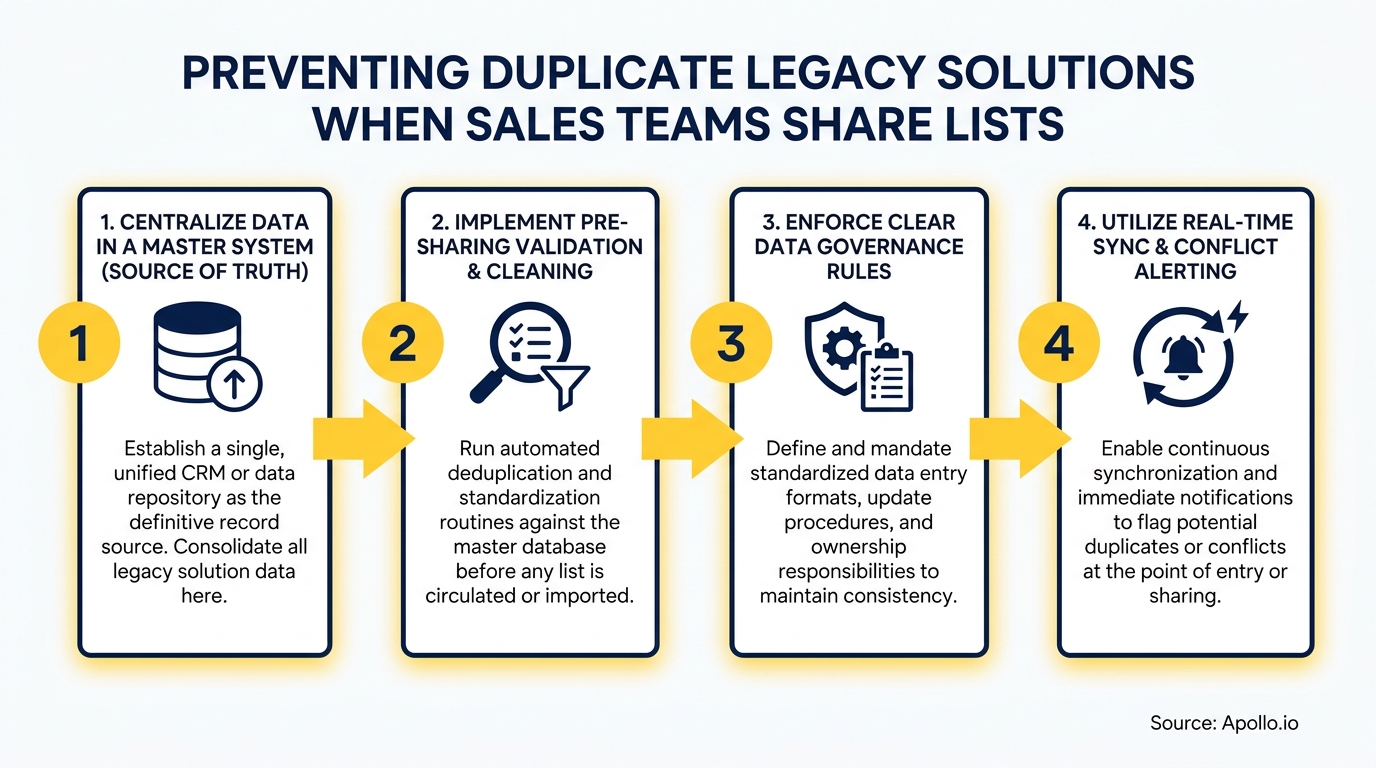
A decay-aware ingest cadence addresses this with three steps: enrich before import, deduplicate against existing records using match rules, and verify sequence eligibility before enrollment.
- Enrich before import: Append current firmographic and contact data to every incoming record so matching rules have accurate fields to compare.
- Dedup against existing records: Run fuzzy-match logic on email address, company domain, and full name. Flag conflicts for RevOps review rather than auto-merging.
- Pre-send verification: Check sequence suppression lists, active opportunity ownership, and do-not-contact flags before any contact enters a new sequence.
For SDRs managing high-volume outbound, this cadence removes the manual burden of cross-checking shared lists. For RevOps, it creates an auditable ingest log that surfaces collision patterns over time. Pair this with sales automation best practices to build the cadence into your workflow rather than relying on manual checks.
What Platform Capabilities Prevent Duplicate Outreach at the System Level?
Platform-level dedup prevention requires three native capabilities: sequence enrollment guards, record ownership enforcement, and contact-level suppression that persists across list sources.
- Sequence enrollment guards: The platform should block a contact from entering a sequence if they are already enrolled in another active sequence, regardless of which rep initiated it.
- Record ownership rules: Contacts assigned to a rep or account should be invisible or locked to other reps during active outreach, preventing parallel touches.
- Cross-list suppression: When a contact exists in multiple imported lists, the system should recognize the duplicate at the record level and suppress redundant enrollment automatically.
Teams using disconnected tools (separate prospecting database, separate sequencer, separate CRM) face the highest duplicate risk because suppression logic does not cross system boundaries. As Cyera noted after consolidating onto Apollo: "Having everything in one system was a game changer." Platforms that unify contact discovery, enrichment, and sequencing in a single workspace make cross-list suppression native rather than a custom integration problem. See how teams compare their options in this Apollo vs. Outreach vs. Salesloft comparison.
What Is the 30-60-90 Day Plan to Eliminate Duplicate Outreach?
A 30-60-90 day plan gives RevOps a structured path from reactive cleanup to proactive prevention.
| Phase | Actions | Owner |
|---|---|---|
| Days 1-30 | Audit current list-sharing process; document all ingest points; identify top duplicate sources; assign record ownership rules in CRM | RevOps |
| Days 31-60 | Implement match rules and suppression lists in sequencing platform; establish pre-import validation SOP; train SDRs on new ingest process | RevOps + Sales Ops |
| Days 61-90 | Measure duplicate rate reduction; build dashboard tracking enrollment collisions; run quarterly governance review cadence | RevOps + Sales Leadership |
For teams also refining how their list-building process feeds this governance model, the guide on building lead lists that convert offers a compatible upstream workflow. And if you want to understand how intent signals can further sharpen list quality before ingest, intent data fundamentals are a natural next layer.
Struggling to keep prospect data clean across a growing team? Apollo's data enrichment keeps your contact records verified and current, so your dedup rules always have accurate fields to match against.

How Do You Stop Duplicate Outreach for Good?
Preventing duplicate outreach permanently requires shifting from periodic cleanup to always-on governance. That means dedup rules enforced at every ingest point, suppression logic that persists across all list sources, and a single workspace where prospecting, enrichment, and sequencing share the same contact record.
Predictable Revenue put it directly: "We reduced the complexity of three tools into one." When your team stops passing lists between disconnected systems, the duplicate problem shrinks to a governance task rather than a daily firefight.
Apollo brings contact discovery, sales productivity tools, and multi-channel sequencing into one unified platform, with built-in enrollment guards and ownership rules that prevent rep collisions before they happen. Ready to eliminate duplicate outreach at the system level? Request a Demo and see how Apollo's unified workspace keeps your GTM team coordinated at scale.
Prove Pipeline ROI Before Next QBR
Budget approval stuck on unclear metrics? Apollo delivers measurable pipeline impact so you walk into every QBR with hard numbers, not guesses. Nearly 100K paying customers are already proving the ROI.
Schedule a Demo →Don't miss these
Sales
Inbound vs Outbound Marketing: Which Strategy Wins?
Sales
What Is a Sales Funnel? The Non-Linear Revenue Framework for 2026
Sales
What Is a Go-to-Market Strategy? The 2026 GTM Playbook
See Apollo in action
We'd love to show how Apollo can help you sell better.
By submitting this form, you will receive information, tips, and promotions from Apollo. To learn more, see our Privacy Statement.
4.7/5 based on 9,690 reviews
