
Dedicated Dialer Tool or All-in-One Platform: How Do You Choose in 2026?
Your sales team is losing deals, not because of bad messaging, but because reps are juggling too many tools. The dialer question comes up fast: buy a dedicated dialer or consolidate into an all-in-one platform? The answer depends on your specific bottleneck, and the wrong choice wastes both budget and rep capacity. Before evaluating vendors, check out this playbook for building a sales tech stack that scales revenue to frame your decision correctly.

Research Less. Pipeline More With Apollo.
Tired of your reps burning hours verifying contact info instead of selling? Apollo delivers 230M+ business contacts with 97% email accuracy so your team hits the phones faster. Start building pipeline today.
Start Free with Apollo →Key Takeaways
- Your bottleneck determines your tool: call throughput problems point to a dedicated dialer; workflow fragmentation points to an all-in-one platform.
- Nine in ten sales organizations are already consolidating software stacks, trading point solutions for unified platforms with a single source of truth.
- Compliance risk (TCPA, DNC) is a financially material factor when choosing dialing infrastructure, not just a legal checkbox.
- All-in-one platforms win when your team needs coordinated email, phone, and social outreach, not just raw dialing speed.
- SDRs and RevOps leaders benefit most from consolidation: fewer logins, cleaner data, and faster rep ramp time.
What Is the Real Difference Between a Dedicated Dialer and an All-in-One Platform?
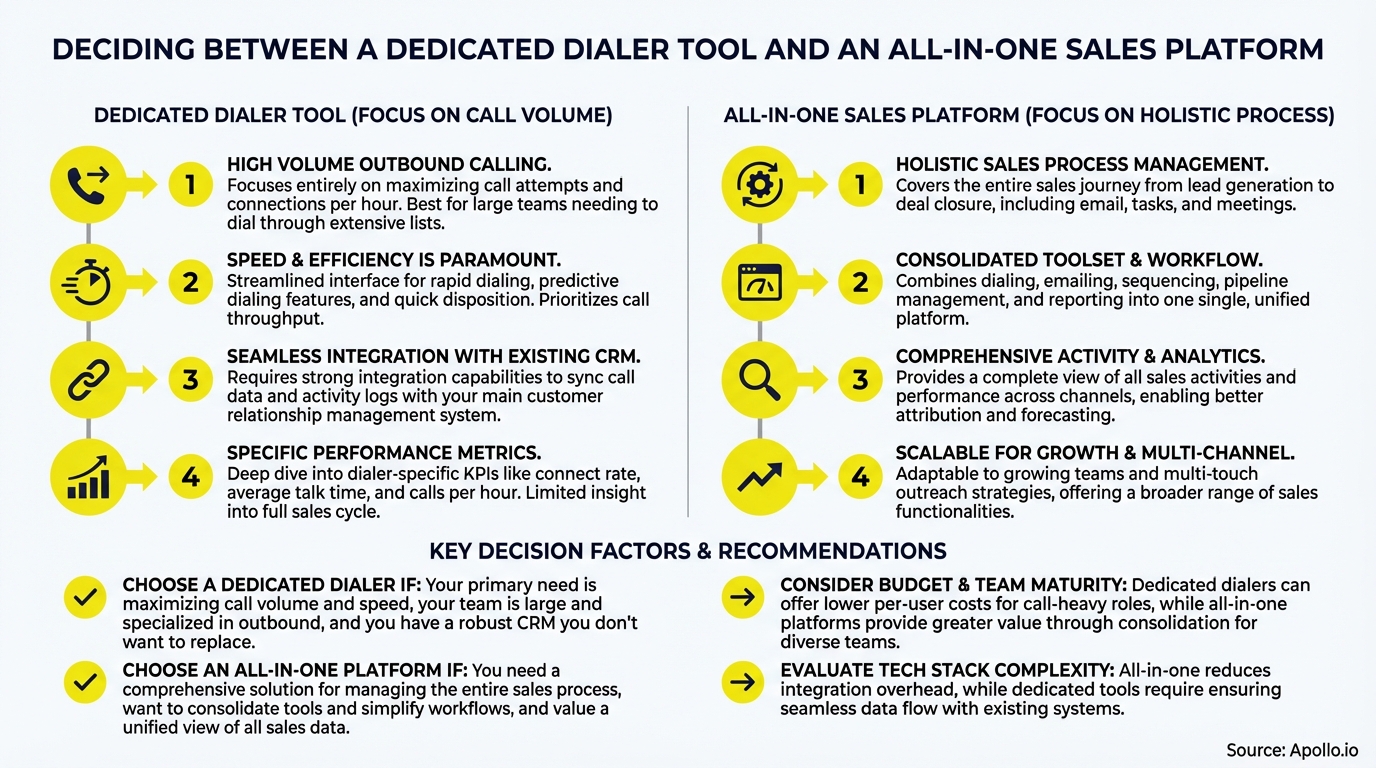
A dedicated dialer focuses exclusively on call throughput: parallel dialing, local presence, voicemail detection, and caller reputation management. An all-in-one sales engagement platform (SEP) bundles dialing alongside email sequencing, task management, CRM sync, analytics, and AI-assisted workflows in a single workspace.
Dedicated dialers win on raw speed. All-in-one platforms win on orchestration. The distinction matters because buyers no longer operate on one channel. According to BookYourData, 80% of B2B sales interactions between suppliers and buyers were expected to occur through digital channels by 2025, making single-channel dialing tools a structural mismatch for most modern outbound motions.
How Do You Diagnose Your Team's Actual Bottleneck?
Identify your bottleneck before buying anything. Use this framework to match your problem to the right solution.
| Symptom | Root Cause | Better Fit |
|---|---|---|
| Low connect rates, low call volume | Call throughput or number reputation | Dedicated dialer |
| Reps skip steps, miss follow-ups | No sequence enforcement or task management | All-in-one platform |
| Data lives in 3+ tools | Fragmented stack, no single source of truth | All-in-one platform |
| High call volume, low conversion | No coaching layer or call intelligence | All-in-one with AI call tools |
| Compliance risk at scale | No DNC scrubbing, consent tracking, or time-zone controls | Dedicated dialer with compliance stack |
Research from JohnnyGrow confirms this consolidation trend: nine in ten sales organizations are trading point solutions for broader CRM platforms to give sellers a single source of truth. If your reps are context-switching between tools all day, the bottleneck is workflow fragmentation, not dialing speed.

When Does a Dedicated Dialer Actually Make Sense?
A dedicated dialer makes sense when call volume and live-conversation yield are your primary revenue levers. Specifically, consider a standalone dialer when your team makes high-volume outbound calls daily, connect rates are low due to spam labeling, or compliance risk is significant enough to require purpose-built controls.
Compliance is not a minor consideration. TCPA statutory damages run $500 per violation and up to $1,500 per willful violation. The FTC reported approximately 258.5 million active Do Not Call registrations as of September 30, 2025. At scale, a dialer without embedded DNC scrubbing, time-zone enforcement, and consent tracking is a financial liability. Review Apollo's dialer software to see how compliance controls can be built into calling workflows rather than bolted on separately.
Dedicated dialers also differentiate on speed layers: power dialing, parallel dialing, local presence, and voicemail drop. If raw throughput is your constraint, these features matter.
But if your reps make 30-50 calls per day and also send emails and manage follow-up tasks, a standalone dialer solves only part of the problem.
When Should SDRs and RevOps Leaders Choose an All-in-One Platform?
SDRs and RevOps leaders should choose an all-in-one platform when workflow fragmentation, not call speed, is killing productivity. Fragmented stacks force reps to toggle between a dialer, a sequencing tool, a CRM, and a data provider, creating data gaps and missed follow-ups that compound over time.
Data from SalesHive shows CRM returns about $8.71 for every dollar invested, but one-third of companies admit fragmented data is already costing them revenue. RevOps leaders feel this acutely: every disconnected tool adds a reconciliation burden and an integration failure point.
For SDRs running multi-channel sequences (email, phone, and social), an all-in-one platform enforces sequence steps, logs activity automatically, and keeps account context in one place. Spending too much time on manual outreach? Automate your multi-channel sequences with Apollo's sales engagement platform and keep every touchpoint coordinated in one workspace.
All-in-one platforms also bundle conversation intelligence, AI call summaries, and coaching insights alongside dialing. As sales analytics become central to rep development, having call data and sequence data in the same system removes the need for a separate analytics tool.
Turn Funnel Chaos Into Predictable Revenue
Tired of forecasts built on gut feel instead of real data? Apollo surfaces in-market buyers before your pipeline runs dry, so every stage moves with confidence. Over 600K companies trust Apollo to keep their funnel full and forecasts honest.
Start Free with Apollo →What Does the Tech Stack Consolidation Trend Mean for Your Decision?
The broader market is moving toward platform consolidation, and for good reason. Buyers increasingly want the system that holds account context to also generate call notes, next steps, and AI coaching, reducing tool-switching and data fragmentation.
This trend accelerates the case for all-in-one platforms for most B2B GTM teams.
The global sales tech market is projected to grow to $104,470 million by 2030 at a 16.3% CAGR, according to Inaccord. Much of that growth reflects investment in unified platforms rather than additional point solutions. Consolidation isn't just a cost argument; it's a data quality argument. Fewer tools mean fewer sync failures and less dirty data entering your CRM.
Apollo customers have seen this firsthand. "We reduced the complexity of three tools into one," said Collin Stewart of Predictable Revenue. "Having everything in one system was a game changer," noted the team at Cyera. These outcomes reflect what happens when prospecting, sequencing, dialing, and analytics share the same data layer.

How Do AEs and Sales Leaders Evaluate the ROI of Each Option?
Account Executives and sales leaders should evaluate total cost of ownership, not just license fees. A dedicated dialer appears cheaper at first glance but requires separate subscriptions for sequencing, data enrichment, and analytics.
The true comparison includes integration costs, admin overhead, and the revenue impact of data fragmentation.
Use this quick ROI checklist before deciding:
- Count your current tools: How many separate platforms do reps touch daily?
- Measure non-selling time: How much rep time goes to logging, switching tools, and manual data entry?
- Quantify compliance exposure: What is your monthly outbound call volume, and do you have DNC and TCPA controls in place?
- Assess channel mix: Are reps only calling, or also emailing and using social outreach?
- Check coaching gaps: Do managers have visibility into call quality, or is coaching anecdotal?
If three or more of these reveal gaps, consolidation to an all-in-one platform will likely outperform adding another point solution. Explore how AI sales tools factor into the total ROI picture when choosing between dialer-only and full-platform options.
Struggling to manage pipeline across a fragmented stack? Get complete pipeline visibility with Apollo's deal management tools and eliminate the revenue gaps that come from disconnected systems.
What Is the Right Choice for Your Team in 2026?
Most B2B GTM teams, from SDR teams at growth-stage companies to enterprise revenue operations, will get more leverage from an all-in-one platform than from a standalone dialer. The exception is teams with very high outbound call volume where parallel dialing speed and dedicated compliance infrastructure are primary requirements.
Apollo combines sales automation, a built-in dialer, multi-channel sequencing, data enrichment across 230M+ contacts, AI call assistance, and deal management in one unified workspace. Trusted by nearly 100K paying customers including Anthropic, Redis, and Smartling, it replaces the fragmented stacks that slow teams down. "We cut our costs in half," reported the team at Census after consolidating to Apollo.
The dialer-vs-platform debate resolves quickly once you identify your real bottleneck. For most teams, the bottleneck is orchestration, not throughput.
Start there, and the right tool choice becomes clear.
Get Leads Now and see how Apollo's all-in-one GTM platform consolidates your entire outbound stack into one workspace.
Prove Pipeline ROI With Apollo
ROI pressure killing your tool budget? Apollo gives sales teams measurable pipeline impact from day one. Leadium 3x'd their annual revenue — see why nearly 100K paying customers trust Apollo to justify every dollar.
Start Free with Apollo →Don't miss these
Sales
Inbound vs Outbound Marketing: Which Strategy Wins?
Sales
What Is a Sales Funnel? The Non-Linear Revenue Framework for 2026
Sales
What Is a Go-to-Market Strategy? The 2026 GTM Playbook
See Apollo in action
We'd love to show how Apollo can help you sell better.
By submitting this form, you will receive information, tips, and promotions from Apollo. To learn more, see our Privacy Statement.
4.7/5 based on 9,690 reviews
