
How to Keep Your B2B Contact Database Fresh and Prevent Data Decay
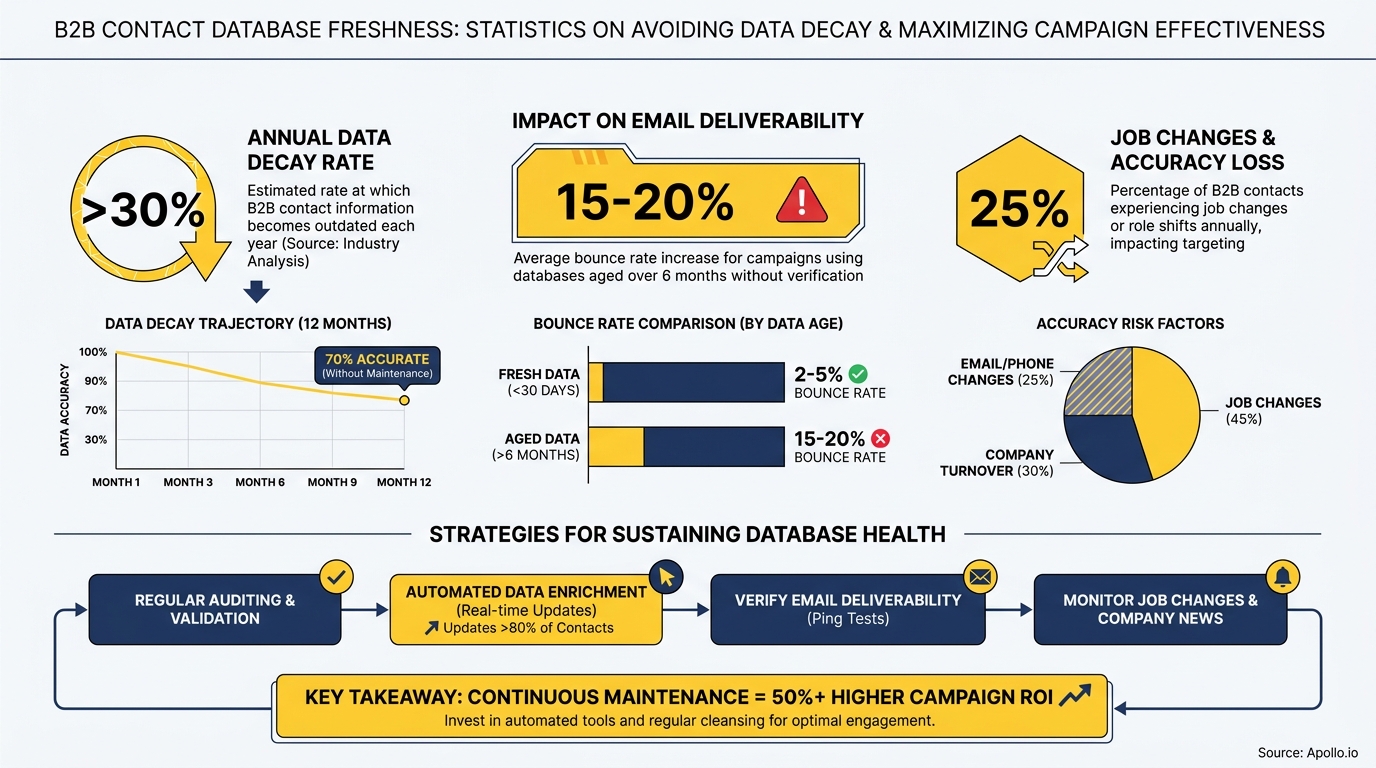
Your B2B contact database is rotting right now. According to Landbase, B2B database decay runs at approximately 2.1% per month, compounding to 22.5% annually. Leave a 10,000-record CRM untouched for a year and roughly 2,250 contacts are already stale. For SDRs dialing wrong numbers, AEs emailing departed decision-makers, and RevOps teams feeding bad data into AI scoring models, the damage compounds fast.
This guide gives you a practical, cadenced framework to keep your B2B contact database continuously fresh and revenue-ready in 2026.

Scale Smarter With Apollo's Living Data
Tired of your reps burning hours verifying contacts instead of closing deals? Apollo delivers 97% email accuracy and scalable playbooks so your team hits quota faster. Start building pipeline that actually converts.
Start Free with Apollo →Key Takeaways
- B2B contact data decays at 2.1% per month, meaning nearly a quarter of your database becomes unreliable every year without active maintenance.
- Poor data quality carries significant financial consequences for individual organizations, making hygiene a board-level concern, not just an ops task.
- SDRs waste substantial time working bad prospect data, directly reducing quota attainment and pipeline quality.
- AI-powered GTM workflows amplify bad data risks: stale inputs produce misdirected scoring, routing errors, and wasted personalization spend.
- The fix is a cadenced "Data Freshness Operating System" combining verification schedules, governance ownership, and continuous enrichment.
What Is B2B Data Decay and Why Does It Happen?
B2B data decay is the gradual degradation of contact and account record accuracy caused by job changes, company reorgs, email domain shifts, and business closures. It is not a one-time event but a continuous, structural process driven by normal labor market movement.
People change roles, companies merge, and titles evolve constantly.
Data from LeadGenius shows that some studies indicate B2B contact data can decay by as much as 70.3% per year in high-churn industries. The practical planning baseline sits at 22.5% annually, but your actual exposure depends on your target verticals and seniority levels.
The most common decay triggers:
- Job changes: Contacts move to new companies, invalidating email and title simultaneously.
- Promotions and reorgs: Titles, reporting lines, and responsibilities shift without a contact record update.
- Company events: Acquisitions, spin-offs, and closures orphan entire account records.
- Email infrastructure changes: Domain migrations and IT policy changes kill previously valid addresses.
What Does Data Decay Actually Cost GTM Teams?
Poor data quality carries material financial consequences for individual organizations, not just minor inefficiencies. Research from Readyworks shows individual organizations lose an average of $12.9 million to $15 million per year due to poor data quality through wasted marketing spend, lost sales opportunities, and operational inefficiencies.
The cost breaks down across three GTM segments:
| GTM Function | Primary Data Decay Impact | Revenue Risk |
|---|---|---|
| SDR / BDR Teams | Dials to wrong numbers, bounced cold emails, wasted sequences | Lost pipeline, missed quota |
| Account Executives | Wrong decision-maker contact, stale org charts, deal delays | Extended sales cycles, lost deals |
| Marketing / Demand Gen | Wasted paid media spend, poor email deliverability, inflated bounce rates | Budget waste, damaged domain reputation |
| RevOps / AI Workflows | Corrupt scoring inputs, misrouted leads, broken personalization | Compounded errors across the entire funnel |
Additionally, data from Serghei Pogor on Medium indicates sales representatives lose approximately 500 hours annually due to bad prospect data. For SDR managers, that translates directly to reduced capacity and missed meetings without adding headcount.
Tired of dirty data slowing down your team? Start free with Apollo's 230M+ verified business contacts and stop working stale lists.

How Do I Build a Data Freshness Cadence That Actually Works?
A data freshness cadence is a scheduled, field-level verification program that treats database hygiene as an ongoing operational process rather than a periodic cleanup project. The cadence maps specific data fields to verification frequencies based on how fast each field type decays.
Use this cadence matrix as your starting point:
| Data Field | Decay Speed | Recommended Verification Cadence | Method |
|---|---|---|---|
| Business email address | High | Monthly | Email verification API at point of capture and before sends |
| Direct phone / mobile | High | Quarterly | Enrichment provider re-verification |
| Job title | Medium-High | Quarterly | Professional network signals, enrichment |
| Company name / employer | Medium | Quarterly | Firmographic enrichment on CRM records |
| Company size / revenue | Low-Medium | Semi-annually | Firmographic data refresh |
| Tech stack / intent signals | Variable | Monthly | Intent data feeds, technographic enrichment |
Each record should carry a last-verified timestamp per field. Any contact without a verified email timestamp within 90 days should be flagged before entering an automated sequence or AI scoring workflow. Learn more about structuring this in a B2B data enrichment strategy.
Turn Funnel Guesswork Into Pipeline Confidence
Tired of watching marketing leads die before they ever reach your pipeline? Apollo surfaces high-intent prospects and keeps your funnel moving with 97% email accuracy. Join 600K+ companies forecasting with confidence.
Start Free with Apollo →How Does Data Decay Affect AI-Powered GTM Workflows?
Stale data is the single largest risk multiplier for AI-enabled GTM workflows because AI models amplify whatever patterns exist in their inputs. Feed a lead scoring model bad job titles and outdated firmographics, and it will confidently route low-quality leads to your top AEs.
Before any contact enters an AI workflow, including scoring, routing, or personalized sequence generation, it should pass a data quality gate:
- Email verified within 90 days: Block or re-enrich before sending.
- Title verified within 90 days: Prevent role-mismatch personalization errors.
- Company active status confirmed: Remove acquired, closed, or rebranded entities.
- No suppression flag: Cross-check against opt-out and deletion request lists before any AI action.
This pre-AI validation gate is especially critical in 2026, as mailbox providers like Microsoft Outlook have tightened authentication and reputation requirements for high-volume senders. Sending to stale addresses damages domain reputation, which then undermines every future send regardless of data quality. Pair your enrichment workflow with intent data signals to prioritize re-verification on accounts showing active buying behavior first.
How Should RevOps Teams Own Data Governance?
RevOps teams should own data governance through a formal data ownership map that assigns field-level accountability across CRM, marketing automation, and enrichment systems. Without clear ownership, no one is responsible when records go stale.
A practical governance model assigns three roles:
- Data Owner (RevOps): Sets standards, cadence SLAs, and tooling. Approves new data sources entering the stack.
- Data Steward (Marketing Ops): Executes enrichment runs, monitors bounce rates, and flags deliverability degradation.
- Data User (Sales, SDRs): Reports bad data at point of use via CRM workflow, triggering re-enrichment.
RevOps leaders should also enforce a suppression sync SLA: any deletion or opt-out request must propagate across CRM, marketing automation platform, enrichment vendor, and outbound sequencing tool within 24 hours. This is no longer optional with California's DELETE Act (DROP) requiring data brokers to honor deletion requests starting August 2026. See how data sync can automate this propagation across your stack.
Struggling to keep contact records accurate across tools? Apollo's CRM enrichment tool continuously verifies and updates records so your team always works from accurate data.
What Tools and Processes Keep a B2B Database Continuously Fresh?
Keeping a B2B database continuously fresh requires combining point-of-capture validation, scheduled enrichment, engagement-based sunsetting, and CRM change-detection rules. No single tool solves this alone.
The modern data freshness stack includes:
- Point-of-capture verification: Validate email format and deliverability at form submission and SDR import before any record enters your CRM.
- Scheduled enrichment runs: Use a CRM enrichment tool to re-verify and update records on your cadence schedule, not just at initial import.
- Engagement-based sunsetting: Flag contacts with zero email engagement after 6 months for re-verification before including them in future campaigns.
- Bounce-triggered re-enrichment: Route any hard bounce immediately to an enrichment workflow to find an updated address rather than simply deleting the record.
- CRM change-detection rules: Trigger a re-enrichment job automatically when a contact's company field changes, indicating a job change.
For teams that rely on multiple data providers, a data enrichment and cleansing workflow that consolidates verification across sources reduces the tool sprawl that often causes suppression gaps. As Cyera noted after consolidating their GTM stack: "Having everything in one system was a game changer."

How Do I Start Fixing My B2B Contact Database Today?
Start fixing your B2B contact database by running an immediate audit of your highest-priority segments: active pipeline contacts, current sequence enrollees, and your top ICP accounts. These records carry the most revenue risk if stale.
Your 30-day action plan:
- Week 1: Export active pipeline and sequence contacts. Run email verification on all records. Flag any contact without a verified timestamp in the past 90 days.
- Week 2: Assign data ownership roles. Define your cadence SLA document (email monthly, phone and title quarterly).
- Week 3: Configure bounce-triggered and change-detection enrichment rules in your CRM. Set up suppression sync between all tools.
- Week 4: Establish your pre-AI validation gate. Any record failing verification criteria is held from scoring and sequencing until enriched.
Apollo consolidates prospecting, enrichment, and engagement in a single platform, eliminating the handoff gaps where contacts go stale between tools. Trusted by nearly 100K paying customers including Anthropic, Smartling, and Autodesk, Apollo's B2B data enrichment keeps CRM records accurate with 97% email accuracy across 230M+ business contacts.
Ready to stop working stale data? Try Apollo free and build your data freshness operating system today.
Prove Pipeline ROI With Apollo
ROI pressure killing your tool budget? Apollo delivers measurable pipeline impact fast — teams like Leadium 3x'd annual revenue after switching. See your ROI before the next budget review.
Schedule a Demo →Don't miss these
Sales
Inbound vs Outbound Marketing: Which Strategy Wins?
Sales
What Is a Sales Funnel? The Non-Linear Revenue Framework for 2026
Sales
What Is a Go-to-Market Strategy? The 2026 GTM Playbook
See Apollo in action
We'd love to show how Apollo can help you sell better.
By submitting this form, you will receive information, tips, and promotions from Apollo. To learn more, see our Privacy Statement.
4.7/5 based on 9,690 reviews
