
How to Identify Decision-Makers and Buying Committee Members Within a Target Account (2026)
Chasing a single "decision-maker" is a losing strategy in 2026. Modern B2B deals involve entire buying committees, and the first vendor to map that committee wins. According to Influ2, Forrester's 2024 research indicates the average B2B buying group has 13 people, often spanning multiple departments. That means your target account list needs contact coverage across roles, not just one champion's inbox.
The good news: a structured, signal-driven approach lets you build a verified buying-group roster before a competitor even gets their first reply.

Research Less, Close More With Apollo
Tired of your reps burning hours on manual lead research instead of selling? Apollo surfaces verified contacts instantly so your team spends time closing, not digging. Join 600K+ companies building pipeline faster.
Start Free with Apollo →Key Takeaways
- B2B buying committees average 10–13 people across multiple departments, so mapping the full group is more important than finding one title.
- Intent signals and behavioral data are the fastest way to surface committee members who are already researching without contacting you.
- Each stakeholder role (finance, security, procurement, end-user) needs role-specific content to reduce internal friction and move the deal forward.
- SDRs and AEs who track "buying group completeness" as a pipeline metric catch late-stage surprises before they kill deals.
- A unified GTM platform consolidates the prospecting, intent, and engagement tools needed to manage multi-stakeholder outreach without a bloated tech stack.
Why Does Buying Committee Mapping Matter More Than Ever?
Buying committee mapping matters because multi-stakeholder decisions are now the norm across company sizes and deal values. Research from Jolly Marketer shows 92% of B2B decisions now involve multiple stakeholders, with enterprise deals sometimes requiring up to 19 decision-makers. Missing even one key influencer, such as a security lead or finance approver, can stall or kill an otherwise strong deal.
In 2026, risk and governance stakeholders are entering deals earlier, especially for technology and AI purchases. Legal, data governance, and procurement teams now expect role-specific information from day one, not just at the security review stage.
Sellers who map these roles proactively shorten cycles and reduce last-minute objections.
What Are the Core Roles in a Buying Committee?
A buying committee typically contains six functional archetypes, each with distinct concerns and veto points.
| Role | Primary Concern | Content They Need |
|---|---|---|
| Economic Buyer (CFO/VP Finance) | ROI, budget, payback period | Business case, ROI model |
| Technical Evaluator (IT/Security) | Integration, risk, compliance posture | Security assessment pack, architecture docs |
| End-User Champion (Department Lead) | Usability, workflow fit, adoption | Demo, pilot results, peer case studies |
| Procurement / Legal | Contract terms, vendor risk | MSA summary, vendor questionnaire |
| Executive Sponsor (C-Suite) | Strategic alignment, competitive advantage | Executive brief, board-ready summary |
| Internal Validator (RevOps / Data) | Data integrity, process impact | Integration checklist, change-management kit |
For enterprise sales, all six roles are typically active simultaneously. In mid-market deals, one person often wears two hats, but the concerns remain the same.
How Do You Build a Signal-Driven Buying Group Roster?
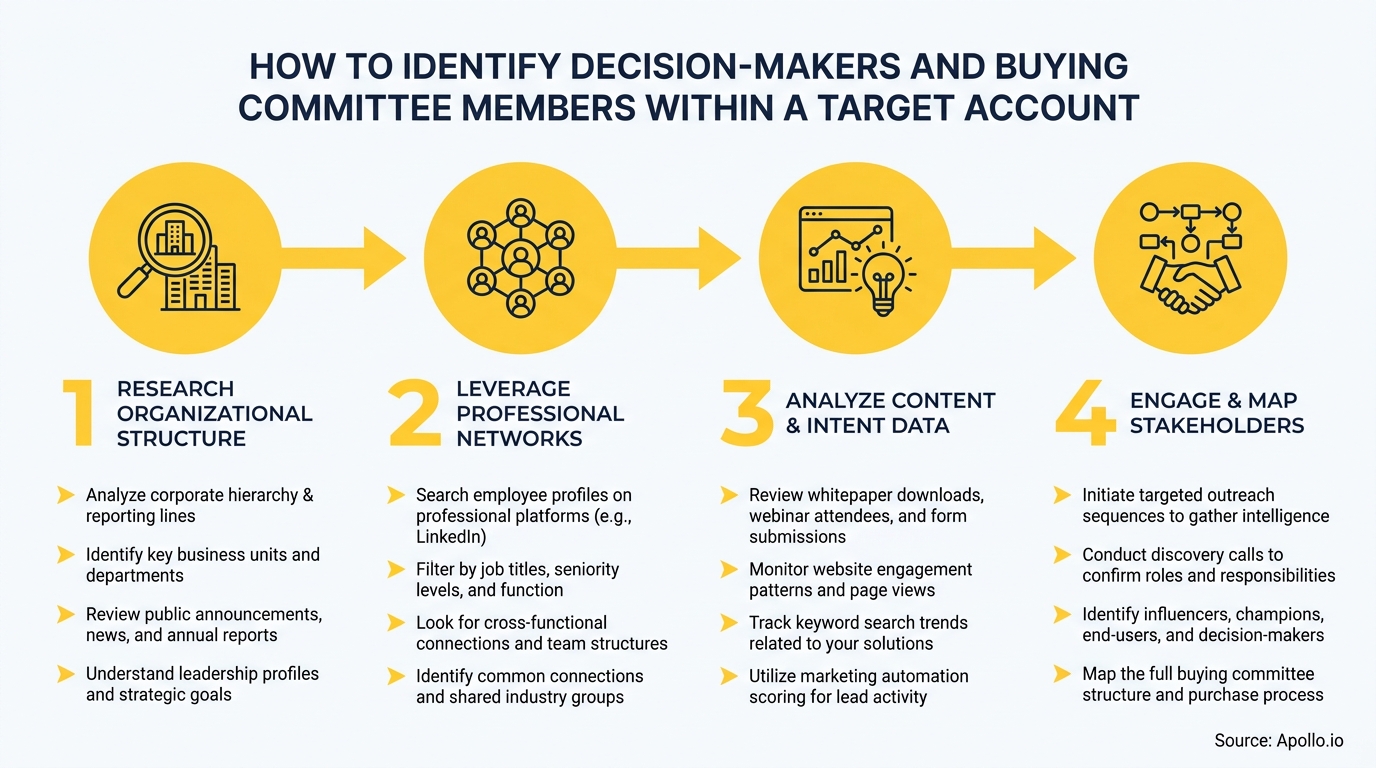
You build a verified buying-group roster by combining three signal layers: firmographic filters, behavioral intent data, and first-party engagement signals from your own CRM and marketing tools.
Step 1: Start with your ICP role map. Define the six to eight titles you expect in any deal at this account size and industry.
Use a prospecting platform with advanced filters to find matching contacts across the account's org chart.
Step 2: Overlay intent signals. Intent data tells you which contacts or accounts are actively researching topics related to your solution. Contacts showing high intent are likely active committee members even before they raise their hand. Tools like Apollo Buying Intent surface these signals directly inside your prospecting workflow.
Step 3: Validate with first-party signals. Cross-reference your CRM email opens, webinar attendance, and content downloads against the account.
Anyone engaging with your content is a probable committee member. Tag them by role and update your roster weekly.
Step 4: Score for coverage gaps. Track which roles are confirmed, which are suspected, and which are missing. "Buying group completeness" is a leading indicator of deal health.
A roster missing finance or security at the mid-stage is a red flag worth acting on immediately.
Struggling to surface all the right contacts across a target account? Search Apollo's 230M+ contacts with 65+ filters to build a complete buying-group roster in minutes.
Turn Funnel Gaps Into Pipeline Gold
Pipeline forecasting a guessing game because quality leads never make it to opportunity? Apollo surfaces verified, in-market buyers so your funnel actually converts. Join 600K+ companies turning prospecting into predictable revenue.
Start Free with Apollo →How Do AEs and SDRs Use Intent Signals to Find Hidden Stakeholders?
AEs and SDRs use intent signals to identify committee members who are researching solutions but have not yet responded to outreach. Because buyers conduct most of their research independently, buying intent signals are often the only visible trace of committee activity before a vendor is formally contacted.
For SDRs working a named account, the practical workflow looks like this:
- Monitor account-level intent spikes weekly for topics matching your solution category.
- When intent rises, cross-reference which known contacts are engaging with your content.
- Identify title gaps on your roster and use prospecting filters to find likely holders of missing roles.
- Prioritize outreach to the missing roles with role-specific messaging, not generic sequences.
For AEs managing active opportunities, this approach surfaces the "internal validators" who appear late in deals and slow approvals. Finding and enabling them early, with a security pack or ROI model, removes a common source of deal slippage. See how intent data powers smarter B2B sales for a deeper breakdown of signal types and use cases.

What Role-Specific Assets Does Each Stakeholder Need?
Each buying committee member needs assets that address their specific risk or concern, not a generic pitch deck. Sending the wrong content to the wrong role signals poor understanding and slows consensus.
- Finance / CFO: ROI calculator, payback period model, total cost of ownership comparison.
- Security / IT: Security assessment pack, data handling overview, architecture diagram, compliance posture summary.
- Procurement / Legal: Standard agreement summary, vendor risk tier, data processing addendum.
- End-User / Champion: Peer case studies, pilot scope template, implementation timeline, adoption playbook.
- Executive Sponsor: One-page executive brief, competitive differentiation summary, strategic alignment narrative.
- RevOps / Internal Validator: CRM integration checklist, data field mapping, change-management kit.
According to UnboundB2B, the average B2B buying committee is a team of 10–11 stakeholders, and for large enterprise deals it can extend to 15 people.
That scale makes templated, role-specific asset kits a practical necessity, not a nice-to-have.
Also consider that Mixology Digital reports three-quarters (75%) of B2B buyers prefer a rep-free sales experience. Self-serve content hubs that route each role to the right asset reduce friction and capture stakeholder identity data at the same time.
How Does Apollo Help GTM Teams Map Buying Committees Faster?
Apollo consolidates the prospecting, intent, and engagement tools GTM teams need to identify and reach full buying committees without managing a fragmented tech stack. SDRs can search 230M+ contacts by title, department, and seniority inside a single workspace, then layer in intent signals and launch multi-channel sequences, all without switching platforms.
RevOps leaders find that having contact data, intent signals, and engagement history in one system gives a clean, single source of truth for buying-group coverage. "Having everything in one system was a game changer" (Cyera). For teams managing complex, multi-stakeholder sales prospecting across enterprise accounts, that consolidation translates directly into faster roster-building and better pipeline visibility.
Need to engage multiple stakeholders across a single account without juggling five tools? Run coordinated multi-channel sequences with Apollo's sales engagement platform and track committee coverage in one place.
How Do You Keep Your Buying Group Roster Accurate Over a Long Sales Cycle?
You maintain roster accuracy by treating buying-group completeness as an ongoing pipeline metric, not a one-time discovery task. B2B buying cycles are long, and committee membership changes as deals progress.
- Review roster completeness at each deal stage gate in your CRM.
- Flag accounts where key roles (finance, security) remain unconfirmed past the mid-stage.
- Use revenue operations workflows to trigger enrichment and re-prospecting when contacts go dark or leave the account.
- Re-run intent checks monthly to catch new stakeholders who enter the research process mid-cycle.
- Update role-specific asset delivery based on which stakeholders engage with which content.
Privacy and data changes in 2026 are making third-party contact tracking less reliable in some channels. Building a first-party stakeholder graph, grounded in CRM engagement data and permissioned intent signals, is the most durable approach for maintaining accurate committee maps over time.

Start Mapping Buying Committees With Confidence in 2026
Identifying decision-makers and buying committee members is a committee-first, signal-driven discipline. Define your expected roles, use intent and behavioral signals to surface active members, deliver role-specific assets that reduce internal friction, and track coverage completeness as a pipeline health metric throughout the cycle.
Apollo gives B2B GTM teams, from SDRs to RevOps leaders to enterprise AEs, a unified platform to prospect the full committee, activate intent signals, and run coordinated outreach without a fragmented stack. Trusted by nearly 100K paying customers including Anthropic, Cyera, and Smartling, Apollo replaces the complexity of multiple tools in one workspace.
Schedule a Demo to see how Apollo helps your team build complete buying-group rosters and close deals faster.
Prove Pipeline ROI With Apollo
Budget approval stuck on unclear metrics? Apollo delivers measurable pipeline impact from day one — so you walk into every renewal conversation with proof. Leadium 3x'd annual revenue after making the switch.
Start Free with Apollo →Don't miss these
Sales
Inbound vs Outbound Marketing: Which Strategy Wins?
Sales
What Is a Sales Funnel? The Non-Linear Revenue Framework for 2026
Sales
What Is a Go-to-Market Strategy? The 2026 GTM Playbook
See Apollo in action
We'd love to show how Apollo can help you sell better.
By submitting this form, you will receive information, tips, and promotions from Apollo. To learn more, see our Privacy Statement.
4.7/5 based on 9,690 reviews
