
How to Fix Email Deliverability Issues Caused by Poor Sender Reputation in 2026
Your emails are sending, but deals aren't moving. Open rates have dropped, replies dried up, and your pipeline attribution looks broken. The most likely culprit: your sender reputation. According to Mailmend, an overwhelming 83% of email non-delivery traces back to sender reputation — making it the single highest-leverage fix for any B2B team. If you're serious about repairing your sender reputation, this playbook gives you the provider-specific, measurement-first steps to do it.

Research Less, Pipeline More With Apollo
Tired of burning hours hunting down emails that bounce and numbers that go nowhere? Apollo surfaces verified contacts instantly so your reps spend time selling, not searching. Nearly 100K paying customers have already made the switch.
Start Free with Apollo →Key Takeaways
- Sender reputation is now a continuous score, not a campaign-by-campaign reset — fix it operationally, not cosmetically.
- Gmail enforces a hard complaint-rate threshold that removes recovery options when crossed; staying below it is a non-negotiable operational KPI.
- Microsoft/Outlook is the toughest mailbox environment for B2B senders and requires separate IP reputation diagnostics.
- Most teams measure "delivered" instead of inbox placement — that measurement gap is why reputation problems persist.
- List hygiene and authentication are prerequisites before any volume ramp or re-engagement campaign.
Why Is Poor Sender Reputation Silently Killing Your Pipeline?
Poor sender reputation causes mailbox providers to filter, defer, or silently block your emails before recipients ever see them. Research from SalesHive shows that only 83–87% of marketing emails reach the inbox, meaning roughly 1 in 6 emails never makes it to prospects. For B2B teams sending sequences to enterprise buyers, that gap translates directly to missed meetings and lost revenue.
The problem compounds because most teams don't measure it correctly. They track "delivered" (accepted by the receiving server) rather than actual inbox placement. You can have a 99% delivery rate and still have 20% of your mail landing in spam — and never know it. Check your spam placement diagnostics before assuming your deliverability is healthy.
How Do You Diagnose the Root Cause Before You Fix Anything?
Diagnose before remediating — fixing the wrong layer wastes weeks. Use this decision framework to pinpoint whether your issue is authentication, list quality, or behavioral reputation.
| Symptom | Likely Root Cause | First Action |
|---|---|---|
| Emails deferred or bounced at SMTP | IP/domain blacklist or authentication failure | Check MXToolbox, Google Postmaster Tools, DMARC reports |
| Low open rates, no bounces | Spam folder placement | Run inbox placement seed test across Gmail, Outlook, Yahoo |
| Rising complaint rate in Postmaster Tools | Poor targeting / irrelevant content | Suppress unengaged segments immediately; audit ICP targeting |
| Outlook-specific drop-off | IP reputation with Microsoft | Submit to Microsoft SNDS and Junk Mail Reporting Program |
| High hard bounce rate | Stale or purchased list | Validate all contacts before next send |
Struggling to send outreach to verified contacts in the first place? Enrich and verify your contact data with Apollo before your next campaign to reduce bounce rates at the source.
What Are the Provider-Specific Fixes for Gmail and Outlook?
Gmail and Microsoft require different remediation approaches because they score sender reputation differently. Treating them as identical environments is one of the most common reasons recovery stalls.
How Do You Fix Gmail Deliverability?
Gmail's enforcement is complaint-rate-driven. The Digital Bloom confirms that Gmail, Yahoo, and increasingly Microsoft require SPF, DKIM, DMARC, and one-click unsubscribe for bulk senders (those sending 5,000+ emails per day). Beyond authentication, Google's guidance targets a spam complaint rate below 0.1%, with 0.3% as the hard ceiling above which mitigation options disappear.
- Authenticate fully: SPF, DKIM, and DMARC (p=quarantine or p=reject)
- Enable one-click unsubscribe: Required for bulk senders; reduces complaint rates
- Monitor Google Postmaster Tools daily: Track domain reputation, IP reputation, and spam rate
- Suppress immediately: Anyone who hasn't opened in 90 days is a complaint risk
- Reduce volume temporarily: Send to your most engaged 20% first while reputation recovers
How Do You Fix Outlook and Microsoft Deliverability?
Microsoft's ecosystem is the toughest environment for B2B senders. Belkins reports that Outlook has the highest average bounce rate at 6.95% — significantly above other providers. Microsoft's support documentation explicitly calls out low IP spam reputation as a primary cause of delivery trouble.
- Check SNDS (Smart Network Data Services): Microsoft's free IP reputation diagnostic dashboard
- Enroll in JMRP: Microsoft's Junk Mail Reporting Program sends you complaint data
- Use a dedicated sending IP: Shared IPs inherit the reputation of other senders on that server
- Reduce sending frequency to Outlook domains while reputation recovers
- Submit a mitigation request via Microsoft's Sender Support portal if blocked
Turn Funnel Gaps Into Predictable Pipeline
Tired of watching marketing leads stall before they ever reach your pipeline? Apollo surfaces high-intent buyers the moment they're ready, so your team stops guessing and starts closing. Nearly 100K paying customers have already ditched the forecast anxiety.
Start Free with Apollo →How Do SDRs and RevOps Teams Measure Inbox Placement Correctly?
SDRs and RevOps teams should measure inbox placement — not just delivery rates — using seed testing and provider-specific dashboards. Most teams only track delivery confirmation, which misses spam-folder routing entirely.
Seed testing places test addresses across major mailbox providers so you can see exactly where your mail lands before sending to real prospects.
Minimum measurement stack for B2B teams:
- Google Postmaster Tools: Domain/IP reputation, spam rate (free, requires setup)
- Microsoft SNDS: IP-level reputation data for Outlook recipients (free)
- Inbox placement tool: GlockApps, Mail-Tester, or similar for cross-provider seed testing
- Bounce and complaint tracking: Built into your sending platform; review weekly
For RevOps leaders managing multi-rep outbound programs, sequence-level deliverability diagnostics help identify which campaigns are generating complaints before they damage your domain's standing across the team.

What Is the 6-Week Sender Reputation Recovery Plan?
Sender reputation recovery follows a controlled, phased approach — not a volume ramp. Here is a practical 6-week cadence for B2B GTM teams.
| Week | Priority Actions | Success Signal |
|---|---|---|
| 1–2 | Pause bulk sends. Validate all contacts. Fix SPF/DKIM/DMARC. Remove hard bounces and complainers. | Bounce rate below 2%; authentication passing 100% |
| 3–4 | Resume sends to top 20% most engaged contacts only. Monitor Postmaster Tools daily. Run seed tests. | Spam rate trending down; inbox placement above 85% |
| 5–6 | Gradually expand send volume. Add frequency caps. Implement 90-day sunset policy for non-openers. | Complaint rate below 0.1%; stable domain reputation score |
Sending to unverified contacts is one of the fastest ways to re-damage a recovering domain. Verify every email address before it enters a sequence. Low-quality lists are the leading cause of bounce spikes and reputation resets after recovery.
What List Hygiene and Authentication Practices Prevent Reputation Damage?
List hygiene and authentication are ongoing governance requirements, not one-time fixes. The two most common reasons B2B teams fall back into poor reputation after recovery are sending to stale contacts and letting authentication records drift out of sync.
- Never buy email lists: Purchased lists contain spam traps and invalid addresses that destroy reputation fast. See why buying email lists fails.
- Validate contacts before import: Use email verification to filter invalid, role-based, and catch-all addresses
- Set a 90-day sunset rule: Suppress contacts who haven't engaged in 90 days from bulk sends
- Implement DMARC at enforcement: p=reject prevents domain spoofing that can damage your reputation without your knowledge
- Use permission-based outreach:Permission-based email marketing structurally reduces complaint rates
- Audit SPF records quarterly: SPF includes can break silently when vendors change sending IPs
How Does Apollo Help B2B Teams Protect and Recover Sender Reputation?
Apollo consolidates the tools B2B GTM teams need to send at scale without damaging their domain. Instead of managing separate data providers, engagement platforms, and email verification services, Apollo brings verified contacts, sequence automation, and built-in deliverability controls into one workspace.
Email marketing delivers an estimated $36–42 for every $1 spent when properly executed — but only if your emails actually reach the inbox.
Apollo's email deliverability software includes sending limits, bounce controls, and sequence-level diagnostics that protect domain reputation across your entire team's outreach. SDRs running high-volume sequences benefit from guardrails that prevent a single aggressive campaign from tanking the domain for everyone.
Sending outreach to stale data? Run your sequences through Apollo's sales engagement platform with verified, up-to-date contacts and built-in deliverability controls that keep your sender score intact.

Start Sending Emails That Actually Reach the Inbox
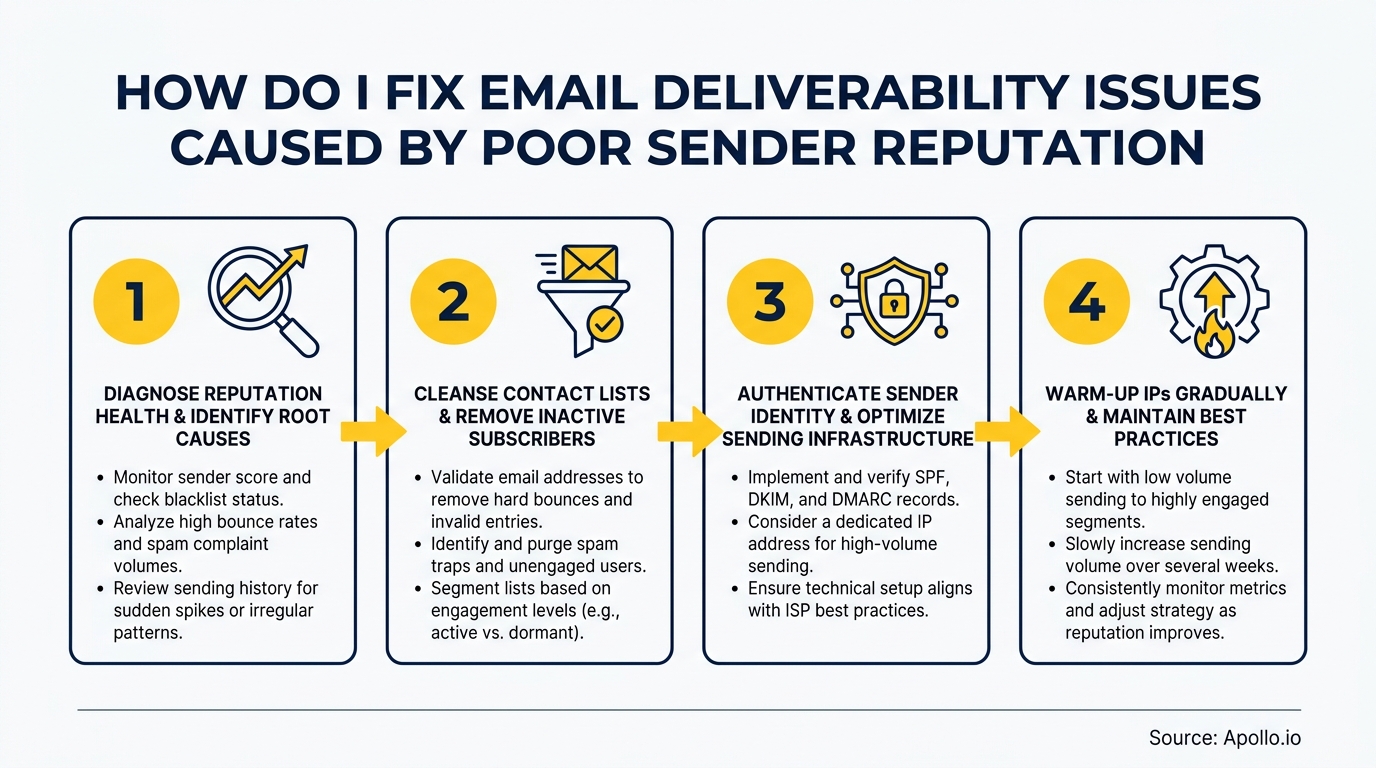
Fixing sender reputation is a systems problem, not a copy problem. Authenticate your domain, clean your list, suppress non-engagers, and measure inbox placement — not just delivery.
Then rebuild volume slowly with the most engaged segments first. The teams that recover fastest treat complaint rate as a hard operational KPI, monitor provider dashboards weekly, and use verified contact data from the start.
Apollo gives B2B GTM teams the data quality, engagement controls, and deliverability infrastructure to run outbound at scale without burning their domain. Start a free trial and protect your sender reputation from day one.
Prove Pipeline ROI With Apollo
ROI pressure killing your next tool renewal? Apollo delivers measurable pipeline impact from day one — no guesswork, no waiting. Leadium 3x'd their annual revenue. You're next.
Start Free with Apollo →Don't miss these
Sales
Inbound vs Outbound Marketing: Which Strategy Wins?
Sales
What Is a Sales Funnel? The Non-Linear Revenue Framework for 2026
Sales
What Is a Go-to-Market Strategy? The 2026 GTM Playbook
See Apollo in action
We'd love to show how Apollo can help you sell better.
By submitting this form, you will receive information, tips, and promotions from Apollo. To learn more, see our Privacy Statement.
4.7/5 based on 9,690 reviews
