
How Do I Ensure the Leads I Find Have Accurate Email and Phone Details?
Bad contact data is not a minor inconvenience. Research from Only-B2B shows sales representatives waste an estimated 27% of their time dealing with bad data, translating to approximately 550 hours or $32,000 per rep annually in lost productivity. If you want to know how to ensure the leads you find have accurate email and phone details, the answer is a continuous verification framework, not a one-time list clean. Start by verifying email addresses before every outreach sequence and treating data accuracy as an always-on operational KPI.

Verified Data. Real Connections. More Pipeline.
Tired of burning hours verifying contact info that goes nowhere? Apollo surfaces accurate business contacts so your team spends time selling, not searching. Nearly 100K paying customers trust Apollo to keep their pipeline moving.
Start Free with Apollo →Key Takeaways
- B2B contact data decays rapidly, meaning lists verified today become unreliable within weeks without continuous re-enrichment.
- Keeping your email bounce rate below 2% is a hard operational threshold that protects your sender reputation and deliverability.
- Phone accuracy in 2026 means more than a valid number. It means reachability under FCC STIR/SHAKEN and RMD enforcement.
- Multi-source enrichment with confidence scoring is more reliable than trusting any single upstream data provider.
- Consolidating prospecting, enrichment, and engagement into one platform eliminates the data-handoff gaps where accuracy breaks down.
Why Does Contact Data Decay So Fast?
B2B contact data decays because people change jobs, get new numbers, and update email domains constantly. According to IndustrySelect, approximately 37.3% of email addresses change annually, and about 42.9% of contacts acquire new phone numbers each year. That means nearly half your phone list can become stale within 12 months.
Data from Landbase shows B2B contact decay ranges from 22.5% to 70.3% annually depending on the industry. In fast-moving sectors like tech, Cleanlist.aireports decay can reach 30-40% per year. The practical implication: a "verified" list from three months ago may already have significant inaccuracies by the time your SDRs touch it.
This is why treating data decay as a 2026 operational KPI matters. Point-in-time verification is not enough.
What Are the Right Benchmarks for Email Accuracy?
Your target email bounce rate should stay below 2%. Validity's 2023 research found the average bounce rate was 1.26%, and explicitly flags anything above 2% as a risk threshold that can trigger spam filtering and sender-reputation penalties from mailbox providers.
Open rates are no longer a reliable hygiene signal. Validity also found that 70% of all email opens in 2023 were generated by Apple's privacy proxy, meaning inflated open metrics mask whether your contacts are actually real.
Focus on these hard outcome metrics instead:
- Bounce rate: Keep below 2% per campaign
- Hard bounce rate: Flag any contact that hard-bounces for immediate re-verification or suppression
- Reply rate: A better signal of list quality than opens
- Complaint rate: Keep below 0.1% to stay within Google and Yahoo bulk-sender thresholds
Google and Yahoo's bulk-sender enforcement, now extended into 2025-2026, means authentication posture (SPF, DKIM, DMARC alignment plus one-click unsubscribe) is part of what makes an email contact "accurate" for deliverability purposes. Learn more in Apollo's guide to email deliverability and avoiding spam filters.
How Do SDRs Build a Reliable Email Verification Workflow?
SDRs should verify emails at the point of export, not at the point of purchase, to minimize bounce risk from data that aged during list building. A four-step email verification workflow covers the main failure modes:
| Step | What It Checks | Why It Matters |
|---|---|---|
| 1. Syntax check | Format validity (@ symbol, domain structure) | Catches typos and malformed addresses |
| 2. Domain validation | MX records, domain existence | Flags defunct company domains |
| 3. Mailbox verification | SMTP ping to confirm inbox exists | Reduces hard bounces |
| 4. Suppression check | Cross-reference against bounce and unsubscribe lists | Protects sender reputation |
For contacts that fail verification, trigger a re-enrichment workflow rather than simply discarding them. Use a verified business contact finder to locate a current address before removing the lead from your pipeline entirely.
Tired of bounced emails hurting your sender score? Start free with Apollo's 230M+ verified business contacts and keep your bounce rate in check from the start.
Turn Funnel Guesswork Into Pipeline Wins
Pipeline forecasting a guessing game because leads stall before they ever reach sales? Apollo surfaces quality contacts and buying signals so your team stops chasing dead ends. Nearly 100K paying customers run tighter funnels with Apollo.
Start Free with Apollo →How Do I Validate Phone Numbers for Outbound Calling?
Phone validation in 2026 requires more than confirming a number exists. It requires confirming the number is reachable under current FCC enforcement conditions.
A valid number can still be blocked or labeled as spam if your dialing infrastructure lacks STIR/SHAKEN attestation.
In January 2026, the FCC tightened its Robocall Mitigation Database (RMD) compliance rules, requiring voice providers to keep certifications current. In August 2025, the FCC removed 185 providers from the RMD and directed blocking of their traffic.
For outbound sales teams, this means phone accuracy is now a two-part check:
- Number validity: Is the number formatted correctly, active, and assigned to the expected contact?
- Call reachability: Will the call be delivered, or will it be labeled or blocked by the carrier?
Build a re-verification cadence for phone numbers. Given that roughly 42.9% of contacts acquire new numbers annually (per the IndustrySelect data cited above), a quarterly re-check for active sequences is a practical starting SLA. Use Apollo's B2B phone and email finder to surface current direct dials without leaving your workflow.

Why Is Multi-Source Enrichment More Reliable Than a Single Database?
No single data provider has complete coverage. Relying on one upstream source means inheriting its blind spots.
A multi-source enrichment approach queries multiple providers in priority order (a "waterfall") and assigns field-level confidence scores based on recency and source agreement.
The structural reason coverage gaps persist: business records are inherently fragmented and require continuous updating to stay accurate. This is why confidence-scored, multi-source enrichment consistently outperforms any single-vendor approach for high-volume outbound teams.
Practical multi-source enrichment rules for RevOps leaders:
- Assign a recency weight to each data field (email verified within 30 days scores higher than 90 days)
- Only route contacts with high-confidence emails into automated sequences
- Trigger re-enrichment on job-change signals (new title, new company, domain change)
- Suppress low-confidence contacts to a manual review queue rather than discarding them
Apollo's waterfall enrichment queries multiple verified sources automatically, so your team always reaches contacts with the highest-confidence data available without managing separate vendor contracts.
How Do AEs and RevOps Teams Keep Contact Data Accurate at Scale?
Account Executives and RevOps teams need systematic triggers, not manual spot-checks, to keep contact data accurate across a large pipeline. The most effective teams build verification into their CRM sync and sequence-export workflows so data is re-checked at every handoff point.
Key automation triggers to implement:
- On CRM import: Auto-enrich and verify all new contacts before they enter sequences
- On job-change signal: Flag contact for immediate re-verification of email and phone
- On hard bounce: Remove from active sequences and route to re-enrichment queue
- On 90-day inactivity: Re-verify before re-engaging
For AEs preparing for calls, pre-meeting intelligence matters as much as contact validity. Pair verified contact data with timely context using Apollo's prospecting and lead-finding tools to walk into every conversation with current, accurate details. Teams at Cyera have noted that "having everything in one system was a game changer" for maintaining this kind of data integrity without adding tools.
Also consider timing. Verified contact data only converts to pipeline when you reach out at the right moment. See Apollo's research on the best times to email and call prospects to maximize the value of your verified list.
How Do I Ensure Lead Contact Accuracy Without Expanding My Tech Stack?
The fastest way to introduce data accuracy gaps is to move contacts across multiple disconnected tools. Each handoff (database to enrichment tool to CRM to sequencer) is an opportunity for stale data to slip through undetected.
Consolidating prospecting, enrichment, verification, and engagement into a single platform eliminates those gaps. Apollo combines a 230M+ contact database with 97% email accuracy, built-in enrichment, and multi-channel sequences in one workspace.
Predictable Revenue found they "reduced the complexity of three tools into one" after consolidating on Apollo, and Census reported cutting costs in half.
For teams still evaluating how to structure their outbound stack, the outbound prospecting guide covers how to build a reliable pipeline from contact discovery through close, without the tool sprawl that creates data quality problems.

Start Finding Leads You Can Actually Reach
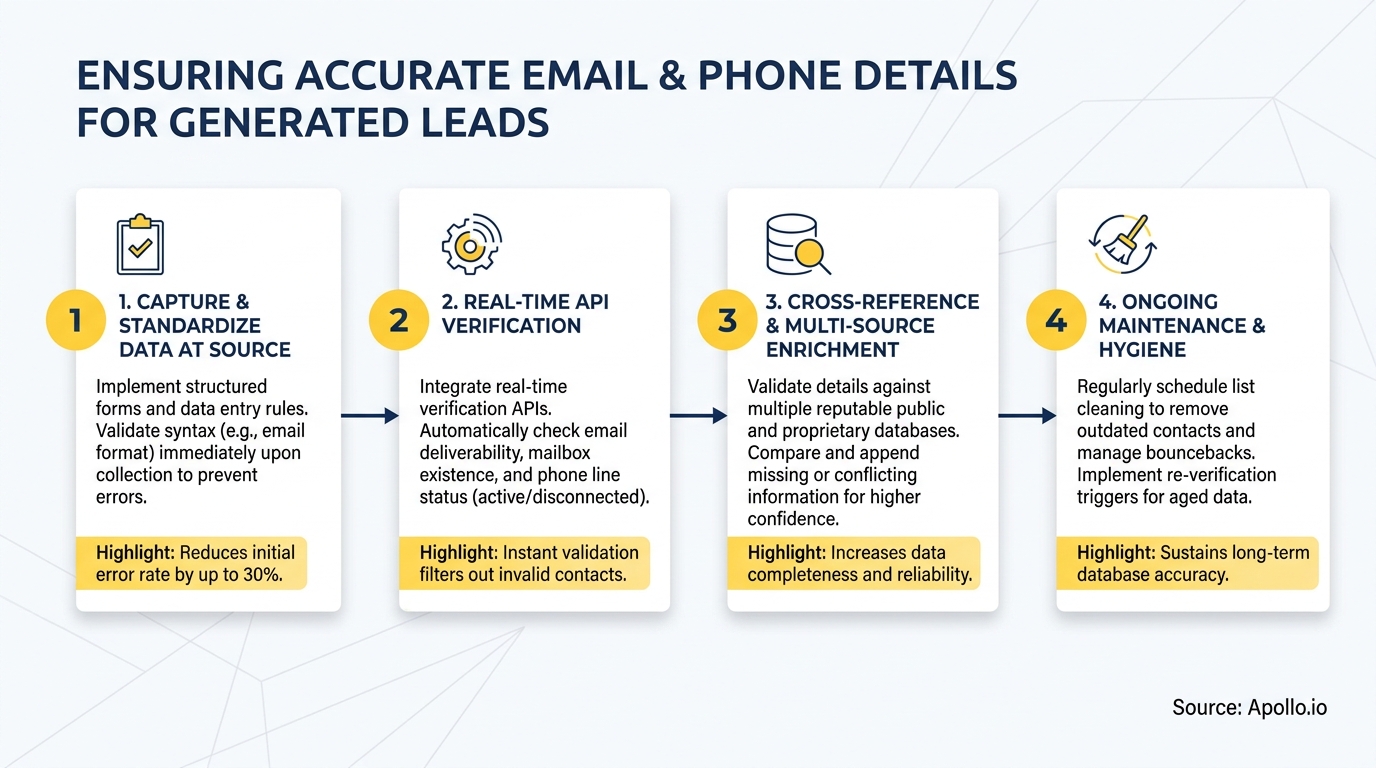
Accurate email and phone data is not a database feature. It is a continuous process: verify at export, enrich on job-change signals, suppress on bounce, and re-verify on cadence.
The teams that treat contact accuracy as an operational KPI, not a one-time task, consistently outperform those that trust static lists.
Apollo gives SDRs, AEs, and RevOps teams a unified platform to find, verify, and reach business contacts with 97% email accuracy and waterfall enrichment built in, so your outreach hits real inboxes and live numbers every time.
Start Prospecting free today and build a pipeline on verified contact data from day one.
Prove ROI Before Budget Gets Cut
ROI pressure killing your tool renewals? Apollo delivers measurable pipeline impact from day one — so you walk into budget reviews with wins, not excuses. Nearly 100K paying customers already have the numbers to back it up.
Start Free with Apollo →Don't miss these
Sales
Inbound vs Outbound Marketing: Which Strategy Wins?
Sales
What Is a Sales Funnel? The Non-Linear Revenue Framework for 2026
Sales
What Is a Go-to-Market Strategy? The 2026 GTM Playbook
See Apollo in action
We'd love to show how Apollo can help you sell better.
By submitting this form, you will receive information, tips, and promotions from Apollo. To learn more, see our Privacy Statement.
4.7/5 based on 9,690 reviews
