
How Fast Does B2B Contact Data Decay and How Do You Fix It
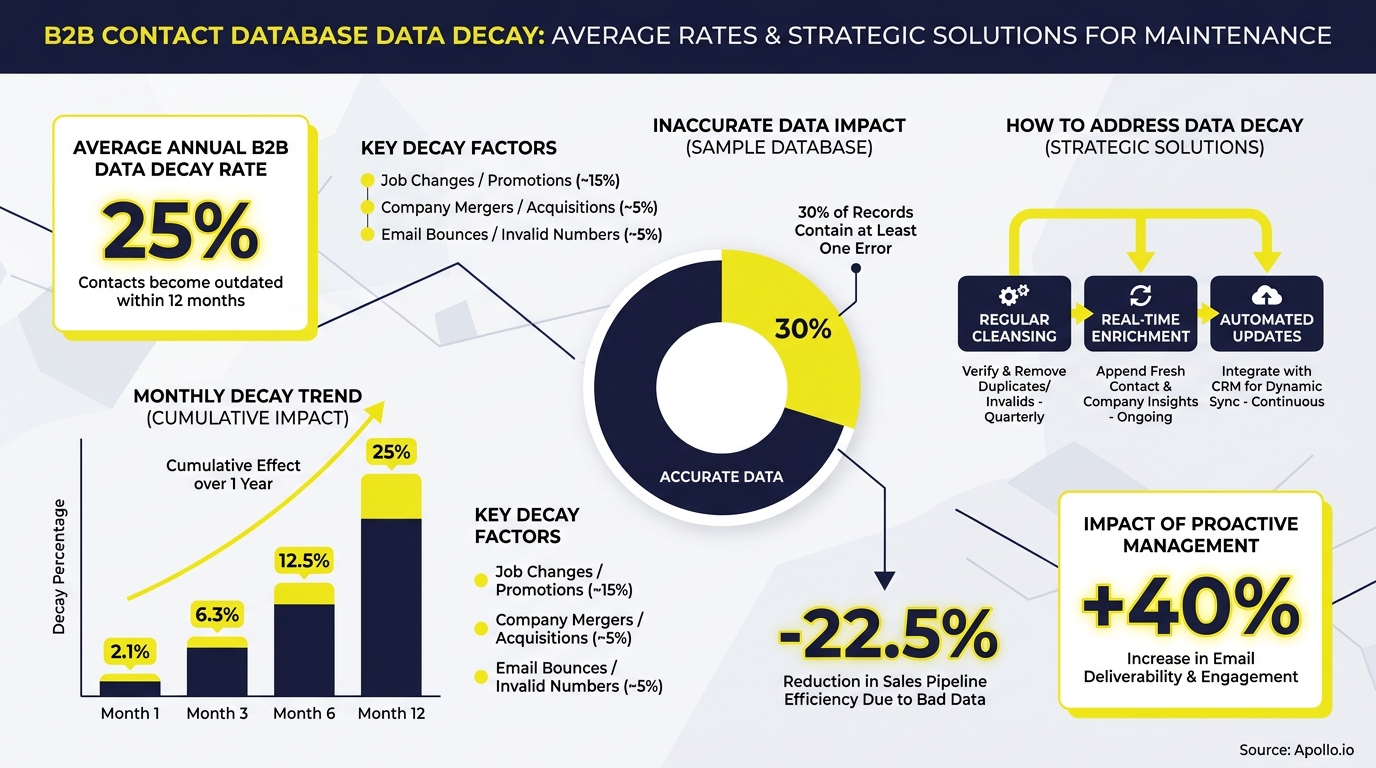
B2B contact data has a shelf life, and it's shorter than most teams realize. According to Only-B2B, B2B data deteriorates at an average monthly rate of 2.1%, which compounds to roughly 22.5% annually. But that's just the floor. Research from Landbase shows B2B contact data can decay between 22.5% and 70.3% annually depending on how many fields you track. Stale records don't just waste SDR time — they quietly kill deliverability, pipeline accuracy, and AI automation readiness. Understanding what data enrichment is and how it works is the first step toward solving this problem at its root.

Research Less, Close More With Apollo
Tired of burning hours verifying contact info instead of selling? Apollo delivers 97% accurate emails and business phone numbers so your team hits the phones faster. Join 600K+ companies turning research time into revenue.
Start Free with Apollo →Key Takeaways
- B2B contact data decays at roughly 2.1% per month on average, but multi-field decay (title, phone, email, company) compounds significantly faster.
- Data decay is now a deliverability risk, not just a CRM annoyance: stale lists drive bounces, damage domain reputation, and suppress pipeline.
- Most organizations significantly underestimate how inaccurate their CRM data actually is, creating a dangerous gap when deploying AI or automation.
- Fixing decay requires an ongoing operating model with refresh SLAs, role-based ownership, and trigger-based enrichment — not annual cleanup projects.
- Apollo's continuous enrichment tools and 230M+ contact database help RevOps and GTM teams maintain data accuracy without adding tools to their stack.
What Is B2B Data Decay and Why Does It Happen?
B2B data decay is the process by which contact records become inaccurate over time as professionals change jobs, titles, emails, and phone numbers. It is not a one-time event but a continuous, structural problem driven by employee turnover. According to Cleanlist, approximately 30% of professionals change jobs annually, invalidating their contact details across every database that holds them.
Decay happens across multiple fields simultaneously:
- Email addresses change when professionals switch employers or companies rebrand.
- Job titles shift with promotions, restructures, or role changes.
- Phone numbers become unreachable when direct lines are reassigned.
- Company data changes due to acquisitions, rebrands, and office closures.
The practical implication: a database that was accurate at the start of the year may have meaningful gaps by Q2, and substantial inaccuracy by Q4.
What Is the Real-World Impact on Revenue and Deliverability?
Data decay translates directly into lost revenue and damaged outreach channels. Datamaticsbpm reports that poor data quality costs U.S. businesses an estimated $3.1 trillion annually. That figure spans wasted outreach, failed campaigns, and missed pipeline opportunities.
Beyond the revenue cost, decay has become a deliverability problem. Stale lists generate hard bounces, spam complaints, and inactive contacts — all signals that damage domain reputation and reduce inbox placement rates.
In a tightening email environment with stricter sender authentication requirements, decayed lists effectively tax every campaign you send.
For RevOps leaders, the risk compounds when AI or automation is layered on top of inaccurate data. Garbage in, garbage out — automated sequences sent to wrong contacts waste sequences, burn domain reputation, and skew attribution reporting.
How Do SDRs and RevOps Teams Feel the Pain of Data Decay Daily?
SDRs working from a decayed database face a hidden productivity drain: significant time spent on research, re-verification, and manual updates instead of actual outreach. When contact records are stale, sequences bounce, calls go nowhere, and quota attainment suffers without any obvious root cause.
For RevOps teams, decayed data creates downstream problems across the entire GTM motion:
- Inaccurate lead routing assigns records to the wrong territory or rep.
- CRM reports become unreliable, making forecasting and coaching harder.
- Automation triggers fire on stale signals, wasting sequences and credits.
- AI tools trained on bad data surface low-quality recommendations.
Tired of dirty data degrading your team's output? Start free with Apollo's 230M+ verified business contacts and stop building pipeline on stale records.
Turn Funnel Gaps Into Predictable Pipeline
Tired of watching marketing leads stall before they ever reach sales? Apollo surfaces high-intent prospects and keeps your pipeline moving with 230M+ verified contacts. Join 600K+ companies forecasting with confidence.
Start Free with Apollo →How Should You Build a Data Decay Operating Model?
A data decay operating model replaces ad hoc cleanup with a scheduled, trigger-based refresh system. The goal is always-on hygiene rather than periodic spring cleaning.
Here is a practical framework by cadence:
| Cadence | Trigger or Schedule | Action |
|---|---|---|
| Before every campaign send | Pre-send trigger | Email validation and bounce-risk check |
| On form fill or inbound signal | Real-time trigger | Enrich and normalize new record immediately |
| Monthly | Scheduled | Re-verify active prospect and customer records |
| Quarterly | Scheduled | Full database audit: deduplicate, suppress, re-enrich cold segments |
| Annually | Scheduled | Governance review: field strategy, SLA updates, ownership reassignment |
High-velocity industries (tech, recruiting, financial services) warrant more frequent refresh cycles than stable verticals. Segment your database by industry and apply cadence accordingly. Building a solid data enrichment strategy is the foundation that makes this operating model sustainable.

What Governance Model Keeps Data Quality from Degrading Again?
Governance is what turns a one-time cleanup into a durable system. Without ownership and accountability, data quality reverts to baseline within months of any refresh effort.
Effective governance requires three things: assigned roles, defined SLAs, and enforced field standards.
- Data Owner (RevOps or Marketing Ops): Sets field requirements, monitors quality scores, and owns the refresh calendar.
- Enrichment Trigger Rules: Define which events (form fill, deal stage change, territory reassignment) automatically trigger a re-verification call.
- Required Field Policy: Enforce minimum required fields before a record can be routed to an SDR or entered into a sequence.
- SLA by Segment: Document the maximum acceptable age of a record before it must be re-verified. For active prospects, 90 days is a common threshold.
Governance is also increasingly a compliance function. Organizations operating in regulated regions should track data source, last verification date, and opt-out status as part of standard record hygiene. For teams managing data synchronization across multiple business systems, governance rules must be applied consistently across every connected tool.
How Does Continuous Enrichment Address Data Decay at Scale?
Continuous enrichment solves data decay by replacing static database snapshots with dynamic, always-current records. Rather than relying on a single import or annual list purchase, continuous enrichment re-verifies and updates records on a rolling basis using live data signals.
Apollo's data enrichment tools connect directly to your CRM, automatically updating contact and account records when changes are detected across Apollo's 230M+ person database. This means SDRs always work from current data, and RevOps teams spend less time on manual QA. It also consolidates what previously required separate verification tools, enrichment vendors, and CRM maintenance workflows into a single platform.
For Account Executives, enriched records mean pre-meeting intelligence is current: right title, right company context, right contact. For sales leaders, it means forecast data reflects reality rather than stale pipeline assumptions. Understanding how contact data enrichment drives ROI makes the business case clear for any team under revenue pressure.

Start Fixing Data Decay Today
B2B contact data decays faster than most teams budget for, and the cost shows up in bounces, missed pipeline, and broken automation before anyone notices the root cause. The fix is not a one-time project.
It is an operating model: scheduled verification, trigger-based enrichment, governance with real ownership, and a data source that stays current.
Apollo gives B2B GTM teams a unified platform to prospect, enrich, and engage from verified data without stitching together multiple vendors. Trusted by nearly 100K paying customers including Anthropic, Smartling, and Redis, Apollo consolidates sales intelligence and engagement in one workspace.
Start Prospecting with Apollo — free, no credit card required.
Prove Pipeline ROI Before Next QBR
ROI pressure killing your tool budget? Apollo surfaces measurable pipeline impact so you can walk into any budget review with hard numbers. Leadium 3x'd annual revenue — your board meeting just got easier.
Schedule a Demo →Don't miss these
Sales
Inbound vs Outbound Marketing: Which Strategy Wins?
Sales
What Is a Sales Funnel? The Non-Linear Revenue Framework for 2026
Sales
What Is a Go-to-Market Strategy? The 2026 GTM Playbook
See Apollo in action
We'd love to show how Apollo can help you sell better.
By submitting this form, you will receive information, tips, and promotions from Apollo. To learn more, see our Privacy Statement.
4.7/5 based on 9,690 reviews
