
How to Enrich Inbound Leads Automatically Before They Reach Your Sales Team (2026)
Every minute a new inbound lead sits in your CRM without context is a minute your SDR wastes on manual research instead of booking meetings. Worse, leads handed off with incomplete or inaccurate data get misrouted, mishandled, or simply dropped. The fix is a pre-handoff enrichment pipeline that appends firmographics, verifies contact data, scores ICP fit, and routes the lead automatically — before any human touches it. This guide covers the architecture, governance, and tools to make that happen. For a broader foundation, see What Is Data Enrichment? Boost CRM Data Quality & Sales.

Rich Data That Makes Every Rep Deadly
Tired of sending generic outreach because your data has zero context? Apollo enriches every contact with firmographic and technographic depth — so your team stops guessing and starts converting. 97% email accuracy. Start closing.
Start Free with Apollo →Key Takeaways
- Enriching leads before handoff dramatically improves conversion rates — enriched leads consistently outperform unenriched ones on conversion.
- Data quality is a governance problem as much as a tooling problem: nearly 75% of B2B organizations report at least 10% of their lead data is inaccurate or outdated.
- Signal-led enrichment — combining firmographics with intent, behavior, and engagement signals — is replacing static form-fill data as the routing standard in 2026.
- An automated enrichment gate (validate, enrich, score, route) eliminates the manual research burden that consumes SDR capacity.
- Apollo consolidates enrichment, scoring, sequencing, and routing into one platform, replacing the need for multiple point solutions.
Why Does Pre-Handoff Lead Enrichment Matter So Much?
Pre-handoff lead enrichment matters because incomplete lead data is one of the most direct causes of lost revenue. According to Landbase, 67% of lost sales result from inadequate lead qualification — and qualification is impossible without complete data. When a lead arrives with only a name and email, your SDR must manually research company size, industry, tech stack, buying intent, and decision-maker context before crafting a personalized opener. That research time is non-selling time.
The scale of the data quality problem is significant. The "State of Marketing Data 2025" report from Integrate and Demand Metric found that nearly 75% of respondents estimate at least 10% of their lead data is inaccurate, outdated, or non-compliant. Sending reps after bad data wastes quota capacity and erodes confidence in the pipeline. Automated enrichment before handoff solves this upstream.
For RevOps leaders building scalable inbound motions, enrichment automation is foundational to sales analytics that actually drive revenue growth — because clean, complete data is the prerequisite for any meaningful reporting.
What Is a Pre-Handoff Enrichment Gate?
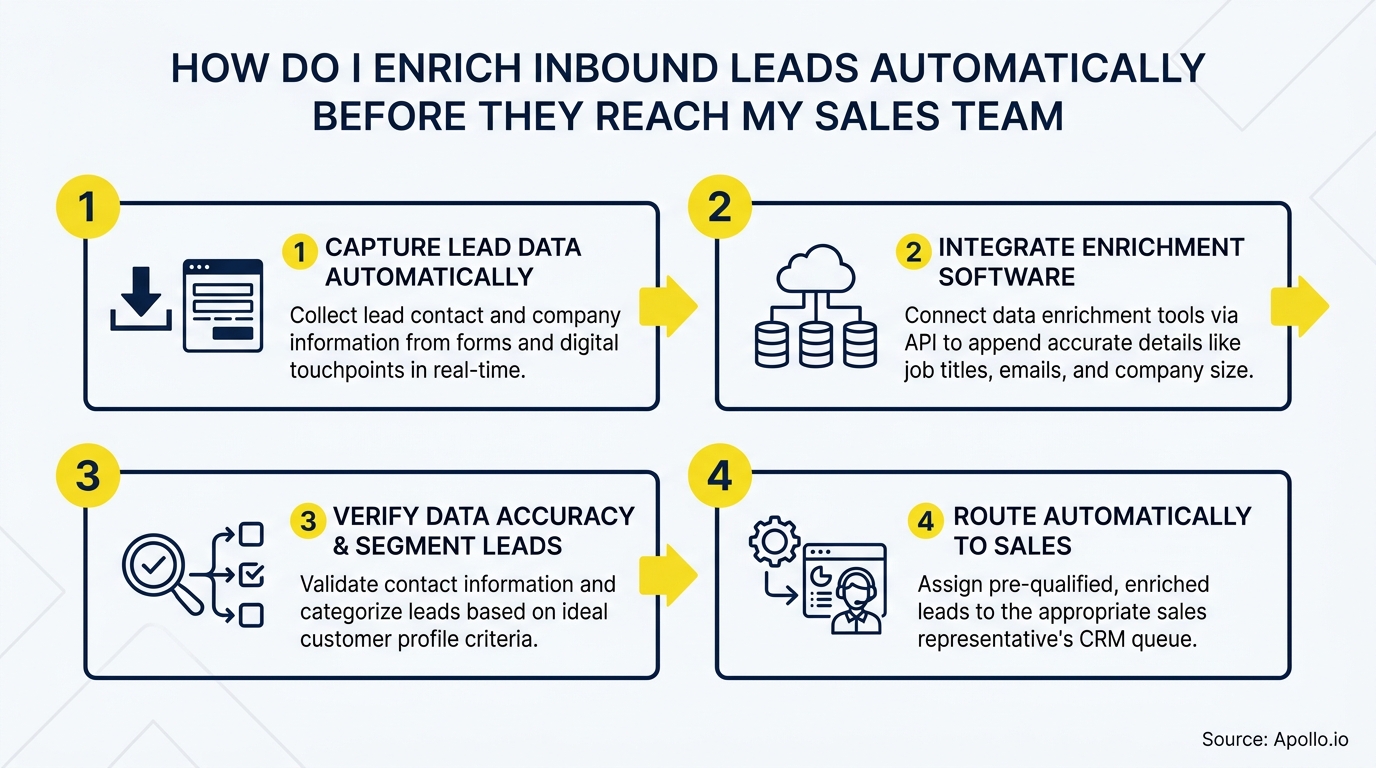
A pre-handoff enrichment gate is an automated checkpoint that every inbound lead passes through before it is assigned to a rep. It validates, enriches, scores, and routes the record without human intervention.
Think of it as a quality control layer inserted between form submission and CRM assignment.
A well-designed gate executes four steps in sequence:
| Step | What Happens | Output |
|---|---|---|
| 1. Validate | Verify email deliverability, deduplicate against existing records | Clean, unique record |
| 2. Enrich | Append firmographics, job title, company size, tech stack, intent signals | Complete lead profile |
| 3. Score | Apply ICP fit model, assign a confidence score and segment tier | Prioritized lead |
| 4. Route | Assign to correct rep, territory, or sequence based on score and segment | Actionable handoff |
Leads that fail validation thresholds (low match rate, missing key firmographic fields, compliance flags) enter a hold queue for review rather than being pushed to reps. This prevents SDRs from wasting time on leads that are not ready for outreach.
Turn Weak Leads Into Pipeline That Closes
Pipeline forecasting a guessing game because your leads never convert? Apollo surfaces in-market buyers with real-time signals so your team stops chasing dead ends. Join 600K+ companies building predictable pipeline.
Start Free with Apollo →How Does the Real-Time Enrichment Architecture Work?
Real-time enrichment architecture works by triggering enrichment events at the moment of form submission, not hours later during a nightly CRM sync. The architecture is event-driven: form submit fires a webhook, the webhook calls an enrichment API, the API response updates the CRM record, and the scoring engine then classifies the lead — all within seconds.
Key components of a real-time pipeline:
- Event trigger: Form submit, chat conversation, or intent signal fires a webhook
- Enrichment API call: Firmographics, contact data, and intent signals appended in real time
- Deduplication check: Record matched against existing CRM accounts to prevent duplicates
- ICP scoring: Rule-based or AI-assisted model assigns a tier (A/B/C or numeric score)
- Routing logic: Score + territory rules determine rep assignment and sequence enrollment
- SLA timer: Triggers escalation if lead is not contacted within defined window
Research from SuperAGI shows that real-time API integration and AI-driven tools can lead to a 25% reduction in time spent on data research and enrichment, freeing reps to focus on higher-value activities. The shift from batch enrichment to event-driven enrichment is the single biggest architectural upgrade most teams can make in 2026.
Tired of incomplete lead profiles reaching your reps? Automate contact enrichment with Apollo's verified data and stop the manual research cycle.
What Governance Rules Should Protect the Enrichment Pipeline?
Governance rules define who owns each field, which source wins in a data conflict, and what compliance checks run before a record is assigned. Without governance, enrichment pipelines create new data quality problems: conflicting values, overwritten opt-outs, and ungoverned field sprawl.
Core governance design decisions every RevOps team needs to make:
- Field survivorship: Define which source wins when enriched data conflicts with form-captured data (e.g., enriched company size overrides form input; contact email from form is authoritative)
- Recency windows: Set maximum data age thresholds — Default.com notes that over 30% of B2B contact data becomes outdated annually, making recency checks critical
- Compliance flags: Auto-check enriched records against suppression lists, consent flags, and regional compliance rules before routing
- Cross-functional ownership: Marketing Ops owns enrichment rules; Sales Ops owns routing logic; Privacy/Legal owns suppression and compliance checks
- Audit trail: Log every enrichment event with source, timestamp, and field changes for data lineage visibility
Signal-led enrichment — combining firmographics with intent data and behavioral signals — is replacing static form data as the routing standard. Governance must account for how intent signals are weighted, refreshed, and expired in the scoring model.

How Do SDRs and RevOps Teams Benefit from Automated Enrichment?
SDRs benefit from automated enrichment by receiving leads that already include company context, ICP score, and suggested talking points — eliminating the pre-call research step that previously consumed significant prep time. For RevOps leaders, automated enrichment means the CRM becomes a reliable source of truth rather than a patchwork of partially complete records.
Specific gains by role:
- SDRs/BDRs: Open a lead record and see company size, funding stage, tech stack, and intent signals already populated. Start personalizing the outreach immediately instead of opening five browser tabs.
- Account Executives: Pre-meeting intelligence is pre-loaded. No manual prep to understand the account's business context before a discovery call.
- RevOps: Routing rules execute consistently. No manual territory assignments or misrouted leads creating rep conflict.
- Marketing Leaders: ICP match rates become measurable. Attribution clarity improves because enriched records carry the firmographic fields needed for cohort analysis.
According to MarketsandMarkets, enriched leads convert 20-30% better than unenriched ones. That conversion lift compounds across the entire inbound volume — meaning enrichment ROI scales with pipeline growth. For a deeper look at how enrichment fits into your overall inbound strategy, see Inbound Leads Built for B2B Growth.
Struggling with reps spending more time on research than selling? Automate your inbound workflow with Apollo's AI sales automation and hand reps ready-to-work leads.
How Does Apollo Automate Inbound Lead Enrichment End to End?
Apollo automates inbound lead enrichment by combining a 230M+ contact database, automated enrichment workflows, ICP scoring, and multi-channel sequencing into a single platform — eliminating the need to stitch together separate tools for data, enrichment, scoring, and outreach.
Here is how the end-to-end flow works inside Apollo:
- Inbound capture: Lead submits a form; Apollo's webhook integration triggers immediately
- Enrichment: Apollo appends 65+ data attributes — job title, company size, industry, tech stack, funding, and more — using its verified database
- Scoring: Apollo's ICP scoring model classifies the lead and assigns a tier based on your defined criteria
- Routing: Workflow engine assigns the lead to the correct rep or territory automatically
- Sequencing: Lead is enrolled in the appropriate multi-channel sequence without any manual steps
This consolidation is the core value proposition. As Cyera put it, "Having everything in one system was a game changer." Rather than managing separate subscriptions for enrichment, routing, and engagement, Apollo handles the full pipeline in one workspace. That directly supports the sales automation model that high-performing GTM teams are building in 2026. To understand how this fits into a broader stack, see How to Build a Sales Tech Stack That Scales Revenue.

Ready to Enrich Every Inbound Lead Before It Reaches Your Team?
Automated pre-handoff enrichment is no longer optional for B2B GTM teams that want consistent pipeline quality. The architecture is straightforward: validate, enrich, score, and route — all before a rep touches the record.
The governance layer protects data quality over time. And the ROI case is clear: better-qualified leads convert at higher rates, and reps spend more time selling instead of researching.
Apollo gives SDRs, AEs, RevOps, and marketing leaders a single platform to run the entire enrichment-to-engagement workflow without managing multiple vendor contracts. Trusted by nearly 100K paying customers including Anthropic, Smartling, and Redis, Apollo is purpose-built for B2B GTM teams that need to do more with less. See how Predictable Revenue reduced their tech stack complexity by moving to Apollo.
Try Apollo Free and start enriching every inbound lead automatically before it reaches your sales team.
Prove Pipeline ROI From Day One
ROI pressure killing your tool budget before it even gets approved? Apollo delivers measurable pipeline impact fast — so your numbers speak for themselves. Leadium 3x'd annual revenue. Yours could too.
Start Free with Apollo →Don't miss these
Sales
Inbound vs Outbound Marketing: Which Strategy Wins?
Sales
What Is a Sales Funnel? The Non-Linear Revenue Framework for 2026
Sales
What Is a Go-to-Market Strategy? The 2026 GTM Playbook
See Apollo in action
We'd love to show how Apollo can help you sell better.
By submitting this form, you will receive information, tips, and promotions from Apollo. To learn more, see our Privacy Statement.
4.7/5 based on 9,690 reviews
