
How to Compare All-in-One Sales Platforms on Data Quality, Engagement, and Analytics
Choosing an all-in-one sales platform is one of the highest-stakes decisions a GTM team makes in 2026. The wrong call means paying for capability you never use, or worse, building your pipeline on bad data.
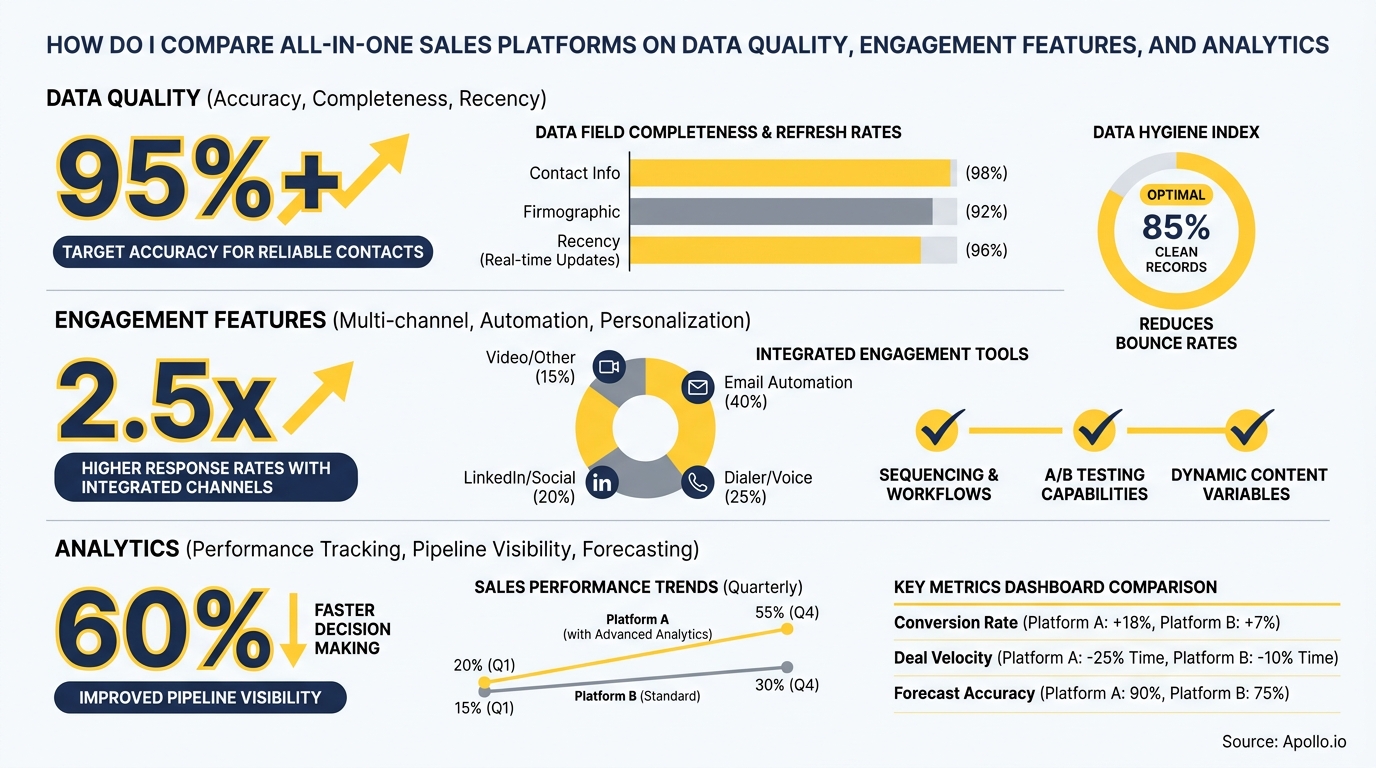
To compare platforms effectively, you need a structured framework across three axes: data quality, engagement features, and analytics depth. This article gives you exactly that, plus a practical pilot protocol to validate vendor claims before you sign.
Before diving in, it helps to understand how contact data enrichment drives ROI and why data accuracy sits at the foundation of every downstream outcome, from email deliverability to pipeline forecasting.

Build Pipeline Without the Manual Grind
Tired of your reps burning hours on research instead of selling? Apollo surfaces verified contacts and scales your outreach automatically. Nearly 100K paying customers stopped guessing and started closing.
Start Free with Apollo →Key Takeaways
- Data quality should be your first evaluation filter: bad contact data corrupts engagement and analytics simultaneously.
- Engagement features should be scored on relevance governance (segmentation, intent signals) as much as channel count.
- Analytics comparisons in 2026 must include omnichannel attribution and data portability, not just dashboard aesthetics.
- A two-week pilot with real records is the only reliable way to validate vendor data accuracy claims.
- Consolidating into one platform that handles prospecting, engagement, and analytics eliminates data fragmentation and reduces stack costs significantly.
Why Does Data Quality Come First in Any Platform Comparison?
Data quality comes first because it determines the accuracy of every engagement action and every analytics output downstream. According to Landbase, 70% of CRM data is outdated, incomplete, or inaccurate. When you build sequences on bad records, you get bounced emails, wasted calls, and skewed conversion metrics that make your analytics unreliable.
Research from Demand Gen Report shows that in 2025, nearly three-quarters of respondents (75%) estimated at least 10% of their lead data was inaccurate, outdated, or non-compliant. For RevOps leaders managing CRM hygiene, this is not a minor inconvenience. It is a structural pipeline problem.
A key 2026 buying criterion is whether a platform's AI features can actually execute reliably. AI outcomes are only as good as the data they run on, so data quality has become the central prerequisite for any agentic workflow.
Tired of dirty data corrupting your pipeline? Start free with Apollo's 230M+ verified business contacts and see the difference clean data makes on day one.
What Scoring Framework Should You Use to Compare Platforms?
Use a weighted scoring framework that evaluates five dimensions, with data quality carrying the highest weight since it affects every other category.
| Evaluation Dimension | Weight | Key Questions to Ask Vendors |
|---|---|---|
| Data Quality & Accuracy | 30% | What is your email verification rate? How often is data refreshed? Can I run a sample match test? |
| Engagement Features | 25% | What channels are native vs. integrated? How does the platform handle segmentation and intent signals? |
| Analytics & Reporting | 20% | Does it support multi-touch attribution? Can data export to a BI warehouse? What is the attribution model? |
| AI & Automation | 15% | Are AI features outcome-tested or demo-only? What guardrails exist for automated outreach? |
| Consolidation & Integration | 10% | How many tools does this replace? What is the CRM sync depth and data governance score? |
SaaS&Co recommends a data governance score of 90%+ compliance with established standards as a RevOps benchmark. Use that threshold when evaluating vendor data governance claims.
Turn Weak Funnels Into Pipeline Gold
Tired of marketing leads that never convert to real opportunities? Apollo surfaces high-intent prospects already in buying mode, so your team stops chasing and starts closing. Nearly 100K paying customers proved it works.
Start Free with Apollo →How Should SDRs and RevOps Teams Evaluate Engagement Features?
SDRs and RevOps teams should evaluate engagement features on relevance controls and native channel depth, not just the number of touchpoints a platform claims to support.
Gartner's 2024 survey of 632 B2B buyers found 61% prefer a rep-free buying experience, and 73% actively avoid suppliers who send irrelevant outreach. This means SDRs need platforms with strong segmentation, intent data signals, and governance controls, not just high-volume sequence blasting.
For RevOps leaders, the critical question is whether engagement data feeds cleanly back into the CRM and analytics layer. Platforms that silo engagement data from pipeline data force manual reconciliation and create attribution blind spots.
Look for native bi-directional sync and a consistent object model across sales and marketing touchpoints.
- Must-have engagement features: Multi-channel sequences (email, phone, social), intent-based triggers, A/B testing, deliverability monitoring, and automated follow-up logic.
- Differentiators in 2026: AI-generated personalization at send time, sender reputation scoring, and self-serve buyer journey support.
- Red flags: Engagement data that does not sync to your CRM, no deliverability reporting, and sequences that cannot be paused based on buyer behavior signals.
See how Apollo compares to other sales engagement platforms on native channel depth and sequence flexibility.

What Analytics Capabilities Should You Compare Across All-in-One Platforms?
Analytics capabilities to compare include multi-touch attribution, pipeline influence reporting, sequence performance dashboards, and data portability to external BI tools.
McKinsey's B2B Pulse 2024 found that buyers use an average of 10 interaction modes across the purchase journey. A platform that only tracks email opens and call connects will miss most of the story.
Your analytics layer needs to stitch signals across every touchpoint into a coherent view of pipeline influence.
In 2026, analytics comparisons are shifting toward instrumentation depth and data portability. Ask vendors whether their data is warehouse-native or BI-ready, and whether you can export raw event data.
Platforms that lock analytics behind proprietary dashboards with no export path create long-term dependency risk.
For Account Executives managing deal cycles, the most valuable analytics are deal velocity tracking, engagement-to-meeting conversion rates, and call outcome summaries. Evaluate whether the platform provides these natively or requires a separate reporting tool. Learn more about how sales analytics drives revenue growth and what to look for in a reporting layer.
How Do You Run a Pilot to Validate Platform Claims?
Run a two-week pilot using a real sample of 500 to 1,000 records from your target ICP to validate data accuracy, engagement deliverability, and analytics coherence before committing to a contract.
- Step 1 - Data accuracy test: Upload your sample list and measure email verification rates, phone match rates, and field completeness against your known baseline.
- Step 2 - Identity resolution check: Confirm the platform can match contacts to accounts across multiple touchpoints without duplicate records.
- Step 3 - Engagement deliverability test: Run a small sequence and measure inbox placement, bounce rates, and open rates against industry benchmarks.
- Step 4 - Analytics validation: Confirm that sequence activity syncs to your CRM within an acceptable time window and that attribution data is accurate.
- Step 5 - Consolidation ROI estimate: Count which existing tools the platform replaces and calculate the annual cost difference.
Spending hours on manual outreach with no visibility into what is working? Automate your sequences with Apollo's multi-channel engagement platform and track every touchpoint in one workspace.

Why Does Tool Consolidation Matter When Comparing All-in-One Platforms?
Tool consolidation matters because fragmented stacks create data inconsistencies, wasted spend, and adoption gaps that undermine both engagement quality and analytics reliability.
A 2025 study reported by Marketing Ops found that 75% of RevOps professionals cited data inconsistencies as the most frustrating part of their tech stack. When prospecting data lives in one tool, sequences run in another, and analytics sit in a third, every handoff is a potential data corruption point.
Gartner's 2025 Marketing Technology Survey reports martech utilization fell to 49%, meaning nearly half of paid stack capability goes unused. The consolidation case is straightforward: fewer platforms with higher adoption deliver better data fidelity and more reliable analytics than a sprawling stack with low utilization.
Apollo customers have experienced this directly. "We reduced the complexity of three tools into one," said Collin Stewart of Predictable Revenue. "We cut our costs in half," reported Census. "Having everything in one system was a game changer," noted Cyera. For teams evaluating platforms, these outcomes reflect the practical value of a unified workspace for prospecting, engagement, and analytics.
Explore how data enrichment tools drive revenue in 2026 and which capabilities belong in a consolidated GTM platform versus a standalone point solution.
How to Choose the Right All-in-One Sales Platform in 2026
Choose the platform that scores highest on data quality first, then engagement relevance controls, then analytics depth, and validate every claim with a structured pilot before signing.
The right platform for your team depends on your current stack complexity, ICP data requirements, and how mature your analytics needs are. SDRs need clean contact data and multi-channel sequences that respect buyer preferences.
Account Executives need deal intelligence and pipeline visibility. RevOps leaders need a single source of truth with governance controls and CRM sync reliability.
Apollo is built for exactly this use case: a unified GTM platform that combines a 230M+ contact database with 97% email accuracy, native multi-channel engagement, AI-powered automation, and pipeline analytics in one workspace. Trusted by nearly 100K paying customers including Anthropic, DocuSign, and Autodesk, Apollo consolidates your sales tech stack so your data, engagement, and analytics all operate from the same foundation.
Ready to put the framework into practice? Start a Trial and run your own pilot with Apollo's verified contact database, built-in sequences, and revenue analytics, all in one platform.
Prove Pipeline ROI With Apollo
ROI pressure killing your tool budget? Apollo delivers measurable pipeline impact from day one — no guesswork, no long runways. Teams like Built-In saw +10% win rates and +10% ACV. Start free today.
Start Free with Apollo →Don't miss these
Sales
Inbound vs Outbound Marketing: Which Strategy Wins?
Sales
What Is a Sales Funnel? The Non-Linear Revenue Framework for 2026
Sales
What Is a Go-to-Market Strategy? The 2026 GTM Playbook
See Apollo in action
We'd love to show how Apollo can help you sell better.
By submitting this form, you will receive information, tips, and promotions from Apollo. To learn more, see our Privacy Statement.
4.7/5 based on 9,690 reviews
