
How to Compare AI SDR Vendors on Personalization, Deliverability, and CRM Sync
Most AI SDR vendor comparisons stop at features. The real differentiators are measurable: does personalization land with signal-grounded context or generic copy? Do emails reach the inbox or the spam folder? Does CRM sync create clean records or duplicate chaos? Tools like Apollo's AI Sales Assistant show what a workflow-native, end-to-end approach looks like — but any vendor evaluation needs a structured scorecard, not a demo-day gut feeling.
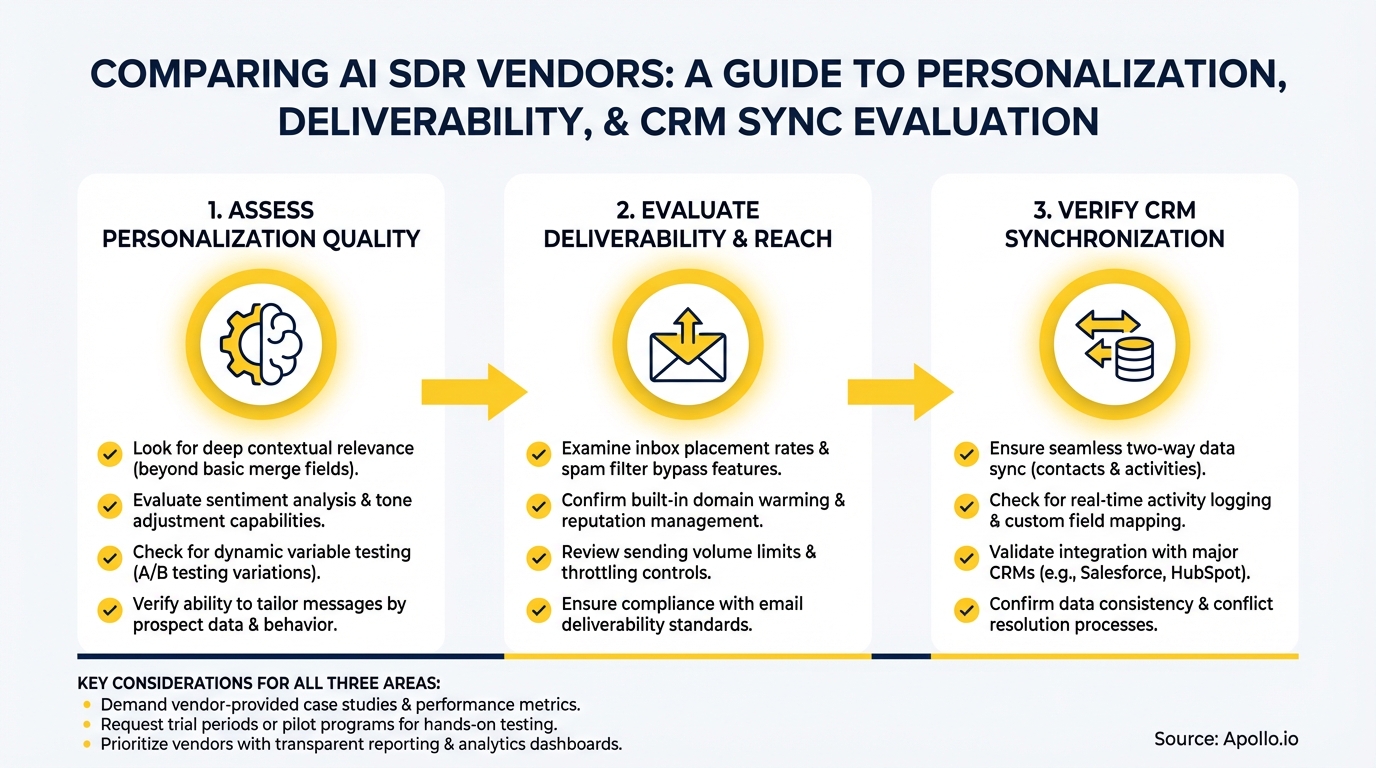
This framework gives SDRs, RevOps leaders, and sales managers a practical method to score AI SDR vendors on the three dimensions that drive pipeline: personalization quality, deliverability, and CRM sync reliability.

Scale Smarter With Apollo's AI Engine
Tired of your reps burning hours on manual research instead of closing deals? Apollo's AI Research Agent surfaces verified contacts and automates outreach so your team scales without the chaos. Over 600K companies trust Apollo to build predictable pipeline.
Start Free with Apollo →Key Takeaways
- Personalization quality depends on data grounding and signal access, not just copy variation — evaluate what signals a vendor can actually pull into messages.
- Deliverability is a product requirement in 2026: roughly one in six emails never reaches the inbox, so inbox placement telemetry must be part of any vendor review.
- CRM sync failures are measurable — score vendors on duplicate prevention, field-overwrite controls, bidirectional sync reliability, and error logging.
- Signal-personalized outreach achieves reply rates far above the cold email average, making data access the highest-leverage factor in your vendor decision.
- The strongest AI SDR platforms consolidate prospecting, sequencing, enrichment, and CRM sync into one workspace — reducing integration risk and tool sprawl.
Why Do Personalization, Deliverability, and CRM Sync Matter Most in 2026?
These three dimensions determine whether AI-generated outreach creates pipeline or creates noise. Personalization without inbox placement means well-crafted emails no one reads.
CRM sync failures mean pipeline data that can't be trusted for forecasting or attribution. All three must be evaluated together — a weakness in any one undermines the others.
The investment signal is clear: according to Sopro, 57% of businesses increased their AI investment in prospecting and personalization in the past 12 months. Vendors are proliferating fast, and feature convergence is real — which is exactly why evaluation frameworks need to go beyond marketing claims.
How Do SDRs and RevOps Teams Score Personalization Quality?
Personalization quality is best scored on data grounding, not copy cleverness. A vendor that pulls job change signals, funding events, or tech stack data into message variables will consistently outperform one generating generic icebreakers from a name and company field.
Research from Autobound shows signal-personalized outreach achieves 15–25% reply rates, compared to the 3–5% industry average for cold email. That gap is driven by data access, not prompt quality. When evaluating vendors, ask these questions:
- Signal sources: Does the vendor use intent data, job changes, funding rounds, or technographic signals to ground personalization?
- Data readiness: Are enrichment fields available before sequence launch, or does the vendor write around gaps?
- Consent-forward enrichment: Does the vendor use business contact information for professionals in their business capacity, with clear data provenance?
- Measurability: Can you attribute reply rate lift to specific personalization variables via A/B testing?
For SDRs, the practical test is simple: run 50 AI-generated emails from a vendor and count how many reference a prospect-specific signal versus a generic opener. That ratio predicts performance at scale. Struggling to get prospect data that actually grounds your messaging? Search Apollo's 230M+ contacts with 65+ filters to build signal-rich prospect lists.
Apollo's AI Research combines Apollo data with web search to pull prospect-specific context directly into email variables. The AI Content Center grounds every message in your value proposition, ICP pain points, and differentiators — so output is business-specific, not generic. As Erik Fernando Nieto, BDR at JumpCloud, puts it: "Apollo's AI Assistant filters and cleans prospect data for me, so I can find the right people faster and run better searches. It saves me about an hour per prospecting session."

How Do You Evaluate Email Deliverability for AI SDR Vendors?
Deliverability evaluation requires distinguishing inbox placement from raw delivery — a message marked "delivered" may still land in spam. According to Mailreach, the global inbox placement average is around 84%, meaning roughly one in six emails never reaches the inbox. Vendor benchmarks that cite only "delivery rates" obscure this gap entirely.
Score vendors on these deliverability dimensions:
| Dimension | What to Test | Green Flag |
|---|---|---|
| Inbox placement rate | Seed testing across major mailbox providers | Provider-specific placement data available |
| Spam placement telemetry | Monitor spam folder rate, not just bounce rate | Dashboard shows inbox vs. spam breakdown |
| Authentication support | SPF, DKIM, DMARC configuration guidance | Setup wizard or documentation provided |
| Domain/IP warmup | New domain ramp cadence | Automated warmup or explicit controls |
| Sending volume controls | Daily limits and throttling per mailbox | Configurable per-inbox sending caps |
Agentic AI is shifting vendor comparisons from copy quality to workflow quality — and deliverability infrastructure is now table stakes, not a differentiator. Any vendor that can't show inbox placement telemetry per mailbox provider should not pass your evaluation.
Turn Funnel Gaps Into Pipeline Gold
Tired of watching marketing leads stall before they ever reach your pipeline? Apollo surfaces in-market buyers with verified contact data so your team reaches the right prospects at right moment. Nearly 100K paying customers trust Apollo to turn funnel gaps into closed deals.
Start Free with Apollo →How Do You Test CRM Sync Reliability for AI SDR Tools?
CRM sync reliability is a measurable engineering problem, not a checkbox. The failure modes — duplicate records, field overwrites, attribution loss, API throttling — are observable if you know what to test. See how a sound CRM integration strategy prevents these issues before they compound into data debt.
RevOps leaders should run this test protocol before committing to a vendor:
- Duplicate test: Import a contact that already exists in your CRM. Does the vendor merge, skip, or create a duplicate?
- Field overwrite test: Manually update a CRM field, then trigger an AI SDR enrichment. Does the vendor overwrite your manual data?
- Bidirectional sync test: Update a record in CRM. Does the change reflect back in the AI SDR tool within a defined SLA?
- Error log access: Can you see failed syncs, skipped records, and API errors in a dashboard? Or do failures happen silently?
- Attribution integrity: Does sequence activity (opens, replies, meetings) sync to CRM with proper source attribution?
Spending too much time debugging CRM data quality? Apollo's sales engagement platform syncs sequences, activity, and enrichment directly to Salesforce and HubSpot with bidirectional reliability. For deeper setup guidance, the Apollo CRM integration walkthrough covers field mapping, deduplication settings, and sync controls. Apollo also publishes detailed guidance on how data sync improves B2B sales and marketing ROI — a useful benchmark for what good looks like.
What Does a Vendor Comparison Scorecard Look Like?
A structured scorecard prevents vendor selection from defaulting to recency bias or demo polish. Assign weights based on your team's current bottleneck: deliverability matters most if you're scaling volume; personalization depth matters most if you're targeting high-ACV accounts; CRM sync matters most if RevOps owns data quality SLAs.
| Dimension | Suggested Weight | Key Questions |
|---|---|---|
| Personalization quality | 35% | Signal sources, data grounding, A/B testing capability |
| Deliverability infrastructure | 35% | Inbox placement telemetry, authentication support, warmup controls |
| CRM sync reliability | 20% | Deduplication, field controls, error logging, bidirectional sync |
| Workflow consolidation | 10% | Does the vendor replace multiple tools or add to the stack? |
Score each vendor 1–5 per dimension, multiply by weight, and sum. The workflow consolidation dimension matters more than it looks: teams that stitch together separate prospecting, sequencing, enrichment, and CRM tools absorb integration debt that compounds over time. As the team at Cyera noted: "Having everything in one system was a game changer." And Predictable Revenue found they "reduced the complexity of three tools into one" with Apollo.
How Can Account Executives and SDRs Pilot a Vendor Before Committing?
A structured pilot produces decision-quality data in 30 days. The goal is to generate enough volume across a controlled segment to measure all three dimensions simultaneously.
- Week 1: Configure AI Content Center or equivalent, set up CRM sync, establish seed email addresses for deliverability monitoring.
- Week 2: Launch a 100-contact pilot sequence with signal-personalized messaging. Track inbox placement via seed accounts, not just open rates.
- Week 3: Audit CRM records for duplicates, field overwrites, and attribution accuracy.
- Week 4: Measure reply rate by personalization variable, inbox placement rate, and CRM data quality score.
For Account Executives evaluating vendors for high-touch accounts, add a pre-meeting research test: ask the AI SDR tool to prep a meeting brief for a target account. The depth of that output reveals how grounded the personalization engine actually is. Apollo's AI Assistant guide shows what this looks like in practice — from list building to sequence launch to meeting prep, all in one workflow.

How Do You Choose the Right AI SDR Vendor in 2026?
The right vendor scores highest on the dimension that constrains your current pipeline — but the strongest vendors score well across all three. Avoid point solutions that excel at one dimension while creating new integration debt.
The goal is a platform where personalization, deliverability, and CRM sync are all observable, measurable, and improvable from one workspace.
Apollo brings prospecting, AI-powered sequencing, data enrichment, and CRM sync into a unified GTM platform trusted by nearly 100K paying customers, including Anthropic, Smartling, and Redis. The Apollo AI Sales Assistant handles end-to-end outbound workflows from a single natural-language interface — research, list building, sequence creation, and CRM sync without switching tools. See the full Apollo AI overview to understand how it all fits together.
Ready to see how Apollo scores on all three dimensions for your team? Schedule a Demo and bring your scorecard.
Prove Pipeline ROI With Apollo
Budget approval stuck on unclear metrics? Apollo delivers measurable pipeline impact your leadership can see from day one. Leadium 3x'd annual revenue — your ROI story starts here.
Start Free with Apollo →Don't miss these
Sales
Inbound vs Outbound Marketing: Which Strategy Wins?
Sales
What Is a Sales Funnel? The Non-Linear Revenue Framework for 2026
Sales
What Is a Go-to-Market Strategy? The 2026 GTM Playbook
See Apollo in action
We'd love to show how Apollo can help you sell better.
By submitting this form, you will receive information, tips, and promotions from Apollo. To learn more, see our Privacy Statement.
4.7/5 based on 9,690 reviews
