
How Do I Choose Between a Power Dialer and a Parallel Dialer for My Sales Team?
The dialer decision isn't just about speed. In 2026, it's a compliance, data quality, and stack consolidation decision that affects every SDR, AE, and RevOps leader on your team. Choose wrong, and you're either leaving pipeline on the table or exposing your company to regulatory risk. This guide gives you a clear framework to pick the right dialer for your motion — and build the right infrastructure around it. For a broader view of your calling options, start with Apollo's dialer software for sales teams.

Let Apollo Do the Research For You
Tired of burning hours verifying contacts instead of closing deals? Apollo surfaces accurate, ready-to-dial leads so your team spends time selling, not searching. Join 600K+ companies building pipeline faster.
Start Free with Apollo →Key Takeaways
- Power dialers call one number at a time per rep, making them lower-risk and better suited for complex B2B sales requiring personalization.
- Parallel dialers dial multiple lines simultaneously per rep, maximizing volume but raising compliance exposure if abandonment rates exceed the 3% regulatory cap.
- Data quality must come before dialer selection — bad contact lists waste dials regardless of which mode you use.
- Stack consolidation is now the primary buying constraint: the best dialer is one that lives inside your sales engagement platform, not alongside it.
- SDRs and BDRs get the most from dialers when call outcomes feed directly into CRM workflows, not a separate system.
What Is the Core Difference Between a Power Dialer and a Parallel Dialer?
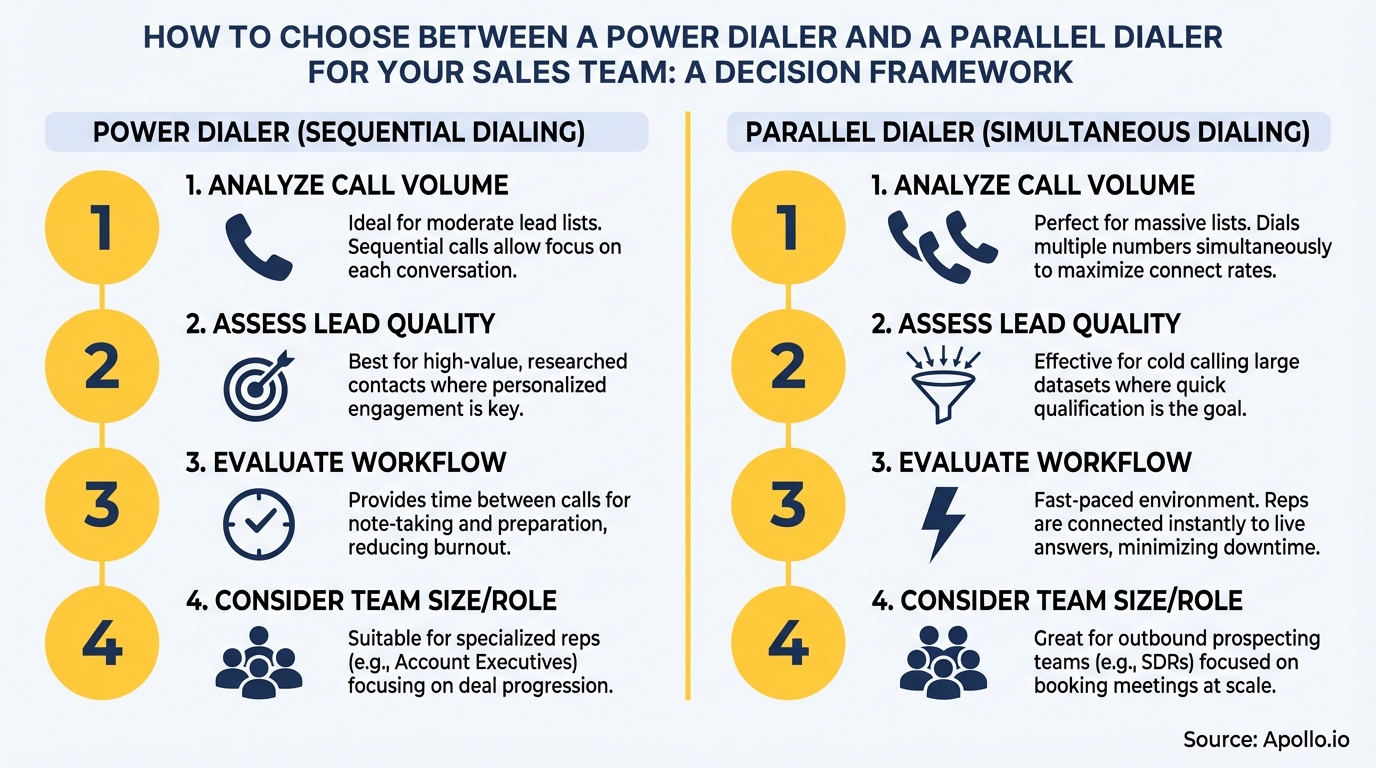
A power dialer calls one number at a time per rep, automatically moving to the next when a call ends or goes unanswered. A parallel dialer calls multiple numbers simultaneously per rep, connecting the rep only when a live answer is detected.
According to powerdialer.ai, the sequential (power dialing) approach gives sales reps more time between calls for preparation, personalization, and detailed CRM updates — making it well-suited for complex B2B sales and relationship-based selling. Parallel dialing, as Leadium notes, is designed for maximizing connection attempts and efficiency in high-volume outreach scenarios.
| Factor | Power Dialer | Parallel Dialer |
|---|---|---|
| Lines per rep | 1 | 2–10 simultaneously |
| Call volume | Moderate | High |
| Compliance risk | Lower | Higher (abandonment cap risk) |
| Best for | Complex B2B, relationship sales | High-volume outbound, large TAMs |
| CRM logging quality | Cleaner dispositions | Requires tighter controls |
| Stack fit | Native to most SEPs | Often a specialist add-on |
Why Does Compliance Change the Parallel Dialer Math?
Parallel dialing raises abandonment risk because when multiple lines ring simultaneously and more than one prospect answers, only one can connect — the rest hear silence and hang up. U.S. telemarketing rules cap abandoned live-answered calls at 3%, measured over a rolling 30-day window per campaign.
Exceeding that threshold creates regulatory exposure that scales with call volume.
In 2025 and into 2026, state-level "mini-TCPA" rules and STIR/SHAKEN call authentication enforcement have compounded this risk. Teams running aggressive parallel configurations (5–10 lines per rep) are increasingly seeing calls flagged as spam or blocked by carriers — a problem that erodes the very connect rates they were chasing. As Skipcall notes, power dialers are generally safer in terms of compliance because they call one number at a time, avoiding the abandoned call risks associated with multi-line dialers.
Compliance checklist before enabling parallel dialing:
- Abandonment rate monitoring dashboard (30-day rolling window per campaign)
- Pacing controls that throttle lines when abandonment approaches 2.5%
- Number attestation (STIR/SHAKEN A-level signing where possible)
- Do-not-call scrubbing integrated before each dial session
- Call recording retention policy aligned to state requirements
How Should SDRs and BDRs Think About Dialer Selection?
SDRs and BDRs benefit most from dialers when call outcomes flow automatically into their CRM and sequence workflows — not when they're toggling between two systems. The right dialer for an SDR team is the one that maximizes qualified conversations per rep-hour, not raw dials.
Data from SalesHive shows that power dialers can enable 50–60+ calls per hour, compared to 10–15 with manual dialing. That volume lift alone justifies the switch for most SDR teams — before even considering parallel dialing. For BDR teams targeting enterprise accounts or navigating multi-threaded buying committees, the personalization window a power dialer provides is often more valuable than the extra connects a parallel setup offers.
Struggling to fill your dialing lists with verified contacts? Search Apollo's 230M+ contacts with 65+ filters to build call-ready lists before your reps pick up the phone.

What Data Readiness Do You Need Before Choosing a Dialer?
Data quality is a prerequisite for dialer ROI, not an afterthought. A 2026 Salesforce State of Sales report found that 74% of sales teams with AI are prioritizing data hygiene — because bad numbers produce low connect rates regardless of how fast you dial.
Before committing to a dialer type, verify your contact data is ready:
- Phone verification: Validate mobile vs. landline, check for disconnected numbers
- Enrichment: Fill gaps in direct dials, titles, and company data
- Routing logic: Ensure the right rep calls the right account at the right time
- List segmentation: Separate high-intent accounts (power dialer) from broad prospecting lists (parallel dialer candidates)
This is where your sales tech stack architecture matters most. A dialer sitting on top of stale or unverified data will underperform regardless of its mode. Use Apollo's data enrichment to verify and complete contact records before your next dial session.
Turn Funnel Guesswork Into Real Pipeline
Quota stress keeping you up at night? Apollo surfaces quality leads that actually convert, giving your team real-time pipeline clarity. Nearly 100K paying customers stopped forecasting blind — and started closing.
Start Free with Apollo →How Does Stack Consolidation Affect the Dialer Decision?
The dialer that lives inside your sales engagement platform almost always wins on total cost and operational simplicity. A 2026 Salesforce State of Sales report found that 84% of sales teams without an all-in-one platform plan to consolidate their tools — and standalone dialers are a primary consolidation target.
Parallel dialers, in particular, often require specialist providers bolted onto your existing SEP. That means separate contracts, separate compliance controls, separate reporting, and separate training.
RevOps leaders managing these stacks consistently report that governance gaps (audit logs, access controls, call recording policies) are harder to enforce across two systems than one.
The trend is clear: sales-engagement platforms are standardizing power/sequential dialing natively, while parallel dialing becomes a targeted add-on for specific high-volume motions. As noted in comparisons of top sales engagement platforms, the integration between dialing, sequencing, and CRM logging is a primary differentiator. "Having everything in one system was a game changer," said a revenue leader at Cyera.
For RevOps teams evaluating revenue operations infrastructure, the right question isn't just "power or parallel" — it's "which dialer mode can we run inside the platform we already own?"
Which Dialer Should Your Team Choose? A Decision Framework
Use this framework to match your team's motion to the right dialer type before signing any contract.
| If your team... | Choose This | Why |
|---|---|---|
| Sells complex B2B with long cycles | Power Dialer | Personalization window between calls matters more than volume |
| Runs high-volume SMB outbound with large TAMs | Parallel Dialer (2–3 lines) | Volume needed to manufacture enough live connects |
| Lacks compliance infrastructure | Power Dialer | Lower abandonment risk, easier to monitor |
| Uses intent signals to prioritize accounts | Power Dialer | Intent-qualified lists don't require brute-force volume |
| Needs calls natively in your SEP | Power Dialer | Most SEPs offer this natively; parallel often requires add-on |
| Has strong compliance + pacing controls in place | Parallel Dialer (with monitoring) | Volume uplift justified when abandonment is controlled |
Pairing your dialer with intent data signals often reduces the need for aggressive parallel dialing entirely — your reps connect with fewer dials because they're calling the right accounts at the right time.
How Does Apollo Fit Into Your Dialing Stack?
Apollo's built-in dialer software sits natively inside the same platform as your contact database, sequences, CRM sync, and AI-powered workflows. That means no separate compliance system to manage, no disconnected call logging, and no duplicate data entry after each call.
For SDRs, this translates to faster ramp, cleaner dispositions, and call outcomes that automatically trigger next steps in their sequences. For RevOps and sales leaders, it means a single source of truth across prospecting, engagement, and pipeline — without the overhead of stitching together a standalone dialer.
As Predictable Revenue put it: "We reduced the complexity of three tools into one."
Apollo also integrates with your existing CRM, so call data flows directly into Salesforce or HubSpot without manual logging. See how Apollo connects with HubSpot and Salesforce to keep your stack lean and your data clean. For sales leaders focused on team performance, explore Apollo for Sales Leaders to see how consolidated tooling drives quota attainment.

Conclusion: Make the Dialer Decision Part of Your Stack Strategy
The power vs. parallel dialer question resolves quickly once you frame it correctly. For most B2B GTM teams — especially those selling complex solutions, using intent data, or lacking dedicated compliance infrastructure — a power dialer is the right starting point.
Parallel dialing earns its place only when you have the volume requirements, the contact data quality, and the compliance controls to run it safely.
Either way, the dialer you choose should live inside your sales engagement platform, not beside it. Consolidation reduces risk, improves data quality, and makes every rep more effective from day one.
Ready to see how a unified dialing, prospecting, and engagement platform works in practice? Start Prospecting with Apollo and give your team a dialer that's already connected to everything else they need.
Prove Pipeline ROI From Day One
ROI pressure killing your next tool approval? Apollo delivers measurable pipeline impact fast — so your team ramps quicker and results speak for themselves. Nearly 100K paying customers closed the loop on ROI.
Start Free with Apollo →Don't miss these
Sales
Inbound vs Outbound Marketing: Which Strategy Wins?
Sales
What Is a Sales Funnel? The Non-Linear Revenue Framework for 2026
Sales
What Is a Go-to-Market Strategy? The 2026 GTM Playbook
See Apollo in action
We'd love to show how Apollo can help you sell better.
By submitting this form, you will receive information, tips, and promotions from Apollo. To learn more, see our Privacy Statement.
4.7/5 based on 9,690 reviews
