
How to Calculate the Cost Savings of Replacing or Augmenting SDR Headcount with AI in 2026
Every sales leader faces the same pressure in 2026: do more with the same headcount, or justify new hires against a CFO asking hard questions about ROI. AI-augmented outbound has moved from experiment to boardroom agenda, and the math behind it needs to be defensible. Tools like Apollo's AI Sales Assistant are helping GTM teams automate research, list building, and multi-channel sequencing so SDRs can focus on high-value conversations instead of manual busywork. But before you reallocate headcount or request budget, you need a structured model to calculate actual cost savings.
This guide gives you a finance-first framework: fully loaded SDR costs, AI total cost of ownership (TCO), outcome-based ROI metrics, and a risk-adjusted view that holds up in a CFO review. Read How to Sell with AI for a practical companion to the numbers here.

Research Less, Close More With Apollo
Tired of burning hours verifying contact info instead of selling? Apollo surfaces accurate, ready-to-reach prospects so your team spends time closing, not searching. Join 600K+ companies building pipeline faster.
Start Free with Apollo →Key Takeaways
- Start with fully loaded SDR costs (base, variable, benefits, tech stack, ramp, and management time) — not just salary — to build a credible savings baseline.
- AI SDR TCO includes subscription fees, oversight time, data enrichment, and CRM integration costs. Model all four before claiming savings.
- The most defensible ROI framing in 2026 is "avoided hires" and "capacity created," not headcount elimination.
- Hybrid AI + human designs (AI handles top-of-funnel volume, humans handle high-stakes accounts) consistently outperform pure replacement strategies.
- Risk-adjust your model: factor in a realistic probability that your AI initiative requires iteration before delivering projected returns.
What Does a Fully Loaded SDR Actually Cost?
A fully loaded SDR cost goes well beyond base salary — it includes every dollar your organization spends to put that rep in market. According to Product Growth Blog, a fully loaded human SDR costs between $110,000 and $139,000 annually when you account for all inputs.
| Cost Component | Typical Range |
|---|---|
| Base salary | $50,000–$70,000 |
| Variable / commission | $10,000–$20,000 |
| Benefits (health, 401k, taxes) | $15,000–$25,000 |
| Tech stack (CRM, sequencer, data) | $5,000–$15,000 |
| Recruiting + onboarding | $5,000–$15,000 |
| Manager time + enablement | $8,000–$15,000 |
| Total (fully loaded) | $93,000–$160,000 |
This is your cost baseline. Every savings claim must compare against this number — not just the salary line.
Turn Funnel Gaps Into Closed Deals
Pipeline forecasting a guessing game? Apollo surfaces high-intent prospects the moment they're ready to buy, so your team stops chasing cold leads and starts closing. Nearly 100K paying customers trust Apollo to build predictable pipeline.
Schedule a Demo →What Is the True TCO of an AI SDR Solution?
AI SDR TCO has four components: platform subscription, human oversight, data enrichment, and systems integration. Miss any one of these and your savings model will overstate returns.
- Platform subscription:Mick-Mar reports AI SDR platforms generally cost between $500 and $5,000 per month.
- Human oversight: Someone still reviews sequences, approves messaging, and handles edge cases. Budget 20–30% of one rep's time, minimum.
- Data enrichment: AI quality depends on data quality. Factor in enrichment costs if not included in the platform. Struggling to keep contact data fresh? Apollo's verified contact database keeps your pipeline accurate.
- CRM integration + ops: RevOps setup, routing rules, and ongoing hygiene are real line items. Poor CRM hygiene is consistently cited as the top AI ROI constraint in 2026.
See Solving Data Synchronization Headaches for a practical guide to keeping your systems clean before automating outbound at scale.
How Do SDRs and RevOps Leaders Build the Savings Calculation?
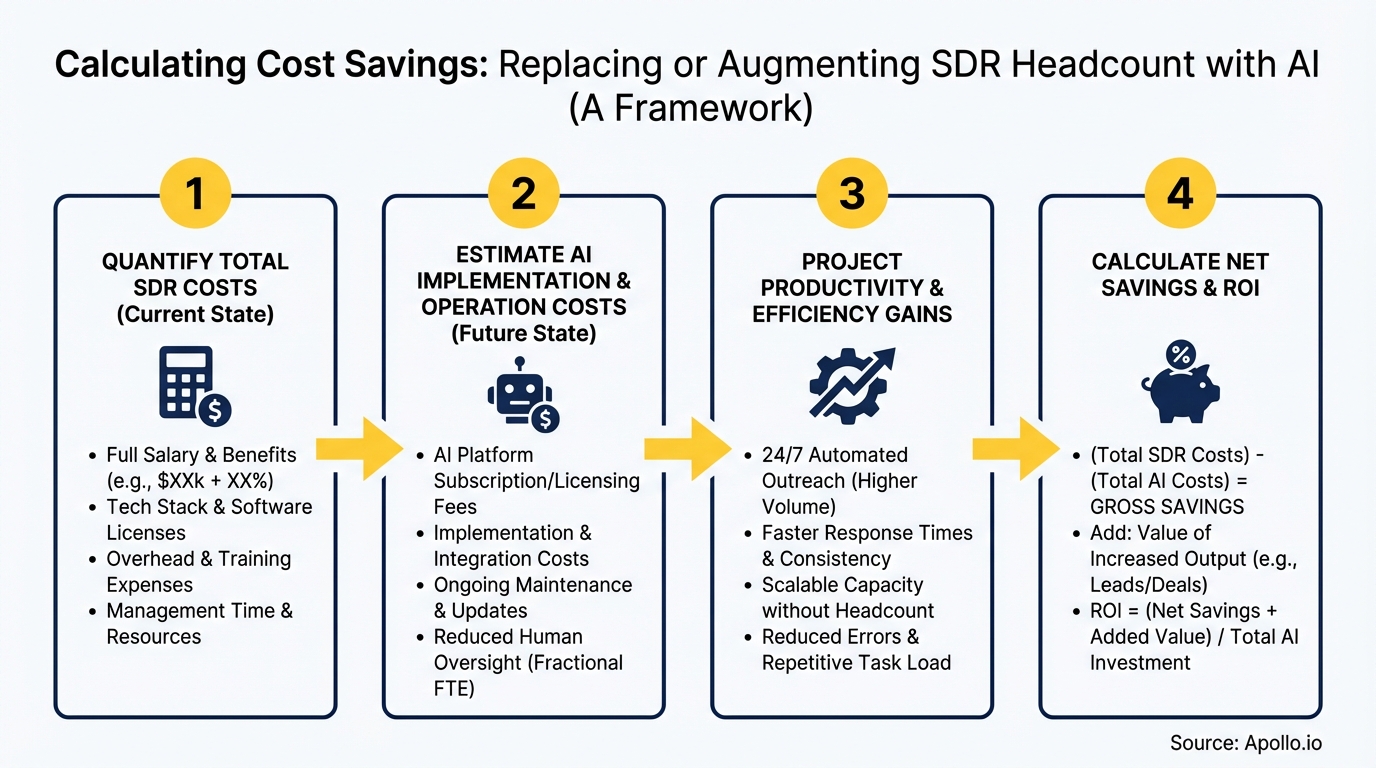
The core savings formula compares fully loaded SDR cost against AI TCO, then adjusts for outcome deltas. Here is the three-layer model used by finance-forward GTM teams:
Layer 1: Direct cost delta
Fully Loaded SDR Cost (annual) — AI TCO (annual) = Gross Savings
Layer 2: Outcome delta
Measure cost per meeting booked, cost per sales-qualified opportunity (SQO), and cost per $1 of pipeline created — before and after AI implementation. ROI modeling is shifting from cost-per-activity to cost-per-outcome in 2026. If AI books more meetings at lower cost per meeting, that delta is additional value beyond direct labor savings.
Layer 3: Capacity created
If human SDRs are freed from list building and first-touch sequences, quantify the value of redirecting that time toward high-stakes accounts, events, or partner plays. This "redeployment value" is often larger than direct cost reduction and is easier to defend to a CFO than headcount cuts.
For broader return-on-sales context, see How to Calculate Return on Sales With Industry Benchmarks.
How Should SDRs and Sales Leaders Risk-Adjust the ROI Model?
Risk-adjusting your AI SDR ROI model means multiplying projected savings by the probability that your implementation achieves full projected returns. Not every AI initiative performs as modeled on day one.
A practical approach:
- Conservative scenario (60% confidence): Apply 60% of projected gross savings. Use this for initial budget requests.
- Base scenario (80% confidence): Full gross savings minus oversight and integration costs. Present this as the primary case.
- Upside scenario (100%): Include outcome deltas (better meeting rate, faster ramp). Use only with documented pilot data.
Build staged ROI gates into your rollout: measure a 30-day pilot against your baseline before committing to full deployment. This gives you real data to replace assumptions — and protects your credibility if results take longer to materialize than the vendor's model suggested.
What Are the Hidden Costs That Kill Paper ROI?
Several line items consistently erode projected savings when teams skip them in the initial model.
- Email deliverability infrastructure: High-volume AI outbound requires domain warming, inbox rotation, and ongoing deliverability monitoring. See How to Improve Email Deliverability in 5 Easy Steps.
- Brand voice QA: AI-generated messaging still requires human review for accuracy, tone, and compliance. Budget governance time explicitly.
- Ramp and change management: Teams switching from manual workflows to AI-assisted workflows need enablement time before hitting peak productivity.
- Reputation risk: Poor personalization or irrelevant outreach at scale damages sender reputation and prospect relationships. Quality gates are not optional.
Spending too much time on manual outreach that isn't converting? Apollo's multi-channel sales engagement platform automates sequences while keeping personalization grounded in real account signals.

What Do Industry Benchmarks Say About AI SDR Cost Savings?
External data provides useful reference ranges for stress-testing your internal model. SuperAGI reports AI SDRs can reduce costs by 70–80% compared to traditional human SDRs. That figure assumes near-full automation of top-of-funnel tasks and should be treated as an upper-bound scenario, not a starting assumption.
A more conservative benchmark: Rev Empire reports AI-driven prospecting can decrease the cost per lead by up to 65%. Applied to a fully loaded SDR cost baseline, even a partial realization of that reduction produces a meaningful dollar figure at the team level.
For SDRs and AEs thinking about how AI changes their day-to-day, tools like Apollo's Outbound Copilot automate ICP-matched list building and sequence enrollment, freeing reps to focus on conversations that actually require a human. Erik Fernando Nieto, BDR at JumpCloud, put it plainly: "It saves me about an hour per prospecting session."
Is Replacement or Augmentation the Better Strategy in 2026?
Augmentation consistently outperforms full replacement in 2026 deployments. The hybrid model (AI handles list building, research, first-touch, and follow-up; humans handle objection handling, high-stakes accounts, and handoffs) produces more pipeline with the same headcount rather than the same pipeline with fewer people.
The strongest business case frames AI as avoided hires, not existing headcount cuts. ServiceNow publicly linked AI to reduced hiring plans and significant cost savings in 2025 — a data point that gives sales and finance leaders board-level framing for the same argument. "We cut our costs in half" (Census) and "Having everything in one system was a game changer" (Cyera) reflect what teams achieve when they consolidate their tech stack rather than simply replacing people.
Apollo's AI Sales Assistant is built for exactly this model: reps use it for research, list building, and sequence creation through natural language, while retaining full control over high-value outreach. Learn more in the AI Assistant usage guide.
How Do You Build a CFO-Ready AI SDR ROI Presentation?
A CFO-ready model has three sections: cost comparison, outcome delta, and risk adjustment. Present all three together.
- Cost comparison table: Fully loaded SDR cost vs. AI TCO (all four components). Show gross savings and net savings separately.
- Outcome delta: Cost per meeting, cost per SQO, cost per $1 pipeline — baseline vs. AI-assisted. Use a 30-day pilot to generate real data before presenting projections.
- Risk-adjusted scenarios: Conservative, base, and upside. Show the conservative case first. Finance teams trust models that acknowledge downside.
Anchor the framing on capacity created and avoided hires, not layoffs. This is the language that moves budgets in 2026. For a deeper look at how sales automation fits into a broader GTM strategy, see Apollo's guide on building sustainable outbound systems. Also worth reviewing: the sales acceleration formula for tying pipeline math back to revenue targets your CFO already cares about.

Start Measuring Before You Commit
The teams that build the most credible AI SDR ROI cases in 2026 are the ones that instrument their baseline first. Know your current cost per meeting, cost per SQO, and fully loaded SDR cost before you introduce AI.
Then run a structured pilot, measure the same metrics, and let the delta speak for itself.
Apollo gives GTM teams the data, AI, and engagement tools to run that pilot without stitching together five separate platforms. "We reduced the complexity of three tools into one" — Collin Stewart, Predictable Revenue. See the full story in the Predictable Revenue case study.
Ready to build your baseline and see what AI-augmented outbound actually costs? Try Apollo Free and run your first AI-assisted prospecting workflow today.
Prove Pipeline ROI Before Next Quarter
ROI pressure killing your tool budget before you see results? Apollo delivers measurable pipeline impact fast — teams like Leadium 3x'd annual revenue after switching. Start free and show your CFO the numbers.
Start Free with Apollo →Don't miss these
Sales
Inbound vs Outbound Marketing: Which Strategy Wins?
Sales
What Is a Sales Funnel? The Non-Linear Revenue Framework for 2026
Sales
What Is a Go-to-Market Strategy? The 2026 GTM Playbook
See Apollo in action
We'd love to show how Apollo can help you sell better.
By submitting this form, you will receive information, tips, and promotions from Apollo. To learn more, see our Privacy Statement.
4.7/5 based on 9,690 reviews
