
How to Build an Outbound Playbook for SDR Teams Targeting Mid-Market
Most mid-market outbound playbooks fail before the first email sends.
They're built around volume, generic templates, and single-channel sequences that ignore how modern B2B buyers actually buy.
If you're an SDR leader or RevOps professional building a playbook from scratch, this guide gives you the architecture that works in 2026: education-first messaging, omnichannel orchestration, AI-assisted workflows, and a measurement backbone that actually moves pipeline.
For foundational context, see our guide to SDR sales roles and responsibilities.

Scale Smarter With Apollo's AI Engine
Tired of your reps burning hours on manual research instead of closing deals? Apollo surfaces verified contacts and automates outreach so your team scales without adding headcount. Join 600K+ companies building predictable pipeline.
Start Free with Apollo →Key Takeaways
- Mid-market outbound requires education-first messaging that frames problems before pitching solutions, since most prospects are not actively buying at any given time.
- Multi-channel sequences dramatically outperform single-channel approaches, requiring coordinated email, phone, and social outreach with a consistent narrative.
- High-performing SDR teams set clear meeting targets, prioritize qualification, and track conversation quality over raw activity counts.
- Data hygiene and enrichment are prerequisites, not afterthoughts: clean lists and accurate contacts determine sequence deliverability and connect rates.
- AI workflows belong in the playbook as standard practice, with explicit human judgment checkpoints for qualification, escalation, and disqualification decisions.
Why Does Mid-Market Outbound Require a Different Playbook?
Mid-market outbound demands a distinct approach because the accounts you're targeting have real buying committees, meaningful budgets, and longer evaluation cycles than SMB, but less formal procurement than enterprise. The core challenge: most of your target accounts are not actively looking for a solution.
Your playbook must create urgency and frame the problem before introducing your product.
Mid-market accounts also require multi-threading. You'll typically need to engage 3-5 stakeholders across different functions. A single-persona sequence won't move these deals. According to SalesHive, outbound campaigns generate deal sizes that are, on average, 50% larger than inbound lead sources, making the complexity worth the investment.
How Do You Build an Omnichannel Sequence Architecture?
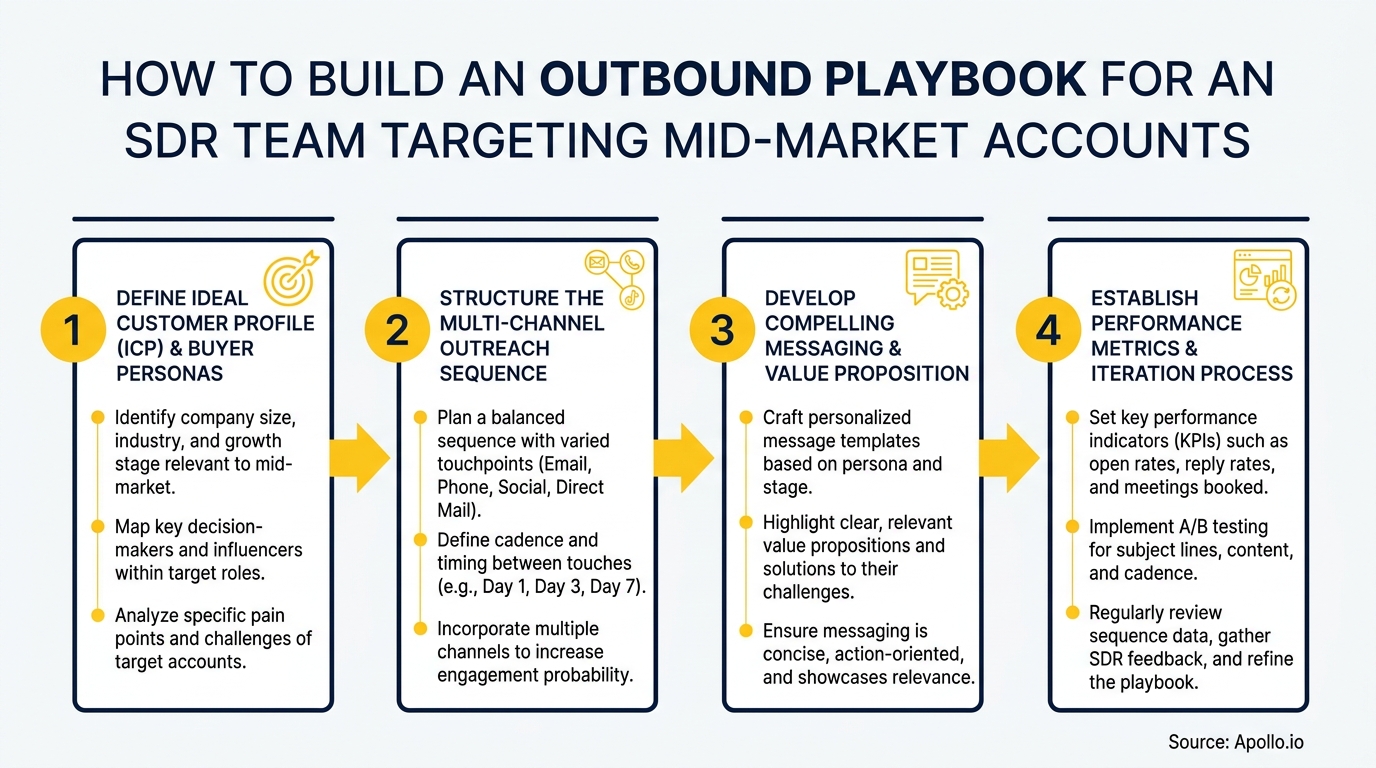
An effective omnichannel sequence assigns a distinct role to each channel rather than repeating the same message across all of them. Each channel contributes differently to the buying conversation.
| Channel | Primary Role | Sequence Position |
|---|---|---|
| Problem framing, proof delivery, async education | Days 1, 4, 8, 14, 21 | |
| Phone | Qualification, objection handling, human connection | Days 2, 7, 15 |
| Social outreach | Warm-up, content engagement, multi-threaded reach | Days 3, 10, 18 |
| Video / direct mail | Pattern interrupts for high-priority accounts | Days 6, 20 |
Research from Martal Group shows that combining email, social, and phone boosts engagement by over 287% compared to single-channel approaches. Each touchpoint should reference the prior one: your phone call should mention the email; your follow-up email should acknowledge the call attempt. This cross-channel continuity is what separates a coordinated campaign from random noise.
Spending hours manually managing multi-channel sequences? Automate your omnichannel sequences with Apollo's sales engagement platform and keep every touchpoint coordinated in one workspace.
What Messaging Pillars Should SDRs Use for Mid-Market Accounts?
Education-first messaging frames the problem your ICP faces before introducing your solution, which increases receptivity significantly among prospects who aren't yet in an active buying cycle. Build your messaging around three pillars:
- Problem framing: Lead with a specific, quantified pain point relevant to their role and industry. Use benchmark data, not generic claims.
- Proof assets: Attach relevant case studies, ROI models, or industry benchmarks to mid-sequence emails. These increase your chances of being invited into formal evaluations.
- Risk reduction: Mid-market buyers stall because they fear a bad decision. Messages that de-risk evaluation (pilot programs, phased rollouts, reference calls) reduce friction and accelerate responses.
Pair each sequence with at least one proof asset tailored to the ICP's vertical. A CFO-persona email sequence should include a cost model. A VP of Sales sequence should include a pipeline benchmark. Generic outreach doesn't move mid-market buyers. For more on building sequences that convert, see Sales Cadence Secrets: Build Winning Outbound Sequences.
Turn Funnel Guesswork Into Real Pipeline
Quota pressure mounting while marketing leads stall before becoming opportunities? Apollo surfaces in-market buyers with verified contact data so your pipeline reflects reality, not wishful thinking. Top GTM teams rely on Apollo to forecast with confidence.
Start Free with Apollo →How Do SDRs Handle Stalled Mid-Market Deals?
SDRs can unstick stalled mid-market deals by shifting from meeting requests to stakeholder alignment plays. When a prospect goes dark after initial interest, the issue is rarely disinterest.
It's usually internal misalignment or unclear next steps.
- Mutual action plan (MAP): Send a lightweight 3-step MAP outlining what you need from them and what you'll deliver. This replaces "just checking in" with a clear collaborative frame.
- Multi-thread the account: If your champion has gone quiet, engage a peer or manager. Reference shared goals, not your deal status.
- Reframe the conversation: Send a new proof asset or a competitor displacement angle to restart dialogue. A fresh problem frame can re-engage a stalled thread.
For context on building a B2B funnel that keeps deals moving, stall-management plays should be documented in your playbook as named plays, not improvised responses.

What Analytics and KPIs Should SDR Teams Track?
The right SDR analytics backbone tracks conversation quality and pipeline influence, not just activity volume. Activity metrics (emails sent, dials made) are lagging indicators that don't predict pipeline outcomes without accompanying quality signals.
| Metric Category | Key Metrics to Track |
|---|---|
| Activity quality | Connect rate, conversation rate, objection coverage score |
| Pipeline influence | Meetings sourced, SAO rate, pipeline sourced per SDR |
| Sequence performance | Reply rate by step, opt-out rate, meeting booked by channel |
| Handoff quality | AE acceptance rate, show rate, deal progression post-handoff |
According to SalesEssentials, high-performing outbound teams aim for 15+ meetings monthly and prioritize qualification to ensure strong show rates. Set clear definitions for each stage in your CRM so attribution is consistent across the team. Sales performance management frameworks can help RevOps leaders operationalize these definitions at scale.
How Do SDRs Use AI in a Mid-Market Outbound Playbook?
SDRs in 2026 use AI as default tooling for account research, first-draft personalization, call summaries, and sequence optimization, but the playbook must specify where human judgment remains non-negotiable. AI handles the routine; SDRs own the judgment.
- AI-permitted tasks: Account research synthesis, first-draft email personalization, call note capture, objection library suggestions, sequence A/B recommendations.
- Human judgment checkpoints: Qualification decisions, disqualification calls, pricing or legal questions, escalation to AE, going off-script for a strategic account.
- QA layer: Include a weekly review of AI-generated outputs against tone guardrails and factual accuracy standards. This prevents hallucinated claims from reaching prospects.
According to MarketBetter.ai, SDRs spend just 28-35% of their time actively selling, with the majority lost to administrative tasks, research, and data entry.
AI automation reclaims that time, but only when the workflow is explicitly defined in the playbook.
For a practical implementation guide, see How to Sell with AI.
Want to put AI to work across your entire GTM motion? Explore Apollo's AI sales automation, where research, personalization, and sequence management come together in one platform instead of five separate tools.
What Data Hygiene Standards Does a Mid-Market Playbook Need?
Clean, enriched contact data is a prerequisite for effective mid-market outbound, not an optional enhancement. Poor list quality directly degrades deliverability, wastes call time, and corrupts your pipeline metrics.
- Enrichment before sequencing: Verify job title, direct email, and phone before any contact enters a sequence. Stale data generates bounces that damage sender reputation.
- ICP scoring at the account level: Apply firmographic and technographic filters to prioritize accounts before SDRs invest time. Use 65+ filters to tighten your ICP slice.
- Routing rules: Define clear account ownership rules to prevent SDR duplication. Document territory logic in the playbook, not just in someone's head.
- Deliverability hygiene: Rotate sending domains, pace sequence volume, and monitor bounce rates weekly. Email filtering in 2026 is aggressive, and templated AI-generated emails face heightened scrutiny.
A strong data enrichment strategy and reliable email verification practices should be documented as required steps before any campaign launches, not remediation tasks applied after deliverability drops.

How Do You Put the Playbook Into Practice and Measure Success?
A mid-market SDR outbound playbook succeeds when it's treated as a living operational system, not a static document. Launch it in phases, instrument everything from day one, and build a regular optimization cadence.
- Week 1-2: Define ICP, build enriched account list, configure sequences and routing rules.
- Week 3-4: Launch first sequences with a pilot cohort of SDRs. Track reply rates, connect rates, and meeting bookings by channel.
- Month 2+: Review sequence performance weekly. Kill underperforming steps. Add proof assets to mid-sequence touchpoints. Refine AI QA checkpoints based on real output review.
SDRs should source a meaningful share of net-new pipeline in high-growth companies, making playbook instrumentation a revenue-critical investment for sales leaders. Tie every sequence and play back to a pipeline attribution model so leadership can see which plays drive outcomes, not just activity.
For a complete view of the tools and workflows that support scalable outbound, see our guide to building a sales tech stack that scales revenue. Teams like Predictable Revenue found that consolidating their stack into one platform made it dramatically simpler to operate: "We reduced the complexity of three tools into one."
Apollo brings prospecting, enrichment, multi-channel sequences, AI automation, and pipeline tracking into a single workspace, so your SDR team spends time selling instead of switching tabs. Schedule a Demo to see how Apollo powers mid-market outbound teams end to end.
Prove Pipeline ROI Before Next QBR
ROI pressure killing your tool budget? Apollo delivers measurable pipeline impact fast — teams like Built-In saw +10% win rates and +10% ACV. Start your free trial and show leadership real numbers.
Start Your Free Trial →Don't miss these
Sales
Inbound vs Outbound Marketing: Which Strategy Wins?
Sales
What Is a Sales Funnel? The Non-Linear Revenue Framework for 2026
Sales
What Is a Go-to-Market Strategy? The 2026 GTM Playbook
See Apollo in action
We'd love to show how Apollo can help you sell better.
By submitting this form, you will receive information, tips, and promotions from Apollo. To learn more, see our Privacy Statement.
4.7/5 based on 9,690 reviews
