
How to Build an Agentic GTM Workflow Without Replacing Your Sales Team
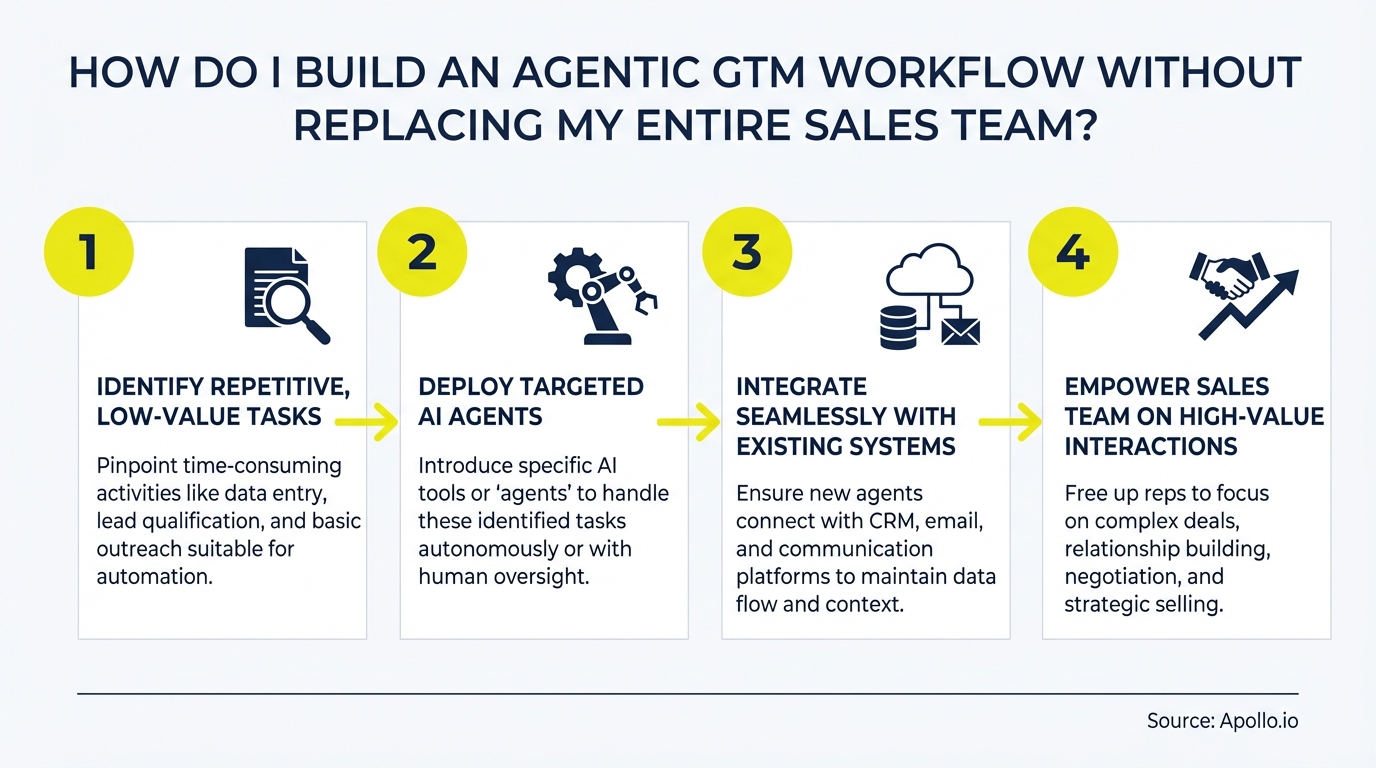
Every sales leader in 2026 is getting the same pitch: replace your reps with AI agents. It's a false choice. The teams winning right now are building agentic GTM workflows that augment their existing reps, not replace them. This playbook shows you exactly how to do that, without blowing up your stack or your headcount budget. If you're rethinking your sales tech stack, this is where to start.

Give Reps Time Back to Actually Sell
Tired of your reps burning hours on manual research instead of closing deals? Apollo delivers verified contacts instantly, so your team spends time selling — not searching. Join 600K+ companies building pipeline faster.
Start Free with Apollo →Key Takeaways
- Agentic GTM is augmentation, not replacement. Agents handle research, enrichment, and CRM writeback. Reps own discovery, negotiation, and relationships.
- Start small: a three-step Phase 1 workflow (research → draft → CRM writeback) delivers measurable ROI without disrupting your team.
- Top-performing sales teams use AI to lift less-experienced reps, not just accelerate top performers.
- Governance and data quality are the difference between a workflow that scales and one that gets abandoned after POC.
- RevOps leaders should own the rollout, not IT. Agents need sales process expertise, not just technical configuration.
What Is an Agentic GTM Workflow?
An agentic GTM workflow is a system where AI agents autonomously execute defined sales and marketing tasks, such as prospect research, message personalization, and CRM updates, under human supervision. Unlike basic automation, agents can chain multi-step actions, make conditional decisions, and act on real-time signals without waiting for manual input at each step.
This is distinct from simple workflow automation. Agents don't just trigger emails. They research accounts, generate first drafts tailored to that research, log outputs to the CRM, and flag edge cases for rep review. According to Sopro, 70% of top-performing sales teams use AI in their workflows to augment human skills, not replace them. That framing matters: agents take the admin load, humans retain judgment.
Major platforms have aligned on this model. Microsoft's Sales Agent inside Microsoft 365 Copilot is designed as workflow-native support, speeding research and follow-ups without eliminating reps.
The pattern: embed agents where sellers already work, not in standalone apps that add context-switching.
How Do SDRs and RevOps Teams Actually Benefit?
SDRs benefit most from agentic workflows when agents handle the tasks that consume time before the first meaningful conversation: account research, ICP qualification, and first-draft personalization. RevOps benefits from the writeback: clean, structured CRM data without chasing reps to log activity.
| Role | Agent Handles | Human Retains |
|---|---|---|
| SDR / BDR | Account research, first-draft outreach, sequence enrollment | Personalization review, call execution, objection handling |
| AE | Meeting prep briefs, competitor summaries, follow-up drafts | Discovery, negotiation, multi-threading |
| RevOps | CRM writeback, data enrichment, routing logic | Process design, governance, analytics review |
| Sales Leader | Pipeline summaries, at-risk deal flags, rep activity roll-ups | Coaching, hiring, strategic decisions |
Research from Cirrus Insight shows 43% of sales reps actively use AI, a 79% year-over-year increase from 24% in 2023 to 43% in 2024. That adoption curve means your team is already experimenting. The risk isn't adoption: it's ungoverned, inconsistent usage that creates data quality problems downstream. Standardizing the workflow is how RevOps gets ahead of it. For sales analytics to be trustworthy, the data flowing into your CRM has to be clean and consistent.
Spending hours on manual prospect research before every call? Apollo's AI sales automation handles research and first drafts so your reps focus on conversations.
What Is the Right Phased Rollout for Agentic GTM?
A phased rollout starts with the lowest-risk, highest-signal workflow first, proves measurable value, then expands. Gartner predicted at least 30% of GenAI projects would be abandoned after proof-of-concept by end of 2025 due to poor data quality and unclear business value.
Phasing directly addresses that risk.

Phase 1: Research, Draft, and CRM Writeback (Weeks 1-6)
- Agent task: Pull firmographic and intent data for a target account list
- Agent task: Generate a personalized first-draft email for rep review
- Agent task: Log research summary and draft to CRM contact record
- Human checkpoint: Rep reviews and sends (or edits) every message
- Measure: Time saved per rep per week, reply rate vs. control group
Phase 2: Signal-Driven Routing and Multi-Channel (Weeks 7-12)
- Layer in intent signals to prioritize which accounts get agent-driven outreach first
- Expand from email to phone and social sequences with agent-suggested messaging
- Add auto-routing logic: high-intent signals route to AE, early-stage to SDR nurture
Phase 3: Governance and Scale (Week 13+)
- Establish approval workflows for agent-generated content above defined thresholds
- Build auditability: every agent action logged, reviewable, and attributable
- Review agent performance against rep performance benchmarks quarterly
Fill Your Funnel With Buyers, Not Noise
Running out of qualified leads before you hit quota? Apollo surfaces in-market prospects from 230M+ contacts so your pipeline never runs dry. Join 600K+ companies turning outreach into revenue.
Start Free with Apollo →How Do You Prove ROI Before Full-Scale Adoption?
Prove ROI by running a controlled split: one group uses the agentic workflow, one uses the existing manual process, then compare pipeline metrics over 30-60 days. According to ICONIQ Capital's State of Go-to-Market 2025, approximately 70% of companies report at least moderate AI adoption in their GTM workflows, with full adoption even more prevalent among high-growth companies. The gap between moderate and full adoption is almost always a measurement problem, not a capability problem.
Track these metrics in your Phase 1 dashboard:
- Time recovered per rep: Hours freed from research and logging
- Reply rate delta: Agent-assisted outreach vs. manual baseline
- CRM data completeness: Percentage of contacts with enriched fields post-writeback
- Pipeline velocity: Days from first touch to qualified meeting, compared across groups
Understanding how sales automation works in practice is essential before setting ROI targets. Don't benchmark against aspirational numbers. Benchmark against your own baseline, then expand from there.
What Guardrails Prevent Agentic Workflows from Breaking Your Pipeline?
Guardrails are non-negotiable. Without them, agentic workflows produce high-volume, low-quality output that poisons pipeline data and damages sender reputation. Four controls every team needs:
- Data quality gates: Agents only act on contacts with verified email and a minimum number of enriched fields. Apollo's data enrichment keeps contact records clean before agents touch them.
- Human-in-the-loop checkpoints: All agent-generated outreach above a defined personalization threshold requires rep approval before sending.
- Escalation paths: Define which signals trigger a human handoff. Pricing questions, legal mentions, or negative sentiment responses always go to a rep.
- Audit logging: Every agent action is logged to the CRM with a timestamp and agent identifier, so RevOps can trace any outcome back to its source.
For teams building outbound from scratch, a solid lead list building process combined with enrichment guardrails prevents the most common failure mode: agents working from stale or incomplete data.
How Do You Build an Agentic GTM Workflow Without Replacing Your Sales Team?
Build an agentic GTM workflow by assigning agents to repeatable, low-judgment tasks and preserving human ownership of every step that requires relationship context, creativity, or authority. The practical answer is a task-to-role matrix: for every step in your sales process, explicitly decide whether it is agent-owned, agent-assisted (human reviews), or human-owned.
The key mindset shift for sales leaders: agents don't replace your best reps. They lift your developing reps to perform closer to top-rep standards.
That's where the pipeline impact compounds. With Apollo's unified platform, teams like Cyera report: "Having everything in one system was a game changer." Consolidating prospecting, engagement, enrichment, and pipeline tracking in one workspace eliminates the coordination overhead that makes agentic workflows brittle across disconnected tools.
Data from SerpSculpt shows 78% of all B2B companies now utilize AI across at least one business function. The competitive advantage has shifted from whether you adopt agentic workflows to how disciplined and governed your implementation is.

Start Your Agentic GTM Workflow This Week
The fastest path to a working agentic GTM workflow is a focused Phase 1 pilot: pick one segment, one agent task (research or first-draft), one human checkpoint, and one metric. Run it for 30 days against your manual baseline.
The data will tell you where to expand next.
Apollo gives GTM teams a unified platform for prospecting, AI-assisted outreach, enrichment, and pipeline management, without stitching together five separate tools. As Predictable Revenue put it: "We reduced the complexity of three tools into one." That consolidation is what makes agentic workflows sustainable, not just a POC that gets abandoned.
Start Free with Apollo and run your first agentic GTM workflow without replacing a single rep.
Prove Pipeline ROI With Apollo
ROI pressure killing your tool adoption? Apollo delivers measurable pipeline outcomes your CFO can't ignore. Leadium 3x'd annual revenue — see what Apollo's GTM platform can do for your numbers.
Schedule a Demo →Don't miss these
Sales
Inbound vs Outbound Marketing: Which Strategy Wins?
Sales
What Is a Sales Funnel? The Non-Linear Revenue Framework for 2026
Sales
What Is a Go-to-Market Strategy? The 2026 GTM Playbook
See Apollo in action
We'd love to show how Apollo can help you sell better.
By submitting this form, you will receive information, tips, and promotions from Apollo. To learn more, see our Privacy Statement.
4.7/5 based on 9,690 reviews
