
How to Build a Business Case for an AI-Native GTM Model
Your CFO wants proof, not promises. Building a business case for shifting to an AI-native GTM model means translating AI potential into pipeline math, governance structure, and a phased rollout your executive team can approve. This guide gives you that framework, starting with the numbers that matter most to a modern GTM strategy.

Apollo Turns Research Into Revenue
Tired of burning hours verifying contacts that go nowhere? Apollo delivers 230M+ accurate business contacts so your team sells instead of searches. Start building real pipeline today.
Start Free with Apollo →Key Takeaways
- AI-native GTM is a revenue strategy, not just an efficiency play. Companies using AI in sales and marketing are measurably outpacing non-AI peers in topline growth.
- The risk of inaction is real: unmanaged BYOAI creates data leakage and brand safety exposure across your GTM team.
- A strong business case quantifies pipeline impact, cost consolidation, and rep productivity together, not separately.
- Governance and maturity staging are what separate successful AI GTM transformations from failed pilots.
- RevOps leaders and Sales Managers are the internal champions most likely to drive approval and adoption.
What Is an AI-Native GTM Model?
An AI-native GTM model embeds AI into every stage of the revenue process: prospecting, qualification, outreach, pipeline management, and forecasting. It is not a single tool purchase.
It is a redesign of how your sales and marketing teams operate, with AI handling signal processing, personalization, and workflow execution at scale.
This is distinct from using AI as a bolt-on. AI-native means AI is the operating layer, not an add-on.
Buyer behavior is already shifting toward AI-assisted discovery and rep-free early research, which means your GTM motion needs to meet buyers where AI is already taking them.
Why Does the Business Case Matter Now?
The gap between AI-native and non-AI-native companies is widening fast. According to ICONIQ's State of Go-to-Market 2025 report, AI-native companies are significantly outpacing their non-AI-native peers in topline growth. That gap compounds over time.
Meanwhile, SERPSculpt reports that by 2025, 78% of all B2B companies are implementing AI across at least one business function. Your competitors are not waiting. The question is whether your AI usage is governed, integrated, and driving measurable outcomes, or fragmented and risky.
Struggling to build pipeline at the speed your targets require? See how Apollo's AI-powered pipeline tools help GTM teams qualify and convert faster.
How Do You Quantify the ROI for a CFO?
A CFO-ready business case for AI-native GTM must connect investment to three measurable outcomes: revenue uplift, cost consolidation, and throughput gains.
| ROI Dimension | What to Measure | Benchmark Reference |
|---|---|---|
| Revenue Uplift | Pipeline created, win rate, deal velocity | Sales teams using AI are 1.3x more likely to see revenue growth (InsightMark Research) |
| Cost Consolidation | Tools replaced, vendor contracts reduced | Companies using AI in marketing see 20%–30% higher ROI than traditional methods (Sopro) |
| Rep Throughput | Customer-facing hours, outreach volume | Sales enablement automation saves reps 12–15 hours per week, increasing customer-facing time by 35% (Optif.ai) |
For your financial model, run three scenarios: conservative (AI applied to outreach only), moderate (AI across prospecting and pipeline), and aggressive (full AI-native operating model). Each scenario should show incremental pipeline value against a fully-loaded implementation cost.
Also factor in the cost of inaction. A 2025 GTM AI Benchmarking Report found that 95% of organizations are boosting their AI investments, with over half planning increases exceeding 50%. Teams that delay standardization will face a larger capability gap and higher catch-up costs.

How Do RevOps Leaders Build the Governance Layer?
RevOps leaders are best positioned to build the governance layer because they sit at the intersection of data, process, and tooling. Governance is not optional in an AI-native GTM model: it is what separates a controlled transformation from a compliance risk.
The BYOAI problem is real. Microsoft's 2024 Work Trend Index found that 78% of AI users bring their own AI tools to work, creating data leakage and brand safety exposure your business case must address directly.
Your governance framework should include:
- Approved tool list: Define which AI tools are sanctioned across sales, marketing, and RevOps
- Data handling rules: Specify what contact data can be passed to AI tools and under what conditions
- Brand safety controls: Require human review for all AI-generated outreach before send
- Audit and logging: Maintain records of AI-assisted decisions for compliance and performance review
- Integration standards: All AI tools must connect to your CRM to maintain a single source of truth
A unified platform approach reduces governance complexity significantly. As Cyera's team put it, "Having everything in one system was a game changer." Consolidating your sales tech stack around a single AI-native GTM platform cuts both governance overhead and vendor sprawl.
Turn Funnel Gaps Into Qualified Pipeline
Tired of watching marketing leads stall before they ever reach your AEs? Apollo surfaces high-intent prospects and arms your team with the signals to act first. Nearly 100K paying customers stopped guessing and started closing.
Schedule a Demo →What Does the Maturity Roadmap Look Like?
An AI-native GTM transition follows a three-stage maturity path. Each stage has clear entry criteria, KPIs, and a governance gate before advancing.
| Stage | Focus | Key KPIs | Gate Criteria |
|---|---|---|---|
| Stage 1: Pilot (0–90 days) | AI in one GTM motion (e.g., outbound sequences) | Reply rate, meetings booked, time saved per rep | Positive ROI signal, governance policy published |
| Stage 2: Scale (90–180 days) | AI across prospecting, qualification, and pipeline | Pipeline velocity, CAC, win rate by segment | CRM integration live, team adoption above 70% |
| Stage 3: AI-Native (180+ days) | AI embedded in every GTM workflow including forecasting | Revenue per rep, forecast accuracy, LTV/CAC ratio | Full stack integration, quarterly board-level reporting |
Pilot selection matters. Choose a use case with a short feedback loop, such as AI-assisted outbound sequences or AI-powered lead scoring. This lets you generate proof of ROI within one quarter, which is the approval cadence most CFOs require.
How Do SDRs and AEs Fit Into an AI-Native GTM Motion?
SDRs and AEs are the daily users of an AI-native GTM model, and their adoption determines whether the transformation succeeds or stalls. Their workflows change in concrete ways at each stage.
For SDRs: AI handles research, signal aggregation, and first-draft personalization. SDRs shift from data entry and list building to sequence review, call prioritization, and relationship development. The result is more conversations per day with higher relevance per touchpoint.
For AEs: AI surfaces deal risk signals, suggests next-best actions, and generates pre-call briefs. AEs spend less time on CRM hygiene and more time on stakeholder alignment and closing. Sales transformation at this level requires clear role definitions so reps understand what AI does versus what they own.
Spending hours on manual prospecting that should be automated? See how Apollo's AI sales automation handles research and outreach so your reps focus on closing.
How Do You Present This to the Executive Team?
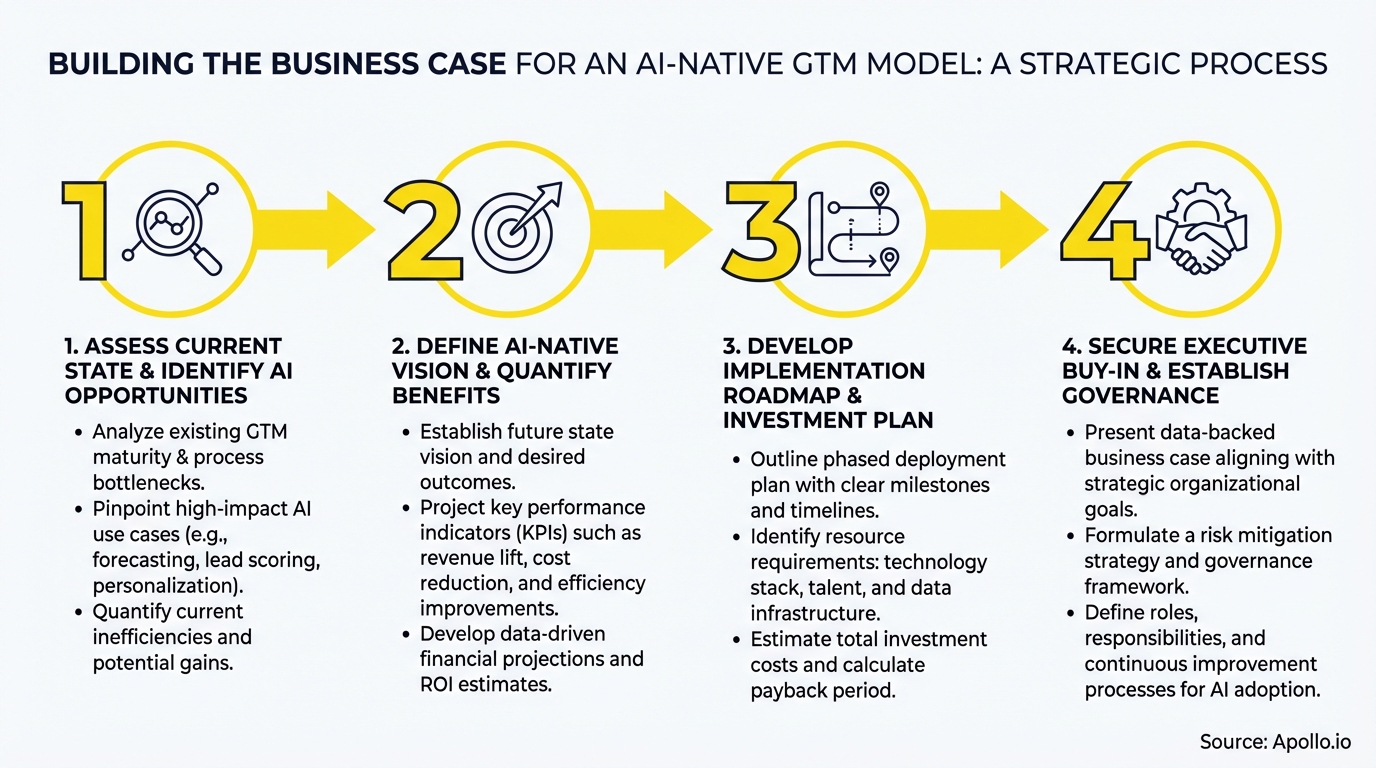
Present the business case as a phased investment with defined ROI gates, not an open-ended transformation. Executives approve initiatives with clear milestones and exit criteria.
Structure your executive presentation around four slides:
- The gap: Current state metrics versus AI-native benchmarks (pipeline velocity, rep capacity, CAC)
- The opportunity: Quantified revenue upside across your three ROI scenarios
- The plan: Three-stage maturity roadmap with 90-day pilot, governance framework, and stack integration
- The ask: Pilot budget, tool consolidation plan, and success criteria for Stage 1 approval
Connect your B2B marketing funnel metrics directly to the AI use cases you are proposing. If AI-assisted outbound is one pillar, show the current cost per meeting booked and the projected improvement. Specificity wins executive approval faster than general efficiency claims.
Also cite the competitive pressure explicitly. As noted above, high-growth companies are planning a 94% average increase in AI spend for internal GTM use cases, according to SaaStr's analysis of ICONIQ's 2025 B2B SaaS report. That is the market signal your leadership team needs to see.

Start Building Your AI-Native GTM Case Today
The strongest business cases for AI-native GTM combine a clear ROI model, a phased maturity roadmap, and a governance framework that addresses BYOAI risk from day one. Teams that start with a pilot anchored in specific pipeline metrics, then scale with proper stack integration, consistently reach Stage 3 faster and with higher executive confidence.
Apollo gives GTM teams a unified platform for prospecting, outreach, pipeline management, and AI automation, consolidating the tools your SDRs, AEs, and RevOps leaders use every day into one workspace. As Census's team noted, "We cut our costs in half." That kind of consolidation is a business case on its own. Explore Apollo's all-in-one GTM platform to see how it fits your transition plan.
Start Your Free Trial and see how Apollo accelerates your AI-native GTM transition from pilot to scale.
Prove Pipeline ROI Before Next Quarter
ROI pressure killing your tool budget? Apollo delivers measurable pipeline impact fast — Leadium 3x'd annual revenue after switching. Start your free trial and show results before the next budget review.
Start Your Free Trial →Don't miss these
Sales
Inbound vs Outbound Marketing: Which Strategy Wins?
Sales
What Is a Sales Funnel? The Non-Linear Revenue Framework for 2026
Sales
What Is a Go-to-Market Strategy? The 2026 GTM Playbook
See Apollo in action
We'd love to show how Apollo can help you sell better.
By submitting this form, you will receive information, tips, and promotions from Apollo. To learn more, see our Privacy Statement.
4.7/5 based on 9,690 reviews
