
How Do I Build a Business Case for Investing in a Sales Intelligence Platform?
Budget approvals for sales technology live or die by one question: "What's the measurable return?" Building a business case for a sales intelligence platform means translating rep productivity loss, data quality costs, and pipeline inefficiency into dollar figures your CFO can act on. This guide gives you the framework to do exactly that.

Let Apollo Find Your Leads Instantly
Tired of burning hours manually researching contacts and verifying emails? Apollo delivers accurate, ready-to-contact prospects so your team sells instead of searches. Over 600K companies have already made the switch.
Start Free with Apollo →Key Takeaways
- Poor data quality and admin work represent quantifiable costs you can anchor your business case on before a single vendor conversation.
- Sales and marketing misalignment on lead definitions is a widespread, measurable pipeline drain that intelligence platforms directly address.
- The strongest 2026 business cases tie investment to workflow outcomes (meetings booked, pipeline velocity, ramp time) not just database access.
- RevOps leaders and sales leaders should build the ROI model together, using a TEI-inspired framework with risk-adjusted assumptions.
- Platform consolidation is now a core cost lever: replacing multiple point tools with one unified GTM platform cuts both license spend and integration overhead.
Why Is a Formal Business Case Necessary in 2026?
Budget holders now require measurable productivity and revenue outcomes, not just product demos. The sales intelligence market is growing rapidly, signaling widespread adoption pressure: according to SNS Insider, the global sales intelligence market was valued at USD 3.37 billion in 2023 and is projected to reach USD 8.76 billion by 2032, growing at a CAGR of 11.22%. Peers are standardizing on these platforms. Without a formal business case, your team risks falling behind while budget sits uncommitted.
The market shift also changes what "value" means. Sales orgs are moving from static contact databases to continuous signals and recommended next-best-actions tied to measurable workflow outcomes.
Your business case must reflect this evolution.
How Do You Establish a Baseline for the Business Case?
Start by quantifying the current cost of operating without sales intelligence. Four baselines drive most CFO-ready cases:
| Cost Driver | Benchmark | How to Measure Internally |
|---|---|---|
| Rep time on non-selling work | ~70% of the week (Salesforce State of Sales 2024) | Time-tracking audit or rep survey (sample 10-20 reps) |
| Data quality costs | $12.9M average annual loss (IBM citing Gartner) | Bounce rates, CRM dedupe overhead, missed SLAs |
| Sales/marketing lead misalignment | 49% of CSOs report differing lead definitions (Gartner, May 2025) | MQL-to-SQL conversion rate; rejected lead volume |
| Pipeline velocity | Buyers spend only 17% of time with suppliers (Gartner Future of Sales) | Average days in stage; win rate by segment |
Each baseline becomes a line item in your ROI model. Even conservative assumptions compound meaningfully across a team of 10+ reps. See Apollo's sales performance management strategy guide for frameworks to translate these metrics into revenue impact.
Struggling to find qualified leads while reps waste time on manual research? Search Apollo's 230M+ contacts with 65+ filters and build your baseline comparison in minutes.

What ROI Framework Should RevOps Leaders Use?
RevOps leaders get the most CFO credibility from a TEI-inspired (Total Economic Impact) framework with explicit assumptions and risk adjustments. Here's a simplified four-component model:
- Productivity gains: Hours recaptured per rep per week multiplied by fully-loaded rep cost. Even recovering a fraction of that lost selling time compounds across headcount.
- Pipeline lift: Improvement in MQL-to-customer conversion rate, anchored to your current baseline. Research from MarketsandMarkets shows sales teams using AI to prioritize outreach saw a 45% increase in sales-accepted leads and a 30% jump in MQL-to-customer conversion within six months.
- Data quality savings: Reduction in bounce rates, CRM cleanup costs, and missed SLA penalties.
- Tool consolidation savings: License and integration costs eliminated by replacing point tools with a unified platform.
Apply a risk adjustment factor (typically 20-30%) to each benefit line to account for adoption lag and implementation variability. This is what separates a defensible CFO presentation from an optimistic vendor pitch.
Turn Funnel Gaps Into Closed Revenue
Pipeline forecasting a guessing game? Apollo surfaces quality leads that actually convert, so your funnel stops leaking and your forecast starts meaning something. Nearly 100K paying customers already know the difference.
Schedule a Demo →How Do SDRs and AEs Translate Platform Value into Quota Impact?
SDRs and AEs are the closest to the daily friction a sales intelligence platform removes, making them credible internal advocates for the business case. SDRs spend significant time on manual research, contact verification, and list building before a single outreach sequence starts.
A platform with verified contact data and AI-powered prioritization converts that wasted time into booked meetings.
For Account Executives managing active deals, pre-meeting intelligence, intent signals, and account hierarchy data shorten research cycles and sharpen messaging. According to TryKondo, AI-enhanced teams are 83% more likely to see revenue growth compared to non-AI teams. Include a rep-level productivity narrative alongside the CFO-level dollar model. This dual framing wins both the budget holder and the end users who will drive adoption.
Spending too much time on manual outreach prep? Automate your sequences with Apollo's multi-channel engagement platform and give your SDRs back their selling time.
How Does Platform Consolidation Strengthen the Business Case?
Tool consolidation is now a standalone cost lever, not a secondary benefit. GTM leaders in 2026 are under pressure to reduce vendor sprawl, integration overhead, and per-seat license stacking.
A unified sales intelligence platform that combines prospecting, enrichment, engagement, and pipeline analytics eliminates the need for multiple separate subscriptions.
Apollo customers have documented this directly. "We reduced the complexity of three tools into one," noted the team at Predictable Revenue. "We cut our costs in half," reported Census. "Having everything in one system was a game changer," said Cyera. In your business case, model both the hard cost savings (license elimination) and the soft savings (reduced IT integration burden, faster rep onboarding). Review Apollo's sales tech stack guide for a practical consolidation framework.
What Governance and Alignment Elements Should the Business Case Include?
ICP governance and Sales/Marketing alignment are ROI drivers that most business cases underemphasize. When sales and marketing operate on different lead definitions, pipeline leaks at the handoff stage.
A sales intelligence platform standardizes ICP criteria, intent signals, and lead scoring in a shared system, creating a measurable baseline for improvement.
Include these governance elements in your business case:
- Shared ICP definition and scoring criteria stored in the platform
- Routing rules and SLA dashboards for lead handoffs
- Data governance policy covering contact hygiene, enrichment cadence, and deduplication
- Security attestations (SOC 2) as a procurement and risk-cost line item
Governance also addresses a growing concern: contact data combined with AI usage raises compliance and reputational risk. Review Apollo's AI policy for a clear framework on responsible data use that you can include in your vendor evaluation criteria.
How Do You Structure the Business Case Document?
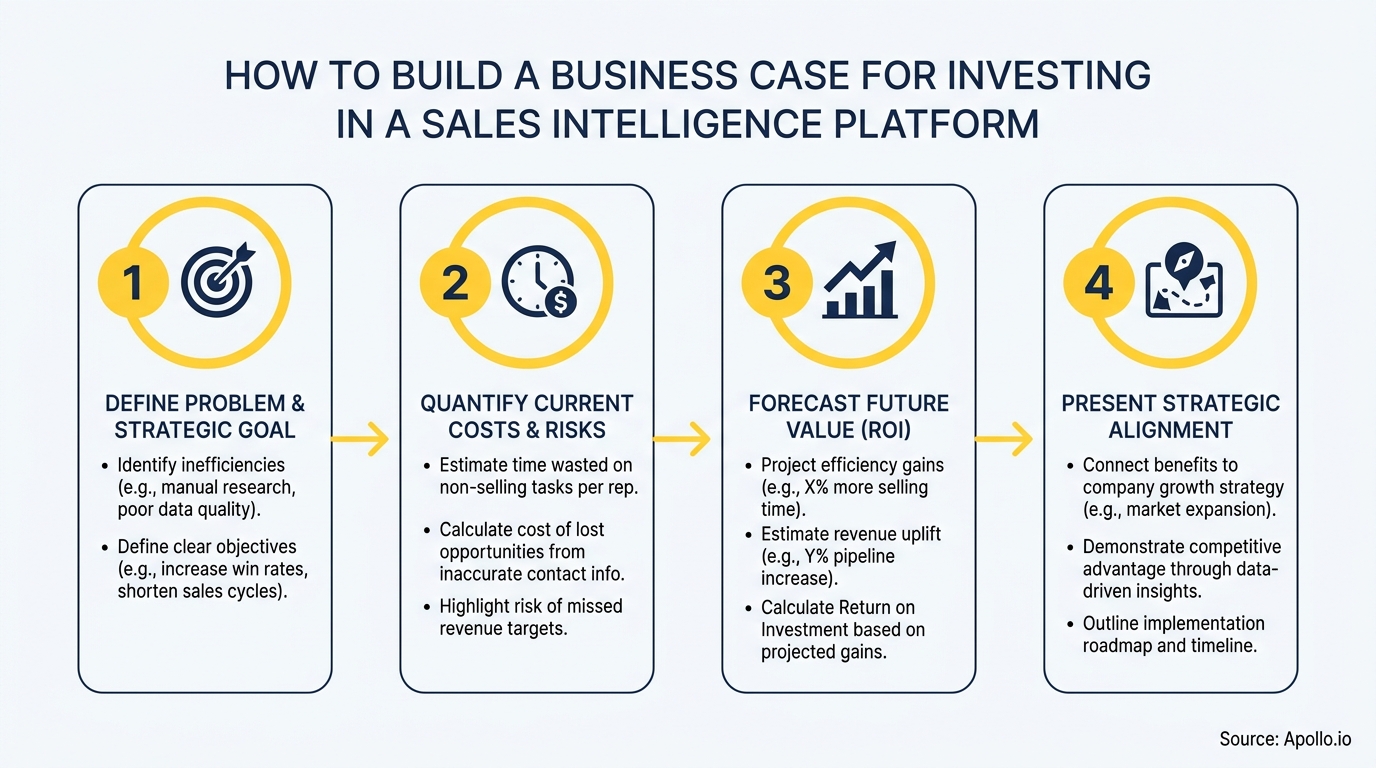
A one-page executive summary followed by supporting appendices is the most effective format for VP-level and C-suite approval. Structure it as follows:
- Executive summary: Problem statement, proposed solution, top-line ROI estimate, and payback horizon (target under 12 months for faster approval)
- Baseline costs: Quantified cost of current state using internal data plus external benchmarks
- Benefit model: Four-component TEI framework with risk-adjusted projections by year
- Consolidation analysis: Tools replaced, licenses eliminated, integration savings
- Governance plan: ICP alignment, data ownership, adoption metrics, and 30-day pilot success criteria
- Vendor evaluation: Platform comparison on data accuracy, AI capabilities, CRM integration, and security posture
For real-world proof points to include as appendices, the Apollo customer case study library provides documented outcomes across multiple industries and team sizes. Explore the Apollo on-demand demo to build your vendor evaluation section with concrete feature comparisons.

Build Your Business Case and Start Winning Budget
A winning business case for a sales intelligence platform rests on four pillars: quantified baseline costs, a risk-adjusted ROI model, a platform consolidation analysis, and a governance plan that aligns sales and marketing. The strongest cases in 2026 commit to a 30-day pilot with pre-defined success metrics so stakeholders see time-to-value, not just projected returns.
Apollo combines prospecting, data enrichment, multi-channel engagement, and AI-powered automation in one unified GTM platform, making the consolidation argument straightforward and the ROI model concrete. Trusted by nearly 100K paying customers including Anthropic, Smartling, and Redis, Apollo gives GTM teams the verified data and workflow tools to operationalize a repeatable revenue motion.
Try Apollo Free and start building your business case with real data from day one.
Ramp Reps Faster, Hit Numbers Sooner
ROI pressure killing your next tool approval? Apollo gets reps productive from day one with a unified platform your whole team actually follows. Teams like GTM Ops drive 4x more meetings — without adding headcount.
Start Free with Apollo →Don't miss these
Sales
Inbound vs Outbound Marketing: Which Strategy Wins?
Sales
What Is a Sales Funnel? The Non-Linear Revenue Framework for 2026
Sales
What Is a Go-to-Market Strategy? The 2026 GTM Playbook
See Apollo in action
We'd love to show how Apollo can help you sell better.
By submitting this form, you will receive information, tips, and promotions from Apollo. To learn more, see our Privacy Statement.
4.7/5 based on 9,690 reviews
