
How Do I Avoid Spam Filters in Cold Outreach? A 2026 Deliverability Playbook
Your cold email was crafted, personalized, and sent — but it never got read. According to Martal, around 17% of cold emails never reach the inbox due to bounces or spam filtering. That means nearly one in five emails fails before a prospect ever sees your subject line. The problem is rarely your copy. It's your infrastructure, list quality, and sender reputation. This email deliverability guide breaks down exactly what's working in 2026.

Verified Data That Actually Reaches Buyers
Tired of burning hours verifying emails that still bounce? Apollo delivers 97% email accuracy so your outreach lands in inboxes, not dead ends. Join 600K+ companies building pipeline that converts.
Start Free with Apollo →Key Takeaways
- Authentication (SPF, DKIM, DMARC) is now mandatory — Google, Yahoo, and Microsoft all enforce it, and non-compliant senders face hard bounces.
- Keep your spam complaint rate below 0.1% daily. Google treats 0.3% as a hard red line for bulk senders.
- List hygiene is as important as copy — unverified contacts generate bounces and spam complaints that damage your sender reputation.
- Personalized, signal-triggered outreach reduces spam complaints because relevant emails get replies, not spam reports.
- Inbox placement — not delivery rate — is the KPI that actually matters for cold outreach performance.
Why Are Spam Filters Getting Harder to Avoid in 2026?
Filters aren't just scanning for trigger words anymore. Major inbox providers now evaluate sender reputation, authentication records, engagement signals, and complaint rates in real time. SalesHive reports that in 2024, spam constituted 47.27% of global email traffic — a volume that has pushed providers to build increasingly aggressive filtering. As a result, The Digital Bloom notes that inbox placement rates have significantly declined year-over-year across major platforms.
Three enforcement changes in 2024–2025 raised the bar permanently:
- Google and Yahoo mandated SPF, DKIM, and DMARC for bulk senders starting February 2024.
- Microsoft Outlook began enforcing authentication with hard 550 rejections for high-volume senders starting May 5, 2025.
- Yahoo began enforcing one-click unsubscribe (RFC 8058 List-Unsubscribe header) in June 2024.
As noted by MarketingProfs, these mandates now apply across all three major inbox providers. Authentication is no longer optional — it's the entry ticket.
What Technical Setup Do You Need to Avoid Spam Filters?
Technical authentication is the foundation. Without it, your emails are flagged before filters even read your content.
| Control | What It Does | Priority |
|---|---|---|
| SPF | Authorizes which servers can send from your domain | Critical |
| DKIM | Cryptographically signs each email to verify sender identity | Critical |
| DMARC | Tells receivers what to do when SPF/DKIM fail (none/quarantine/reject) | Critical |
| List-Unsubscribe Header | Enables one-click opt-out required by Yahoo and Gmail | High |
| Domain Warm-Up | Gradually builds sending reputation for new or cold domains | High |
| Dedicated Sending Domain | Isolates outbound reputation from your main business domain | Recommended |
One critical nuance on DMARC: having p=none (monitoring only) is becoming insufficient. Inbox providers increasingly treat weakly-enforced domains as higher-risk by default. Moving to p=quarantine or p=reject with proper alignment protects your sender reputation and signals legitimate operation. According to Mailgun, in 2024, 53.8% of senders used DMARC — an 11% increase from 42.6% in 2023 — but enforcement-level adoption still lags.
How Does List Hygiene Protect Your Sender Reputation?
Clean lists are a deliverability control, not just a data quality issue. Every invalid address you email generates a bounce.
Every irrelevant prospect you contact risks a spam complaint. Both signals degrade your sending reputation with inbox providers.
Core list hygiene practices for cold outreach:
- Verify contacts before sending — use email verification to eliminate invalid, catch-all, and role-based addresses before they bounce.
- Suppress unsubscribes and previous complaints — re-emailing opt-outs is both a reputation risk and a compliance risk.
- Remove non-responders after a defined cadence — continued sends to cold contacts accumulate negative engagement signals.
- Segment by fit before sequencing — tighter ICP targeting means higher relevance, fewer complaints, and better engagement signals.
Struggling to build a clean, targeted list from scratch? Search Apollo's 230M+ verified contacts with 65+ filters to find prospects that match your ICP before your first send.
For SDRs and BDRs building outbound lists daily, this is where deliverability is won or lost. A well-targeted list built using smart sales prospecting list principles will consistently outperform a larger, poorly filtered one — both in replies and inbox placement.
Turn Funnel Guesswork Into Real Pipeline
Pipeline forecasting a guessing game because leads stall before they ever become opportunities? Apollo surfaces in-market buyers with precision so your funnel fills with deals that actually progress. Nearly 100K paying customers stopped guessing and started closing.
Start Free with Apollo →How Do SDRs and Sales Teams Keep Spam Complaint Rates Below the Threshold?
Google's current guidance sets a practical target of under 0.1% daily spam complaint rate, with 0.3% as a hard enforcement threshold. For SDRs and BDRs sending at volume, this math changes how you build and pace sequences.
Tactics that keep complaint rates low:
- Send fewer, more targeted emails per day — lower volume per inbox, better segmentation.
- Trigger outreach on intent signals — hiring activity, funding rounds, tech stack changes, and category-level search behavior all increase relevance and reduce complaints.
- Write shorter emails — Belkins notes that messages under 200 words generally perform better, and shorter emails also look less like automated campaigns to filters.
- Personalize beyond first name — Sopro reports that personalized cold emails generate a 32% higher response rate. More replies and fewer spam reports is the exact outcome you need for long-term deliverability.
- Disable open tracking pixels — tracking pixels signal automation to filters and introduce noise into your engagement data anyway.
- Simplify email formatting — plain-text or near-plain-text emails are harder to classify as campaigns.
For sales leaders managing teams at scale, intent-based intent data-driven outreach is the most reliable way to keep complaint rates inside safe thresholds while actually increasing meeting rates.

What Email Copy and Sequence Practices Avoid Spam Filters?
Filters in 2026 are AI-driven and pattern-sensitive.
Repetitive copy structures, templated personalization tokens, and heavy HTML formatting are increasingly flagged — even when the content is legitimate sales outreach.
Best practices for spam-safe copy and sequences:
- Write as if to one person, not a list — conversational tone, no promotional language.
- Vary subject lines and body copy across sequence steps — identical templates across thousands of sends create detectable patterns.
- Use one clear CTA per email — multiple links or aggressive CTAs trigger content filters.
- Avoid spam-trigger phrases: "100% free," "guaranteed," "act now," "limited time offer."
- Limit links to one or two per email — link-heavy emails resemble phishing patterns.
- Cap follow-ups at 3–4 touches — excessive follow-up sequences accumulate negative signals over time.
For subject line strategy specifically, see Apollo's breakdown of cold email subject lines that boost open rates without triggering filters. And for full sequence structure, the sales cadence secrets guide covers optimal length and pacing.
Spending hours crafting sequences that still land in spam? Apollo's multi-channel sales engagement platform gives SDRs and AEs one workspace to build, personalize, and pace sequences — without stitching together separate tools.
How Do You Measure Whether Your Emails Are Actually Reaching the Inbox?
Most teams track "delivery rate" — the percentage of emails accepted by a receiving server. This metric is misleading. Accepted by a server includes spam folder delivery. The KPI that matters is inbox placement rate: the percentage of sent emails that land in the primary inbox.
How to measure and monitor inbox placement:
- Seed list testing — send to a set of test addresses across Gmail, Outlook, and Yahoo before launching sequences; check where they land.
- Google Postmaster Tools — monitors your domain reputation and spam rate as Google sees it, in near real time.
- DMARC reporting (RUA/RUF) — aggregate and forensic reports show authentication failures and potential spoofing attempts.
- Bounce rate tracking — hard bounces above 2% signal list quality problems that require immediate hygiene action.
The diagnostic trigger points to act on:
- Spam complaint rate approaching 0.1%: pause sends, audit list quality, tighten ICP.
- Hard bounce rate above 2%: run list through verification before any further sends.
- DMARC failures increasing: check SPF/DKIM alignment and look for unauthorized sending sources.
- 550 rejection errors from Outlook: verify authentication records are correctly published for your sending domain.

How Do You Put It All Together for Consistent Inbox Placement?
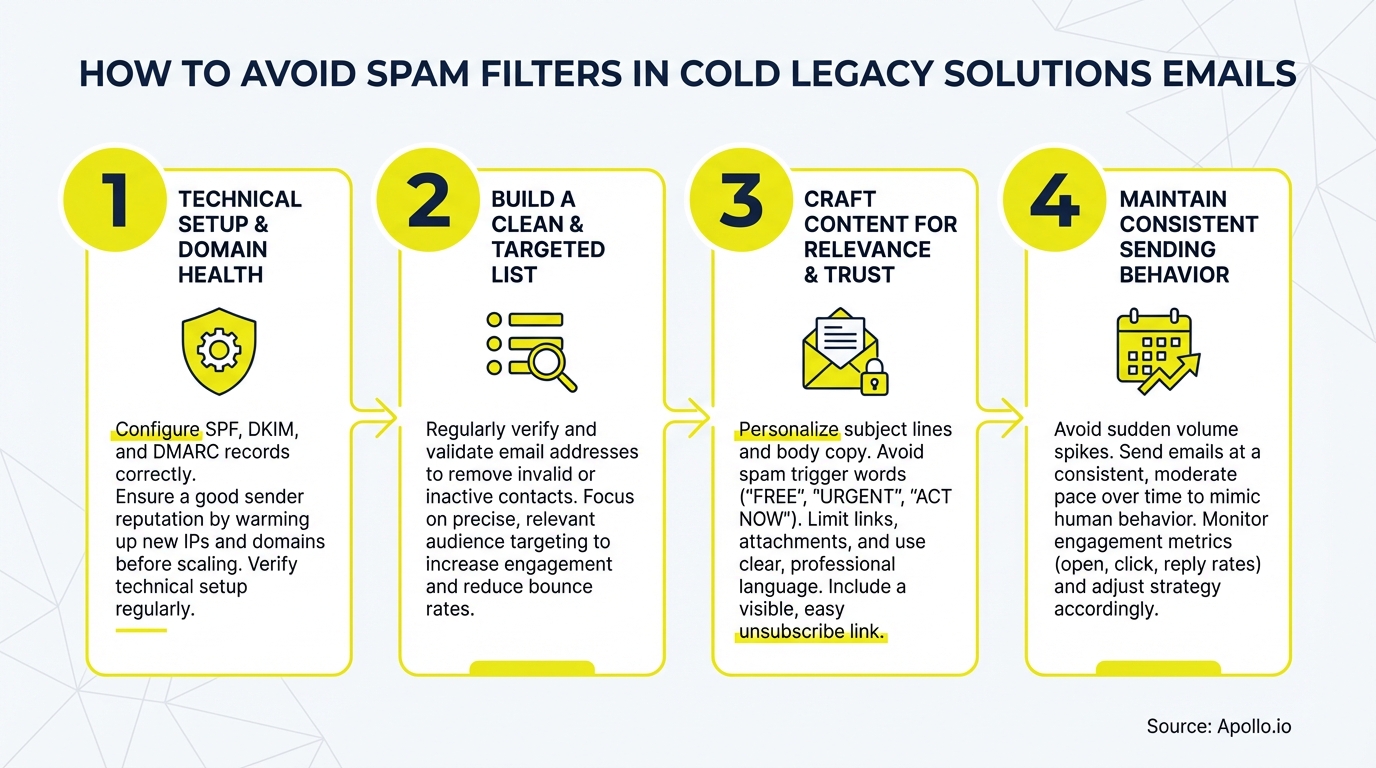
Avoiding spam filters in cold outreach is not a one-time fix. It's an operational system with four ongoing layers: technical authentication, list hygiene, content quality, and reputation monitoring.
Teams that treat deliverability as infrastructure — not an afterthought — consistently outperform those chasing copy hacks.
The highest-performing outbound teams in 2026 combine tight ICP targeting, signal-triggered sequences, and verified contact data into a single workflow. For RevOps leaders and sales managers, consolidating these functions into one platform removes the fragmentation that creates deliverability blind spots.
As Cyera's team put it: "Having everything in one system was a game changer."
For a deeper look at the full outbound system, start with Apollo's outbound prospecting guide and email personalization strategies that drive replies without triggering filters.
Ready to build outreach that reaches inboxes and converts? Get Leads Now and see why nearly 100K paying customers use Apollo to run their full outbound motion from one platform.
Prove Pipeline ROI With Apollo
ROI pressure killing your tool budget? Apollo delivers measurable pipeline impact your leadership can actually see. Leadium 3x'd their annual revenue — start your free trial and show results fast.
Start Free with Apollo →Don't miss these
Sales
Inbound vs Outbound Marketing: Which Strategy Wins?
Sales
What Is a Sales Funnel? The Non-Linear Revenue Framework for 2026
Sales
What Is a Go-to-Market Strategy? The 2026 GTM Playbook
See Apollo in action
We'd love to show how Apollo can help you sell better.
By submitting this form, you will receive information, tips, and promotions from Apollo. To learn more, see our Privacy Statement.
4.7/5 based on 9,690 reviews
