
How Do AI Agents in Sales Handle Complex, Multi-Threaded Account Strategies?
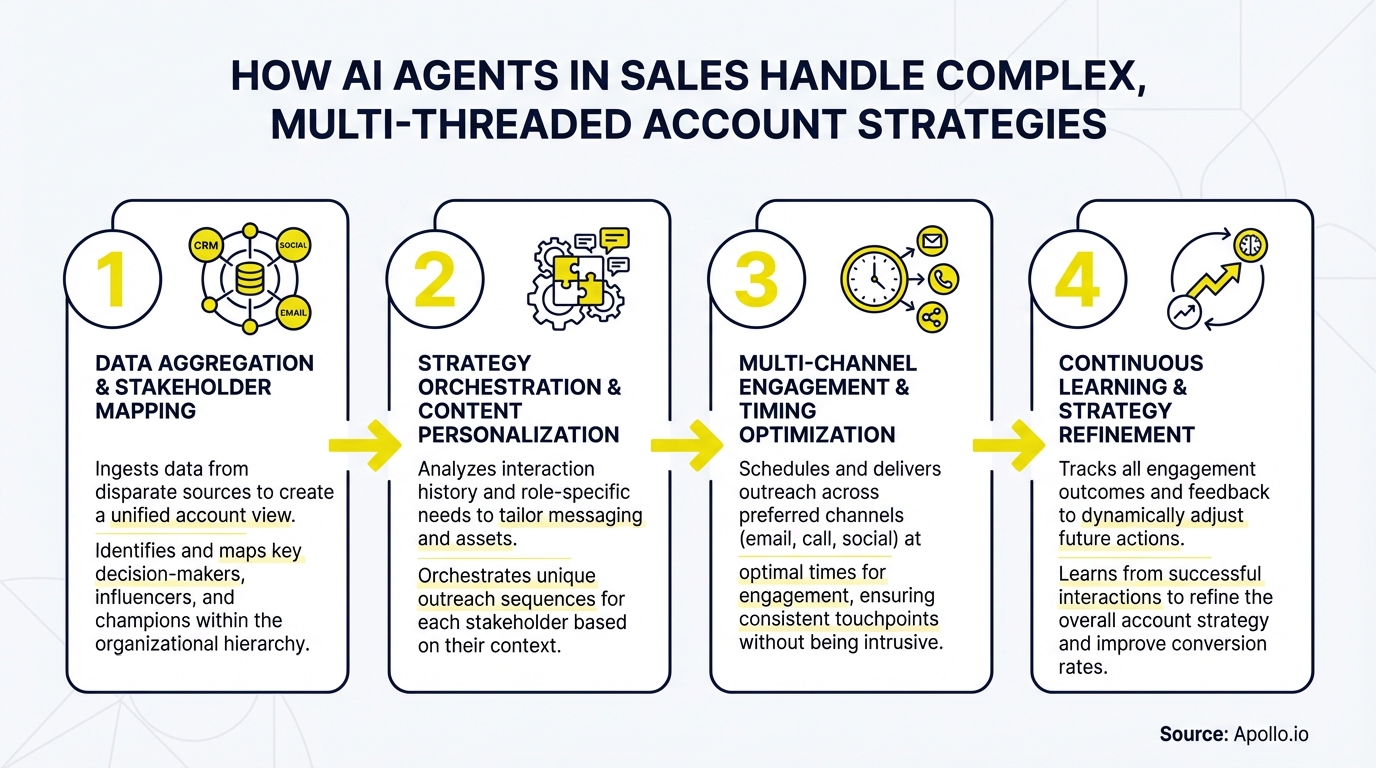
Multi-threading a complex enterprise account manually is a capacity crisis. A single AE managing five or more stakeholders across a buying committee, each at a different stage, each needing tailored messaging, can't sustain that coverage without dropping threads. AI agents in sales handle this by running parallel stakeholder tracks simultaneously, monitoring engagement signals, and surfacing the next best action for each contact, without the rep losing context. For anyone building enterprise sales strategies in 2026, understanding how these agents work is no longer optional.
According to Cirrus Insight, AI adoption among sales representatives nearly doubled from 24% in 2023 to 43% in 2024. That acceleration is reshaping what's possible for account orchestration at scale.

Research Less, Close More With Apollo
Tired of burning hours verifying contacts that go nowhere? Apollo delivers 230M+ accurate business contacts so your team spends time selling, not searching. Join 600K+ companies building real pipeline.
Start Free with Apollo →Key Takeaways
- AI agents handle multi-threaded accounts by running concurrent stakeholder tracks, not sequential ones, solving the core capacity problem for AEs and SDRs.
- Data quality is the single biggest bottleneck: agents are only as effective as the contact and intent data they operate on.
- The pilot-to-scale gap is real. Most organizations have experimented but few have achieved enterprise-wide agent deployment.
- RevOps teams that establish data governance before rollout get measurably faster value realization from agentic workflows.
- AI agents work best as execution amplifiers for human reps, handling research, sequencing, and thread monitoring while reps focus on high-stakes conversations.
What Is a Multi-Threaded Account Strategy and Why Does It Need AI?
A multi-threaded account strategy engages multiple stakeholders within a single target account simultaneously, each through a personalized, role-appropriate communication track. Without AI, this requires a rep to manually track each contact's engagement state, tailor messaging per persona, and coordinate timing across threads, a task that breaks down past three or four contacts.
AI agents solve the capacity problem by automating the monitoring and execution layer. They track who opened, who clicked, who went dark, and what content each stakeholder consumed.
They then trigger the appropriate next action per thread, whether that's a follow-up email, a scheduling nudge, or an escalation alert to the rep.
Research from The Future of Commerce projects that by 2026, 60% of B2B seller work will be done through conversational interfaces powered by generative AI, compared to less than 5% in 2023. Multi-threaded orchestration is a primary use case driving that shift.
How Do AI Agents Orchestrate Concurrent Stakeholder Threads?
AI agents orchestrate concurrent threads through a layered architecture: signal ingestion, identity resolution, engagement sequencing, and cross-thread coordination, all operating in parallel.
| Layer | What the Agent Does | Output for the Rep |
|---|---|---|
| Signal Ingestion | Monitors intent signals, email opens, site visits, job changes | Prioritized contact list by engagement score |
| Identity Resolution | Maps contacts to roles within the buying committee | Account graph showing who is missing, who is engaged |
| Engagement Sequencing | Launches and adjusts personalized sequences per stakeholder | Automated touchpoints with human escalation triggers |
| Cross-Thread Coordination | Prevents conflicting messages across stakeholders at the same account | Unified account timeline visible to the full team |
| Guardrails | Flags anomalies, duplicate outreach, or compliance risks | Alert queue for rep review before execution |
The shift from single-copilot assistance to true multi-agent orchestration is accelerating. Vendors across the revenue stack are moving toward agents that coordinate research, sequencing, meeting prep, and CRM updates as one connected workflow, not isolated features.
Struggling to keep stakeholder data clean enough for agents to act on? Start free with Apollo's 230M+ verified business contacts and give your agents accurate data to work with.
What Data Readiness Do RevOps Teams Need Before Deploying AI Agents?
RevOps teams need verified contact data, consistent account taxonomy, and defined data contracts before deploying AI agents on multi-threaded plays. Without these foundations, agents amplify noise rather than signal.
A Forrester Revenue Operations Survey (2024) found that 38% of revenue operations leaders cite data accuracy and quality as a top challenge, directly limiting an agent's ability to coordinate concurrent stakeholders and identify next-best actions across threads.
The core RevOps checklist before agent deployment:
- Contact coverage: Every target account has at least 3-5 verified stakeholder records mapped to buying roles.
- Account taxonomy: Consistent firmographic fields (industry, size, stage) so agents can segment and prioritize correctly.
- Engagement history: CRM records are current, with no duplicate contacts or stale sequences running.
- Intent data integration: Buyer signals feed into the platform agents query, not siloed in a separate tool. Learn how intent data powers smarter B2B sales.
- Governance policy: Clear rules on who agents can contact, at what cadence, and what requires human approval.
RevOps leaders find that investing in data governance before agent rollout compresses the time between deployment and measurable pipeline impact. "Having everything in one system was a game changer" (Cyera) captures exactly why unified data architecture matters here.

How Do AEs and SDRs Use AI Agents Differently in Multi-Threaded Plays?
AEs use AI agents primarily for account intelligence and thread monitoring, while SDRs use them for top-of-funnel stakeholder identification and initial outreach sequencing across a buying committee.
For Account Executives managing late-stage enterprise deals, agents surface which stakeholders have gone quiet, flag new decision-maker additions to the account, and prepare pre-meeting briefings by aggregating each contact's recent activity. This lets AEs focus their time on high-leverage conversations rather than manual CRM updates.
SDRs benefit from agents that can identify high-intent prospects, research company context, draft personalized outreach sequences, and book meetings, as noted by PowerReach AI. For SDRs working a named account list, this means launching multi-stakeholder sequences simultaneously rather than building them one contact at a time.
Spending hours building manual sequences for every stakeholder in an account? Automate multi-channel sequences with Apollo's sales engagement platform and keep every thread active without the manual load.
Turn Weak Leads Into Qualified Pipeline
Tired of marketing leads that never convert to real opportunities? Apollo surfaces in-market buyers with intent signals so your team reaches the right prospects at right moment. Join 600K+ companies building predictable pipeline.
Start Free with Apollo →What Is the Pilot-to-Scale Maturity Ladder for AI Agent Deployment?
The pilot-to-scale maturity ladder for AI agents in sales has four stages: single-use automation, coordinated sequences, account-level orchestration, and enterprise-wide agentic workflows. Most teams stall between stages two and three.
| Stage | Capability | Gate to Advance |
|---|---|---|
| 1. Single-Use | Agents draft emails or enrich single contacts | Consistent data quality in CRM |
| 2. Coordinated Sequences | Agents run multi-step sequences per contact | Sequence performance benchmarks defined |
| 3. Account Orchestration | Agents manage parallel threads across buying committee | Account graph built, governance policy active |
| 4. Enterprise-Wide | Agents operate across full book of business with human oversight | Full CRM integration, auditability, ROI dashboards live |
The enterprise-wide enablement gap is significant. Scaling agentic motions requires process redesign, not just tool adoption. Teams that treat agent deployment as a technology project rather than a GTM transformation consistently underperform on value realization. For a broader view of how automation fits into your stack, see how to build a sales tech stack that scales revenue.
What Are the Key ROI Metrics for AI Agents on Multi-Threaded Accounts?
The key ROI metrics for AI agents on multi-threaded accounts are stakeholder coverage rate, thread engagement velocity, meetings booked per account, and sales cycle length per thread type.
- Stakeholder coverage rate: Percentage of target accounts with 3+ active threads running simultaneously.
- Thread engagement velocity: Time from first outreach to first response per stakeholder role.
- Meetings per account: Number of discovery or advancement meetings booked across the buying committee.
- Cycle time by thread: How long each stakeholder track takes from first touch to handoff or close.
- Agent-to-human escalation rate: Percentage of threads escalated for rep intervention vs. handled autonomously.
Data from Kondo shows that 83% of sales teams using AI reported revenue growth, compared to 66% of those without AI, a 17 percentage point performance gap. Tracking the metrics above connects agent activity directly to that revenue outcome. Pair agent data with sales analytics to close the loop between thread activity and pipeline impact.

How Do You Get Started with AI Agents for Multi-Threaded Account Strategies in 2026?
Start with a single high-priority account, build a clean account graph with verified stakeholder data, define your thread strategy per buying role, and deploy agents on the sequencing and monitoring layer before expanding to your full book.
The practical starting checklist:
- Audit contact data quality for your top 10 target accounts.
- Map each account's buying committee: champion, economic buyer, technical evaluator, blocker.
- Define a thread strategy per role with distinct messaging and cadence.
- Set governance rules: send limits, approval gates, escalation triggers.
- Measure stakeholder coverage and meeting rates before and after agent deployment.
- Review how to use sales automation the right way to avoid common sequencing mistakes.
Apollo consolidates the data, sequencing, and AI automation your agents need into one platform, replacing the fragmented stack of separate enrichment, engagement, and analytics tools. "We reduced the complexity of three tools into one," said Collin Stewart of Predictable Revenue. See how Predictable Revenue cut tech stack costs with Apollo.
AI agents for multi-threaded accounts deliver the most value when they operate on clean data inside a unified platform. Apollo's AI sales automation gives GTM teams the infrastructure to run concurrent stakeholder threads at scale, without the overhead of managing multiple disconnected tools.
Ready to put AI agents to work on your most complex accounts? Start Your Free Trial and see how Apollo's unified GTM platform handles multi-threaded account strategies from data to close.
Prove Pipeline ROI With Apollo
ROI pressure killing your next budget approval? Apollo delivers measurable pipeline impact — faster. Leadium 3x'd their annual revenue after switching. Start your free trial and show results your CFO can't ignore.
Start Your Free Trial →Don't miss these
Sales
Inbound vs Outbound Marketing: Which Strategy Wins?
Sales
What Is a Sales Funnel? The Non-Linear Revenue Framework for 2026
Sales
What Is a Go-to-Market Strategy? The 2026 GTM Playbook
See Apollo in action
We'd love to show how Apollo can help you sell better.
By submitting this form, you will receive information, tips, and promotions from Apollo. To learn more, see our Privacy Statement.
4.7/5 based on 9,690 reviews
